
⚡ Direct Answer: How Does IATF 16949 Apply to Custom Automation Enclosure Fabrication?
When building automated manufacturing cells, robotic welding stations, and EV battery module assembly lines for automotive Tier-1 suppliers, custom sheet metal enclosures must be fabricated under IATF 16949:2016 automotive quality flowdowns. This rigorous framework guarantees zero assembly defects through 4 mandatory engineering controls: 1) AIAG PPAP Level 3 Submissions: Delivering Process Flow Diagrams (PFD), Process FMEA, Control Plans, Dimensional Results, and Part Submission Warrants (PSW); 2) Process Capability Studies (Cpk ≥ 1.67): Proving statistical stability across critical dimensions including door opening diagonals, mounting hole patterns, and weld shrinkage tolerances; 3) Lot Traceability to Mill Coils: Permanently linking laser-etched serial numbers on enclosure frames to raw ASTM A653 G90 / EN 10204 3.1 Mill Test Reports; and 4) Poka-Yoke Mistake-Proofing: Designing asymmetric press-brake tooling and sensor-verified welding fixtures that prevent misaligned assembly.
Automotive OEMs demand absolute repeatability. A dimensional mismatch or warped door on a large robot control enclosure can halt line commissioning, resulting in substantial financial penalties. MSTFAB manufactures empty galvanized steel automation enclosure shells under stringent automotive IATF 16949 quality procedures.
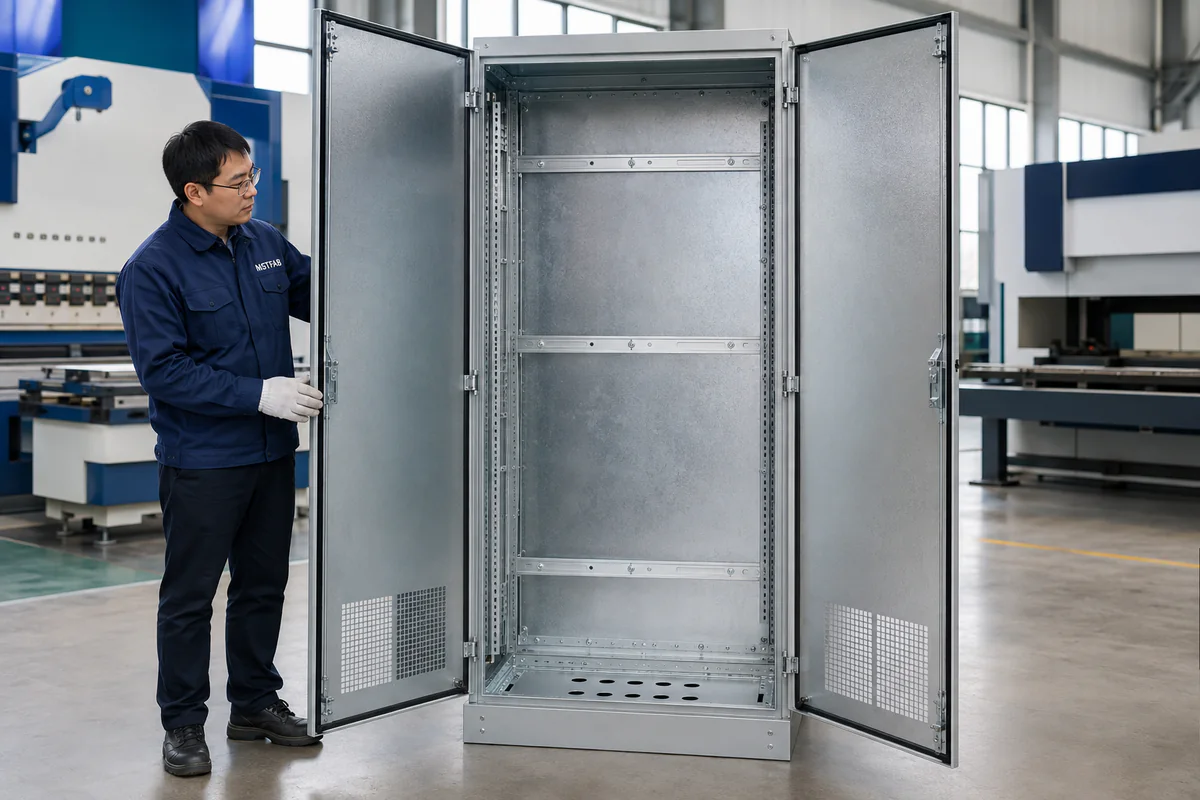
Automotive plant automation enclosure: Heavy-gauge galvanized frame, modular side panels, robotically dispensed PU door seals, and plinth base.
Automotive IATF 16949 vs Standard Industrial Sheet Metal Manufacturing
| Quality Pillar | General Sheet Metal Shop | MSTFAB IATF 16949 Automotive Control | Automotive OEM Value |
|---|---|---|---|
| Product Validation | Visual inspection and basic dimensional checklist | Full PPAP Level 3 dossier with Cpk ≥ 1.67 capability data | Seamless customer audits and zero incoming inspection rejections. |
| Risk Mitigation (FMEA) | Reactive problem solving after defects occur | Proactive Process FMEA identifying RPN risks prior to tooling | Prevents manufacturing defects before production begins. |
| Material Traceability | Steel coil tags discarded after shearing | Serial-number linking to mill heat numbers & IMDS records | Complete material accountability for vehicle platform lifetimes. |
| Gage Repeatability (GR&R) | Uncalibrated tape measures and shop calipers | Formal Measurement Systems Analysis (Gage R&R < 10%) | Ensures measurement reliability across all inspection stations. |
Precision Fabrication & Engineering DFM
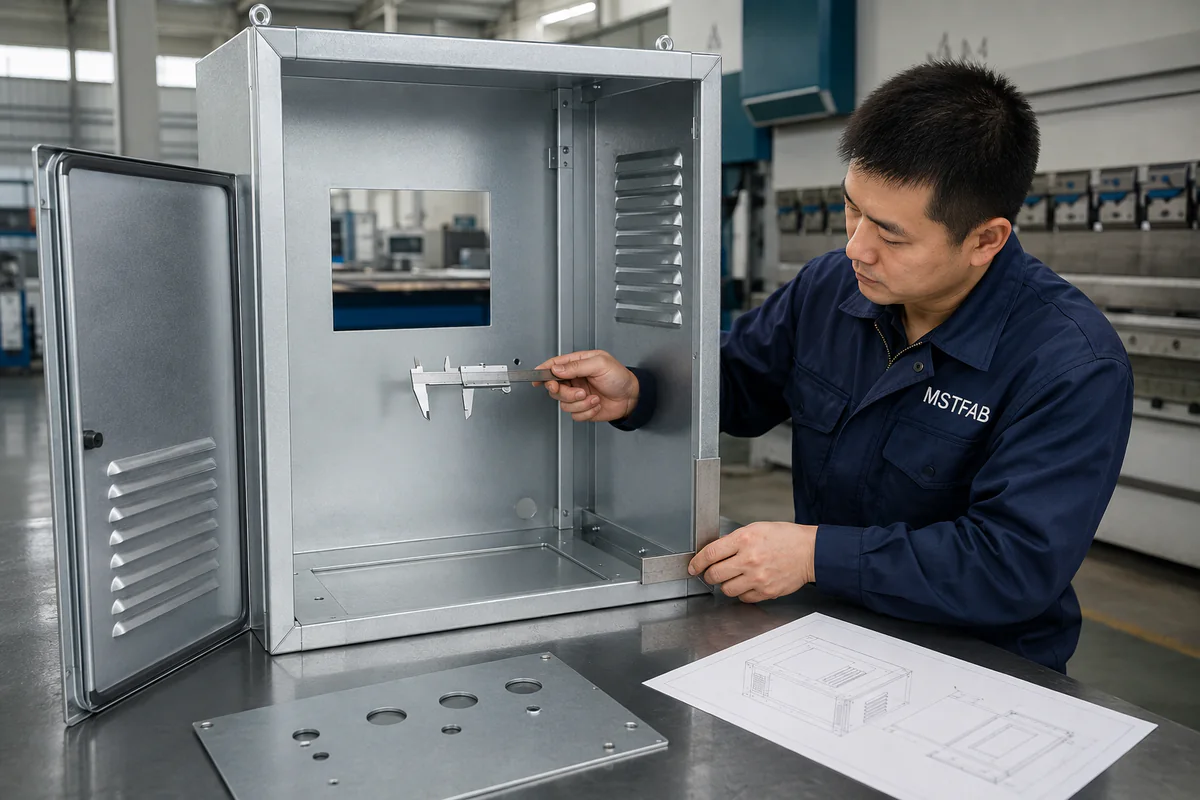
Cable Pull Space & Ventilation DFM
Enclosure layouts incorporate generous wire bending radii (compliant with NEC 312.6) and precision cooling fan cutouts with baffled louvers to prevent hot-spot formation.
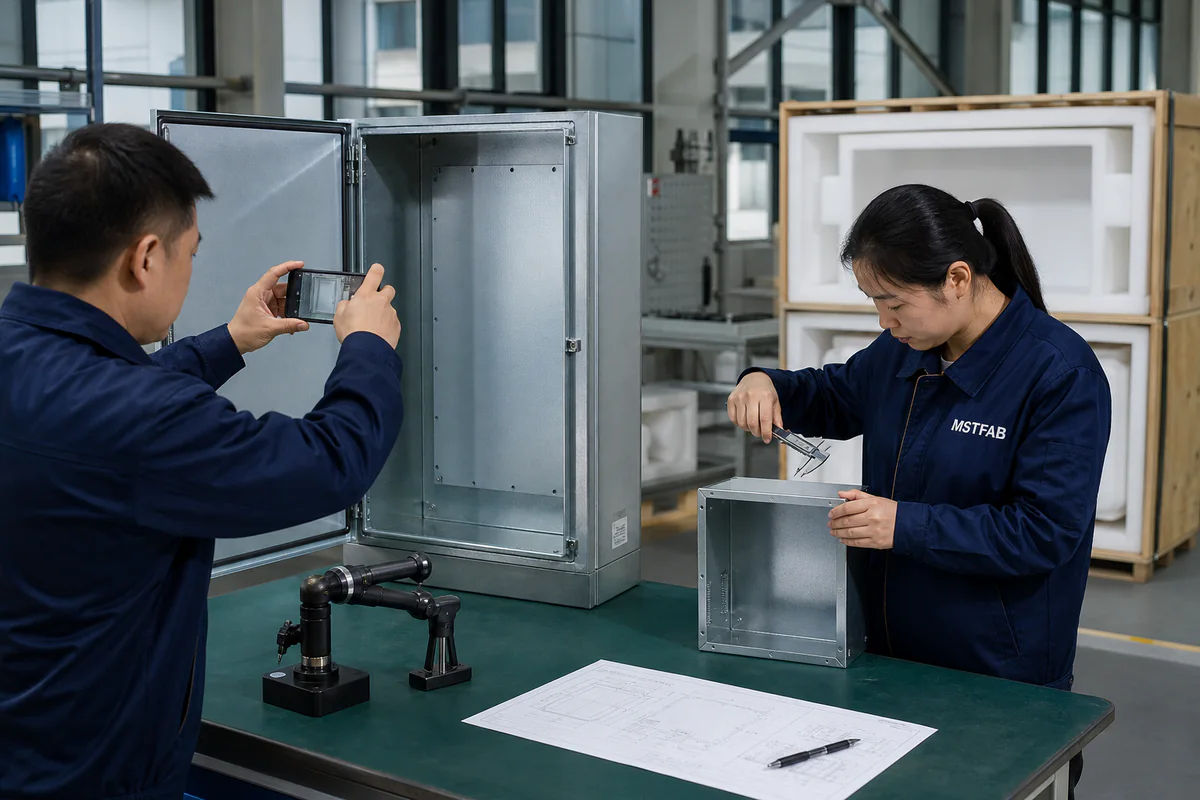
Export Protection & Modular Shipping
Large automation bay enclosures are shipped with reinforced heavy-duty plinth bases, modular lifting eye bolts, and anti-static moisture-barrier barrier packaging.
Procure Automotive-Grade Automation Enclosures
Work with an experienced sheet metal partner equipped for IATF 16949 standards and PPAP Level 3 deliverables. Contact our automotive engineering team today.
Frequently Asked Questions (FAQ)
Can MSTFAB fabricate multi-bay suiteable enclosures for automotive lines?
Yes. We fabricate modular, suiteable enclosure frames with precision gasketing kits and interlocking baying brackets, allowing seamless expansion across multi-cabinet control banks.
What sheet metal thicknesses are used for large automotive enclosures?
Standard frames utilize 2.0mm to 2.5mm (14 Ga – 12 Ga) hot-dip galvanized steel, doors utilize 1.5mm to 2.0mm with welded stiffeners, and heavy sub-panels utilize 2.5mm to 3.0mm (11 Ga) steel.
How are CAD drawings and design revisions synchronized?
Our engineering team imports STEP/IGES models directly into SolidWorks and our ERP system, ensuring laser-cutting and CNC press brake programs reflect the exact approved drawing revision.
 WeChat Contact
 WhatsApp Me Directly