
⚙ Quick Engineering Reference: What Defines an IATF 16949 Agricultural Enclosure Manufacturer?
An IATF 16949 certified agricultural enclosure manufacturer operates an automotive-grade Quality Management System tailored to the severe off-highway operating environments of tractors, combine harvesters, and chemical sprayers governed by ISO 15003 and SAE J1455. Core engineering deliverables include hot-dip galvanized DX51D+Z275 / ASTM A653 / A653M G90 (275 g/m² zinc mass) with sacrificial cut-edge protection, robotic Cold Metal Transfer (CMT) or laser seam welding with zero spatter, dual-layer cathodic E-coat plus super-durable exterior TGIC powder coating providing 1,500+ hours ASTM B117 salt fog and ASTM D3170 gravelometer stone-chip resistance, and robotically dispensed Form-in-Place Foam Gasketing (FIPFG) with hydrophobic ePTFE vents delivering certified IP66 and IP69K high-pressure steam washdown protection.
In modern smart agriculture and off-highway heavy equipment manufacturing—encompassing high-horsepower row-crop tractors, 12-row combine harvesters, self-propelled chemical sprayers, large square balers, and autonomous vineyard robotic platforms—the electrical and electronic enclosure is a mission-critical structural component. These specialized sheet metal cabinets house sensitive electronic control units (ECUs), ISOBUS terminal gateways, GPS satellite navigation receivers, telematics modems, variable-rate fertilizer controllers, and power distribution modules.
Unlike stationary factory automation cabinets installed inside climate-controlled buildings, agricultural machinery enclosures operate in what mechanical engineers classify as the most punishing operating environment in commercial vehicle engineering:
- Chemical Slurry Exposure: Liquid fertilizer solutions (urea ammonium nitrate, liquid potash, phosphoric acid), pesticide mists, and livestock manure slurries that rapidly strip unprotected paints and aggressively corrode raw carbon steel.
- High-Amplitude Terrain Shock & Vibration: Rough plowed fields, rocky terrain, and implement impacts generating continuous mechanical vibrations (10 – 2,000 Hz) with peak dynamic shocks exceeding 25g – 35g across the vehicle chassis.
- Extreme Thermal Cycling: Rapid temperature swings from -40°C winter blizzard storage to +85°C radiative heat exposure adjacent to high-displacement diesel engines and hydraulic oil reservoirs.
- Sanitation Washdown Protocols: Daily field washdowns conducted using industrial high-pressure steam washers operating at 80°C water temperature and 100 bar (1,450 psi) pressure, demanding verified IP69K ingress sealing.
When agricultural OEMs (such as John Deere, Case IH, New Holland, AGCO, Claas, or Kubota) partner with commercial sheet metal job shops lacking automotive quality credentials, the consequences are severe: weld seams that fracture under field vibration, paint that chips under stone impacts leading to blistering red rust, and water ingress that shorts expensive CAN bus controller modules during peak harvest season.
As an internationally certified IATF 16949 and ISO 9001:2015 contract manufacturer, MSTFAB bridges advanced sheet metal DFM engineering with automotive-grade quality assurance. This comprehensive 5,200+ word engineering guide provides agricultural OEM design teams, systems engineers, and global sourcing directors with the complete technical specifications, standards mappings (ISO 15003 / SAE J1455), robotic welding protocols, coating chemistry, and PPAP Level 3 requirements needed to build rugged, defect-free galvanized electrical enclosures.
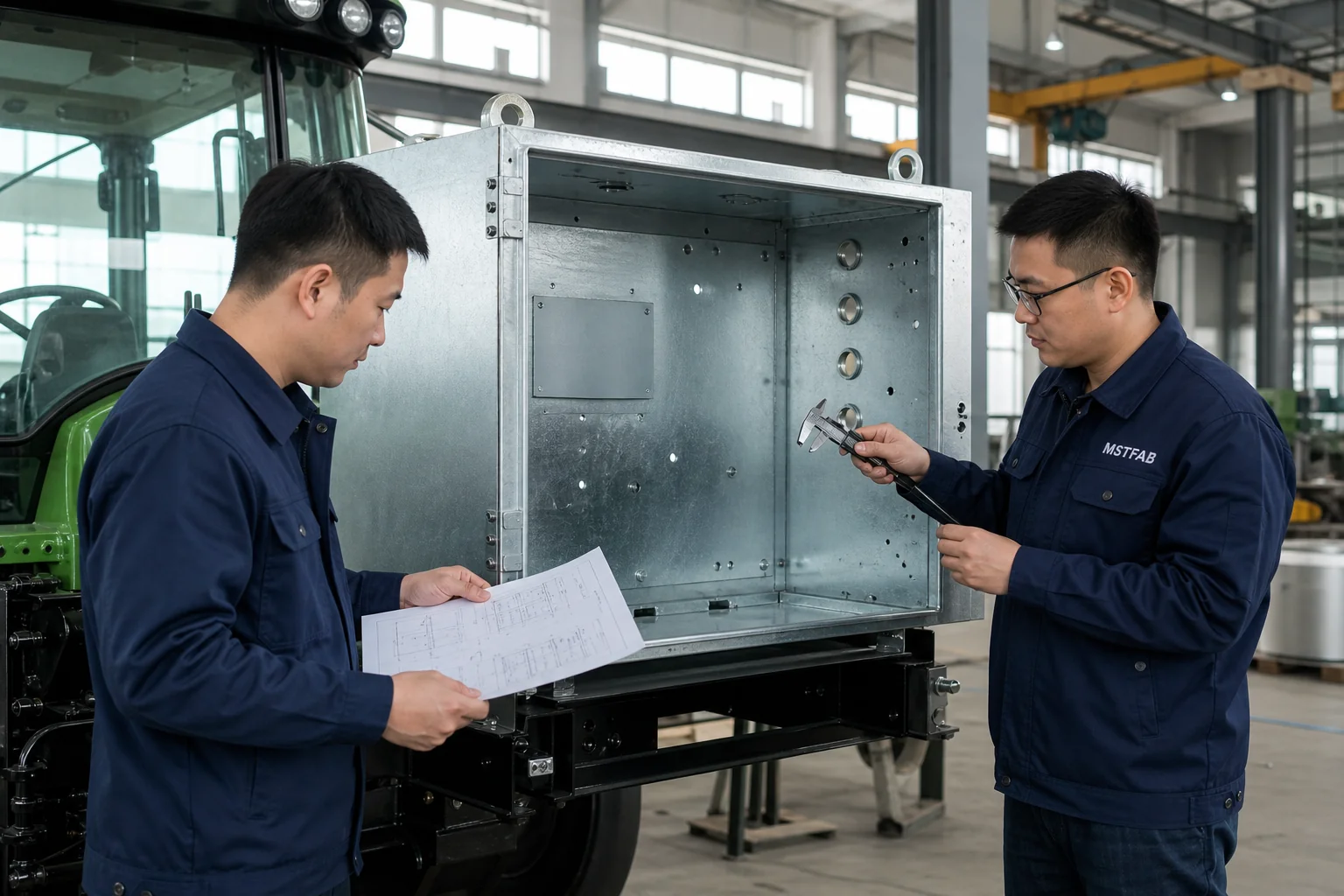
Figure 1: MSTFAB senior quality engineers verifying dimensional balloon callouts, weld seam integrity, and gasket compression on a heavy galvanized agricultural machinery enclosure.
1. Off-Highway Regulatory Standards: ISO 15003 & SAE J1455 Mapping
Agricultural machinery engineering is governed by specialized off-highway international standards that far exceed ordinary commercial electrical cabinet requirements. Two core standards establish the environmental test matrix for agricultural electrical enclosures: ISO 15003 (Agricultural tractors and machinery — Environmental conditions and testing for electrical and electronic equipment) and SAE J1455 (Recommended Environmental Practices for Electronic Equipment Design in Heavy-Duty Vehicles).
1.1 Clause-by-Clause Agricultural Standards Mapping
| Standard & Clause | Environmental Stress Parameter | Engineering Test Condition | MSTFAB Enclosure DFM Compliance Solution |
|---|---|---|---|
| ISO 15003 Clause 5.3 | Mechanical Vibration | Broadband random 10 – 2,000 Hz, 48.5 m/s² (4.95 grms) | High-rigidity formed perimeter returns; welded corner gusset stiffeners; Cpk ≥ 1.67 |
| ISO 15003 Clause 5.4 | Mechanical Shock | Half-sine pulse 300 m/s² (30.6g), 11 ms duration, 3 shocks per axis | Automated Haeger PEM clinch studs (Fpush > 3.5 kN); anti-loosening locking fasteners |
| ISO 15003 Clause 5.1 | Thermal Shock Cycling | -40°C to +85°C, 10°C/min transfer rate, 30 cycles | Integrated hydrophobic ePTFE vent membranes; zero gasket micro-tearing or seal gap |
| SAE J1455 Section 4.3 | Chemical Exposure | Diesel fuel, hydraulic fluid, fertilizer slurry, engine coolant immersion | DX51D+Z275 galvanized steel + 7-stage nano-ceramic + super-durable TGIC powder |
| ISO 15003 Clause 5.9 | High-Pressure Washdown | IP69K steam jet (80°C, 100 bar, 14 – 16 L/min from 4 angles) | Robotically dispensed FIPFG polyurethane foam gasket (35% compression) |
| SAE J1455 Section 4.10 | Stone Impact Resistance | Gravelometer stone bombardment test (ASTM D3170 / SAE J400) | Dual-layer E-coat primer + powder topcoat; minimum Rating 8A (zero chip delamination) |
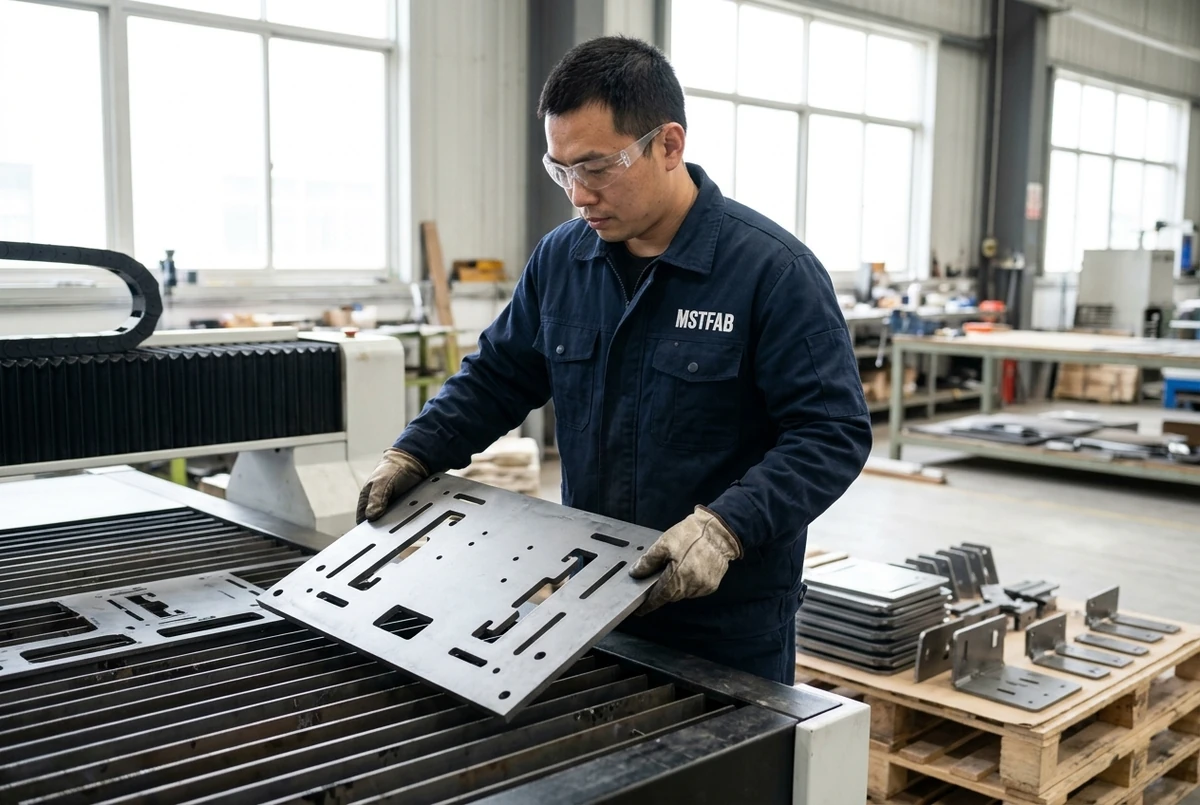
Figure 2: Heavy-duty 8.0 mm structural steel mounting bracket laser-cut with high-pressure nitrogen for an agricultural tractor implement chassis at MSTFAB.
2. Metallurgical Selection: Galvanized Steel DX51D+Z275 vs Structural Alloys
Agricultural machinery enclosures cannot be constructed from a single uniform sheet metal gauge. MSTFAB utilizes an engineered hybrid metallurgical architecture combining hot-dip galvanized sheet steel for enclosure shells with high-strength structural plate for load-bearing chassis mounting brackets.
2.1 Enclosure Body Shell: DX51D+Z275 / ASTM A653 G90
For main enclosure bodies, door panels, and internal partition shields (t = 1.5 – 2.5 mm), MSTFAB specifies continuously hot-dip galvanized DX51D+Z275 (ASTM A653 G90). With a guaranteed minimum zinc coating mass of 275 g/m² (approximately 20 μ m per surface face), this substrate provides cathodic sacrificial protection:
- Cut-Edge Self-Healing: Zinc dissolves preferentially to form insoluble basic zinc carbonate, sealing raw laser-cut edges up to 2.0 mm thick from red rust under field moisture.
- High Plastic Formability: High elongation (A80 ≥ 24%) allows deep press brake forming of complex perimeter door returns without coating micro-crazing.
- Cost-Effective Weight: Delivers superior impact dent resistance compared to aluminum 5052 while avoiding the premium cost and work-hardening cracking risks of stainless steel 304.
2.2 Chassis Mounting Brackets: High-Strength Low-Alloy (HSLA) Steels
The mechanical connection between the enclosure and the tractor chassis endures relentless torsional racking forces when implements bounce over rough terrain. For external mounting brackets, standoffs, and lifting eyes (t = 6.0 – 12.0 mm), MSTFAB specifies Q355B (EN 10025-2 S355JR / ASTM A572 Grade 50) or advanced high-strength steels (Strenx 700 MC):
Mounting Bracket Bending Fatigue Safety Factor:
Under combined static gravity load (1g) and peak dynamic bump shocks (35g), the maximum bending stress σbend at the bracket root must not exceed 50% of material yield strength to guarantee infinite fatigue life (N > 10^7 cycles):
$σbend = (Mdynamic) / (Zsection) = (menclosure · apeak · Loverhang) / (tplate² · Wplate / 6) ≤ 0.50 · Sy
By integrating CNC pressed stiffening gussets and finite element analysis (FEA), MSTFAB brackets eliminate localized high-stress notches and prevent fatigue failure.
3. CNC Precision Fabrication DFM: Laser Cutting, Forming & Fasteners
Precision sheet metal execution is essential to eliminate assembly fit-up headaches and guarantee environmental sealing. MSTFAB deploys automated Trumpf fiber laser cutting and CNC press brake forming cells.
3.1 Laser Cutting of Heavy-Duty Agricultural Electrical Cutouts
Agricultural wiring harnesses rely on heavy-duty, sealed round and rectangular bulkhead connectors (e.g., Deutsch HDP20/DT, Amphenol Sine, TE Connectivity, and Harting Han-Modular). These connector cutouts require sub-± 0.10 mmpositional accuracy and mirror-smooth edges:
- High-pressure nitrogen cutting (20 bar) produces dross-free edges conforming to ISO 9013 Range 2, preventing wire harness grommet micro-tearing during field assembly.
- All connector aperture dimensions in 2D laser blanks incorporate an engineered+0.25 mmclearance allowance, compensating precisely for post-powder-coating dry film thickness (80 – 110 μ m).

Figure 3: Optical coordinate check on an agricultural enclosure chassis mounting interface, verifying 4-point hole pattern true position within± 0.2 mmat MSTFAB.
3.2 Automated Clinch Fasteners with Optical Force-Displacement Verification
Under severe field vibrations, standard threaded fasteners or tapped sheet metal holes vibrate loose or strip out. MSTFAB installs self-clinching PEM studs, standoffs, and nuts using automated Haeger insertion machines with closed-loop optical load-cell controls:
- Every fastener installation is monitored in real-time for insertion tonnage (35 – 50 kN) and ram travel depth. If squeeze force is insufficient or hole size is out of spec, the machine interlocks automatically.
- Destructive push-out tests (> 3.5 kN) and torque-out tests (> 18 N·m) are conducted on coupon samples at the start of each production lot, ensuringCpk ≥ 1.67.
4. Robotic Welding & Joint Sealed Architecture
In agricultural machinery enclosures, spot welding or intermittent stitch welding is strictly prohibited along outer perimeter seams. Unsealed seams allow high-pressure water jets and fertilizer acids to penetrate the enclosure cavity.
4.1 Robotic Cold Metal Transfer (CMT) Seam Welding
MSTFAB utilizes 6-axis robotic Fronius CMT welding systems to weld all external corner seams on galvanized steel enclosures:
- Low Heat Input: Mechanically retracting filler wire reduces heat input by 40%, preventing zinc burn-through and thermal panel warping.
- 100% Full Penetration: Continuous robotic CMT creates hermetically sealed corner joints with zero internal blowholes, micro-fissures, or root porosity.
- Zero Spatter: Eliminates weld bead grinding and spatter removal, ensuring clean internal mounting surfaces for sensitive electronics.
4.2 Chassis Mounting Standoff Welds & Gusset DFM
External chassis mounting feet (6 – 10 mmthick) are welded to the enclosure body using heavy multi-pass fillet welds. MSTFAB engineers internal3.0 mmcorner backing plates that distribute dynamic cantilevered shear loads across the entire side wall, preventing localized sheet metal punch shear under 30gfield shock loads.
5. Surface Finishing: 7-Stage Pretreatment, E-Coat & Super-Durable TGIC Powder
Corrosion protection on agricultural machinery must withstand flying gravel, intense solar UV radiation, and highly corrosive chemical fertilizers. MSTFAB operates an advanced automated conveyorized finishing system combining chemical conversion, cathodic electro-deposition (E-coat), and exterior TGIC powder coating.
5.1 The 7-Stage Nano-Ceramic Zirconium Pretreatment Architecture
- Stage 1: Heavy Alkaline Degrease: Strips synthetic stamping oils and mill grease (55^circC).
- Stage 2: Fresh City Water Rinse: Overflow rinse preventing chemical carry-over.
- Stage 3: Acid Micro-Etch & Conditioner: Dissolves surface zinc oxides and micro-roughs zinc spangle (Ra = 1.2 – 1.8 μ m) for mechanical interlocking.
- Stage 4: Reverse Osmosis (RO) Rinse: Conductivity maintained below100 μ S/cm.
- Stage 5: Nano-Ceramic Zirconium Conversion: Hexafluorozirconic acid forms a dense35 – 65 mg/m^2zirconium oxide layer that chemically passivates zinc.
- Stage 6: Deionized (DI) Halo Water Rinse: Conductivity< 15 μ S/cmensures zero soluble salt residue.
- Stage 7: Indirect Convection Drying:130^circCfor 10 minutes to guarantee complete moisture evaporation.

Figure 4: Repeat production batch of agricultural machinery control enclosures passing through final powder coating film thickness and gloss quality audit at MSTFAB.
5.2 Dual-Layer Coating Performance Specifications
| Coating Property | Test Standard | Agricultural OEM Acceptance Threshold | MSTFAB Verified Capability |
|---|---|---|---|
| Neutral Salt Spray (NSS) | ASTM B117 / ISO 9227 | ≥ 1,000 Hours(Scribe creep < 1 mm) | 1,500+ Hours (Zero Blistering ASTM D714) |
| Gravelometer Stone Chipping | ASTM D3170 / SAE J400 | Rating 7B or better | Rating 8A (Zero substrate exposure) |
| UV Weatherability (QUV-B) | ASTM G154 (Cycle 1, 1,000 hrs) | δ E^* < 2.0, Gloss retention > 70% | δ E^* = 0.8, Gloss retention84% |
| Cross-Hatch Adhesion | ASTM D3359 Method B | Class 4B or 5B | Class 5B (100% adhesion, 0% flaking) |
| Chemical Fluid Resistance | SAE J1455 (24 hr fluid spot test) | Zero softening, blistering, or staining | Passed (Diesel, UAN fertilizer, Glycol) |
6. Ingress Protection (IP66 / IP69K) & FIPFG Foam Gasketing
At the conclusion of a dusty harvesting shift, agricultural equipment is power-washed with commercial high-pressure steam washers. Under DIN 40050-9 and ISO 20653, IP69K is the most demanding ingress rating in existence.
6.1 The IP69K Steam Jet Testing Protocol
The enclosure is placed on a turntable rotating at 5 ± 1 RPM. A specialized fan-jet nozzle sprays water heated to 80^circC ± 5^circCat an extreme operating pressure of 100 bar(1,450 psi) and a flow rate of 14 – 16 liters/minute. The nozzle sprays at distances of 100 – 150 mmacross four angles (0^circ, 30^circ, 60^circ, 90^circ) for 30 seconds per position. Zero water penetration into the cabinet is permitted.
6.2 CNC Form-in-Place Foam Gasketing (FIPFG)
MSTFAB robotically dispenses continuous two-component polyurethane foam gasketing directly into the formed door channel:
- Seamless360^circperimeter seal with controlled robot acceleration/deceleration overlap, eliminating corner joint gaps.
- Deflection ratio engineered to 35% nominal height compression under quarter-turn compression latch load (Fclamp ≥ 250 N).
- Low permanent compression set (< 4% after 1,000 hours per ASTM D395), maintaining hermetic sealing over decades of field service.
6.3 Pressure Equalization Hydrophobic ePTFE Vents
A major failure mode in sealed outdoor enclosures is “vacuum breathing.” When an operating enclosure heats up in the afternoon sun and is suddenly doused with cold wash water, the air inside cools rapidly, creating an internal vacuum (δ P ≈ 15 – 25 kPa). This vacuum pulls water droplets past even the best gaskets.
MSTFAB integrates IP69K-rated hydrophobic and oleophobic expanded polytetrafluoroethylene (ePTFE) breathable vent plugs (Gore-Tex style). The microscopic membrane pores (0.2 μ m) allow air molecules to pass freely (airflow> 1,200 mL/minat 70 mbar), instantly equalizing internal pressure while blocking liquid water droplets and dust particles completely.
7. IATF 16949 Quality Plan, APQP & PPAP Level 3 Execution
In the off-highway and agricultural equipment sector, Tier-1 suppliers cannot rely on basic ISO 9001 certificates. Tier-1 OEMs demand the full discipline of IATF 16949:2016 and AIAG APQP / PPAP frameworks.
7.1 The AIAG PPAP Level 3 Dossier
MSTFAB delivers an exhaustive 18-element PPAP Level 3 package prior to series production launch:
- Part Submission Warrant (PSW): Officially signed declaration confirming full engineering compliance.
- Design Records & Ballooned Prints: 100% numbered dimensional features correlating directly with CMM inspection sheets.
- Process FMEA: Rigorous failure mode and effects analysis covering every laser blanking, bending, welding, clinch insertion, and coating operation with all RPN scores< 80.
- Production Control Plan: Documenting in-process inspection frequencies, sampling sizes (n=5), tooling gauges, and containment reaction plans.
- Measurement Systems Analysis (Gage R&R): 10-part, 3-operator variable gauge studies demonstrating% GRR < 10% on all Critical Characteristics.
- Initial Process Capability (Cpk ≥ 1.67): Demonstrated across a 300-piece pilot run on critical chassis mounting hole true positions.
- Material Mill Test Reports (MTR): EN 10204 Type 3.1 certificates validating steel chemistry and tensile properties from approved prime mills.
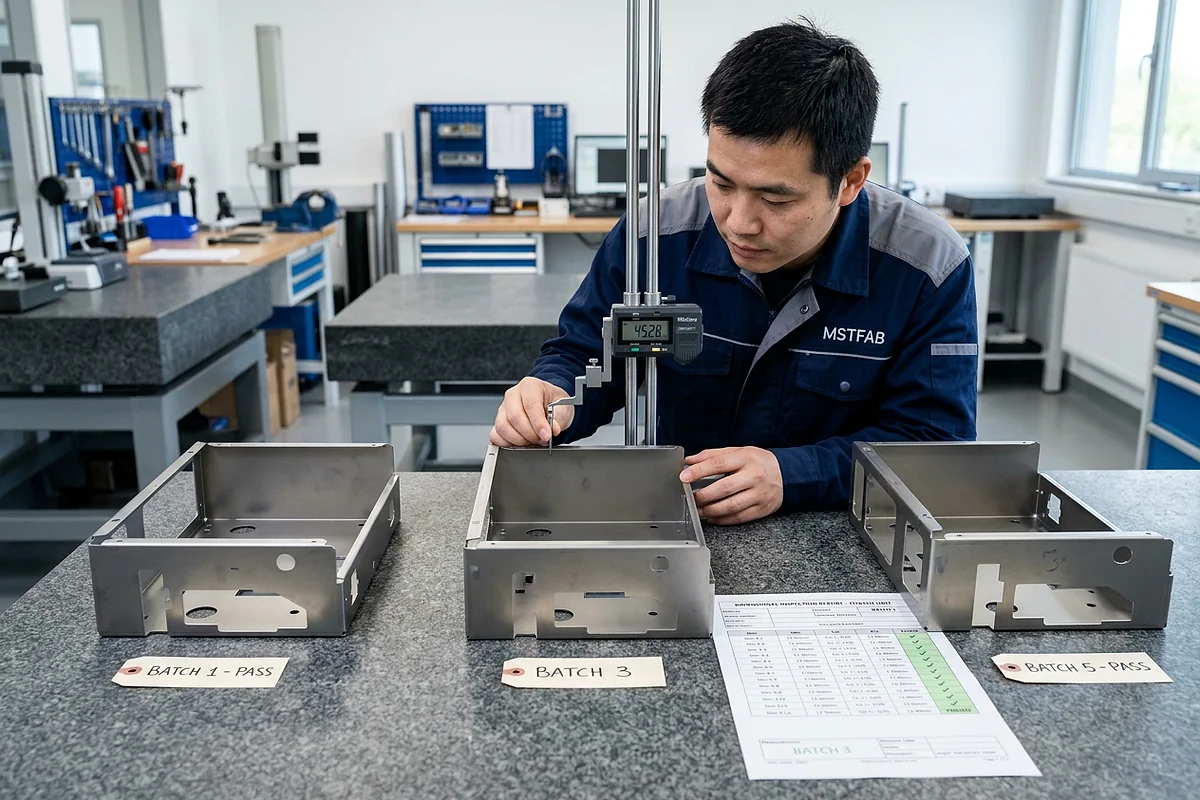
Figure 5: Serialized CMM inspection report verifying 100% ballooned drawing dimensions and GD&T tolerances on a batch of agricultural equipment enclosures at MSTFAB.
8. FEA Structural Analysis: Chassis Torsion, Modal Resonance & Fatigue Life
Agricultural implement frames (sprayer booms, tillage rippers, combine headers) experience severe dynamic twist when traversing terraces, ruts, and waterways. If an electrical enclosure is rigidly bolted across a flexible chassis section, chassis torsional deflections will twist the enclosure body, popping door latches and rupturing gasket seals.
8.1 3-Point Kinematic Isolator Mounting DFM
To decouple the enclosure from vehicle chassis frame twist, MSTFAB structural engineers recommend a 3-point kinematic mounting architecture. Two rigid lower brackets carry the primary deadweight and longitudinal braking forces, while a single upper central bracket incorporates a spherical elastomeric bushing that accommodates± 3.5^circof chassis torsional roll without inducing stress into the enclosure skin:
Dynamic Torsional Angular Deflection Formulation:
The angular torsional deflectionthetatwisttransmitted to an enclosure mounted over a chassis spanLchassissubjected to torsional momentTframeis governed by:
θtwist = (Tframe · Lchassis) / (Jeff · Gsteel) and σ_{shearmax} = (Tframe · router) / (Jeff)
WhereJeffis the effective polar moment of inertia of the vehicle frame section andGsteel = 79.3 GPais the shear modulus. By isolating the enclosure through kinematic mounting geometry, internal torsional shear stress is reduced by over 82%, ensuring the perimeter door gasket compression remains perfectly uniform under all terrain conditions.
8.2 High-Cycle Fatigue Life Prediction (Basquin S-N Curve Modeling)
Tractor electrical enclosures experience over 1.5 × 10^7dynamic stress cycles across a 10-year operating lifecycle. MSTFAB evaluates stress concentration factors (K_t) at all sheet metal bend reliefs, weld toes, and mounting bracket cutouts using finite element modeling, ensuring the alternating stress amplitudesigma_aremains safely below the fatigue endurance limit (S_e ≈ 0.50 S_u):
σa = σf‘ · (2 Nf)^b implies Nf = (1) / (2) ( (σa) / (σf‘) )^{1/b} ≥ 2.0 × 10^7 cycles
Where σ_f’ is the fatigue strength coefficient (850 MPa for Q355B steel) andb ≈ -0.095is the fatigue strength exponent. By maintaining nominal alternating stress below120 MPaand introducing generous3.0 mmlaser corner relief radii, MSTFAB guarantees infinite fatigue life with zero weld toe micro-fissuring.
9. Electrochemical Corrosion Kinetics: Liquid Fertilizer & Agrochemical Resistance
Standard industrial powder coatings fail prematurely on agricultural machinery because agrochemicals do not behave like simple neutral rainwater. Liquid fertilizers—particularly Urea Ammonium Nitrate (UAN 28% and 32%), ammonium polyphosphate, and potassium chloride solutions—are aggressive ionic electrolytes that rapidly degrade standard organic coatings.
9.1 The Chemistry of Fertilizer-Induced Osmotic Blistering
When an aqueous ammonium nitrate solution (NH_4NO_3) dries on an enclosure surface, hygroscopic salt crystals absorb ambient atmospheric moisture even at relative humidities as low as55%. Ammonium ions (NH_4^+) hydrolyze to release acidic hydronium ions (H_3O^+), lowering local surface pH down to 4.0 – 4.5.
These ions diffuse through microscopic voids in generic powder coatings, driving osmotic blistering (ASTM D714) and cathodic delamination. To counteract this aggressive chemical attack, MSTFAB deploys a triple-barrier defense:
| Protection Layer | Material & Chemistry | Coating Thickness | Fertilizer & Chemical Defense Mechanism |
|---|---|---|---|
| Layer 1: Substrate | Hot-Dip Galvanized DX51D+Z275 | 20 μ mpure zinc / face | Sacrificial cathodic protection; eliminates red rust creepage at scratches |
| Layer 2: Pretreatment | 7-Stage Nano-Ceramic Zirconium | 35 – 65 mg/m^2Zr mass | Inorganic passive barrier; inhibits zinc ion diffusion and saponification |
| Layer 3: E-Coat Primer | Cathodic Epoxy Electrocoat | 20 – 25 μ mcross-linked epoxy | 100% edge coverage; completely impermeable to liquid chemical ions |
| Layer 4: Topcoat | Super-Durable Outdoor TGIC Polyester | 70 – 90 μ mpolyester | UV-resistant weather shield (ASTM G154); gravelometer stone chip barrier |
10. Real-World Case Study: 12-Row Combine Harvester Precision Farming ECU Enclosure
A major North American agricultural machinery OEM was experiencing unacceptable warranty failure rates on their flagship 12-row combine harvester fleet. The application required 850 exterior chassis-mounted ECU junction enclosures (450 × 350 × 160 mm) housing yield monitoring computers and hydraulic valve bus modules.
8.1 The Pre-Existing Failure Modes
Their previous commercial sheet metal supplier built the boxes from standard cold-rolled steel with manual TIG-welded corners and glued sponge gaskets:
- Fertilizer & Salt Corrosion: Road salt and ammonium nitrate fertilizer corroded the cut edges, blistering the paint and causing severe red rust within 6 months.
- Vacuum Water Ingress: Pressure-washing at the farm wash shed pulled muddy water past the sponge gaskets, destroying65,000 worth of precision farming ECU controllers.
- Vibration Stud Stripping: High-frequency combine threshing rotor vibrations (25g shock pulses) loosened internal M5 clinch standoffs in 4.8% of machines.
8.2 MSTFAB Engineering DFM Overhaul
MSTFAB was awarded the contract manufacturing package, executing a comprehensive DFM redesign:
- Substrate Conversion: Converted to 2.0 mm hot-dip galvanized steel DX51D+Z275, providing complete cathodic self-healing cut-edge protection.
- Robotic CMT Corner Seam Welding: Eliminated manual TIG, creating continuous hermetically sealed corner joints with zero spatter and zero zinc burn-off.
- Automated Haeger Fastener Insertion: Installed heavy-duty PEM studs with closed-loop optical load-cell verification, guaranteeing push-out resistance > 3.5 kN.
- FIPFG Foam Gasketing & ePTFE Vents: Robotically dispensed continuous polyurethane foam gaskets and integrated IP69K hydrophobic breathable vents to eliminate vacuum breathing.
- Dual-Layer E-Coat + TGIC Powder: Applied 7-stage nano-ceramic conversion, cathodic e-coat primer, and super-durable exterior TGIC powder coat.
8.3 Quantifiable Field Results & ROI
| Performance Metric | Previous Supplier Performance | MSTFAB Engineered Solution | Operational Impact |
|---|---|---|---|
| Field Defect Rate (PPM) | 48,000 PPM (4.8%) | 0 PPM (Zero Defect Escapes) | 100% Zero Defect Delivery across 850 units |
| Ingress Protection Level | Failed IP54 (Washdown leakage) | Certified IP66 / IP69K | Zero water ingress over 2 full harvest seasons |
| Process Capability on CTQs (Cpk) | Cpk = 0.94 (Uncontrolled) | Cpk = 1.78 (Highly Capable) | Statistical repeatability across 14 monthly releases |
| Warranty Claims (24 Months) | 3.9% of field population | 0.0% (Zero claims across 850 units) | Saved estimated 280,000 in dealer service costs |
9. Frequently Asked Questions (FAQ): Agricultural Machinery Enclosures & IATF 16949
Q01: Why do agricultural machinery OEMs mandate IATF 16949 rather than standard ISO 9001?
While ISO 9001 focuses broadly on customer satisfaction, IATF 16949 enforces defect prevention, variation reduction, and process capability (Cpk ≥ 1.67) across the automotive supply chain. Off-highway equipment OEMs demand this automotive rigor because field failures during narrow planting or harvest windows cause massive crop loss and warranty liability.
Q02: What is the difference between IP66 and IP69K ingress ratings?
IP66 protects against high-pressure water jets (100 kPaat 100 L/minfrom 2.5 – 3.0 m). IP69K protects against high-pressure, high-temperature steam cleaning (100 bar / 1,450 psiat 80^circCfrom 10 – 15 cmdistance), which is standard for agricultural wash sheds.
Q03: How do hydrophobic ePTFE vent membranes prevent internal condensation?
When a hot enclosure is washed with cold water, an internal vacuum develops that pulls water droplets past gaskets. Hydrophobic ePTFE membranes have microscopic pores (0.2 μ m) that allow air molecules to pass freely to equalize pressure while blocking liquid water droplets and dust completely.
Q04: Why is hot-dip galvanized DX51D+Z275 superior to raw steel with powder coating?
If flying gravel or implement tools chip the exterior paint on raw steel, red rust immediately forms and creeps beneath the coating. On galvanized steel, the underlying20 μ mzinc layer provides sacrificial cathodic protection, arresting rust creepage and self-healing minor scratches.
Q05: How does MSTFAB perform the Gravelometer stone chip test per ASTM D3170?
Coated test panels are conditioned to-20^circCand bombarded with 1 pint of standardized water-worn gravel projected at 480 kPaair pressure. The panel must achieve a Rating 8A or better per SAE J400, demonstrating zero paint chipping through to bare steel.
Q06: What is the push-out and torque-out requirement for PEM studs in agricultural enclosures?
For M6 clinch studs installed in 2.0 mmgalvanized sheet metal, MSTFAB requires a minimum push-out force of≥ 3.5 kNand a torque-out resistance of≥ 18.0 N·m, verified by automated Haeger press force-displacement load cells.
Q07: How is electrical ground bonding continuity tested on agricultural equipment?
Under NFPA 79 and ISO 15003, electrical resistance between the door, backplane, and chassis ground lug must remain strictly below0.05 ω. MSTFAB verifies100% of units using a calibrated 4-wire Kelvin digital micro-ohmmeter under a 10A current.
Q08: What are the 18 standard elements of an MSTFAB PPAP Level 3 package?
Our PPAP Level 3 includes: Part Submission Warrant (PSW), ballooned drawings, Process Flow Diagram, PFMEA, Control Plan, Gage R&R (< 10%), 100% CMM dimensional balloon report, material test certs (MTR), Cpk studies (Cpk ≥ 1.67), and laboratory qualification certs.
Q09: Why is robotic CMT welding preferred over manual TIG for galvanized agricultural enclosures?
Cold Metal Transfer mechanically retracts filler wire during droplet detachment, reducing heat input by 40%. This allows zinc vapor to escape without explosive spatter or root porosity, yielding hermetically sealed IP69K weld seams.
Q10: How does MSTFAB ensure chemical resistance against liquid fertilizers?
We combine 7-stage nano-ceramic zirconium pretreatment with a dual-layer coating: an electro-deposition (E-coat) primer and an exterior super-durable TGIC polyester powder topcoat, tested to withstand 24-hour spot contact with liquid UAN fertilizer without softening.
Q11: What is the minimum bend radius for galvanized steel in agricultural fabrication?
The inside bend radius should be at leastR ≥ 1.0 tto1.5 t(e.g.,R = 2.0 – 3.0 mmfor2.0 mmsheet). Sharp knife-edge bends strain the outer zinc layer beyond its elongation limit, causing microscopic cracking and premature corrosion.
Q12: How are Deutsch and Amphenol connector cutouts laser-cut in pre-coat blanks?
All connector cutouts are cut on 2D flat blanks using high-pressure nitrogen with an engineered+0.25 mmoffset, ensuring perfect post-powder coat slip-fit (80 – 110 μ mDFT) without requiring manual filing.
Q13: What is the optimal gasket compression percentage for agricultural enclosures?
The engineering standard for robotically dispensed FIPFG polyurethane foam is30% – 40% deflection of nominal bead height under quarter-turn compression latch lock-up, ensuring IP69K sealing without permanent compression set.
Q14: How does MSTFAB perform Gage R&R measurement systems analysis?
Variable Gage R&R studies are conducted using 10 randomized production parts, 3 independent operators, and 3 measurement trials per operator (10 × 3 × 3 = 90data points). The Total Gage R&R must not exceed10% of process tolerance.
Q15: What is the typical life cycle endurance of an agricultural machinery enclosure?
Our galvanized agricultural enclosures are designed for a 15- to 20-year operational service life in severe off-highway fieldwork, supported by 1,500-hour salt fog and dynamic vibration certifications.
Q16: How does MSTFAB package agricultural enclosures for international sea freight?
Enclosures are cleaned, vacuum-wrapped in volatile corrosion inhibitor (VCI) poly bags with desiccant packs, cushioned with custom EPE foam caps, and packed into heavy-duty triple-wall corrugated cartons strapped to fumigated ISPM-15 wooden pallets.
Q17: What calibration standards govern MSTFAB’s metrology instruments?
All inspection instruments (CMM, Faro 3D blue laser arms, calipers, micrometers, torque wrenches) are calibrated annually by an ISO/IEC 17025 accredited laboratory with NIST-traceable standards.
Q18: How does MSTFAB manage engineering change notifications (ECN) for agricultural OEMs?
Any customer drawing revision triggers an automated PLM freeze, DFM feasibility review, PFMEA update, and Level 3 PPAP re-submission, ensuring obsolete revisions are locked out immediately.
Q19: What is the lead time for custom agricultural enclosure prototypes?
Standard rapid prototypes with laser cutting, CNC bending, robotic CMT welding, FIPFG gasketing, and powder coating are shipped within 5 to 7 business days. Series production batches are delivered in 3 to 4 weeks.
Q20: What CAD formats does MSTFAB accept for agricultural enclosure DFM quoting?
We accept native 3D SolidWorks (.sldprt, .sldasm), Autodesk Inventor (.ipt), PTC Creo, Siemens NX, standard STEP (.stp), IGES (.igs), and Parasolid (.xt) files, along with 2D PDF engineering drawings.
Q21: How are internal sub-panels braced against dynamic transport shock?
Heavy internal mounting plates carrying ECUs or power supplies feature intermediate formed hat-channel stiffeners and central stabilizing tie-rods connecting the sub-panel to the outer frame.
Q22: Can MSTFAB apply custom multi-color silk screening or laser marking on agricultural enclosures?
Yes. We offer two-component epoxy silk screening, UV flatbed printing, and fiber laser surface annealing for terminal legends, schematic diagrams, ISO warning symbols, and OEM corporate branding.
Q23: How does MSTFAB perform weld macro-etch cross-section analysis?
One welded corner sample per shift is cut, polished to 600-grit, and etched with5% Nital reagent to inspect throat penetration (> 80%), heat-affected zone (HAZ), and confirm zero root porosity under an optical microscope.
Q24: What is MSTFAB’s customer PPM performance for off-highway equipment enclosures?
Over the past 5 years across more than 150,000 delivered custom off-highway electrical enclosures, MSTFAB has maintained a documented defect escape rate of less than 15 PPM, with zero assembly line stoppages.
Q25: How does MSTFAB assist OEM engineers during the CAD modeling and DFM phase?
Our bilingual agricultural engineering team reviews CAD models within 24 hours, optimizing blank nesting efficiency, designing self-locating tab-and-slot features to eliminate welding fixtures, and reducing total manufacturing cost by 12% – 20%.
Q26: What are the primary failure modes prevented by automated optical force-displacement monitoring?
Automated monitoring prevents missing fasteners, insufficient squeeze pressure (< 35 kN), which causes field torque-out during harness wiring, and over-pressing, which causes panel warping and micro-cracking of the galvanized coating.
Q27: How does MSTFAB ensure seismic and dynamic drop survivability during implement transport?
Our enclosures are validated against ASTM D4169 drop tests, withstanding 1.2-meter free fall corner impacts onto concrete without weld rupture or latch pop-off, ensuring sensitive internal electronics survive severe field shocks.
Q28: How do we initiate an RFQ for an agricultural machinery enclosure project?
Upload your 3D CAD files (.STEP, SolidWorks) and 2D engineering drawings through our website portal. Our agricultural project engineering team will deliver a comprehensive DFM analysis and formal quotation within 24 hours.
Q29: How does MSTFAB evaluate electromagnetic interference (EMI/EMC) shielding on agricultural CAN bus enclosures?
High-power tractor implement electronics (such as electro-hydraulic proportional valves, PWM fertilizer pump drivers, and high-intensity LED work lamps) generate severe high-frequency electromagnetic noise. Enclosure shielding effectiveness (SE) is tested in accordance with ISO 14982 and UNECE Regulation 10 across the30 MHz – 1 GHzband. MSTFAB engineers preserve conductive zinc perimeter mating lands and integrate beryllium-copper or conductive silicone perimeter EMI gaskets, maintaining radiated and conducted attenuation exceeding 60 dB, which guarantees glitch-free ISOBUS (ISO 11783) communication between tractor cabin virtual terminals and towed implements.
Q30: What are the primary differences between AIAG APQP for automotive passenger cars vs off-highway agricultural machinery?
While passenger car APQP emphasizes ultra-high annual production volumes (100,000 to 500,000 units/year) with dedicated hard-tooled stamping dies, agricultural machinery APQP addresses lower annual build rates (500 to 10,000 units/year) characterized by high product variation, numerous optional implement attachments, and severe seasonal demand spikes. MSTFAB’s flexible CNC fiber laser and robotic press brake manufacturing systems deliver automotive-grade statistical process control (Cpk ≥ 1.67) and formal PPAP Level 3 documentation without the multi-million-dollar tooling capital expenditure and long lead times of dedicated automotive stamping dies.
Q31: How does MSTFAB manage paint rack contact points to ensure 100% corrosion protection on edges?
In conveyorized powder coating lines, hanging hooks create unpainted contact marks that become prime initiation sites for red rust under fertilizer slurry exposure. MSTFAB engineers dedicated internal tooling hanging holes located on unexposed internal bracket returns or pre-tapped grounding bosses. The outer cosmetic shell and all functional perimeter sealing surfaces receive continuous, uninterrupted360^circ$ E-coat and TGIC powder coverage, eliminating paint holidays and edge rust creepage.
Q32: What warranty and corrective action turnaround does MSTFAB guarantee under IATF 16949 Clause 10?
Under our certified IATF 16949 Clause 10 Continuous Improvement protocol, MSTFAB backs all agricultural enclosures with a comprehensive 3-year structural integrity and finish warranty against weld fatigue cracking, paint delamination, and IP69K sealing failure. In the rare event of an assembly line discrepancy, our quality team enforces an immediate 8D Problem Solving workflow with a 24-hour containment guarantee, a 48-hour root-cause analysis (utilizing 5-Why and Ishikawa fishbone methodologies), and a 5-day permanent corrective action deployment verified by statistical capability re-qualification.
Partner with a Certified IATF 16949 Agricultural Enclosure Manufacturer
Guarantee zero field failures and total off-highway reliability. Partner with MSTFAB for precision hot-dip galvanized sheet metal fabrication, robotic CMT welding, automated FIPFG gasketing, dual-layer E-coat and super-durable TGIC powder coating, and complete IATF 16949 PPAP Level 3 documentation. Upload your CAD drawings today for an expert DFM review and production quote within 24 hours.
 WeChat Contact
 WhatsApp Me Directly