
What actually drives the cost of custom sheet metal fabrication?
The piece price of custom sheet metal fabrication is determined by six primary cost drivers: (1) Raw material selection and sheet utilization yield (material represents 35% to 50% of total part cost), (2) CNC cutting geometry and laser cycle time (piercing count and cut length), (3) Press brake forming complexity and setup quantity (each unique bend angle or reverse flange requires specialized punch-and-die setups), (4) Tolerance strictness (±0.05 mm precision callouts require specialized gauging, slower feeds, and manual CMM inspection compared to general ISO 2768-mK), (5) Secondary operations including PEM hardware insertion, manual/robotic welding, and multi-stage powder coating, and (6) Production lot volume, where fixed setup and CAM programming amortization drastically lowers unit prices from prototype quantities (1–10 pcs) to mass production (500+ pcs).
When engineering and procurement teams evaluate sheet metal fabrication quotes, they often face significant price disparities between competing fabricators. A supplier quoting USD 12.50 per bracket might seem drastically cheaper than one quoting USD 19.00, until secondary line items—tooling NRE, CAM nesting surcharges, hardware insertion labor, and paint masking fees—are added to the final invoice. Understanding how physical manufacturing processes convert into cost items empowers engineers to optimize designs for manufacturability (DFM) and slash part costs before releasing drawings.
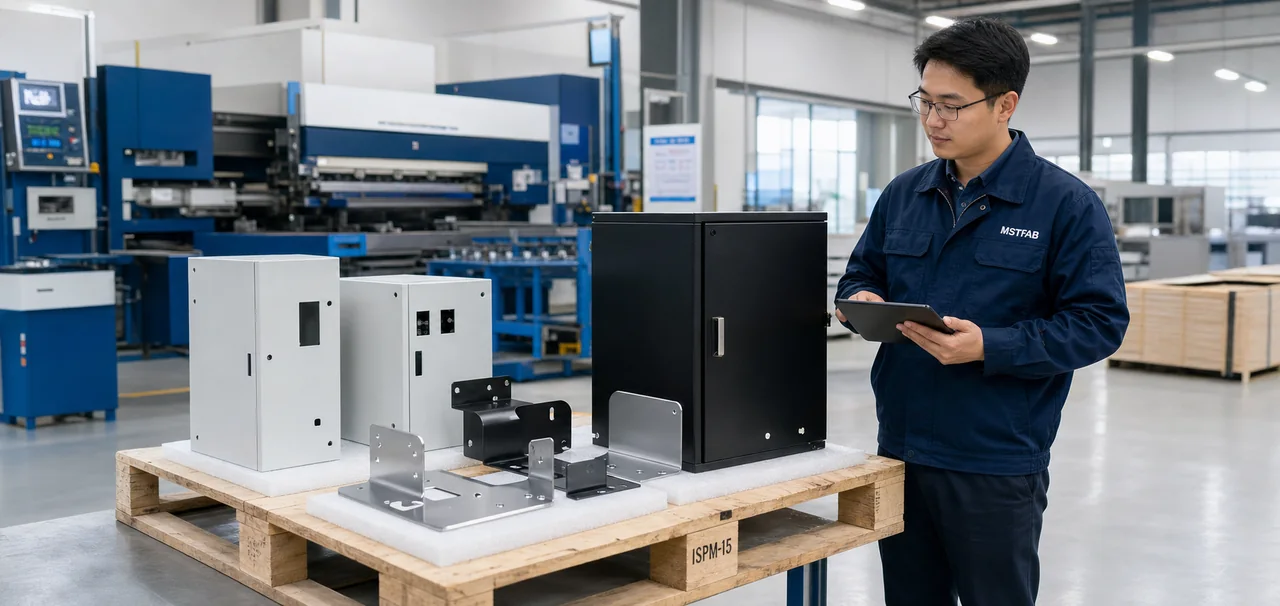
The 6 Physical Drivers of Sheet Metal Part Costs
1. Raw Material Selection and Sheet Nesting Yield
Raw coil or sheet material typically accounts for 35% to 50% of the total manufacturing cost of a sheet metal component. Specifying stainless steel (304 or 316) increases raw material cost by 2.5× to 4× compared to commercial cold-rolled carbon steel (SPCC) or galvanized sheet (SECC). Aluminum alloys such as AL 5052-H32 provide an optimal balance of weight, formability, and corrosion resistance. Furthermore, irregular L-shaped blanks that nest poorly on standard 1250 mm × 2500 mm sheets generate 30% or more scrap, directly inflating unit material costs.
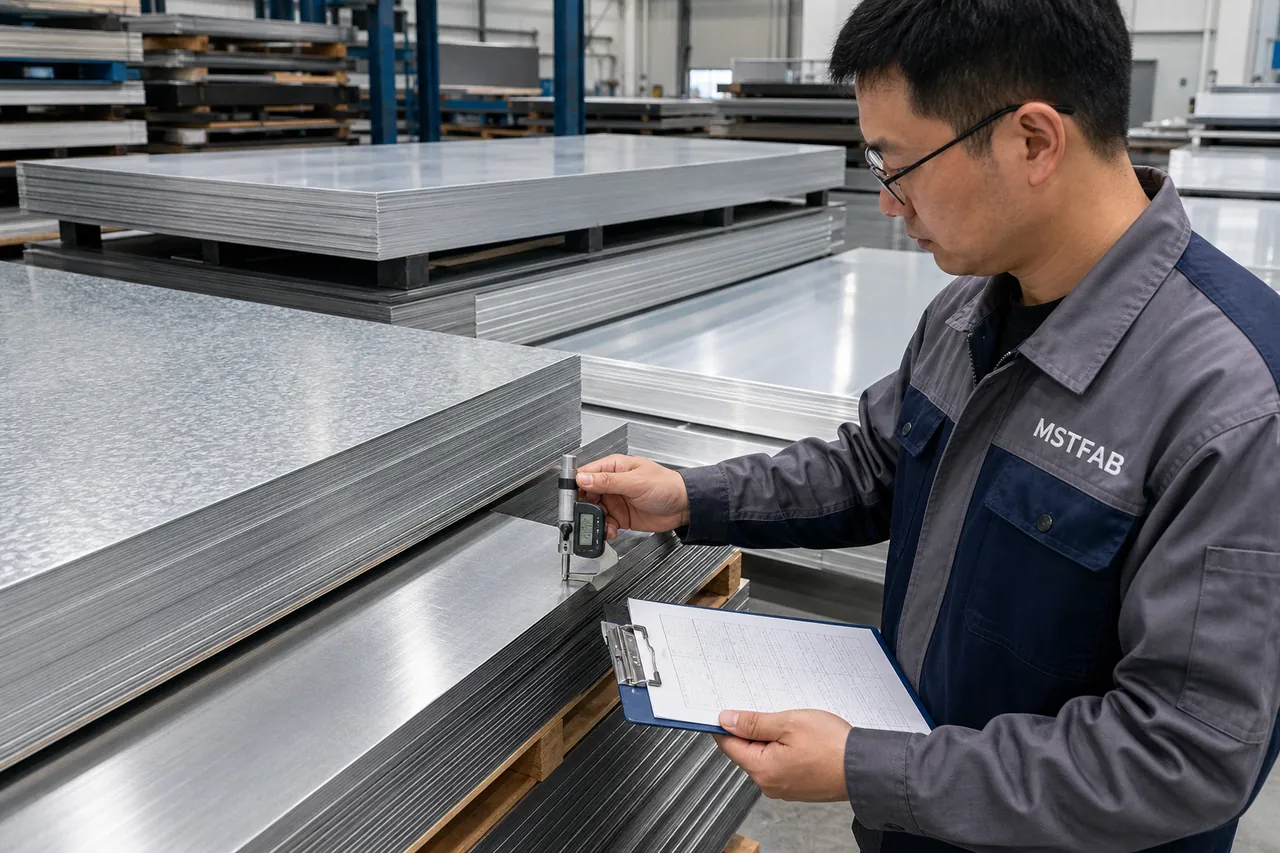
2. CNC Cutting Machine Time: Pierce Count & Contour Length
High-power CNC fiber lasers (12kW–20kW) slice thin gauge sheet at speeds exceeding 30 meters per minute. However, cutting speed is governed by pierce time and contour complexity. Cutting hundreds of small perforated ventilation holes requires hundreds of individual beam pierces, which consume high-pressure assist gas (nitrogen or oxygen) and add machine cycle time. Designing hexagonal perforations or slotted louvers instead of individual round holes can reduce machine cut time by up to 35%.
3. Press Brake Forming Complexity and Setup Counts
Bending is a labor-intensive operation. Each bend line requires operator handling, part positioning against backgauges, and cycle execution. Parts featuring multiple bend radii or deep interior reverse flanges often require two or three separate press brake tool setups, multiplying setup labor. Designing all flanges with a uniform bend radius (e.g., inside radius equal to material thickness R = 1.0T) allows the entire part to be formed in a single setup pass.
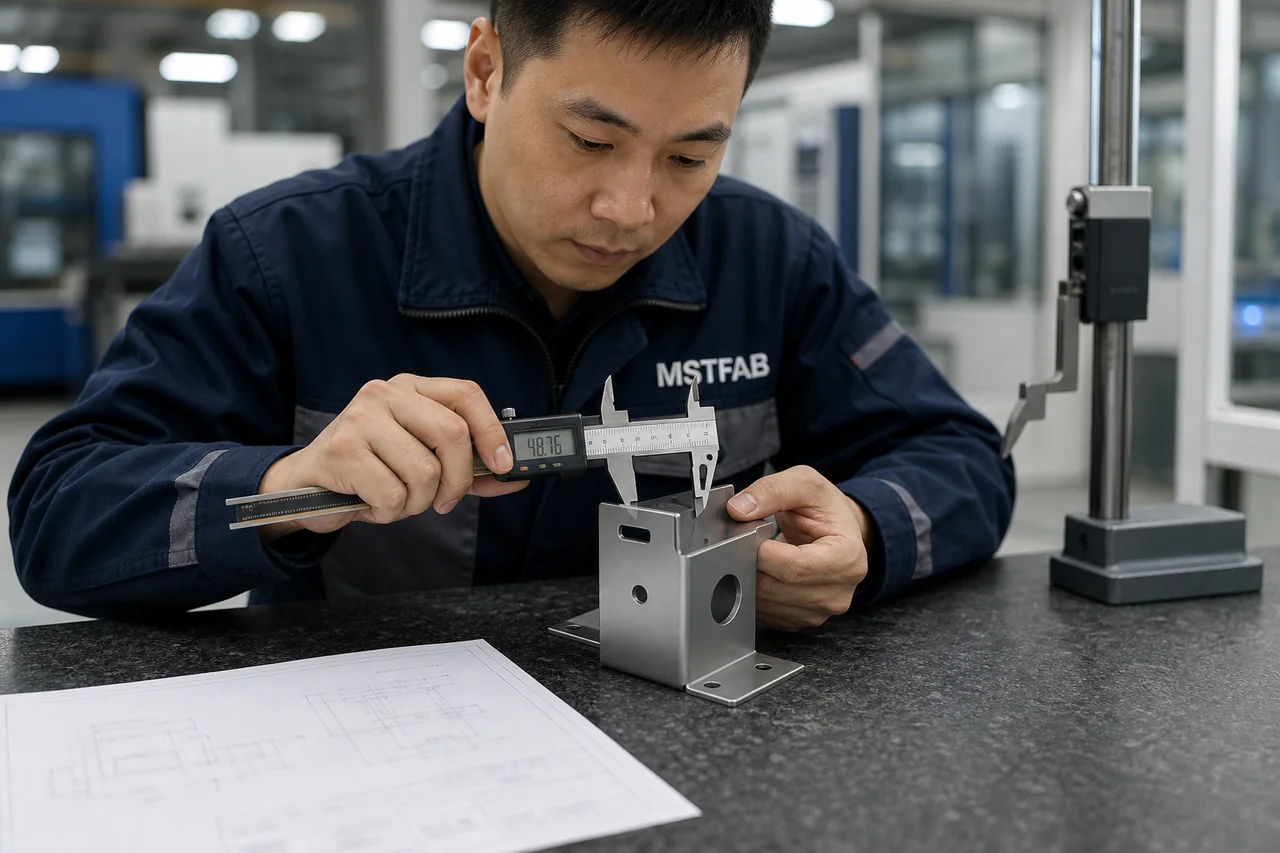
4. Tolerancing Strictness: General vs. Critical GD&T
Sheet metal is a flexible raw material subject to mill rolling gauge variances and elastic springback during bending. Specifying an arbitrary title-block tolerance of ±0.05 mm across large formed panels forces fabricators to slow press brake strokes, execute frequent angle gauge adjustments, and conduct 100% CMM inspection, adding 20% to 40% in quality overhead. Sourcing per ISO 2768-mK (±0.3 mm) for non-critical features while restricting ±0.05 mm to mating holes keeps pricing competitive.
5. Surface Treatment and Finishing Specifications
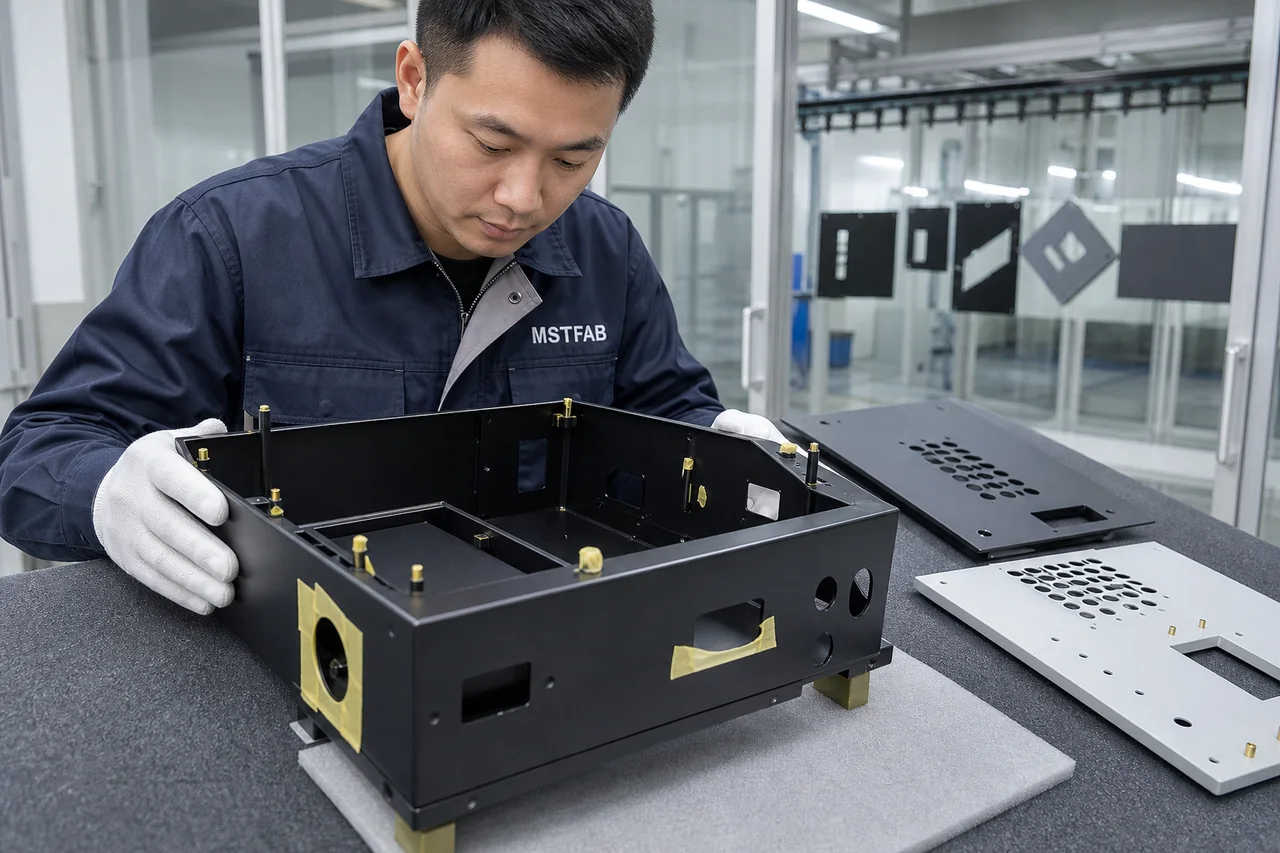
Surface finishing can easily exceed 20% to 30% of total component cost. Standard architectural polyester powder coating provides high durability at modest cost. However, specifying complex two-tone colors, intensive paint masking on threaded PEM studs, military-spec chem-film conversion (MIL-DTL-5541), or high-temp epoxy coatings increases manual preparation time and curing oven cycles.
6. Batch Quantity and Setup Amortization (Prototype vs. Production)
Setting up a CNC laser, loading punch sheet cassettes, adjusting press brake backgauge fingers, and purging powder spray booths requires approximately 1 to 2 hours of technician labor (costing USD 150 to USD 300). When amortized across a 5-piece prototype order, setup costs add USD 30 to USD 60 per part. Across a 500-piece production batch, this overhead drops to mere cents per unit, unlocking dramatic economies of scale.
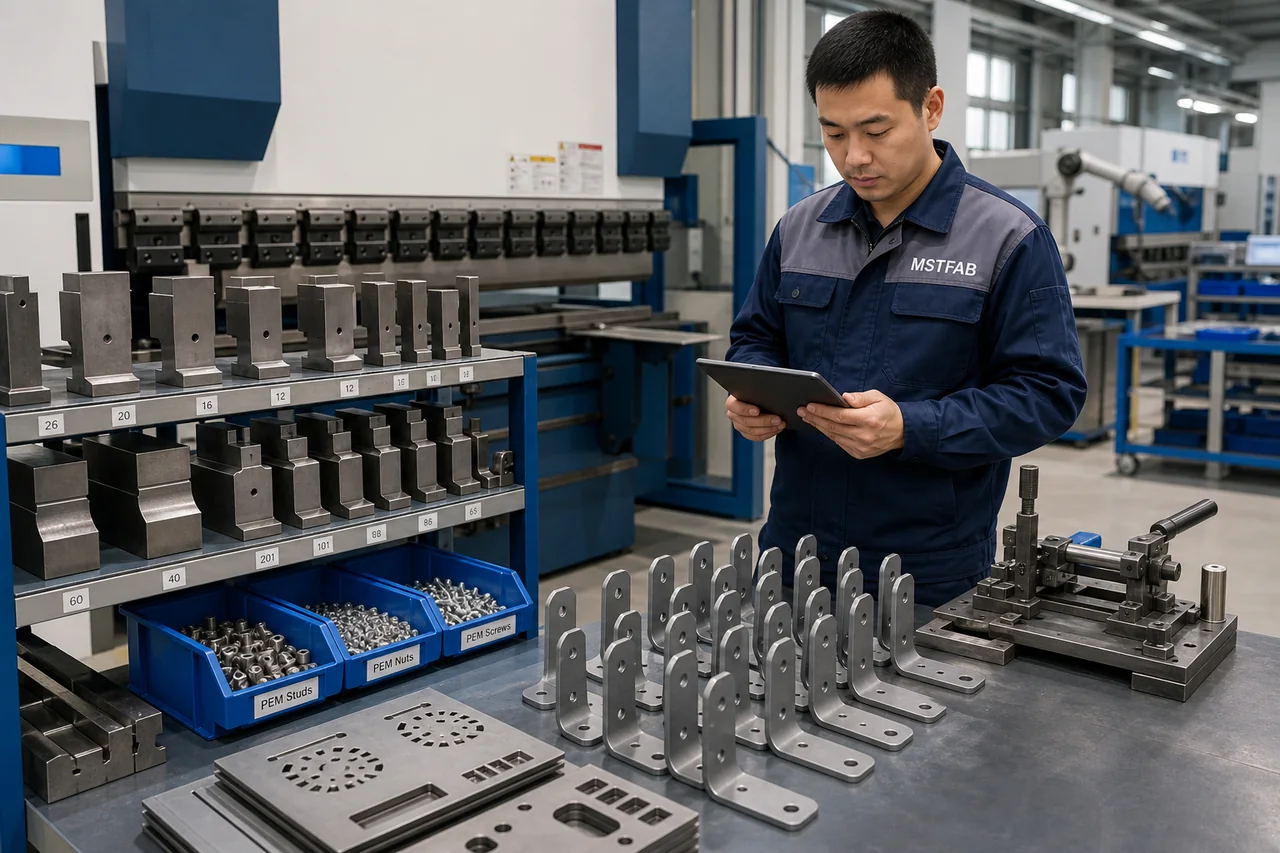
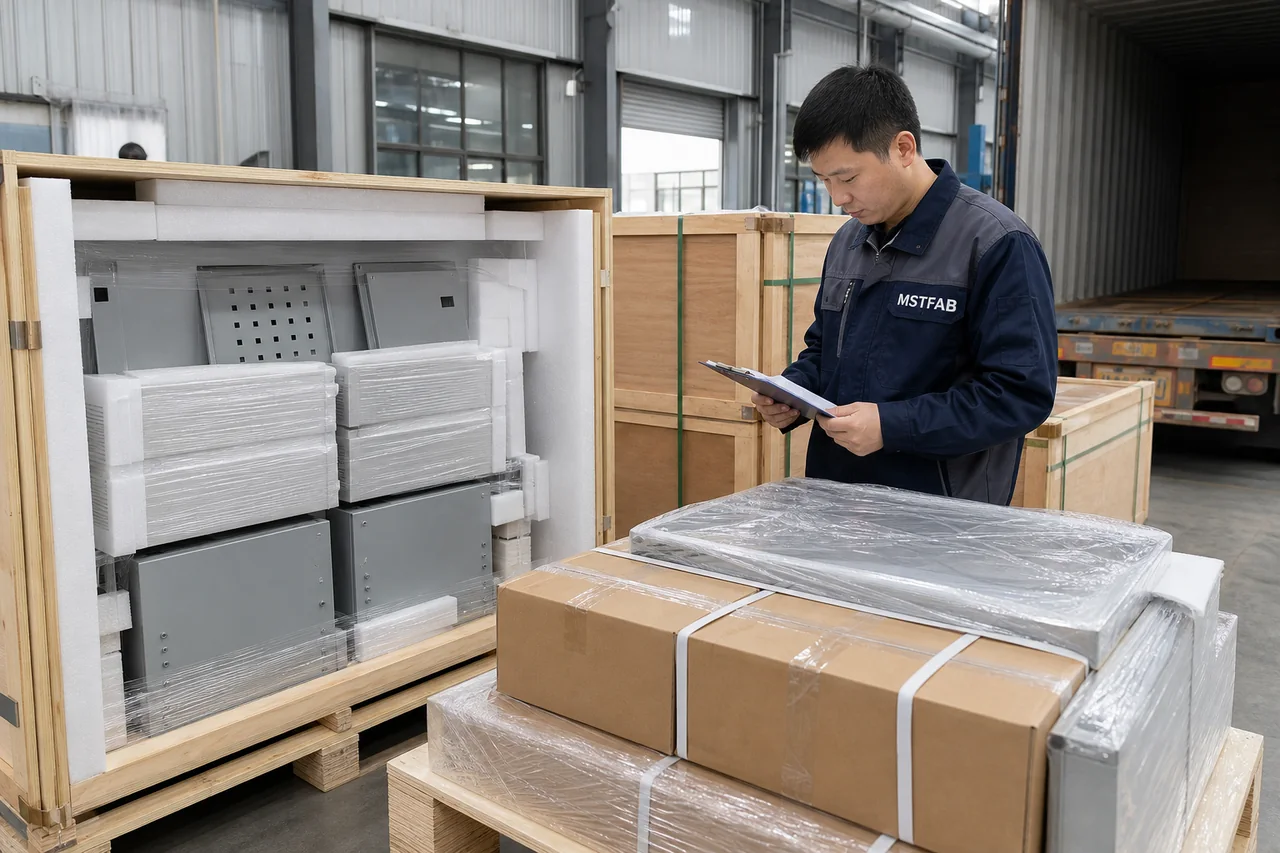
Sheet Metal Cost Breakdown & Optimization Matrix
The engineering matrix below outlines cost percentage distributions, key expense drivers, and actionable DFM design rules to minimize piece-part pricing:
| Cost Category | Typical Cost Share | Primary Cost Inflator | DFM Cost Reduction Strategy | Potential Savings |
|---|---|---|---|---|
| Raw Material | 35% – 50% | Exotic alloys (316 SS), thick gauge, poor sheet nesting yield | Standardize to AL 5052 / 304 SS; optimize nested blank geometry | 15% – 30% |
| Laser / Punch Cutting | 15% – 25% | Thousands of individual pierce holes, intricate micro-contours | Use cluster punching, slotted patterns, common-line cutting | 10% – 25% |
| Press Brake Forming | 15% – 20% | Multiple bend radii, reverse bends requiring tool changes | Maintain single uniform inside bend radius across entire part | 20% – 35% |
| Hardware & Secondary | 10% – 15% | Non-standard PEM studs, manual tapping, multiple rivet types | Standardize fastener thread sizes (M3/M4); use self-clinch | 15% – 20% |
| Surface Coating | 15% – 25% | Custom paint blends, extensive thread masking, multi-layer primers | Standard RAL powder coat colors; eliminate unnecessary masking | 20% – 40% |
| Volume Scale Setup | Variable | Low prototype quantities (1–10 pcs) absorbing 100% NRE setups | Combine prototype runs or commit to pilot blanket releases (100+ pcs) | 40% – 70% |
Optimize Your Sheet Metal Part Costs with MSTFAB
MSTFAB helps hardware engineering teams eliminate unnecessary manufacturing costs through early DFM collaboration. Our automated laser nesting, multi-axis press brakes, and in-house powder coating lines deliver transparent, competitive contract manufacturing for prototyping through high-volume production. Submit your 3D CAD files today for a line-item DFM cost analysis.
 WeChat Contact
 WhatsApp Me Directly