
⚡ Direct Answer: How Does High-Mix Low-Volume (HMLV) Sheet Metal Fabrication Work for OEM Equipment?
High-Mix Low-Volume (HMLV) sheet metal fabrication involves manufacturing dozens to hundreds of distinct part numbers in batch sizes ranging from 5 to 500 units per run without sacrificing dimensional accuracy or incurring exorbitant setup surcharges. Managing HMLV successfully requires 4 core production controls: 1) Common Material & Gauge Harmonization: Standardizing across 1.5mm, 2.0mm, and 3.0mm stock sheets (e.g., 5052-H32 aluminum or galvannealed steel) so multiple part geometries nest dynamically on shared master sheets; 2) Automated Multi-Part Laser Nesting: Combining brackets, covers, and chassis panels on a single fiber laser run to achieve >85% material utilization; 3) Segmented Press Brake Tooling & Hydraulic Clamping: Utilizing modular Wila/TRUMPF segmented punches to execute rapid bend-tool changeovers in under 4 minutes; and 4) Barcoded Digital Travelers: Tracking each discrete part number through punching, deburring, hardware insertion, and powder coating with serialized routing traveler tickets to prevent lot mixing.
In capital equipment, robotics, medical devices, and custom machinery, OEM procurement teams rarely have the luxury of ordering 10,000 identical stamped components. Instead, an annual equipment build cycle typically demands 15 to 40 distinct sheet metal brackets, structural frame gussets, card cages, and protective covers in quantities of 20 to 100 pieces per month. When handled by conventional stamping or rigid job shops, setup fees and lead time friction make HMLV cost-prohibitive. At MSTFAB, our lean CNC workflow amortizes fixed setup steps across agile, digitally synchronized cells.
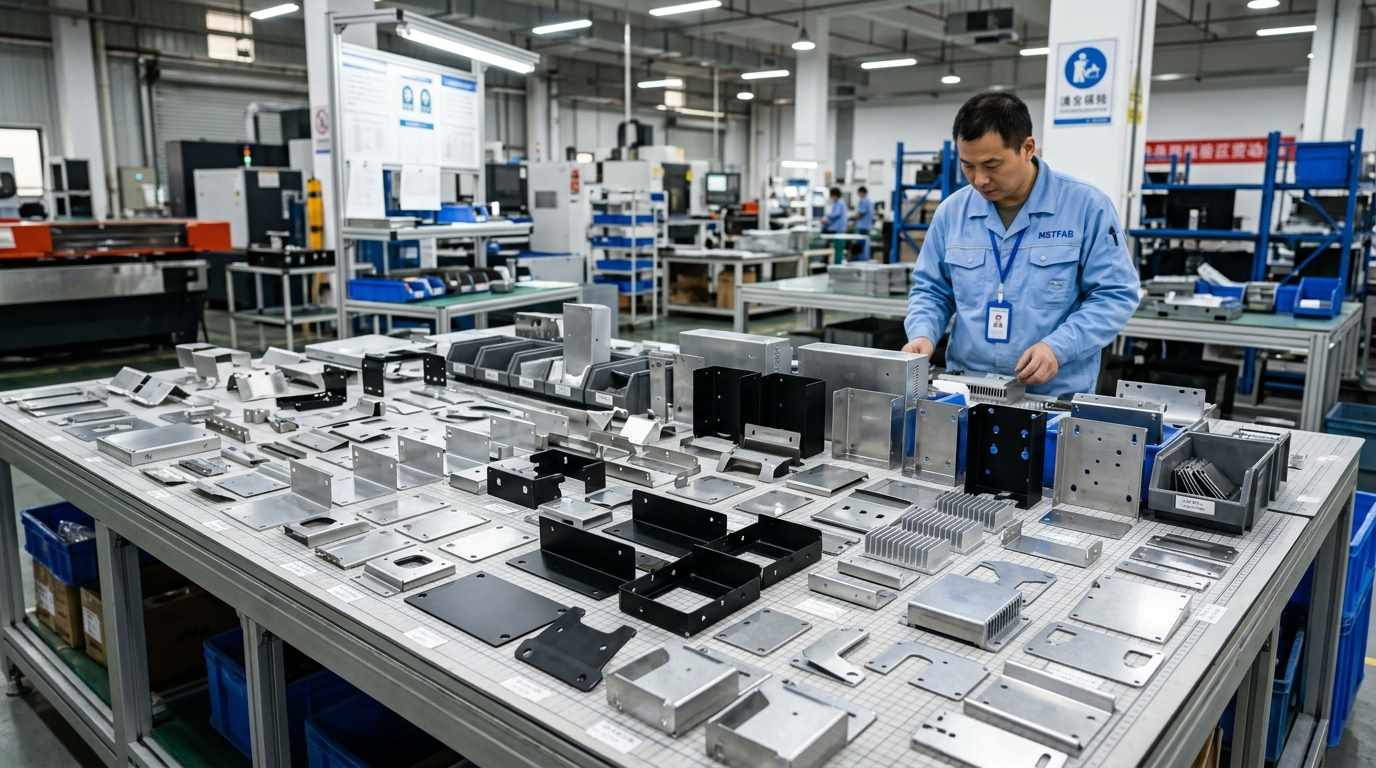
High-mix low-volume sheet metal fabrication: Diverse brackets, covers, and chassis components grouped for synchronized lean manufacturing.
Engineering Comparison: High-Mix Low-Volume vs. High-Volume Stamping
| Operational Parameter | High-Mix Low-Volume (HMLV) Flexible Cell | High-Volume Dedicated Hard Tooling | OEM Design Impact |
|---|---|---|---|
| Tooling Investment (NRE) | 0 – 500 (Universal CNC brake dies & laser software) | 15,000 – 80,000+ (Progressive stamping dies) | Near-zero upfront barrier; allows iterative design revisions. |
| Minimum Order Quantity (MOQ) | 5 to 25 pieces per part number | 2,500 to 10,000+ pieces per production run | Eliminates dead stock and warehouse carrying costs. |
| Cutting & Piercing Technology | High-speed fiber laser (TRUMPF 6kW to 15kW) | Mechanical punching / stamping press stations | Enables intricate hole cutouts and rapid contour changes via software. |
| Forming & Bending Setup Time | 3 to 8 minutes (Hydraulic quick-clamp CNC press brake) | 2 to 4 hours (Heavy press bolster plate changeover) | Economical to switch between left-hand and right-hand assemblies. |
| Material Utilization | 82% – 91% (Dynamic multi-part nesting across sheets) | 65% – 85% (Continuous coil strip skeleton scrap) | Smaller nested parts fill empty voids inside large chassis cutouts. |
| Revision & Engineering Change | Instant (Update DXF/STEP CAD model in CAM engine) | 4 to 8 weeks (EDM tool modifications and tryouts) | Zero tool scrapping cost when upgrading OEM machinery features. |
Optimizing the RFQ Package for High-Mix Low-Volume Runs
When sourcing an entire assembly kit consisting of 20 to 50 unique sheet metal items, issuing 50 separate quote requests will overwhelm both your buyers and the supplier’s estimating engineers. Structuring a consolidated Master RFQ Bill of Materials (BOM) unlocks volume pricing even when individual part quantities are low.
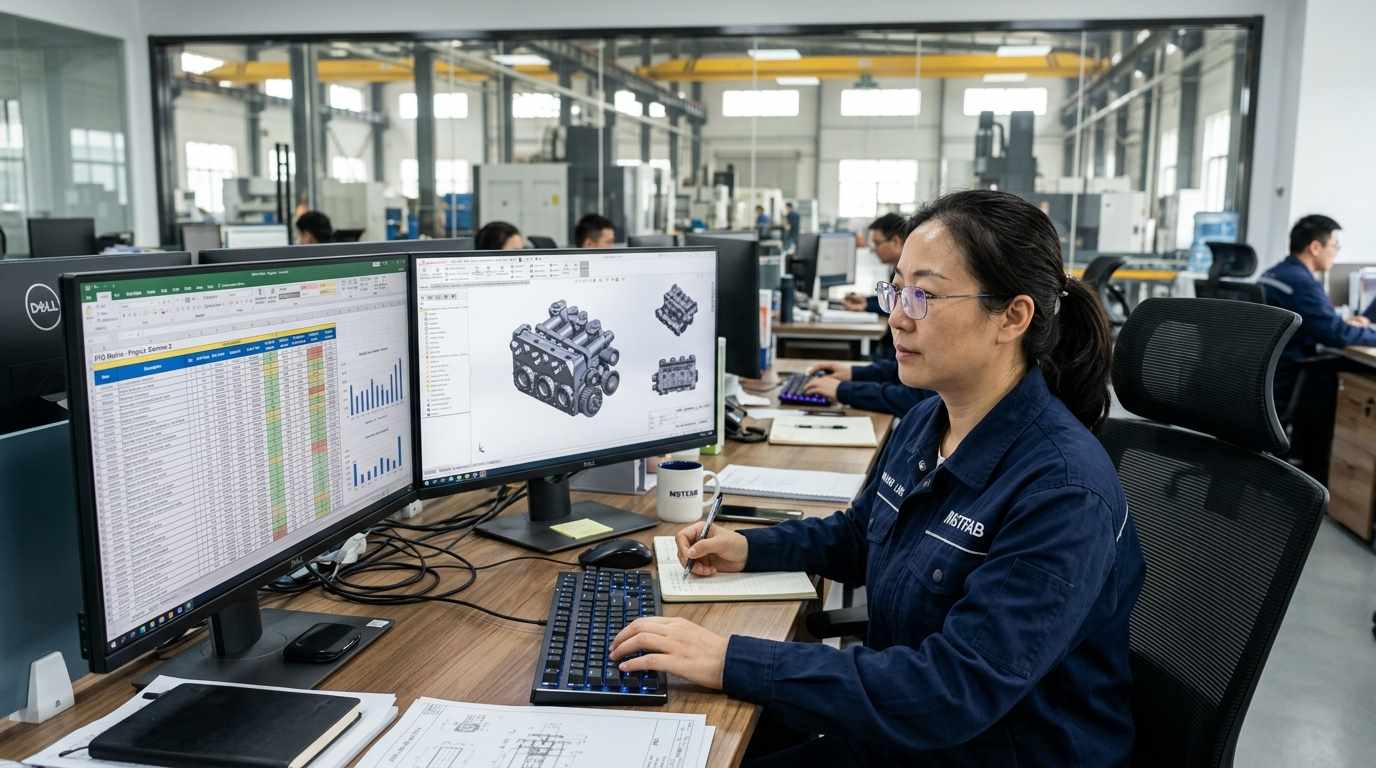
1. Consolidated BOM Matrix
Provide a structured spreadsheet with Part Number, Rev, Material Grade, Thickness, Estimated Annual Usage (EAU), and Expected Batch Release Quantity.
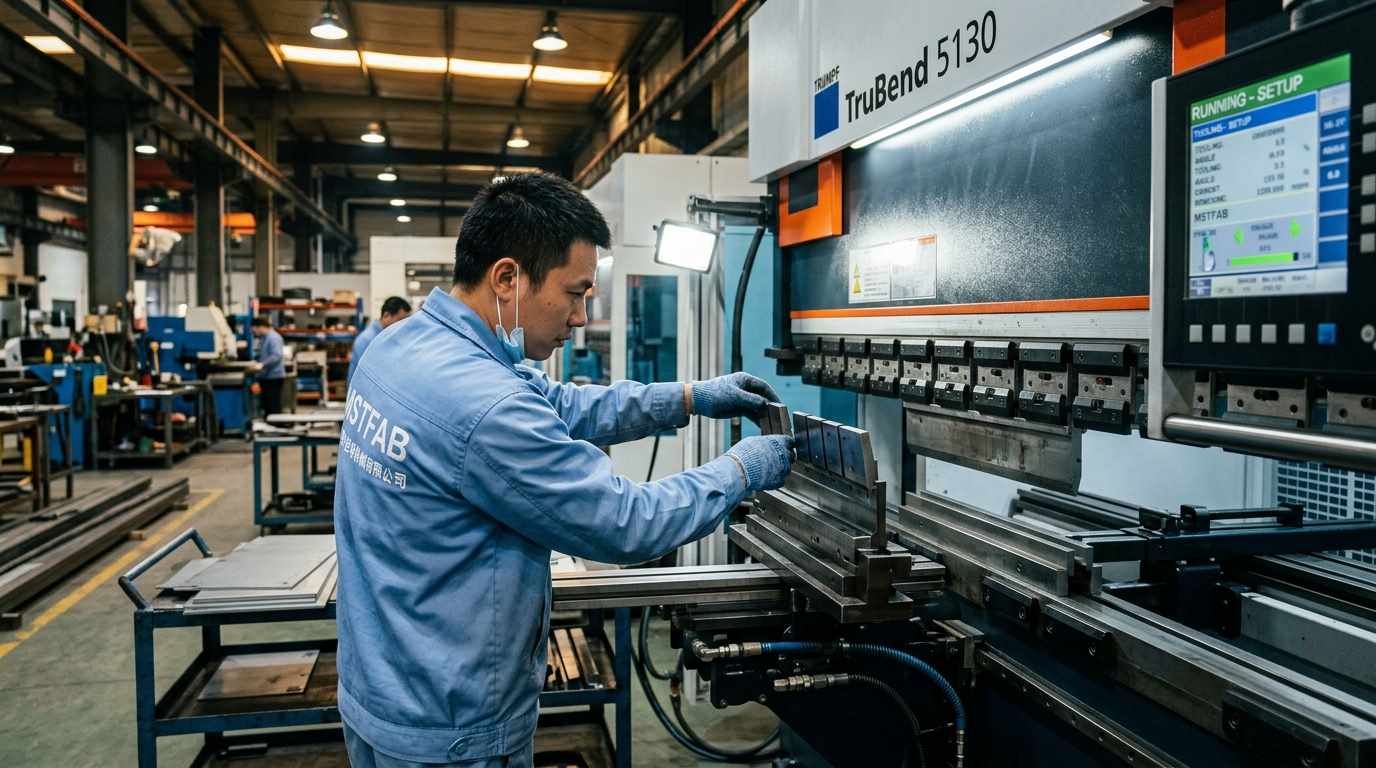
2. Tooling Standardization
Design bend internal radii across different brackets to match standard punch tooling (e.g. R=1.0mm or R=2.0mm) to avoid custom press brake tooling charges.
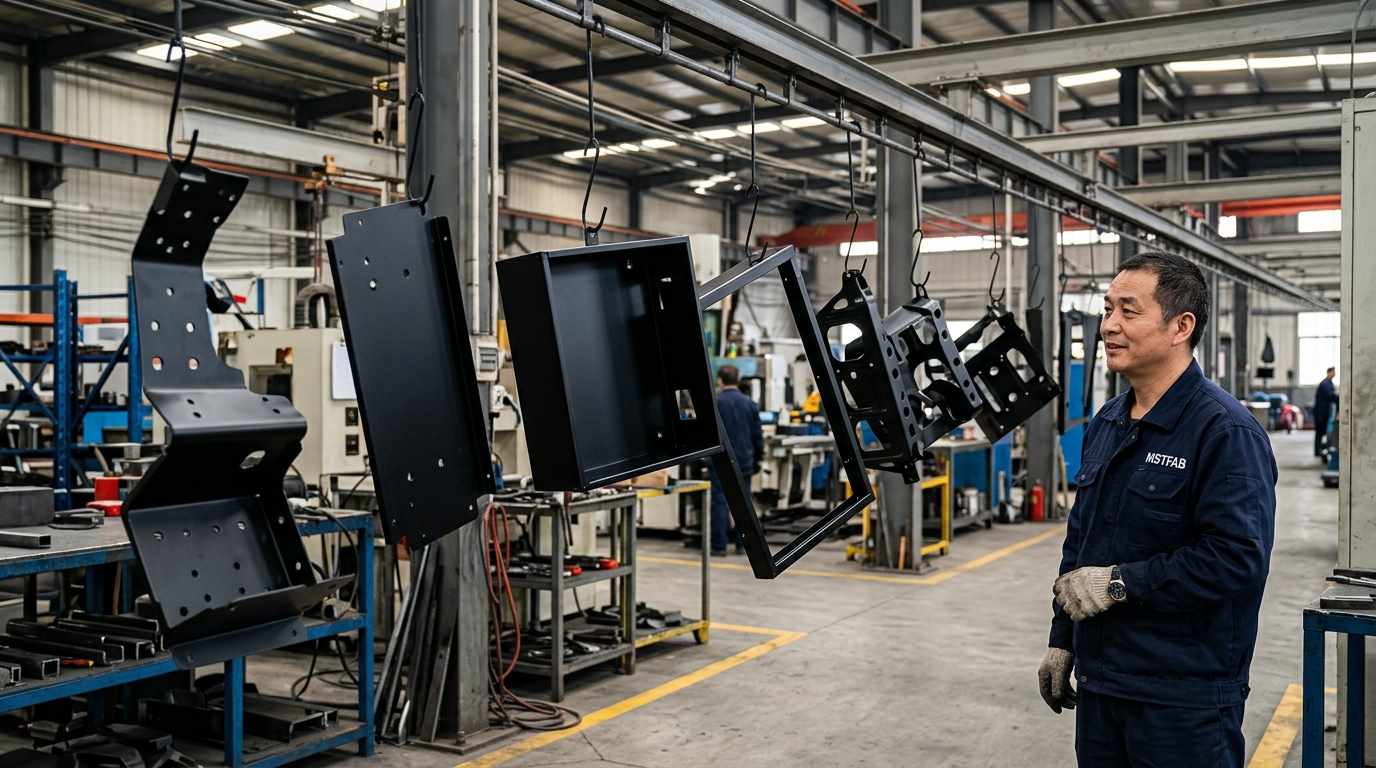
3. Surface Finish Batching
Harmonize powder coat specs (e.g., standard RAL 7035 or RAL 9005 fine texture) so all kit parts run through the wash and bake oven simultaneously without line flushes.
Procuring High-Mix Low-Volume OEM Sheet Metal Parts?
Send your complete multi-part assembly BOM and 3D CAD files. MSTFAB provides nested material amortization, rapid prototype-to-batch production, and serialized kit delivery.
Traceability & Packaging for Multi-Part Assembly Kits
The greatest operational danger in high-mix low-volume manufacturing is component mix-up and assembly kit starvation. If 49 parts of a 50-part machine kit arrive at your assembly plant but one small internal bracket is missing or misidentified, the entire OEM build halts.
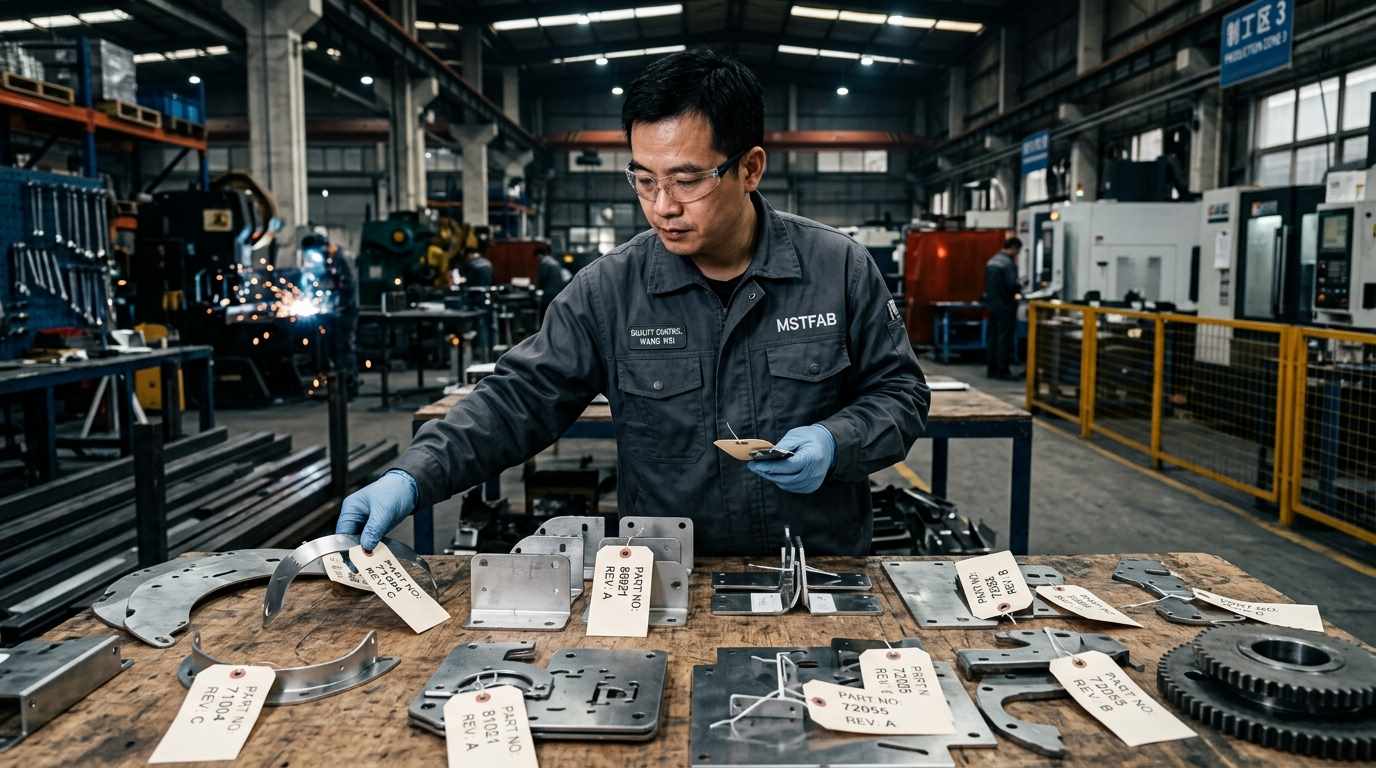
Barcoded Part Identification
Each discrete part features laser-etched part numbers or durable peel-off barcode stickers noting drawing revision, order number, and batch date for zero-error receiving.
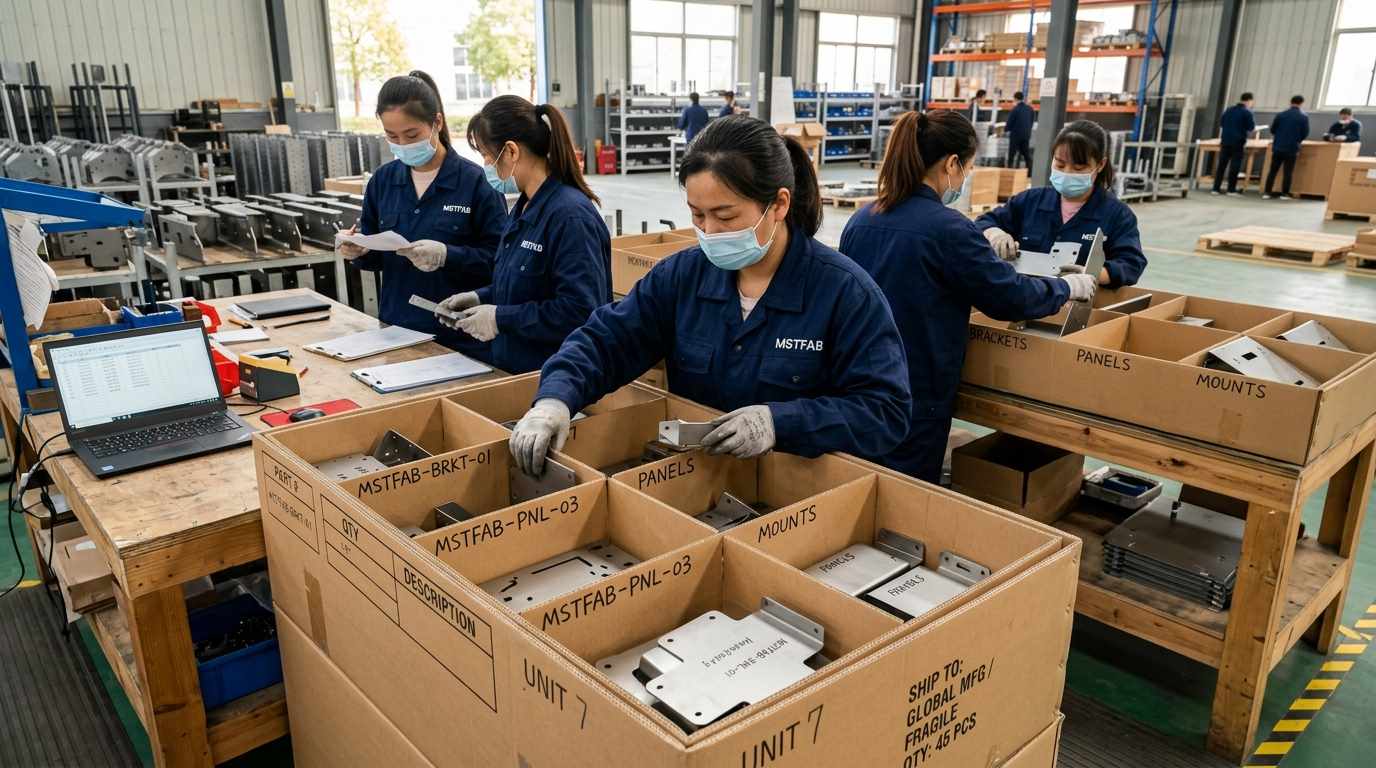
Kitted Crate Packaging
Components are packed in compartmentalized, labeled export crates organized by subassembly order, allowing line workers to unpack components directly into cell bins.
Frequently Asked Questions (FAQ)
What is the typical minimum order quantity (MOQ) per part in an HMLV sheet metal contract?
MSTFAB supports production quantities as low as 5 to 25 units per part number, provided the order is structured within an overall multi-part kit or annual blanket PO exceeding $1,500 total value.
How do you prevent press brake setup charges from inflating unit prices on low-quantity parts?
We utilize standardized 30° acute and universal 90° radius tooling across our CNC press brakes, programming air-bending offsets in CAM offline. This avoids individual setup fees by allowing operators to form multiple part geometries with one common tooling setup.
Can MSTFAB manage engineering changes (ECOs) during an active production run?
Yes. Because our workflow uses digital laser nesting and CNC press brakes rather than fixed stamping dies, revision updates take effect immediately on subsequent nests without tooling rework fees.
 WeChat Contact
 WhatsApp Me Directly