Use this page for welded frame fit-up and load path checks
A farm bracket can look simple until welding pulls the holes out of alignment. This guide focuses on welded fit-up risks, not a broad agricultural parts overview.
This page has been separated from the farm bracket parts article so Google and buyers can see the job of this article clearly. The useful question here is not “can someone make metal parts?” It is: what should a buyer check before sending drawings, approving a quote or moving into production?
- Define load direction and mounting datum before quoting.
- Check whether intermittent welds can control distortion while meeting strength needs.
- Confirm fixture points for repeat production.
- Inspect hole patterns after welding, not only before.
- Plan coating and packaging around welded edges and corners.
| 1 | Define load direction and mounting datum before quoting. |
| 2 | Check whether intermittent welds can control distortion while meeting strength needs. |
| 3 | Confirm fixture points for repeat production. |
| 4 | Inspect hole patterns after welding, not only before. |
| 5 | Plan coating and packaging around welded edges and corners. |
Custom Metal Brackets and Frames Built for Farm Equipment That Works Hard
Farm equipment does not treat metal parts gently. A bracket on agricultural machinery may face vibration, mud, rain, fertilizer, impact, twisting loads, rough transport, outdoor storage, and operators who need the machine running now, not after a supplier explains why the holes are off.
A metal frame may look simple in CAD. Then real life shows up.
- The mounting holes do not align.
- The welded frame pulls out of square.
- The bracket cracks after vibration.
- The powder coating chips during shipping.
- The support frame flexes under load.
- The installer starts drilling into finished parts because the batch does not fit.
That is not fabrication. That is a field problem with bolt holes.
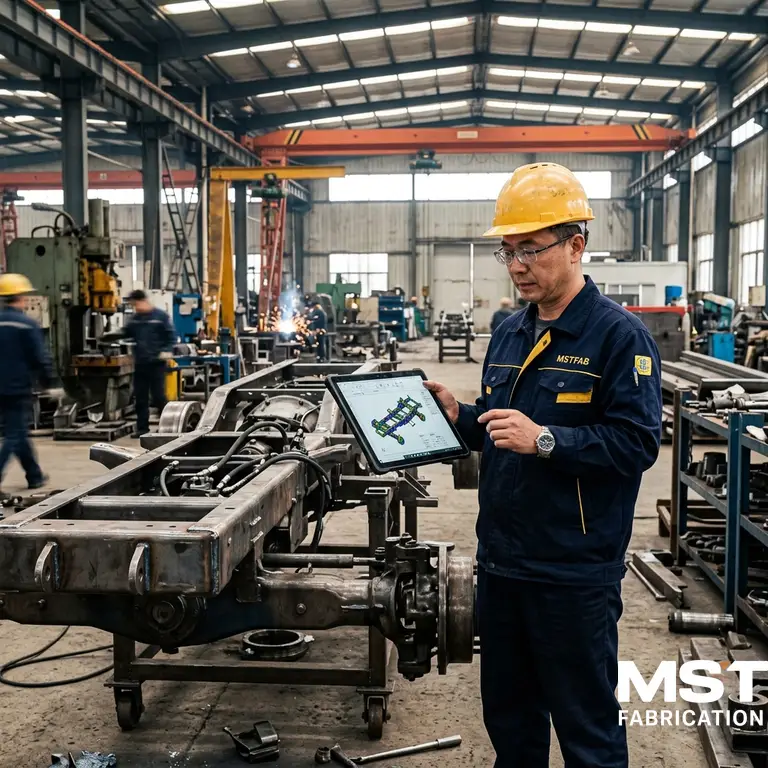
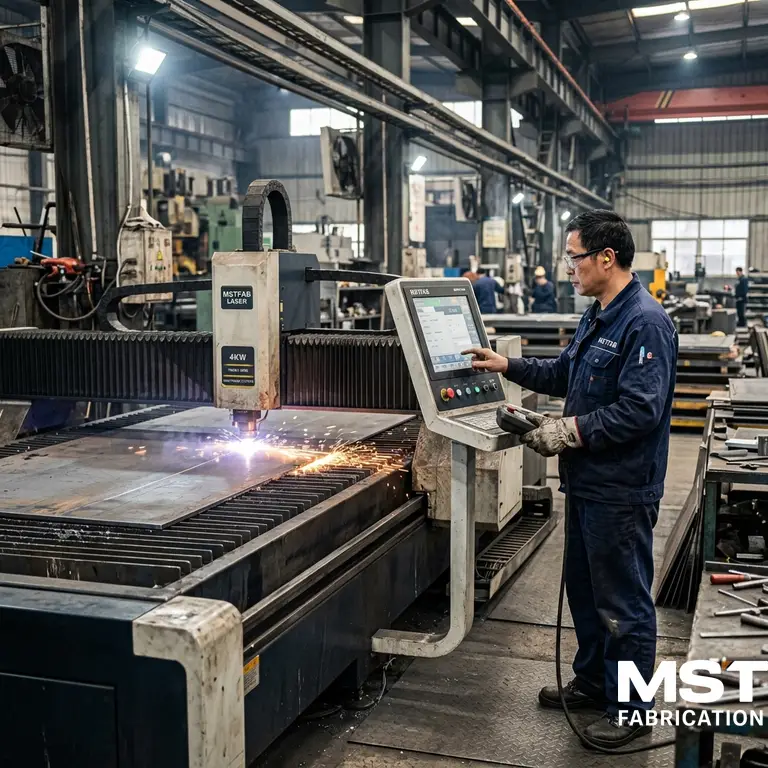
MSTFAB manufactures custom metal brackets and frames for farm equipment based on customer STEP files, 2D PDF drawings, DXF files, samples, or project requirements. Our sheet metal fabrication support can include DFM review, laser cutting, CNC bending, welding, grinding, powder coating, stainless steel finishing, inspection, and export-ready packaging.
Why Farm Equipment Brackets and Frames Need Custom Fabrication
Agricultural machinery rarely uses generic metal parts. Tractors, harvesters, seeders, planters, sprayers, irrigation systems, livestock equipment, and grain handling machines often require brackets and frames designed around the exact machine structure.
Custom metal fabrication allows OEM buyers to control:
- Material grade and Sheet thickness
- Tube, plate, or sheet structure
- Mounting hole positions and Bend angles
- Slot direction and Welded reinforcement
- Frame squareness and Load-bearing areas
- Surface finishing and Powder coating color
- Corrosion protection and Assembly clearance
- Prototype and batch consistency
For farm equipment, “almost fits” is not acceptable. A bracket that almost fits still slows assembly. A frame that almost stays square still causes mounting problems. A welded support that almost survives vibration still becomes a warranty claim.
Agricultural equipment does not reward guesswork. It rewards parts that bolt on correctly and keep working.
Common Applications
Custom metal brackets and frames can be used for:
- Tractor mounting brackets
- Harvester support frames and Sprayer frame components
- Seeder and planter brackets
- Irrigation equipment frames and Livestock equipment supports
- Grain handling equipment frames
- Protective guard brackets and Equipment cover supports
- Battery box brackets and Control box mounting frames
- Cable clamp brackets and Hydraulic line support brackets
- Sensor mounting brackets and Lighting brackets
- Welded farm machinery frames and OEM agricultural sheet metal components
Each part has a different job. A sensor bracket needs accurate positioning. A guard bracket needs strength. A welded frame needs squareness. A hydraulic support bracket needs vibration resistance. A control box mounting frame needs cable clearance and corrosion protection. A planter bracket needs repeatable fit across every batch.
That is why farm equipment metal parts should be reviewed based on their real function, not only their shape. A bracket is never “just a bracket” after it fails.
The Real Cost of Poor Metal Brackets and Frames
A low price can look attractive during sourcing. Then the parts arrive.
| Enclosure Manufacturing Flaw | The Result on Your Assembly Floor |
|---|---|
| Inaccurate Laser Cutouts | Mounting holes do not align, assembly teams drill parts manually. |
| Poor Welding Control | Frame assemblies are out of square, welded brackets distort. |
| Weak Structural Design | Parts crack under vibration, guards or covers rattle. |
| Cheap Surface Finishing | Powder coating chips during transport, edges rust around cut holes. |
| Inconsistent Production | Replacement parts do not match previous batches, forcing field rework. |
The part price is one number. The rework cost is another number. And that second number usually appears when the production schedule is already tight.
Farm machinery buyers do not want beautiful excuses. They want parts that fit, hold, and survive. A reliable manufacturer helps reduce those risks before production begins through DFM review, controlled fabrication, practical inspection, and export-ready packaging.
Designed Around Load, Vibration, and Real Field Conditions
Farm equipment brackets and frames must be designed around real use. Before manufacturing, the design should consider:
- Where the part is installed and what load it carries
- Whether it faces vibration or supports a guard, cover, sensor, cable, hydraulic line, or control box
- Whether it is exposed to mud, rain, fertilizer, chemicals, or UV
- Whether welding is required and slots are needed for adjustment
- Whether the part must match an existing tractor or machine model
- Whether prototype approval is required before batch production
CAD has no mud. CAD has no vibration. CAD has never been installed on farm machinery during a busy season by a mechanic who has no patience for “almost correct.”
That is why metal brackets and frames for farm equipment need practical manufacturing review before production.
DFM Review Before Cutting Metal
DFM means Design for Manufacturability. For agricultural brackets and frames, DFM helps identify production risks before cutting, bending, welding, coating, and packing.
A practical DFM review may check material suitability, sheet thickness, bend radius, hole-to-bend clearance, mounting hole accuracy, slot direction, frame squareness, welding distortion risk, edge safety, and corrosion risk.
This step matters because farm equipment components often look simple but work hard. A hole too close to a bend may deform. A bend radius too tight may crack. A weld in the wrong location may pull the frame out of square. A weak bracket may fail after vibration.
A design issue found before production is a drawing update. A design issue found in the field is a much more expensive conversation. DFM review is not paperwork. It is how you stop the field from becoming your test lab.
Material Options for Farm Equipment Brackets and Frames
Carbon Steel: Widely used for strong brackets, frames, mounting plates, supports, and welded assemblies. Carbon steel is strong and cost-effective, but it needs proper surface protection. Raw steel and farm weather are not friends. They are the beginning of a rust story.
Cold-Rolled Steel: Useful for lighter brackets, covers, protected components, and powder-coated farm equipment parts. For outdoor use, coating and corrosion protection must be reviewed carefully.
Galvanized Steel: Offers better corrosion resistance than standard cold-rolled steel. However, cut edges, welded zones, drilled holes, and ground surfaces still need protection. Galvanized steel is useful. It is not magic. If the exposed edge is ignored, corrosion will still find it.
Stainless Steel: Used when corrosion resistance, hygiene, washdown, chemical exposure, or long service life matters. Stainless steel costs more. But replacing corroded brackets and frames in the field usually costs more than that.
Aluminum: Lightweight and naturally corrosion-resistant. Best for lightweight support frames, equipment panels, and portable farm machinery parts. Aluminum is not soft steel. Treating it like steel is how nice CAD becomes annoying samples.
Sheet Thickness, Plate Thickness, and Structural Strength
Brackets and frames must be strong enough for the job. But “make it thicker” is not always the smartest answer.
Thickness should be selected based on load requirement, vibration exposure, impact risk, bend structure, and weight target. Sometimes thicker material is necessary. Sometimes the better solution is to add a flange, add a gusset, improve the load path, use a better bend structure, or improve weld location.
Good farm equipment bracket and frame design puts strength where the load actually exists. Hope is not a load-bearing feature. But unnecessary heavy steel everywhere is not smart sourcing either.
Mounting Holes, Slots, and Assembly Fit
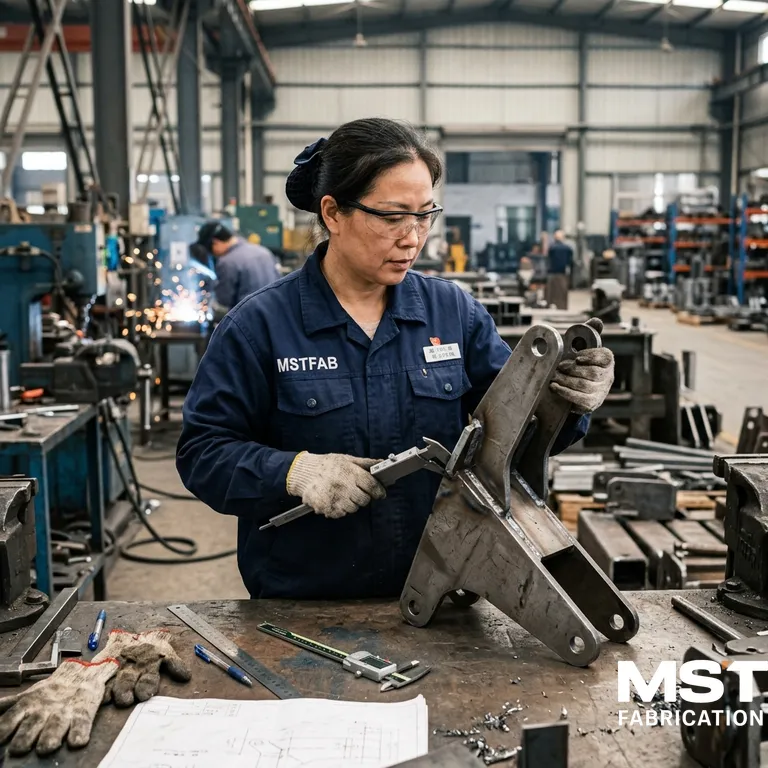
Mounting accuracy is one of the most important factors for agricultural brackets and frames. Poor hole location creates immediate assembly pain.
Important design points include hole diameter, hole pattern accuracy, slot direction, bolt clearance, hole-to-bend distance, and coating thickness around holes.
Slots can help installation tolerance, but they must be used intentionally. Too much clearance can create movement. Too little clearance creates installation pain.
A good farm equipment bracket or frame should fit without forcing the mechanic to become a metal fabricator. If the installer needs a drill, grinder, and emotional support, the part was not ready.
Laser Cutting, CNC Bending, and Welding
- Laser Cutting: Used to produce accurate profiles, mounting holes, bolt slots, and frame plates. Accurate cutting improves assembly speed. A 1 mm error may look small on a drawing. It looks much bigger when the bracket does not line up with the farm equipment frame.
- CNC Bending: Poor bending can cause cracked corners, angle variation, deformed holes, and inconsistent fit. Good bending looks boring. That is exactly why engineers like it. Bad bending makes parts look like they had an argument with geometry.
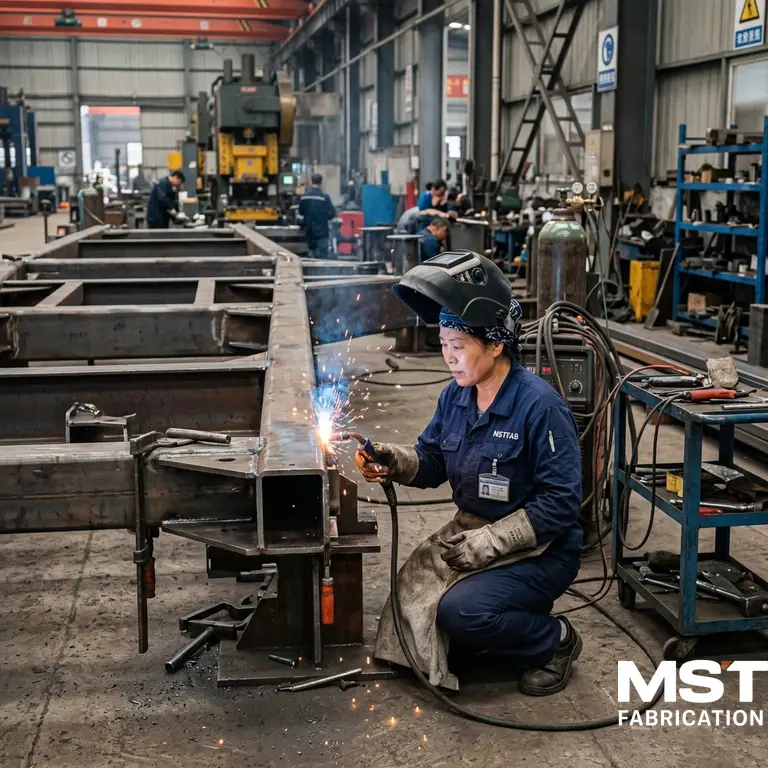
- Welding: Welding adds heat. Heat moves metal. If welding is not controlled, the frame may look correct in CAD and crooked in real life. A farm equipment frame should not come out of welding looking like a banana. Unless the machine is designed to harvest bananas.
Vibration and Fatigue Resistance
Farm equipment vibrates. A lot.
Brackets and frames mounted on tractors, harvesters, seeders, sprayers, and grain handling systems may experience continuous vibration and shock loads. A bracket may look strong in a product photo but still fail if the load path is poor.
Vibration does not care about appearance. It cares about weak points. And it will find them.
Powder Coating and Corrosion Protection
Farm equipment brackets and frames often need surface finishing for appearance and corrosion resistance. Powder coating is not just color. For farm equipment brackets and frames, it may be part of the corrosion protection system.
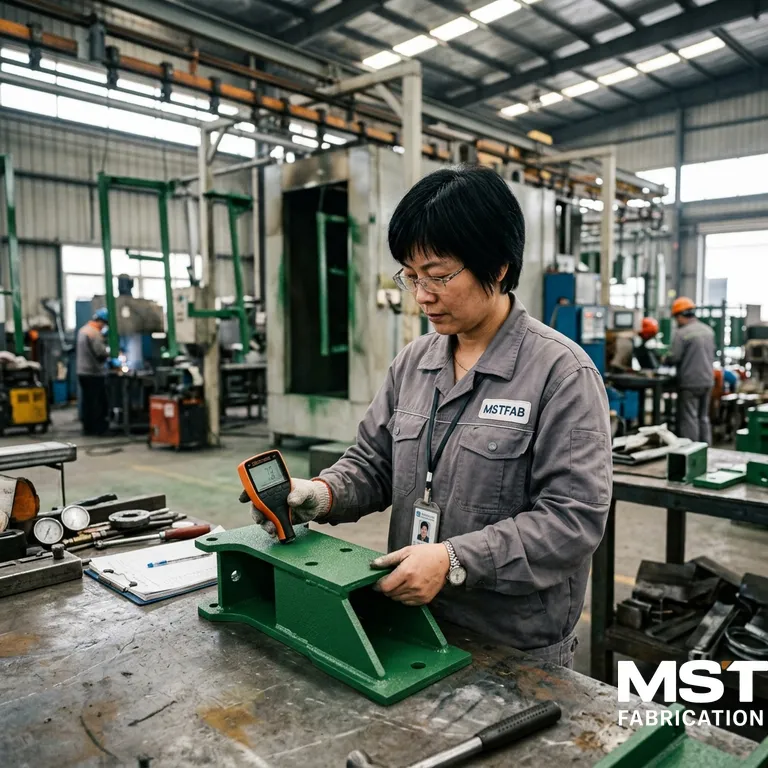
A coated frame that rusts around welds or cut edges after one season is not just a paint problem. It is a material, design, finishing, and quality control problem. Metal remembers shortcuts. Coating reveals them later.
Edge Quality and Safety
Farm equipment brackets and frames may be handled during assembly, maintenance, and field repair. Sharp edges create problems.
A sharp edge is not a small defect. It is a small defect with a talent for cutting hands, cables, hoses, and customer trust. A bracket or frame should feel like a finished part, not a metal trap.
Prototype to Batch Production and Quality Control
Custom brackets and frames for farm equipment often start with samples before moving into batch production. A prototype helps confirm overall size, hole position, frame squareness, machine fit, weld distortion, and assembly clearance.
One good sample is not the finish line. The real goal is stable repeat production. A sample made with heroic manual correction is not manufacturing. It is a magic trick. Magic tricks do not scale.
Quality control should focus on fit, strength, finish, and repeatability. Inspection is not paperwork. It is how the buyer avoids turning the assembly team into the final quality department.
Export Packaging for Brackets and Frames
Agricultural brackets and frames may be coated, heavy, sharp-edged, irregular in shape, or shipped in batches. Poor packaging can damage parts before they reach the assembly line.
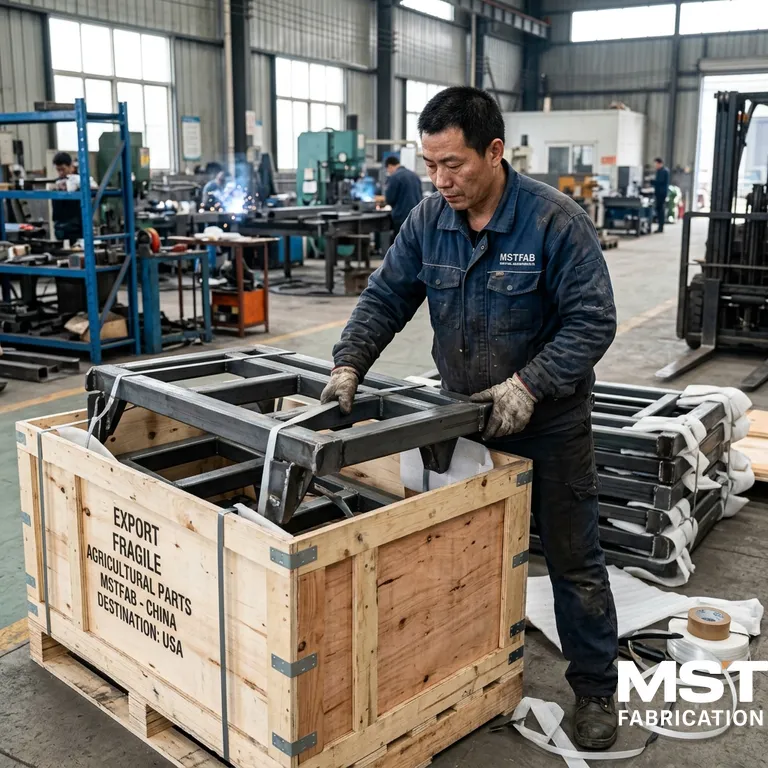
A perfect bracket or frame that arrives scratched, bent, or rusty is no longer perfect. It is a customer complaint with forklift marks. Packaging is not an afterthought. It is the last quality process before the buyer receives the parts.
Why Choose MSTFAB for Farm Equipment Brackets and Frames?
MSTFAB is a custom sheet metal fabrication manufacturer in Guangzhou, China, supporting overseas OEM buyers with drawing-based manufacturing.
Fast Quotation from STEP/PDF Drawings: With complete STEP and PDF drawings, our team can review projects faster. Fast response matters when the buyer is comparing suppliers, the engineer needs feedback, and the production schedule is already staring at the calendar.
DFM Review Before Production: We review material, thickness, bending, welding, mounting hole placement, frame squareness, vibration risk, corrosion protection, powder coating, packaging, and batch production risks before cutting metal.
Clear Manufacturing Scope and IP Protection: We manufacture the physical sheet metal brackets, frames, and metal structures. We do not design tractors. We do not design hydraulic systems. We do not manufacture engines. We do not write control software. This keeps the project boundary clear and helps protect customer intellectual property.
Request a Custom Farm Equipment Bracket and Frame Quote
If you need custom metal brackets and frames for tractors, harvesters, seeders, planters, sprayers, irrigation systems, livestock equipment, grain handling machinery, guards, covers, control boxes, support structures, or OEM agricultural equipment, send us your STEP and PDF drawings.
FAQ
What are custom metal brackets and frames for farm equipment?
They are custom-fabricated metal support parts, mounting brackets, welded frames, guard frames, mounting plates, and structural components used in tractors, harvesters, seeders, sprayers, irrigation systems, livestock equipment, and other agricultural machinery.
What are farm equipment brackets used for?
They can be used to mount covers, guards, sensors, cables, hydraulic lines, battery boxes, control boxes, lighting, fenders, panels, frames, platforms, and other agricultural machinery components.
Can farm equipment brackets and frames be customized?
Yes. Material, thickness, size, bend angle, mounting holes, slots, welds, reinforcement, surface finish, corrosion protection, and packaging can be customized according to drawings.
What materials are used for agricultural brackets and frames?
Common materials include carbon steel, cold-rolled steel, galvanized steel, stainless steel, aluminum, and coated steel. The correct material depends on load, corrosion exposure, weight, finish, and application environment.
Can these brackets and frames be powder coated?
Yes. Powder coating is commonly used to improve appearance and surface protection. Outdoor-grade powder coating, pretreatment, edge protection, and packaging should be reviewed for agricultural field use.
Can MSTFAB make brackets and frames from STEP files?
Yes. STEP files help review the 3D geometry. A 2D PDF drawing should also be provided to define material, thickness, tolerances, finish, welding notes, hole positions, and inspection requirements.
Suggested Further Reading
- Custom Agricultural Sheet Metal Parts
- OEM Agricultural Sheet Metal Components
- Tractor Sheet Metal Brackets
- Irrigation Equipment Metal Enclosures
- Custom Sheet Metal Bending & Welding Parts
- Custom Laser Cutting Service
- CNC Sheet Metal Bending
- DFM for Sheet Metal Enclosures
- Sheet Metal Enclosure Material Selection
- Powder Coating for Sheet Metal Enclosures
- Sheet Metal Enclosure Manufacturing Process
- Custom Fabricated Metal Enclosures
- Outdoor OEM Equipment Enclosures
- Sheet Metal Enclosure Factory
Explore Our Core Capabilities
Discover our full range of agricultural manufacturing services at our core product hub: Custom Agricultural Sheet Metal Parts Fabrication
sheet metal welding services
MSTFAB provides TIG and MIG sheet metal welding services for structural assemblies, cabinets, frames and OEM metal components.
 WeChat Contact
 WhatsApp Me Directly