
⚡ Direct Answer: How to Objectively Evaluate a Sheet Metal Fabricator’s Capacity?
Evaluating custom sheet metal supplier capacity without relying on marketing brochures requires an Evidence-Based On-Site Floor Audit focused on 4 physical checkpoints: 1) Digital Machine-Hour Meter Verification: Examining cumulative power-on and beam-on hours directly on CNC laser and press brake digital controllers (revealing actual machine utilization and maintenance discipline); 2) Work-in-Progress (WIP) Queue Analysis: Reconciling unbent sheet stacks and unfinished parts staged at press brakes and welding bays against the digital ERP schedule (identifying hidden shop bottlenecks); 3) In-House Surface Finishing Throughput vs. Outsourcing Bottlenecks: Confirming whether powder coating and plating are executed on an automated conveyor line in-house or outsourced to external job shops that introduce 5–10 day delays; and 4) Upstream Steel Service Center Credit Audits: Verifying that primary metal mills extend healthy revolving credit lines rather than placing the fabricator on cash-before-delivery holds.
Supplier sales teams routinely claim “20,000 square meters of manufacturing space” and “massive machine capacity”. However, walking the physical shop floor often reveals a completely different reality: two broken laser cutters cannibalized for spare parts, press brakes with single aging operators, and mountain-high WIP queues blocking walkways. Auditing physical evidence ensures your production never stalls.
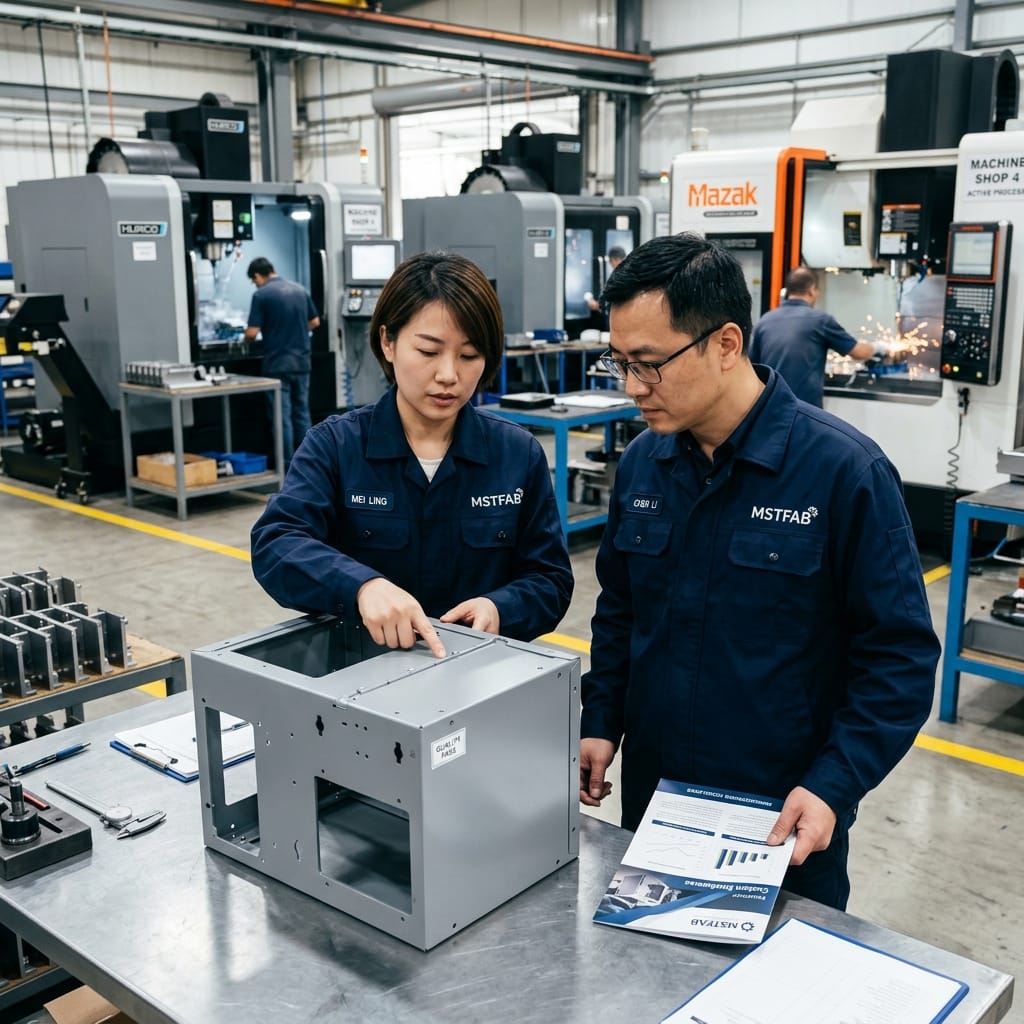
The 4-Checkpoint Physical Capacity Audit Framework
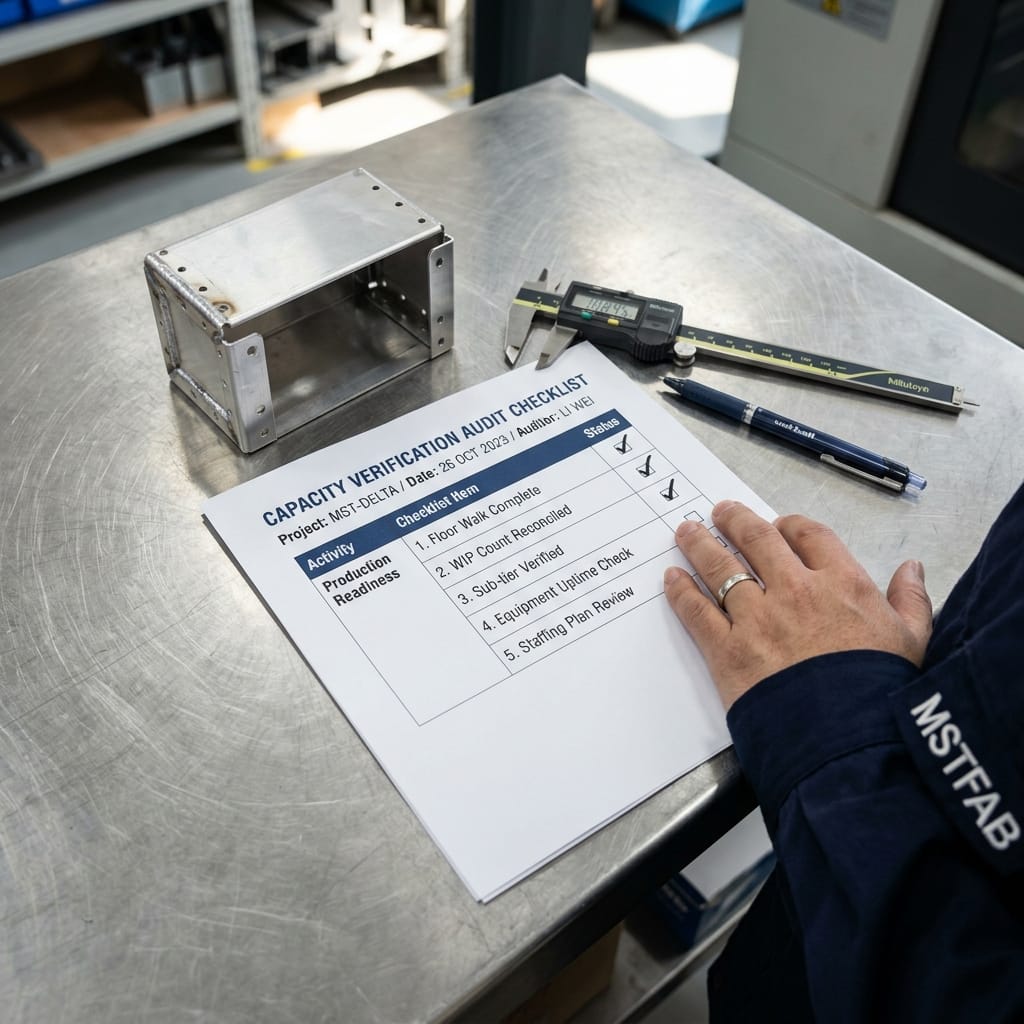
Deploy this disciplined audit checklist when conducting physical or remote on-site supplier evaluations:
| Audit Checkpoint | What to Inspect on Floor | Red Flag (False Capacity Claim) | Audit Benchmark (MSTFAB Standard) |
|---|---|---|---|
| 1. Machine Hour Meters | Digital controller system menus: “Operating Hours” vs “Beam-on Cutting Hours” | Controller display covered, unpowered, or displaying chronic error codes | Transparent machine run logs; logged preventive maintenance schedules; >85% OEE operational uptime |
| 2. WIP Staging Queues | Physical part totes staged between laser tables and CNC press brakes | Massive stacks of dusty, unbent laser cut blanks waiting days for press brake availability | Lean 1-piece or small-batch flow; parts routed from laser to brake within 4 hours via automated robotic handling |
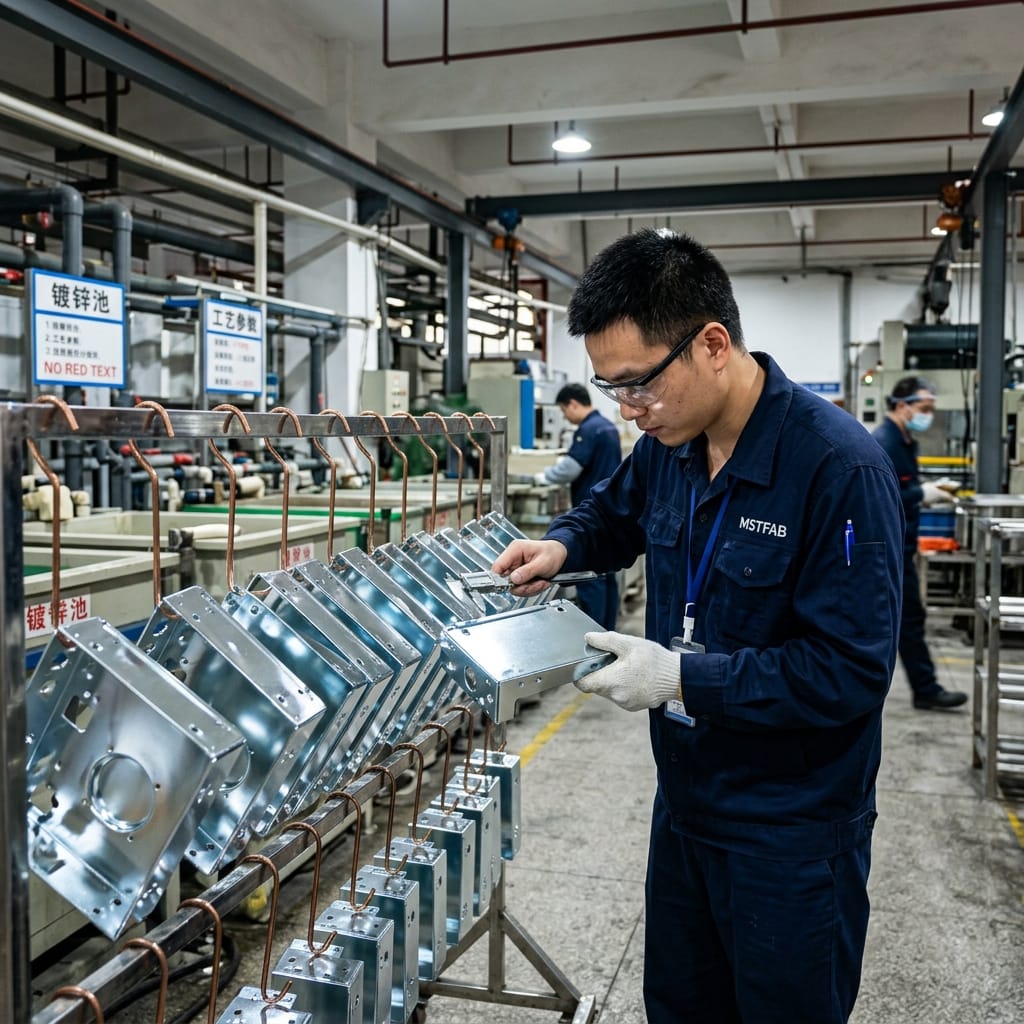
| 3. Finishing Throughput | Automated powder coating line, chemical wash tanks, curing ovens | Outsourcing 100% of finishing to third-party workshops with no quality oversight | In-house automated 5-stage zirconium pre-treatment conveyor line with real-time oven temperature profiling |
| 4. Metrology & Quality Lab | Climate-controlled QA metrology room: CMM machines, optical comparators, XRF analyzers | CMM machine uncalibrated, used as a storage table, or room kept hot without temperature control | Active Zeiss/Hexagon bridge CMM in continuous 20° C environment with certified calibration records and daily logs |

How to Reconcile Floor WIP Against the Digital ERP Schedule
A factory’s Work-in-Progress (WIP) volume tells the unvarnished truth about its production health. During your plant walk, pick three physical part totes at random and execute a 3-point reconciliation:
- Scan the Traveler Job Card Barcode: Match the physical part serial number against the live ERP dispatch schedule on the shop floor terminal.
- Check the Staged Aging Date: If the laser cutting date stamp was 12 days ago and the part is still waiting for press brake bending, the supplier has a critical bottleneck in forming capacity.
- Calculate the WIP-to-Throughput Ratio: Under Little’s Law (Lead Time = WIP / Throughput), excessive WIP directly translates into inflated production lead times. Clean, lean shops with minimal buffer stock deliver parts 3× faster than cluttered shops.


Secure Scalable Audited Sheet Metal Manufacturing Sourcing With MSTFAB
MSTFAB operates high-capacity automated fiber laser towers, robotic press brakes, and in-house powder coating lines backed by China-enforceable NNN IP security and reserved capacity agreements. Accelerate your production with zero downtime.
Frequently Asked Questions (FAQ)
Can an overseas buyer conduct a valid capacity audit remotely?
Yes. At MSTFAB, we conduct high-definition live video audits where our engineers walk the floor with buyers, displaying live CNC laser cutting heads, opening CNC controller diagnostic screens to view hour counters, showing real-time ERP dispatch monitors, and running live CMM probe routines on active production parts.
What is a healthy capacity utilization target for a sheet metal shop?
A well-managed contract fabricator should operate at 65% to 75% baseline capacity utilization. A shop running at 95%+ utilization has zero elasticity; any unexpected order surge or machine maintenance breakdown will cause immediate delivery delays for all customers.
Why is in-house powder coating a major capacity advantage?
Outsourcing powder coating adds 5 to 10 days of transit and queue time at third-party paint shops, while exposing parts to transit scratch damage. MSTFAB’s fully integrated automated conveyor line washes, coats, and cures enclosures in a continuous 90-minute cycle, slashing lead times by over a week.
 WeChat Contact
 WhatsApp Me Directly