
How should OEM procurement teams execute a dual sourcing strategy for custom sheet metal?
OEM procurement teams execute successful sheet metal dual sourcing by: (1) adopting a dynamic 70/30 volume allocation model that rewards top quarterly KPI performers with volume shifts (e.g., 60/40 or 80/20), (2) maintaining duplicate digital CAM nesting programs and synchronized PLM drawing revisions across both vendors, (3) investing in redundant soft-tooled laser cutting to avoid duplicate hard die costs, and (4) holding quarterly benchmarking reviews to ensure cost parity and continuous quality competition.
In custom precision sheet metal fabrication, relying on a single supplier creates severe vulnerability to machine breakdowns, regional freight disruptions, labor strikes, and unilateral price increases. Conversely, splitting volume between two unmanaged job shops can dilute purchasing power and create finger-pointing over tolerance stack-ups. A well-architected **Dual Sourcing Strategy** balances volume pricing leverage with rock-solid supply chain resilience.
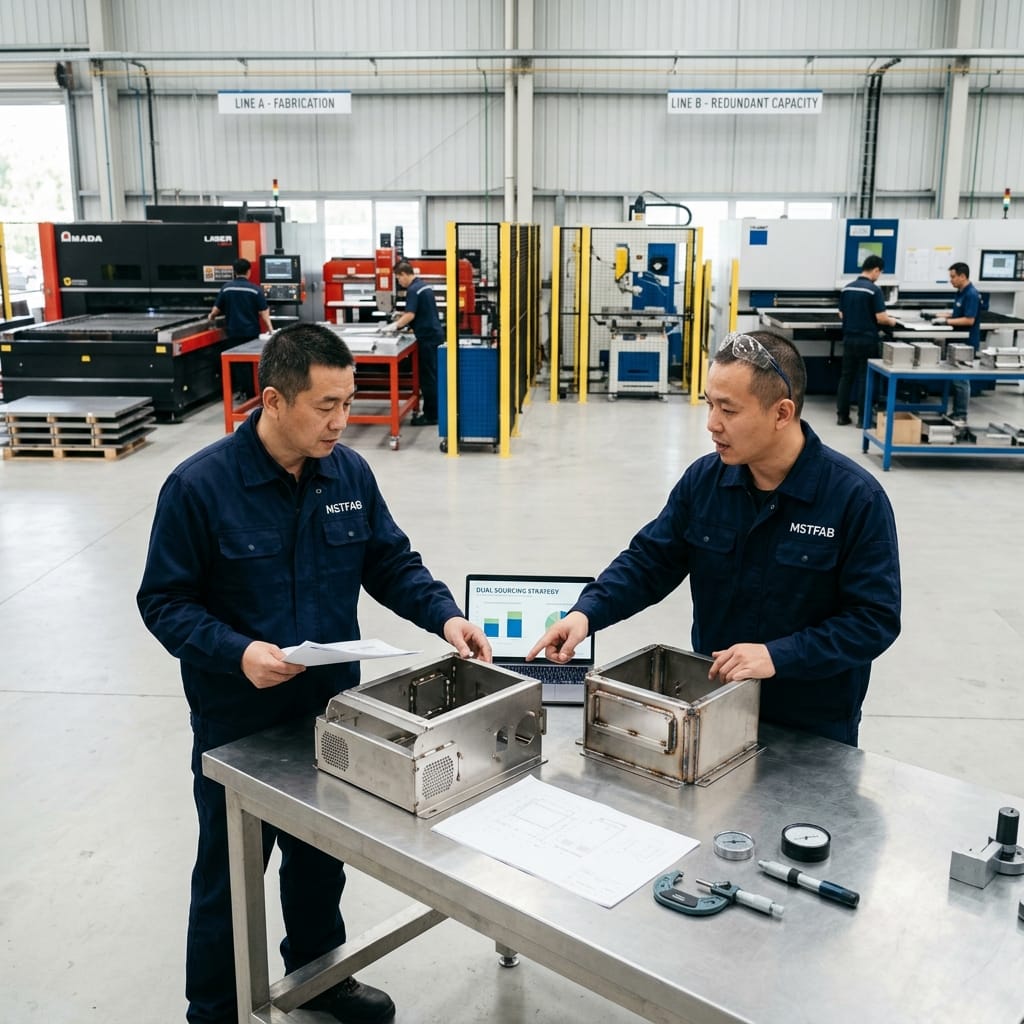
The 4 Pillars of a Sheet Metal Dual Sourcing Architecture
1. Dynamic Volume Allocation (The 70/30 Formula)
Never split volume 50/50. A 50/50 split creates supplier indifference, as neither vendor feels like the primary partner. Instead, establish a dynamic baseline: 70% to the Primary Supplier and 30% to the Secondary Partner. Every quarter, the 10% swing allocation shifts based on objective scorecard rankings: if the secondary supplier beats the primary on OTD and defect PPM, the split shifts to 60/40, providing intense commercial motivation for continuous improvement.

2. Tooling Strategy: Soft Tooling vs. Hard Die Duplication
The biggest financial hurdle in sheet metal dual sourcing is tooling duplication. For high-speed CNC fiber laser cutting and press brake bending (soft tooling), duplication costs are near zero – both vendors program off the same 3D CAD models. For stamped parts requiring progressive dies, smart OEMs run the 70% high-volume run on a dedicated hard die while authorizing the 30% secondary partner to run CNC laser/punch combo cells, eliminating the need to buy two multi-thousand-dollar stamping dies.
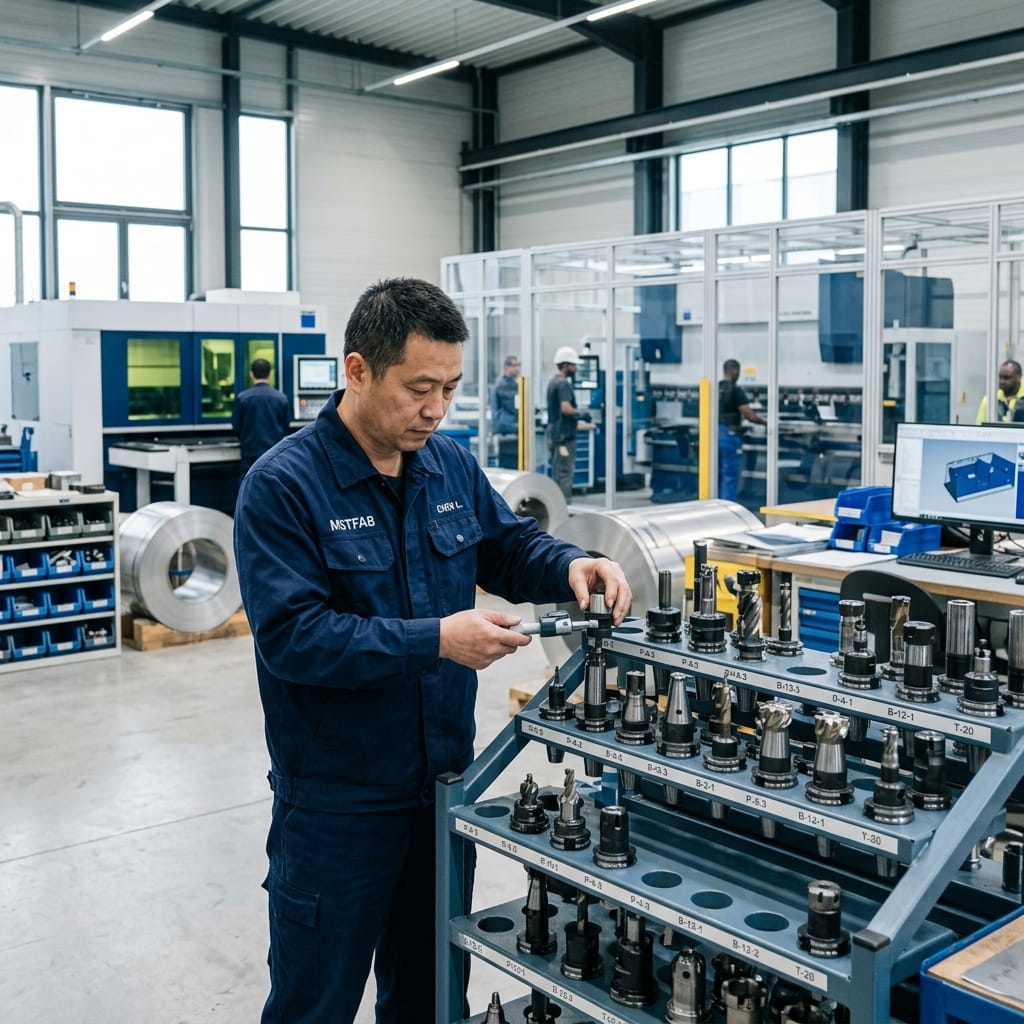
3. Real-Time PLM Engineering Synchronization
Dual sourcing collapses if Vendor A builds to REV C while Vendor B cuts REV B. All 2D drawings, 3D solid models, and ECO cutover dates must be broadcast simultaneously through a centralized cloud PLM portal. Both suppliers must acknowledge ECO releases within 24 hours.

4. Cross-Supplier Quality Benchmarking
Measure parts from both suppliers using identical CMM metrology fixtures and AQL Level II sampling plans. When both vendors realize their quality metrics and piece prices are directly benchmarked against a live competitor every month, complacency is completely eliminated.

Dual Sourcing vs. Single Sourcing Trade-Off Matrix
The table below provides a comparative analysis of single sourcing versus active dual sourcing in precision sheet metal manufacturing:
| Strategic Dimension | Single-Sourcing Model | Active Dual-Sourcing Model (70/30) | Strategic OEM Benefit |
|---|---|---|---|
| Disruption Recovery Time | 6 to 12 Weeks (Catastrophic shutdown) | 3 to 5 Days (Scale 30% to 100%) | Guaranteed factory line continuity |
| Pricing & Cost Leverage | High initial discount, low long-term leverage | Continuous competitive pressure (5–8% savings) | Eliminates captive supplier price creep |
| Quality Accountability | Weak (Supplier blames CAD or material) | Objective (Vendor A vs. Vendor B benchmark) | Drives defect rates < 300 PPM |
| Capacity Surge Flexibility | Capped at single plant ceiling | Access to two distinct factory floors | Absorbs sudden 40% demand spikes |
| Administrative Management | Low (One PO, one contact) | Moderate (Requires automated PLM sync) | Small overhead yields massive risk protection |

Optimize Your Sheet Metal Sourcing Strategy With MSTFAB
Whether you need an aggressive primary supplier or an agile 30% secondary partner, MSTFAB delivers precision sheet metal fabrications with guaranteed CMM accuracy, synchronized PLM revision tracking, and industry-leading on-time delivery. Contact our procurement engineering directors today to structure your dual-sourcing roadmap.
 WeChat Contact
 WhatsApp Me Directly