
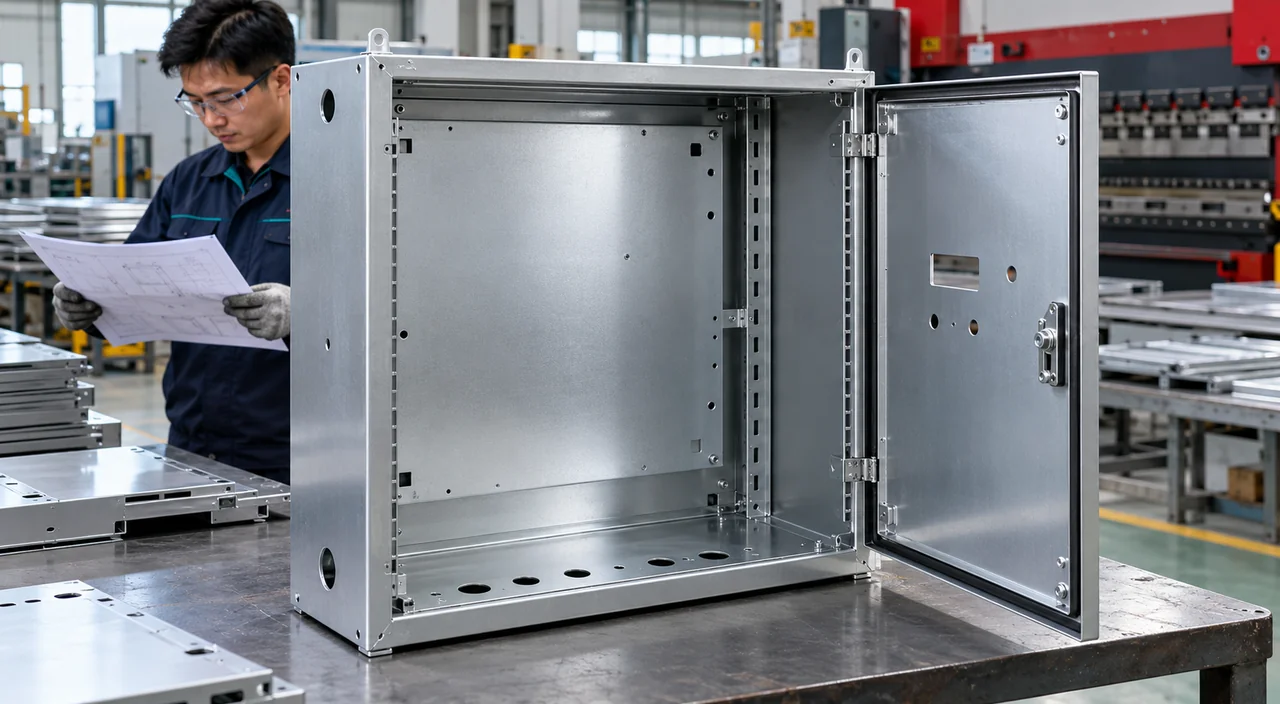
For many OEM buyers, sheet metal fabrication problems rarely appear during quotation. They appear after production starts — or worse, after parts arrive onsite.
At MSTFAB, we’ve reviewed projects where customers experienced welded enclosure deformation, hole position mismatch during assembly, inconsistent bend dimensions, powder coating rework, door alignment problems, and cable installation interference.
In most cases, the problem was not caused by a single manufacturing error. It was caused by design decisions, process instability, or incomplete manufacturability review before production.
In one recent industrial enclosure project, a customer reported that mounting holes between the enclosure body and internal electrical panel no longer aligned after welding and powder coating. The laser cutting dimensions were correct. The actual problem came from cumulative tolerance stack-up combined with thermal distortion during welding. The parts passed flat inspection individually. But the assembly failed operationally.
For OEM buyers, understanding common sheet metal fabrication defects is critical because rework cost is usually far higher than initial manufacturing cost. This article explains the most common fabrication defects in industrial sheet metal manufacturing — and how experienced OEM teams reduce these risks before production begins.
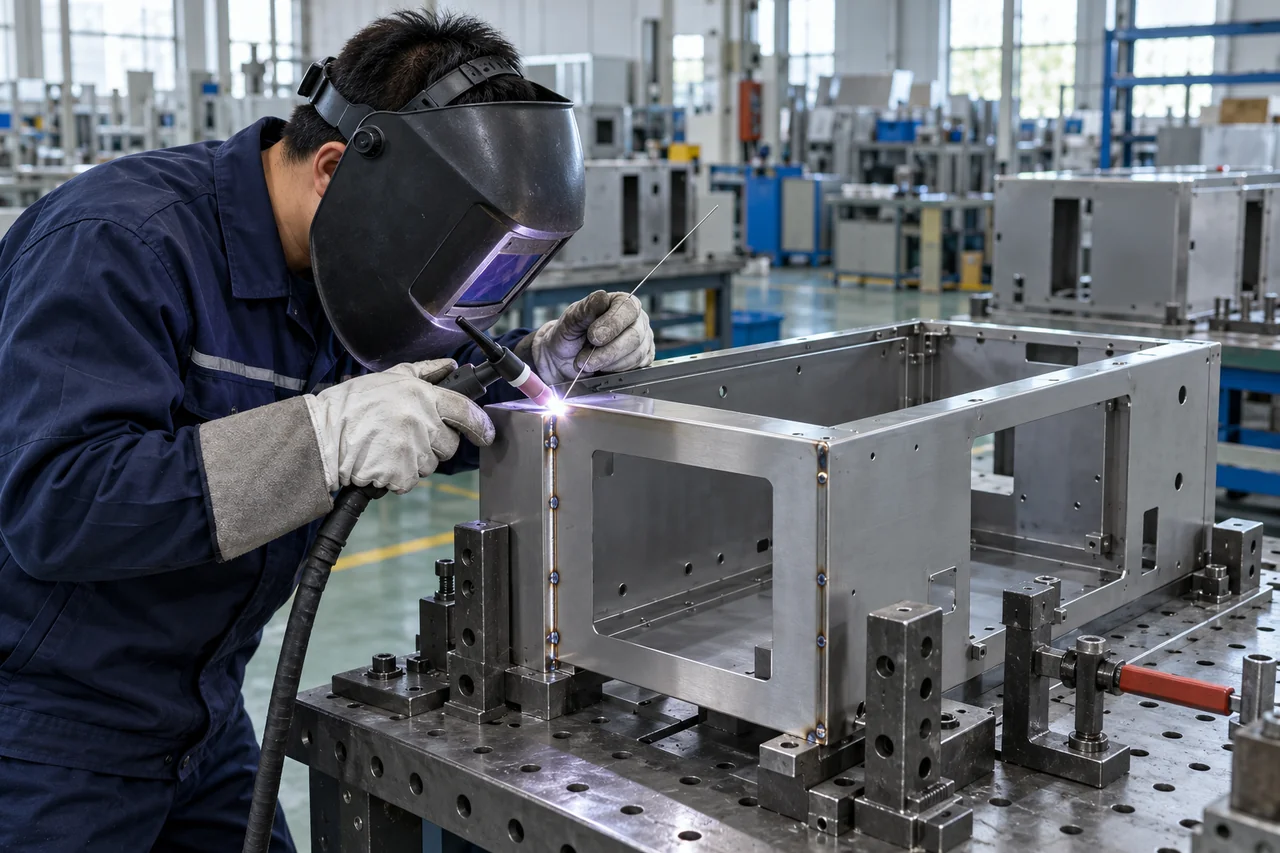
1. Welding Distortion Is One of the Most Common Causes of Rework
Welding deformation is one of the largest hidden risks in custom sheet metal fabrication. This problem becomes especially serious in large electrical enclosures, outdoor cabinets, welded frame structures, stainless steel assemblies, and thick sheet metal projects.
During welding, heat causes localized expansion and contraction. Without proper process control, this creates panel warpage, door twisting, mounting hole movement, uneven sealing surfaces, and assembly interference.
One common OEM mistake is specifying continuous welding across long unsupported panels without considering thermal stress behavior. In many cases, excessive welding actually reduces assembly stability instead of improving strength.
At MSTFAB, distortion risk is commonly reduced through controlled weld sequence, intermittent welding where appropriate, fixture stabilization, reinforcement bend optimization, and minimizing unsupported flat areas. Good enclosure rigidity often starts with structural geometry — not simply adding more welds.
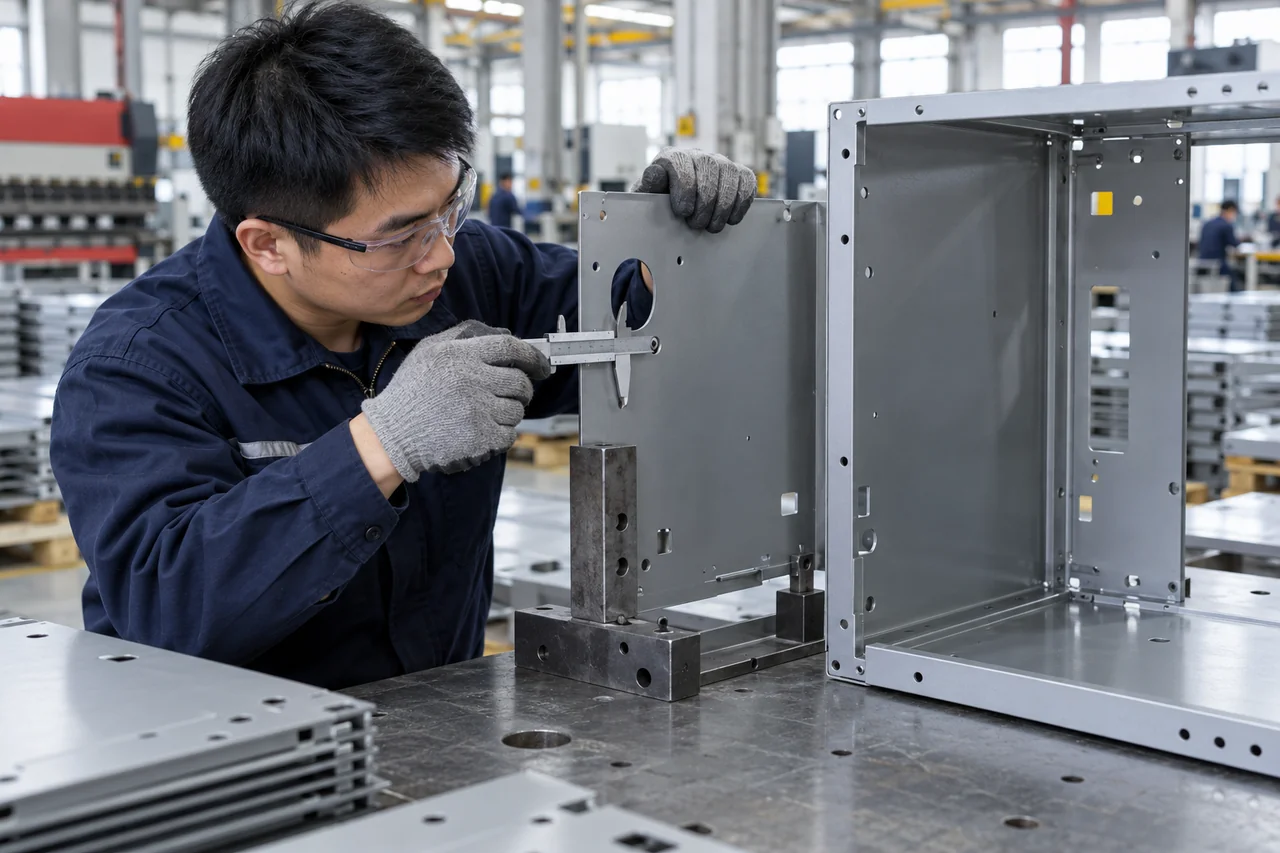
2. Hole Position Errors Usually Come From Process Accumulation — Not Laser Cutting
Many overseas buyers assume hole misalignment is caused by poor cutting accuracy. In reality, laser cutting is usually one of the most stable processes in fabrication.
Most hole position problems actually come from bend variation, welding movement, tolerance stack-up, incorrect datum control, and assembly sequence changes. For example, a hole may be perfectly accurate before bending. But after multiple bends, welding, and coating processes, the final assembled position shifts enough to create installation problems.
This becomes especially serious in DIN rail mounting systems, electrical panels, telecom cabinets, and multi-component enclosure assemblies. Experienced OEM buyers evaluate not only individual part tolerances — but also assembly tolerance accumulation across the entire structure.
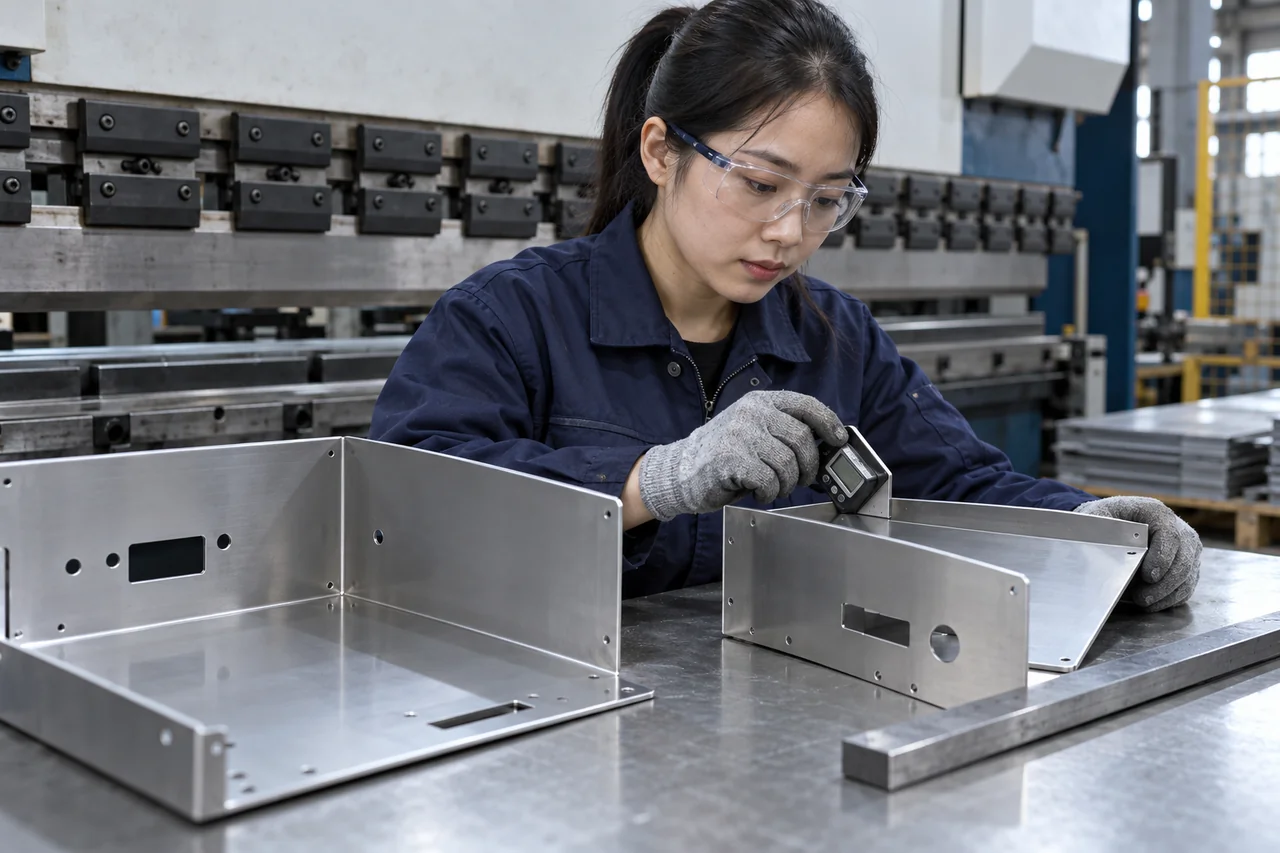
3. Bend Variation Frequently Causes Assembly Instability
Bend inconsistency is one of the most underestimated fabrication defects in OEM sheet metal projects. Even small bend angle variation can create door gap inconsistency, hardware misalignment, poor panel contact, assembly interference, and uneven gasket compression.
This becomes increasingly serious in projects involving multiple interconnected panels, enclosure doors, removable access covers, and welded cabinet structures.
Several factors influence bend repeatability, including material springback, tooling wear, bend direction relative to grain, operator setup consistency, and material thickness variation.
One common RFQ issue is over-specifying cosmetic tolerances without understanding actual manufacturing repeatability at production volume. For industrial OEM projects, functional consistency matters more than cosmetic perfection.
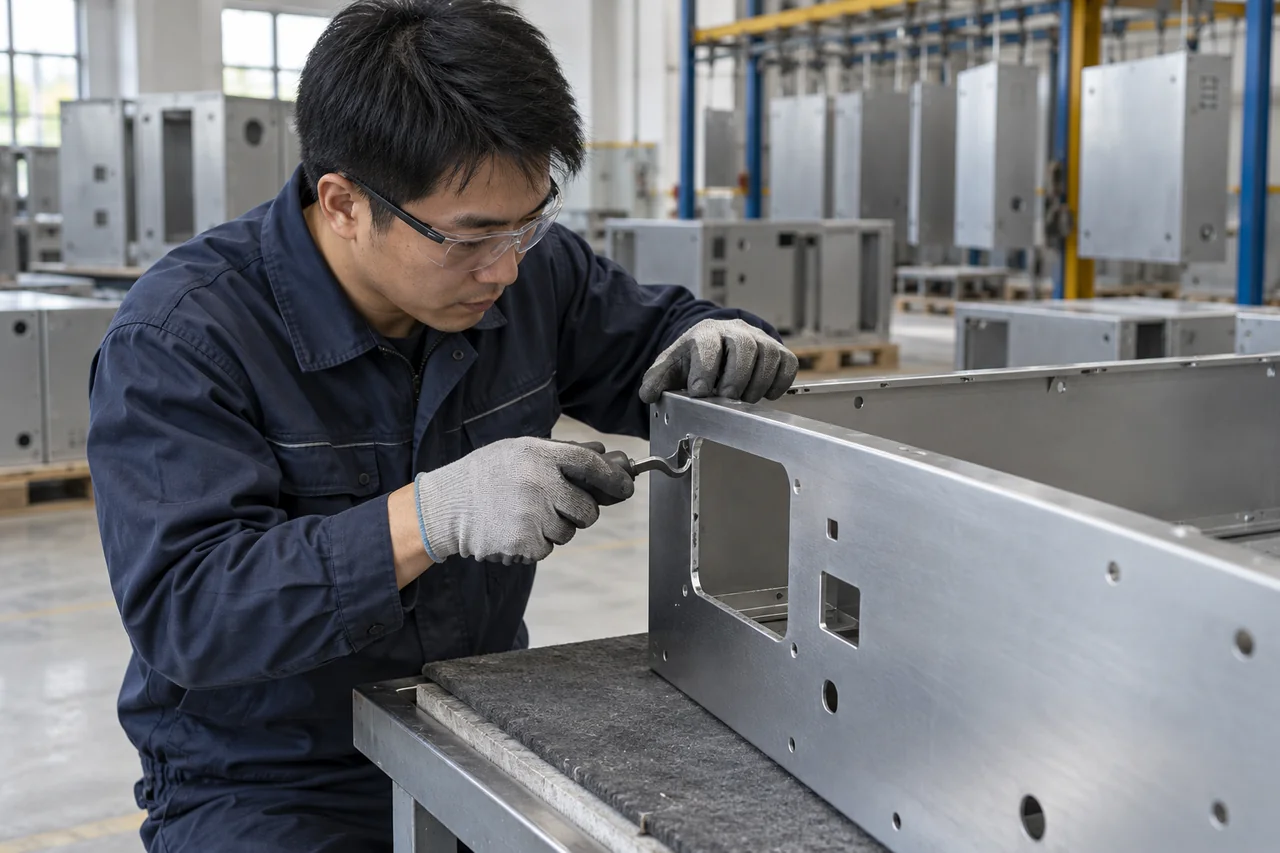
4. Powder Coating Defects Often Start Before Coating Begins
Many buyers treat powder coating defects as a finishing issue. In reality, most coating problems originate earlier during fabrication.
Common coating-related defects include edge peeling, poor adhesion, inconsistent texture, visible grinding marks, and coating thickness variation. These problems often begin because of excessive welding heat, poor surface preparation, sharp edge geometry, oil contamination, and inconsistent grinding quality.
For outdoor enclosures, powder coating failure creates long-term corrosion risk — especially around weld seams, cable entry cutouts, mounting holes, and hardware installation zones. Experienced OEM buyers evaluate coating process capability, not only coating appearance.
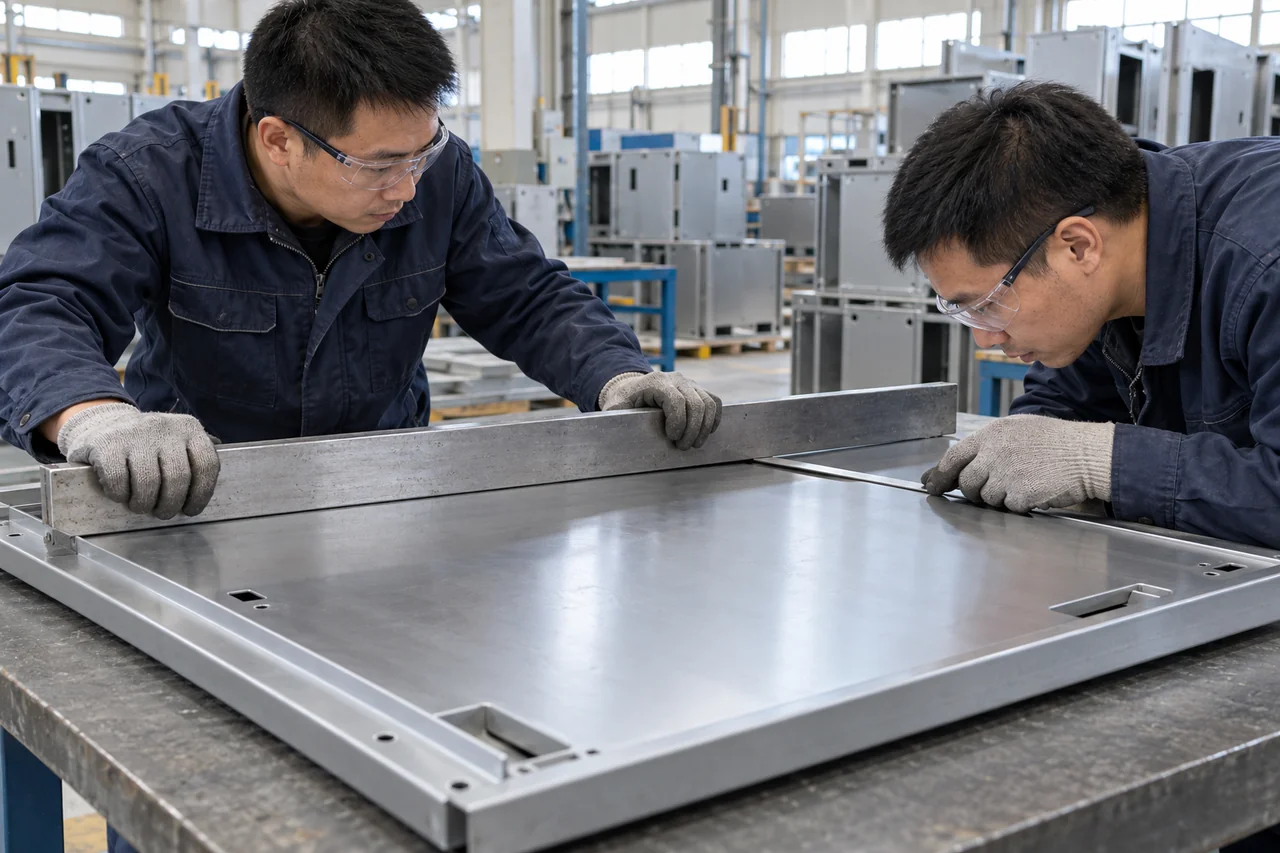
5. Flatness Problems Become Serious on Large Enclosures
Large flat sheet metal surfaces are difficult to keep perfectly stable during fabrication. This is especially true for wide enclosure doors, outdoor cabinet panels, electrical mounting plates, and welded enclosure frames.
Factors contributing to flatness defects include residual material stress, welding heat concentration, uneven grinding, improper bend reinforcement, and transportation handling. One common mistake is designing large unsupported flat panels with minimal structural folds.
These panels may appear acceptable immediately after fabrication but deform later during powder coating curing, shipment vibration, or outdoor temperature cycling. At MSTFAB, enclosure rigidity is often improved through reinforcement bends, return flanges, structural fold optimization, and balanced weld distribution before production begins.
6. Rework Cost Is Usually Higher Than Initial Manufacturing Cost
Many OEM buyers focus heavily on unit price reduction while underestimating rework risk. In reality, fabrication defects create downstream costs such as delayed production schedules, repeated assembly labor, shipping replacement cost, onsite modification, production downtime, and customer warranty claims.
One incorrectly positioned mounting hole may require drilling rework, repainting, assembly modification, and field installation adjustment.
For overseas OEM projects, these costs often exceed the original manufacturing savings from choosing the cheapest supplier.
Defect Prevention Controls and Buyer Evidence
Agree the inspection points and records in the drawing, quality plan or purchase order before production. The examples below are questions to close for each project, not blanket guarantees or certifications.
| Defect risk | Control to agree | Buyer evidence to request |
|---|---|---|
| Wrong revision or datum | Confirm the released CAD and drawing revision, critical features and measurement datums. | Revision reference on the production traveler and an agreed first-article check sheet. |
| Hole or hinge misalignment | Check critical hole positions and fit after forming and welding. | Dimensional record and fit-up photos for the specified interfaces. |
| Welding distortion | Define fixture support, weld sequence and critical flatness or door-fit checks. | First-article fit and dimensional results against the agreed drawing. |
| Bend variation | Confirm bend direction, tooling assumptions and sample acceptance points. | Sample bend-angle and flange checks where specified. |
| Finish or edge defects | Identify burr-sensitive cutouts, visible faces, masking and finish requirements. | Approved appearance sample or finish photos when specified. |
| Large-panel flatness or shipping damage | Agree flatness criteria, return-flange design and surface protection. | Flatness record and pre-shipment packing photos where required. |
Record types and acceptance criteria depend on the agreed project scope.
Why Experienced OEM Buyers Prioritize DFM Before Production
Most fabrication defects are not random factory mistakes. They are predictable manufacturability problems.
At MSTFAB, common RFQ issues include unrealistic tolerance expectations, inaccessible weld areas, excessive cosmetic requirements, poor bend sequencing, insufficient reinforcement structure, and thermal distortion risk. Many of these problems can be improved before production begins through proper DFM review.
Experienced OEM buyers increasingly prioritize process stability, manufacturability, assembly consistency, tolerance management, and long-term operational reliability instead of focusing only on quotation price.
What OEM Buyers Should Check Before Production Approval
Before approving sheet metal fabrication production, buyers should evaluate:
- Weld distortion risk
- Bend sequence feasibility
- Assembly tolerance accumulation
- Coating process capability
- Flatness reinforcement strategy
- Fixture stability
- Process repeatability
- DFM engineering support
The most expensive fabrication defect is usually the one discovered after shipment arrives.
Final Thoughts
Sheet metal fabrication defects are rarely caused by a single mistake. Most defects result from poor coordination between design, manufacturability, welding strategy, bending process, assembly planning, and finishing control.
For industrial OEM projects, stable manufacturing quality depends heavily on identifying risk before production begins.
At MSTFAB, we support OEM customers with CNC laser cutting, CNC bending, TIG & MIG welding, powder coating, enclosure assembly, DFM optimization support, and manufacturing process control for industrial enclosures, electrical cabinets, telecom systems, and OEM sheet metal fabrication projects worldwide.
Prevent defects before they happen—Contact MSTFAB today →
Related engineering resource: If your project involves EV charging infrastructure, review our custom EV charger enclosure fabrication capabilities for outdoor sheet metal cabinet design, powder coating, and export-ready manufacturing.
sheet metal welding services
MSTFAB provides TIG and MIG sheet metal welding services for structural assemblies, cabinets, frames and OEM metal components.
 WeChat Contact
 WhatsApp Me Directly