
What are the most common and costly mistakes when choosing a sheet metal fabrication supplier?
The top mistakes hardware teams make when choosing a sheet metal fabricator include: (1) selecting vendors based strictly on the lowest quoted piece price while ignoring hidden NRE and scrap costs, (2) failing to verify whether surface finishing (powder coating/plating) is in-house or outsourced to un-audited sub-tiers, (3) assuming a single prototype sample proves mass production repeatability, (4) omitting explicit GD&T hole-to-bend tolerancing on 2D prints, and (5) failing to mandate Level 3 PPAP / First Article Inspection (FAIR) with 3D CMM metrology data.
Choosing a sheet metal fabrication partner is a strategic engineering commitment. Unlike off-the-shelf standard fasteners or passive electronic components, precision sheet metal enclosures, chassis, and frames are 100% custom-tailored build-to-print assemblies. Making the wrong supplier selection leads to broken assembly line schedules, recurring non-conformance reports (NCRs), and thousands of dollars in scrapped inventory. Avoiding common procurement traps ensures seamless production launches.

The 7 Costliest Supplier Selection Pitfalls
Mistake 1: The “Piece-Price Only” Blind Spot
Fixating exclusively on the piece-price column on an RFQ sheet ignores the massive Cost of Poor Quality (COPQ). A supplier quoting USD 18 per bracket who delivers 4% defective parts, halts your assembly line for 8 hours, and demands USD 650 in crating surcharges is significantly more expensive than an all-inclusive precision fabricator quoting USD 21.
Mistake 2: Overlooking In-House Finishing Capabilities
Sheet metal fabrication is only half the battle; surface finishing (powder coating, chromate conversion, anodizing) determines corrosion protection and cosmetic customer appeal. When a fabricator outsources finishing to third-party plating shops, parts are trucked back and forth, accumulating transit scuffs, losing traceability, and adding 7 to 10 days to lead times.
Mistake 3: Believing the “Golden Sample” Illusion
A supplier can easily hand-craft two flawless prototype brackets using veteran toolmakers, manual file adjustments, and custom bend tapping. However, prototypes do not prove volume machine repeatability. Qualification must evaluate a 30-to-50-piece production trial lot produced on automated CNC machinery with demonstrated process capability (Cpk ≥ 1.33).
Mistake 4: Skipping the On-Site or Evidence-Based Factory Audit
Relying on a PDF copy of an ISO 9001 certificate is insufficient. Auditing actual floor evidence – machine calibration stickers, press brake tooling organization, raw coil heat-lot traceability, and temperature-controlled CMM labs – reveals whether a fabricator operates with true quality rigor.
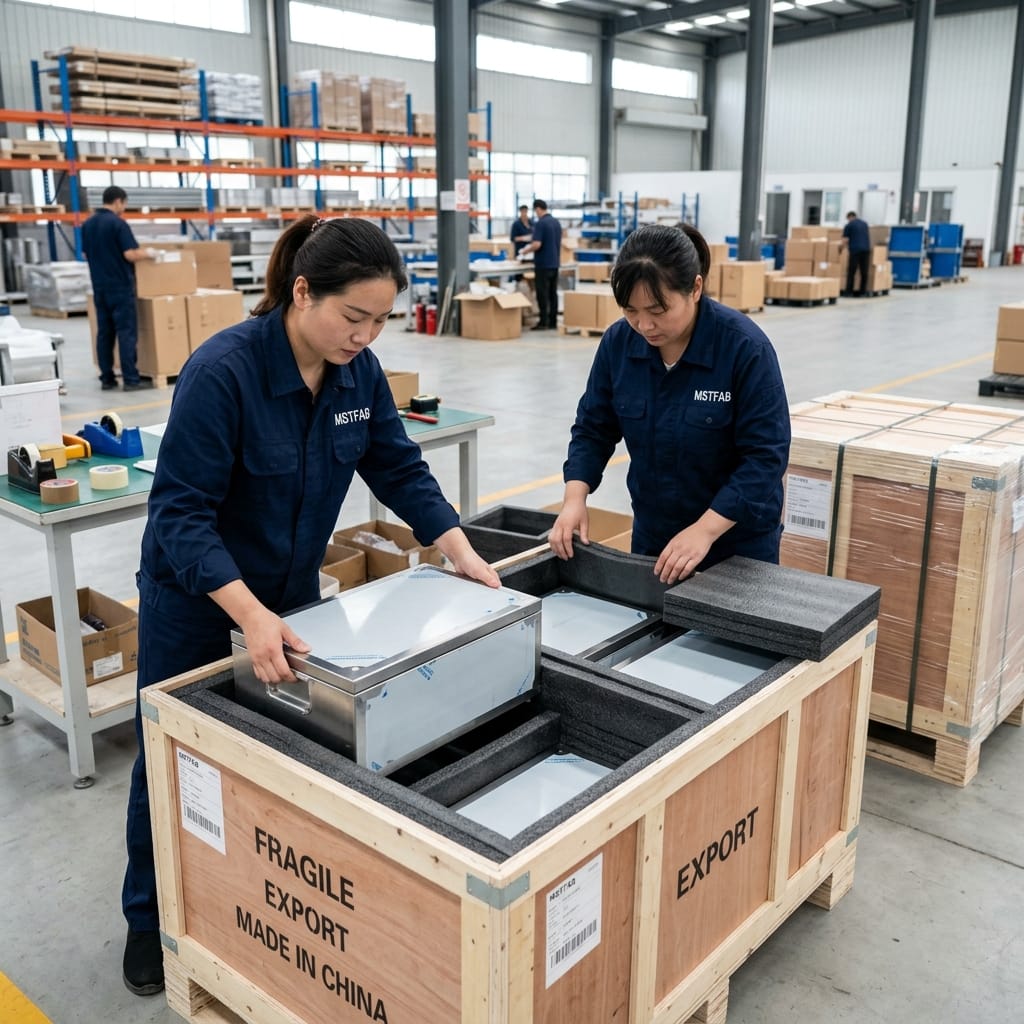
Mistake 5: Neglecting Packaging Specifications
Assuming that a supplier knows how to pack precision parts for international transit is a recipe for disaster. Heavy sheet metal enclosures packed into flimsy cardboard boxes will dent, scratch, and break through container walls during maritime freight. Explicit export packaging standards (ISPM-15 plywood crates, foam corner blocks, and desiccant packs) must be pre-negotiated.
Supplier Selection Mistakes vs. Best Practice Matrix
The table below summarizes common sourcing errors and the corresponding engineering-led best practices:
| Common Sourcing Mistake | Downstream Manufacturing Consequence | Best Practice Sourcing Standard | Verification Deliverable |
|---|---|---|---|
| 1. Piece-Price Fixation | Hidden NRE setups, sorting labor, high COPQ | Evaluate Total Cost of Ownership (TCO) | All-inclusive quotation audit |
| 2. Unverified Sub-Tier Coating | Paint flaking, orange peel, 10-day lead delay | Demand in-house automated finishing lines | Pre-treatment titration logs & gloss tests |
| 3. Golden Sample Trust | Volume production dimensional drift | Mandate 50-piece production trial lot | Level 3 PPAP / FAIR with CMM data |
| 4. Omission of GD&T Callouts | Hole misalignment on final assembly backplanes | Define functional datums and true position | Controlled 2D drawings with GD&T frames |
| 5. Undefined Crating Rules | Bent corners, surface scratches, moisture corrosion | Enforce ISPM-15 plywood crates with EPE foam | Packaging specification sign-off |
Avoid Supplier Pitfalls & Partner With MSTFAB
MSTFAB eliminates supplier selection risks by providing transparent all-inclusive quotations, automated in-house fiber laser and press brake capacity, in-house Class A powder coating, and full CMM First Article verification. Contact our engineering team today to review your project specifications.
 WeChat Contact
 WhatsApp Me Directly