China battery storage enclosure sourcing guide / OEM buyer scorecard
Quick answer: a public list of the top 5 battery storage enclosure manufacturers in China is not something a serious buyer should copy into a sourcing decision. BESS enclosure projects vary by cabinet size, structural load, outdoor exposure, material grade, thermal-interface design, sealing target, cable-entry plan, pressure-relief interface, inspection evidence and export packaging. This guide gives OEM buyers a practical scorecard for building their own defensible shortlist, then shows what a paid trial order should prove before any production purchase order.
Scope boundary
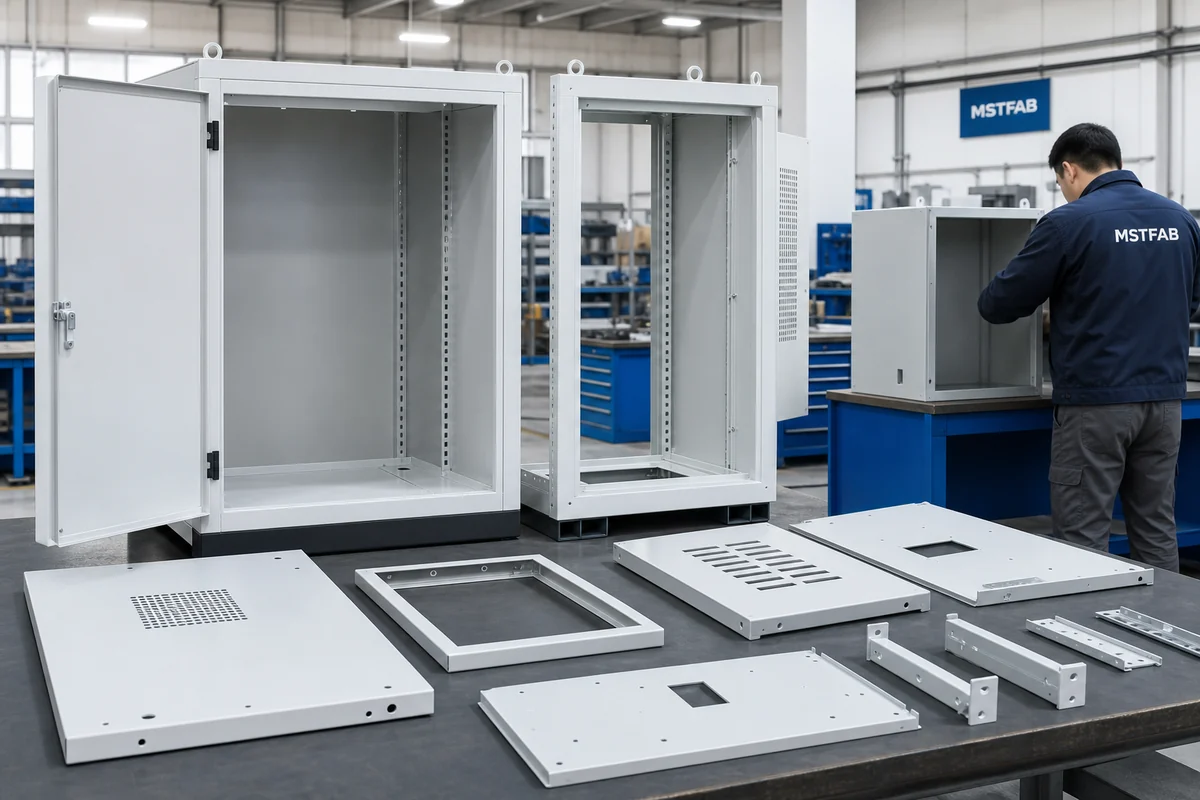
What MSTFAB can support, and what remains with the BESS OEM
MSTFAB fabricates empty battery storage enclosure shells and mechanical sheet metal parts from buyer drawings. Typical work includes laser-cut cabinet panels, CNC-bent doors, welded base frames, plinths, gasket flanges, rain lips, vent-panel openings, cable-entry plates, mounting plates, bracket rails, grounding tabs, powder coating, dimensional inspection and export packaging.
MSTFAB does not supply complete battery energy storage systems, lithium cells, battery modules, BMS, PCS, inverters, wiring, fire suppression systems, coolant hardware, energized testing or final product certification. The buyer, BESS OEM, system integrator or approved test lab remains responsible for battery safety architecture, thermal-runaway validation, electrical design, final ingress testing, EMC testing, transportation compliance and market approvals for the complete assembled system.
- Empty BESS cabinet shells and outdoor enclosure bodies
- Doors, side panels, covers, gland plates and vent panels
- Laser-cut openings, slots, holes and cable-entry plates
- CNC-bent sealing flanges, rain lips and reinforcement brackets
- Welded bases, plinths, frames and anti-racking structures
- Grounding tabs, studs and masked contact areas when specified
- Powder coating, masking, visual checks and basic hardware installation
- First-article dimensional inspection and export packing
- Cells, modules, racks, BMS, PCS and inverter systems
- Electrical wiring, energized assembly and functional testing
- Fire suppression, sensors, coolant loops and live safety systems
- Thermal propagation design and approved safety validation
- UL 9540A, IEC 62619, IEC 63056, CE, EMC or UN38.3 test programs
- Final gasket, vent, cable gland and field installation validation
- Complete system grounding, insulation and transportation approvals
- Regulatory approvals for the finished energy storage system
Why a BESS enclosure shortlist needs its own lens
A battery storage enclosure is not a simple metal box with a larger invoice. The finished energy storage system may contain high-power DC components, heavy modules, thermal-control hardware, safety sensors, cable entries, outdoor sealing and service access requirements. The empty sheet metal shell does not make the system compliant by itself, but poor shell fabrication can make the buyer’s safety and assembly plan harder to execute.
That is why the shortlist should not be built from catalog photos alone. A supplier may show a nice outdoor cabinet and still fail on frame squareness, sealing flange flatness, vent-panel geometry, cable-entry reinforcement, material traceability, coating masking or export packaging. In buyer language, the risky part is not the word “cabinet.” The risky part is the detail that nobody measured until the sample arrived.
Why China is worth shortlisting, but still needs verification
China is a major manufacturing base for energy storage equipment, power electronics and custom sheet metal enclosures. For overseas OEM buyers, the practical advantages are real: sheet metal supply, fiber laser cutting, press brake forming, welding, PEM hardware, powder coating, gasket suppliers, inspection teams and export packing can be coordinated efficiently when the supplier is a real manufacturer.
The risk is also real. A trading company can look polished online. A general metal shop can claim “battery cabinet” experience while treating the vent path, material grade and first-article report as optional. A low price can hide weak welding control, hidden subcontracting, missing material records, poor coating prep or packaging that protects the quote better than the cabinet. The fix is simple: verify the factory, define the evidence and run a paid trial order before scale.
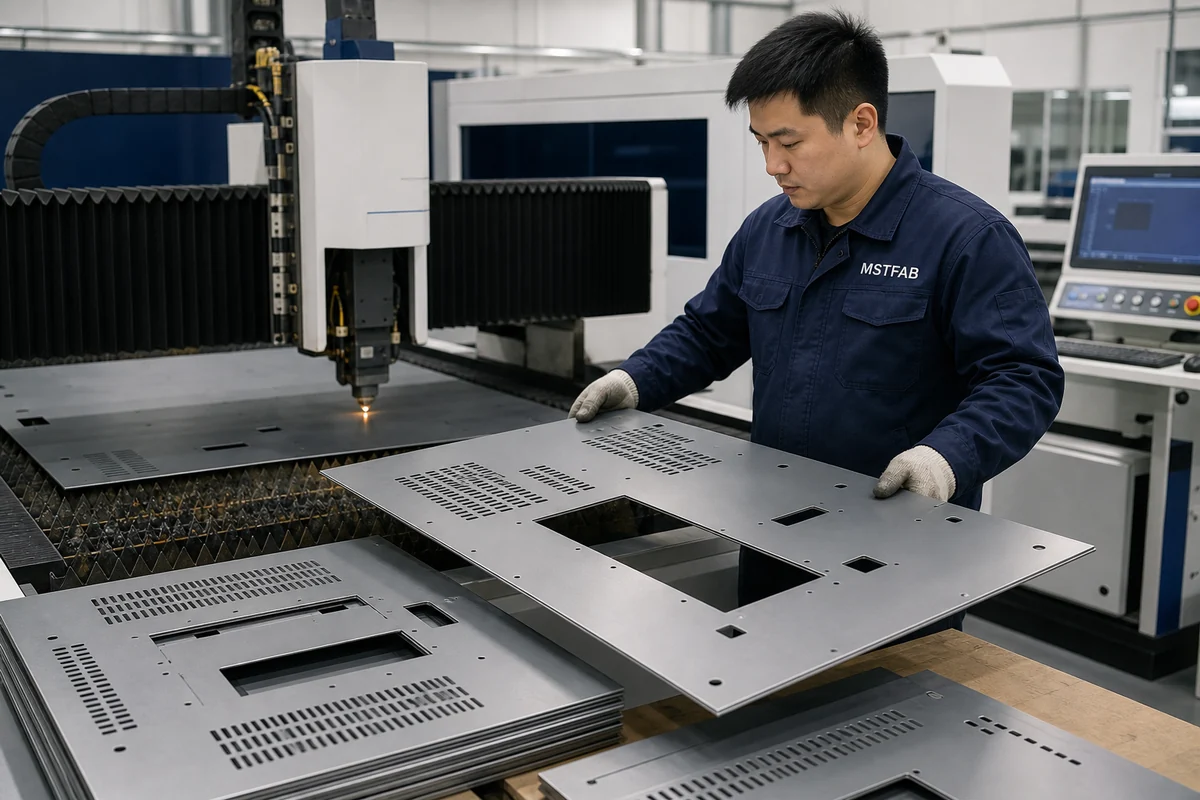
For the cutting stage behind BESS panels, vent openings and gland plates, review MSTFAB’s laser cutting services. The useful question is not only whether the laser can cut the shape, but whether the features still align after bending, welding, coating and assembly.
The seven dimensions that actually rank a battery storage enclosure maker
Use the scorecard below to build your own shortlist. Score each dimension from 1 to 5. Dimension 1, Dimension 2, Dimension 4 and Dimension 6 are hard gates. If a supplier fails one of those, the price can look friendly and still be the wrong decision. A cheap enclosure that blocks assembly is just a calendar problem wearing a discount.
| Dimension | Weight | What to verify | Pass or fail signal |
|---|---|---|---|
| D1 Real factory identity and BESS shell evidence | Gate | Owned cutting, bending, welding, hardware, inspection and packing workflow; similar empty battery cabinet shell projects | Fail if the supplier cannot prove it actually fabricates the metal shells it quotes |
| D2 Safety-interface discipline | Gate | Buyer-defined separation panels, vent openings, grounding tabs, masked faces, cable plates and mechanical interfaces for the approved safety design | Fail if the supplier treats safety-related interfaces as generic cutouts |
| D3 BESS-specific fabrication capability | 20% | Heavy-gauge cutting, long bends, welded frames, plinths, rails, gasket flanges, flat mounting faces and distortion control | Fail if the shop can only show light indoor cabinets |
| D4 Material certification, PMI and corrosion fit | Gate | Material grade, thickness, heat or batch traceability, PMI checks where required, pretreatment, coating and outdoor exposure fit | Fail if the supplier cannot provide material evidence for the quoted grade |
| D5 Sealing, vent and cable-entry control | 15% | Door gap, gasket channel, rain lip, vent-panel opening, gland plate, cable strain-relief interface and masked contact areas | Fail if outdoor sealing is quoted without interface discussion |
| D6 Quality evidence and certification boundary | Gate | First-article report, critical dimensions, coating checks, packing photos and buyer-controlled test support | Fail if the supplier refuses drawing-based inspection evidence or overclaims system certification |
| D7 Commercial clarity and export logistics | 25% | Price breakdown, lead time, volume breaks, change control, Incoterms, packing method and communication quality | Fail if the quote is cheap because everything important is undefined |
D1: verify a real battery storage enclosure fabricator
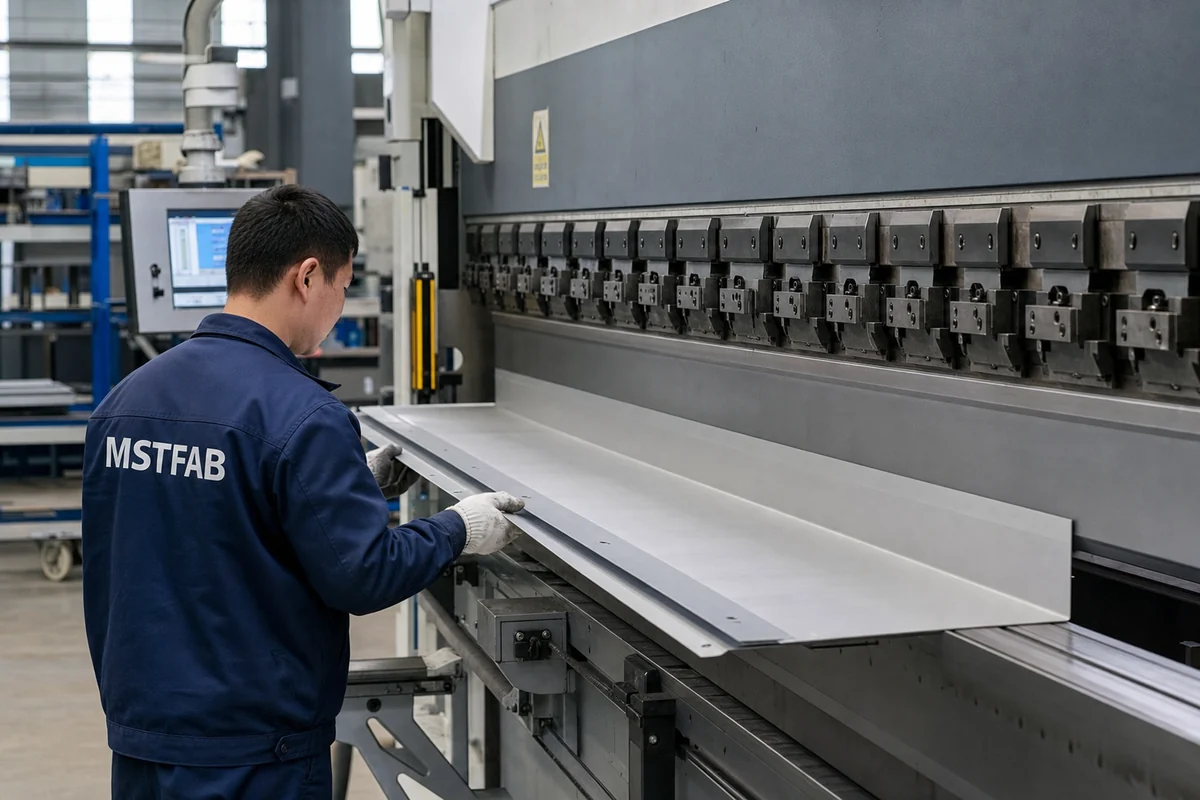
Start with the factory floor. Ask for a live video walk through sheet storage, laser cutting, CNC bending, welding fixtures, hardware installation, coating preparation or coating partners, inspection benches and packing. For large BESS enclosure shells, look for welded bases, plinths, lifting points, long panels, door assemblies, vent-panel openings and frame structures in progress. If the supplier can only send glossy finished-system photos, the evidence is thin.
A real fabricator should ask about material, thickness, bend sequence, weld sequence, cosmetic faces, flatness, gasket path, vent-panel scope, cable-entry hardware, grounding tabs, masked coating areas, critical dimensions and packaging. Those questions may slow the first quotation by a day. They can save weeks later. Silence is fast, but it is not always efficient.
D2: treat safety-interface discipline as a hard gate
The finished battery energy storage system has safety requirements that belong to the BESS OEM, integrator and approved test lab. MSTFAB does not validate thermal propagation, approve fire-safety architecture or certify the finished system. What a sheet metal supplier can do is fabricate the mechanical features that support the buyer’s approved design: separation panels, removable covers, vent openings, pressure-relief interfaces, grounding studs, masked contact faces, cable plates, plinths and service access panels.
The supplier should understand which features are ordinary dimensions and which features protect the buyer’s safety plan. A vent opening in the wrong place may interfere with the approved path. A warped mounting face may hurt module or cold-plate fit. Powder coating over a contact face may break the intended bonding path. A bracket moved for easier welding may create an assembly problem nobody wanted to meet. The drawing should define the requirement, and the fabricator should show how it will control it.
D3: score BESS fabrication capability, not cabinet vocabulary
BESS cabinets often use heavier-gauge panels, welded bases, structural rails, lifting features, large doors, removable side panels and plinth structures. This is different from a small indoor control box. Long bends can drift. Welded frames can rack. Large cutouts can distort. Powder-coated panels can scratch during handling. A supplier should have a process route for these risks, not just a cheerful answer.
Ask how the supplier controls bend sequence, weld fixture setup, diagonal measurement, door fit, base flatness, hole-position drift after welding, and assembly order after coating. If the enclosure uses thermal interface plates or flat mounting faces, ask how flatness will be checked. If the cabinet ships as a knock-down kit, ask how part labels and hardware bags will be controlled. The boring questions are the ones that keep the assembly line boring in the best possible way.
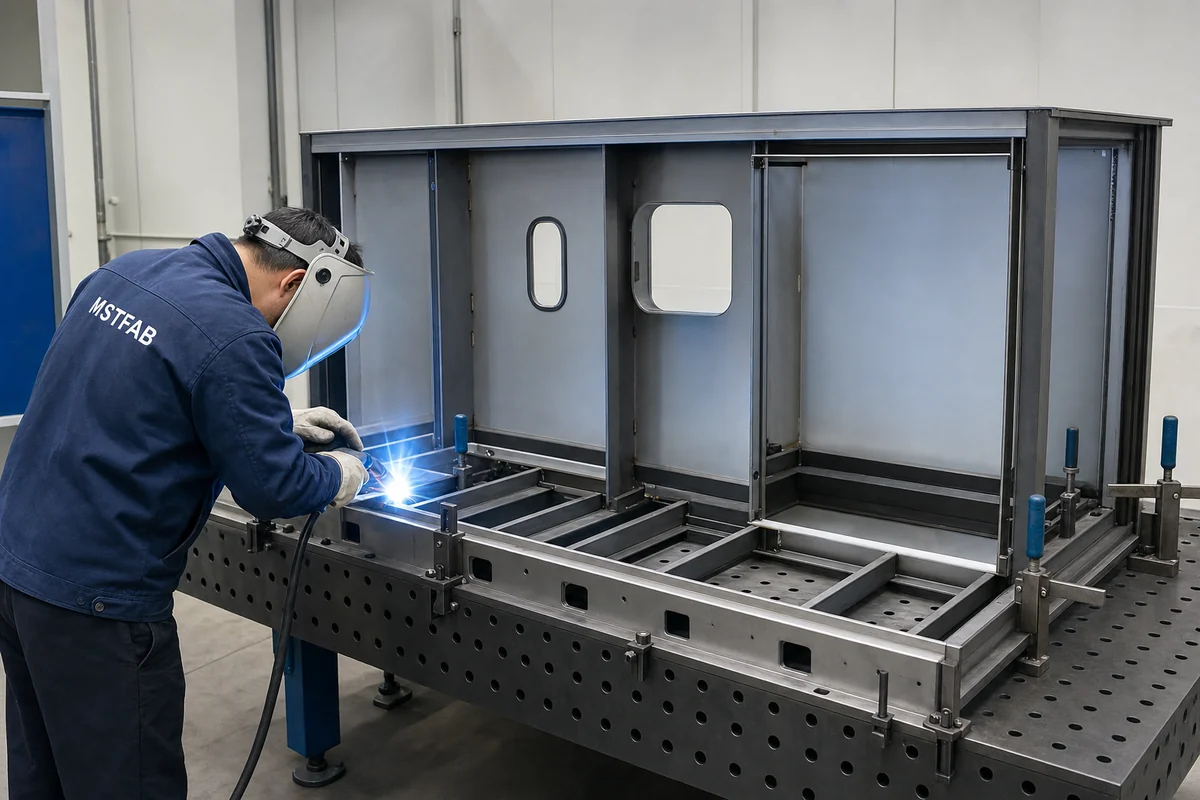
For structural frames, bases and rails, review MSTFAB’s welding services and sheet metal bending capability pages.
D4: material certification and PMI are hard gates
Outdoor battery storage enclosures may use powder-coated carbon steel, galvanized steel, stainless steel or aluminum, depending on site exposure, weight, corrosion requirement and budget. The right choice belongs in the buyer’s specification. The supplier’s job is to quote the specified grade honestly and provide material evidence when required.
For stainless steel and aluminum projects, ask for material certificates and PMI checks where the project requires them. For coated carbon steel, define thickness, pretreatment, powder type, film thickness, edge coverage and salt-spray expectation. For coastal or industrial sites, do not treat “painted steel” as a complete corrosion plan. It is a starting point, not a guarantee. The ocean is a very patient inspector.

Use MSTFAB’s sheet metal material guide when comparing stainless steel, aluminum, galvanized steel and cold rolled steel for enclosure shells.
D5: sealing, vent and cable-entry control decide outdoor behavior
Ingress and ventilation details should be evaluated as mechanical interfaces, not decoration. A battery storage cabinet may include gasket channels, rain lips, filtered vent panels, pressure-relief openings, gland plates, drain-sensitive areas, fastener penetrations and removable service covers. The buyer owns the final tested configuration; the sheet metal supplier must make the specified geometry repeatable.
For a serious RFQ, define the door gap, gasket channel width, flange flatness, vent-panel hole pattern, cable-entry plate thickness, gland opening tolerance, masking zones, hardware scope and inspection method. If the supplier cannot explain how these features will be checked before shipment, the project is not ready for batch production. Nobody wants to discover a sealing problem after the cabinet is already full of expensive equipment.
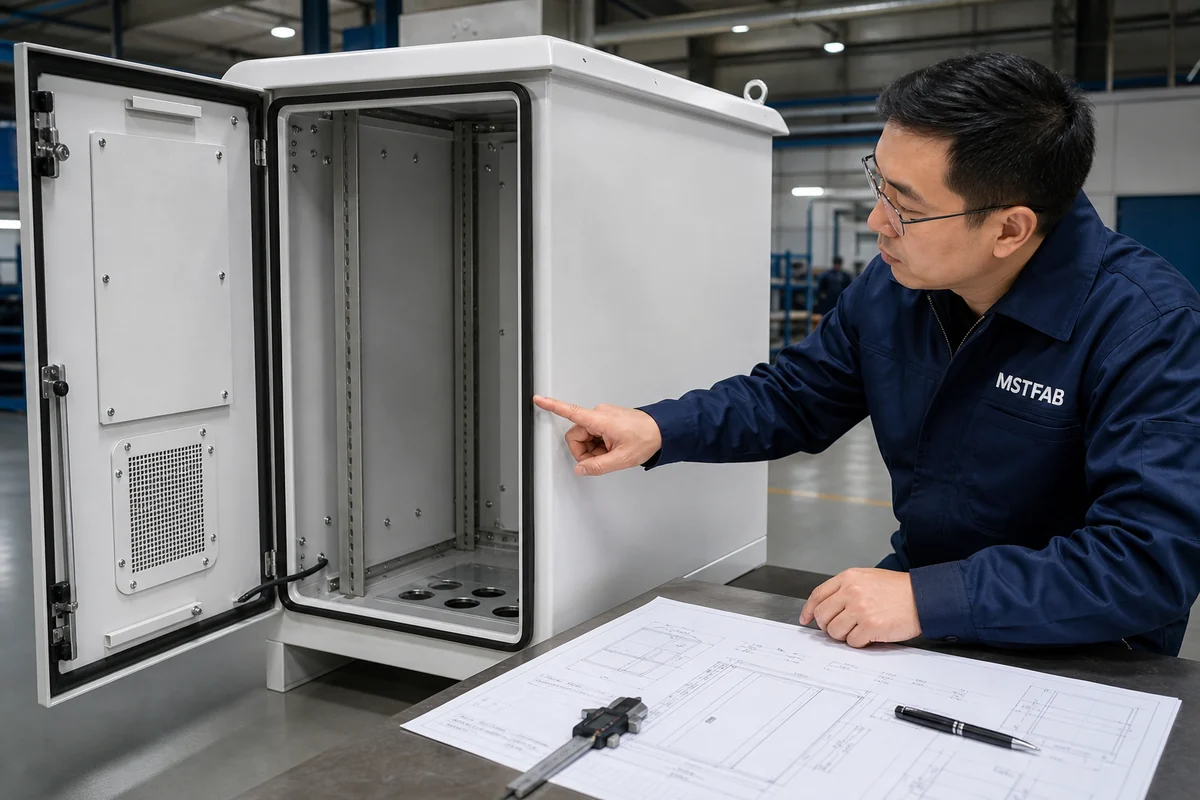
For outdoor finish and masking requirements, see MSTFAB’s surface treatment page.
D6: quality evidence and certification boundary must be clear
A battery storage enclosure supplier should provide evidence for what it controls: material, fabrication, welding, dimensions, coating, masking, hardware installation if included and packaging. It should not claim to certify the complete BESS if it is only fabricating empty sheet metal shells. That boundary protects the buyer and the supplier.
A useful first article inspection report should cover critical dimensions: overall size, base flatness, frame squareness, door gap, hinge location, latch location, gasket flange, vent-panel openings, cable-entry plates, rail positions, bracket locations, hole patterns and cosmetic faces. For buyer-controlled validation, the metal sample can support IP, EMC, transportation, thermal or safety testing, but the test owner should be clearly defined.

D7: commercial clarity and export logistics are part of the ranking
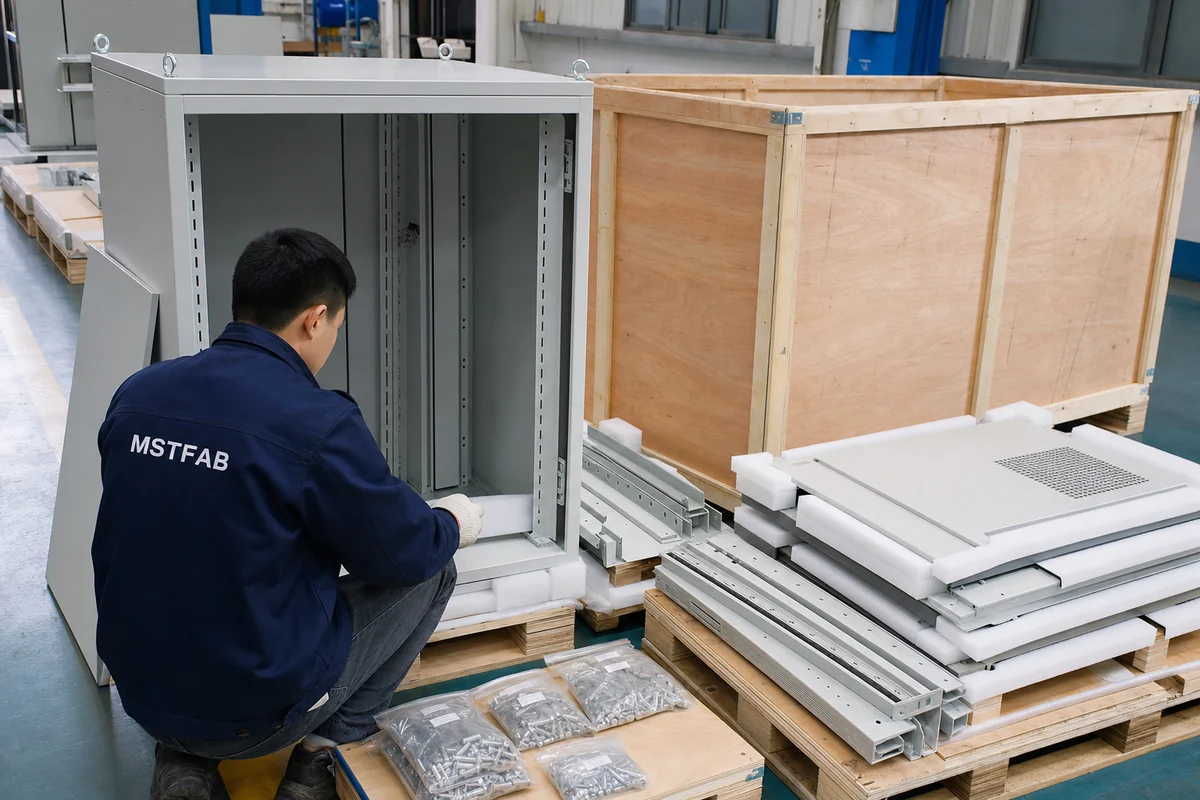
BESS cabinet shells can be large, heavy and easy to damage at door edges, gasket surfaces and painted panels. Export packaging is not an afterthought. It protects the value created by cutting, bending, welding, finishing and inspection. If the package list is vague, the quote is still unfinished.
Ask for a price breakdown by material, fabrication, welding, hardware, finishing, inspection, packaging and freight term. Confirm prototype lead time, first article approval timing, batch lead time, change-control rules, Incoterms, crate dimensions, gross weight, moisture protection, foam placement, hardware bag labels and receiving inspection support. A good supplier treats shipping evidence as part of manufacturing evidence.
Evidence table for a BESS enclosure trial order
| Evidence to request | Why it matters | Who should own it | When to request it |
|---|---|---|---|
| Factory video audit or visit photos | Confirms the supplier has real cutting, forming, welding, inspection and packing capability | Buyer sourcing team and supplier | Before shortlist approval |
| DFM review notes | Shows risks around long bends, weld distortion, sealing flanges, vent panels, cable entries and coating | MSTFAB engineering and buyer engineer | Before quotation or purchase order |
| Material certificate and PMI record where required | Confirms material grade, thickness and traceability for the quoted enclosure shell | Supplier purchasing and quality team | Before or during first article |
| First article dimensional report | Verifies critical geometry, flatness, door fit, bracket positions and mounting datums | Supplier quality team | Before batch release |
| Coating and masking record | Protects color, texture, film thickness, threads, gasket faces and bonding contact areas | Supplier finishing and quality team | Before sample shipment |
| Buyer-directed safety, ingress or transportation test | Validates the complete assembled BESS configuration against the buyer’s market requirement | Buyer, system integrator or approved lab | Before volume production |
| Packing photos and package list | Confirms enclosure shells, doors, panels, rails, brackets and hardware are protected for international transport | Supplier shipping team | Before every first shipment and batch shipment |
For stronger procurement evidence, define a dimensional inspection report, use first article inspection for trial approval, and confirm export packaging before the enclosure leaves the factory.
How the top five would sort themselves in real sourcing
If you run this scorecard on eight to ten suppliers, they usually fall into three groups. The first group is real enclosure specialists with cutting, bending, welding, finishing control, inspection evidence and export packing. They may not be the cheapest, but they usually ask the questions that prevent rework. The second group is capable metal fabricators moving into energy storage shells. They can be useful when the buyer owns the system design and gives clear drawings, but they need stronger evidence around BESS-specific interfaces. The third group is trading companies. They may communicate well, but unless they disclose and qualify the actual factory, they should not pass the real-maker gate.
Your own top five should be the suppliers that clear every hard gate and score highest on safety-interface discipline, material evidence, quality records and export execution. That list will be more useful than a public ranking because it is built around your cabinet, your market and your risk tolerance.
The trial-order gate: the real ranker
A paid trial order should represent the real enclosure geometry, not a tiny souvenir part. Send the same drawing pack to the strongest candidates. Include STEP files, 2D drawings, material grade, thickness, finish, critical dimensions, gasket path, vent-panel scope, cable-entry details, hardware scope, inspection plan, expected annual volume, target market and packaging requirements.
The trial package should include the finished empty enclosure shell or representative section, stage photos, material evidence, PMI record if required, first-article dimensional report, coating and masking photos, door and panel fit evidence, weld and flatness checks, hardware installation record if in scope and export packing photos. If the project requires UL 9540A, IEC 62619, IEC 63056, CE, EMC, UN38.3 or other final validation, define the complete test sample and responsible test owner separately. The sheet metal fabricator can support the mechanical sample. The finished system validation belongs to the product owner.
Red flags that remove a supplier from the shortlist
Eight-step workflow to build your own top five
- Define the enclosure type. Separate indoor cabinet, outdoor cabinet, container-style structure, wall-mount unit or rack enclosure.
- Freeze the fabrication scope. Separate empty metal shell, purchased hardware, batteries, electronics, thermal equipment and final certification ownership.
- Build a long list. Search for BESS enclosure shell fabricators, battery cabinet metalwork suppliers and sheet metal enclosure factories with relevant evidence.
- Verify real makers. Use video audits, factory photos, machine lists and sample records to remove traders or shops without enclosure-shell capability.
- Score the seven dimensions. Treat real factory evidence, safety-interface discipline, material traceability and quality records as hard gates.
- Send a complete RFQ. Include STEP, 2D PDF, material, finish, critical features, hardware scope, inspection plan and packing requirements.
- Run a paid trial order. Compare the same geometry, evidence package, response quality, packaging and landed cost.
- Rank and rescore. Select suppliers for your project and rescore after design changes, new markets or volume changes.
What MSTFAB can manufacture for battery storage enclosure projects
MSTFAB supports drawing-based sheet metal fabrication for battery storage enclosure shells, BESS cabinet bodies, outdoor cabinet doors, side panels, vent panels, gland plates, base frames, plinths, internal rails, bracket sets, grounding tabs, welded structures and powder-coated sheet metal parts. We work from buyer CAD files and drawings, then review manufacturability before prototype or batch production.
For commercial battery enclosure projects, review battery storage enclosure fabrication, battery storage cabinet fabrication, outdoor energy storage cabinet fabrication and BESS cabinet enclosure procurement checklist. For the core fabrication route, see sheet metal fabrication, laser cutting services, welding services and surface treatment.
Key takeaways
- A useful top five is built from project evidence, not copied from a generic supplier list.
- Battery storage enclosure suppliers should be judged on real empty-shell fabrication evidence, safety-interface discipline, structural capability, material traceability, inspection records and export packing.
- MSTFAB supplies drawing-defined metalwork only: empty battery storage enclosure shells and mechanical sheet metal parts, not complete BESS systems or energized electrical equipment.
- The best ranking method is a paid trial order with first-article inspection, material evidence and buyer-defined final validation scope.
- Clear scope saves money. It also prevents the classic procurement headache: everyone assumed someone else owned the difficult detail.
Related fabrication resources
FAQ
Can you name the actual top 5 battery storage enclosure manufacturers in China?
No. A universal list would be more confident than useful. The right suppliers depend on cabinet size, structural load, site exposure, material, finish, safety-interface design, inspection scope, target market and export packaging. Use this scorecard to build a top five that fits your project.
What should I check before shortlisting a BESS enclosure supplier?
Verify that the supplier is a real sheet metal manufacturer, has empty battery cabinet shell experience, can follow buyer-defined safety-interface details, provides material evidence where required, and will issue first-article dimensional records before batch production.
Does MSTFAB make complete battery energy storage systems?
No. MSTFAB fabricates empty battery storage enclosure shells and mechanical sheet metal parts from buyer drawings. We do not supply lithium cells, battery modules, BMS, PCS, inverters, wiring, fire suppression systems, coolant hardware, energized testing or final product certification.
Can an empty battery enclosure shell be called UL 9540A or IEC 62619 certified?
Not by itself. Those requirements relate to tested cells, modules, systems or defined assemblies. MSTFAB can fabricate sheet metal features that support the buyer’s approved test sample, while the buyer, integrator or approved lab owns final safety validation and certification scope.
What evidence should a battery storage enclosure trial order include?
Useful evidence includes stage photos, material and thickness record, PMI record where required, first-article dimensional report, door and panel fit photos, coating and masking record, weld and flatness checks, and export packing photos.
Can MSTFAB support battery storage enclosure projects for Europe and North America?
Yes, MSTFAB can support export-focused sheet metal fabrication for battery storage enclosure shells and related metal parts. Buyers should provide drawings, material, finish, quantity, inspection requirements, packaging needs and any buyer-controlled test or certification requirements.
Battery enclosure RFQ review
Need a drawing-defined battery storage enclosure shell supplier?
Send your STEP file, 2D drawing, material, thickness, finish, cabinet size, vent-panel details, cable-entry requirements, grounding-interface requirements, inspection plan and packaging notes. MSTFAB will review the sheet metal fabrication route and quote the empty enclosure shell scope clearly, without pretending to be your battery, BMS, PCS, fire-suppression or certification department.
 WeChat Contact
 WhatsApp Me Directly