BUYER GUIDE – EMPTY OUTDOOR ENERGY CABINET METALWORK
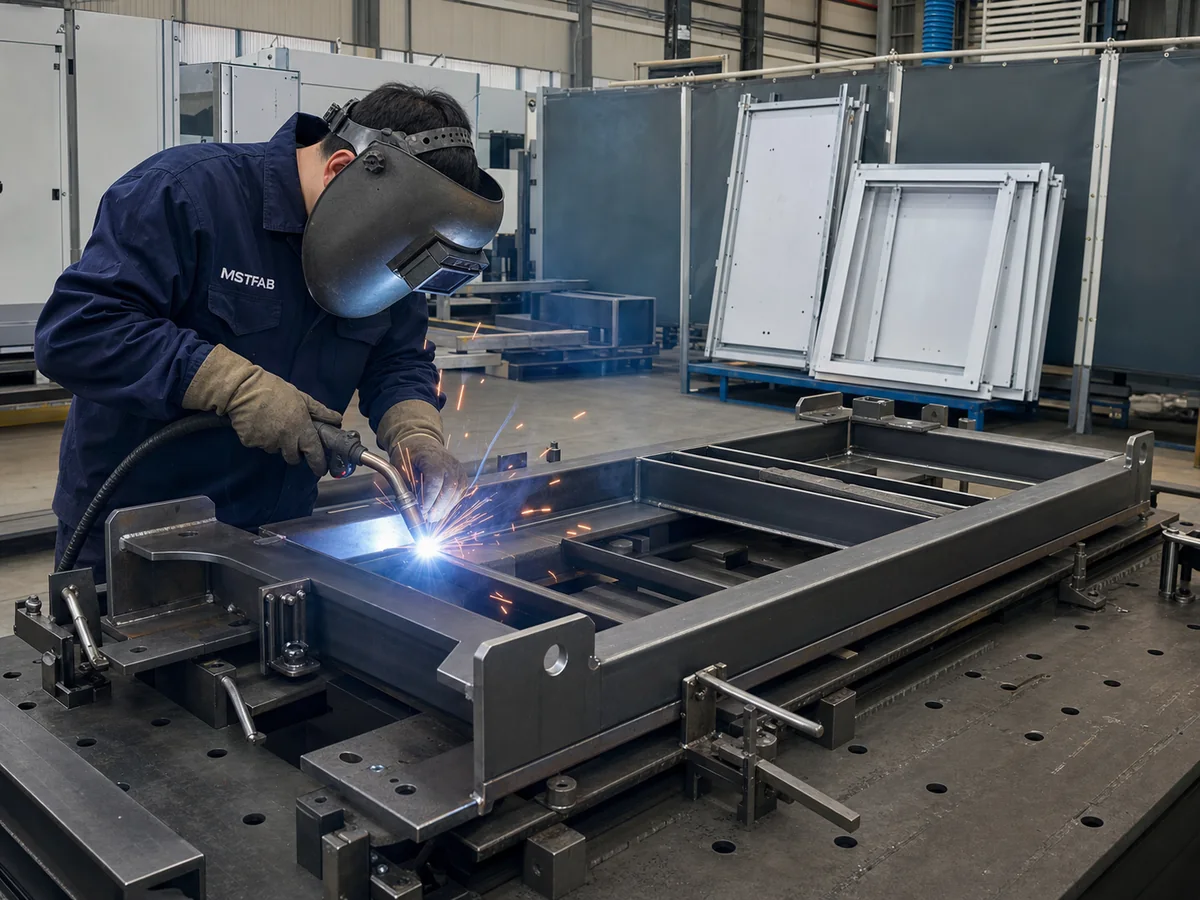
An outdoor energy cabinet drawing must coordinate doors, panels, equipment openings, mounting plates and a reinforced base before any battery or electrical hardware arrives. MSTFAB fabricates the empty sheet metal cabinet shells, doors, rain hoods, louver panels, mounting plates, cutout frames, bases and brackets to customer drawings.
This article covers five drawing checks that reduce metalwork rework. It does not promise a completed energy storage system, because a powder-coated box with no batteries is still, rather decisively, a box.

Empty outdoor energy cabinet parts MSTFAB can fabricate
Cabinet shells and doors
Drawing-built empty outer shells, front or rear doors, side panels, roof panels and removable service covers.
Mounting plates and frames
Empty internal mounting plates, structural rails, support frames and brackets for customer-installed equipment.
Weather-interface metalwork
Rain hoods, louver panels, gland plates, door returns and customer-defined gasket channels without HVAC or electrical components.
Reinforced bases and brackets
Base frames, anchor plates, lifting-point metalwork and reinforcements fabricated to customer-engineered loads and drawings.

Check 1: define every equipment interface on the drawing
HVAC, fan, gland, cable and service openings affect bends, stiffeners and panel strength. MSTFAB can cut the openings and fabricate the surrounding metalwork, but the customer must define their size, location, clearance and sealing concept.
| Customer input | Why it matters to fabrication | MSTFAB review |
|---|---|---|
| Cutout size and datum | Prevents openings from colliding with bends, doors or reinforcements. | Feature position, edge distance, forming clearance and inspection method. |
| Mounting-hole pattern | Controls fit with customer-installed HVAC, glands or equipment. | Hole size, spacing, hardware and access for installation. |
| Service clearance | Determines whether panels and doors can be removed or opened. | Mechanical interference and tool-access review. |
| Sealing interface | Defines the flat metal surface available for the customer’s gasket or unit. | Flange geometry, weld dressing and coating or masking notes. |

Check 2: separate cabinet fabrication from thermal design
MSTFAB can laser cut louver patterns, fan openings and HVAC cutout frames to the approved drawing. The customer or system integrator selects the cooling equipment, performs heat calculations and validates the completed system. That division of responsibility keeps a sheet metal RFQ honest and prevents an attractive enclosure from being mistaken for a thermal engineering report.
Check 3: make door and gasket geometry measurable
A customer-defined ingress target depends on the completed assembly, gasket, locks, cable entries, field installation and testing. MSTFAB can fabricate the metal sealing surfaces and door geometry, but it does not certify a completed IP rating unless a separate agreed test is performed on the final configured product.

Check 4: engineer the base, loads and lifting points before quotation
The cabinet fabricator should not invent the load case. The customer engineer must define equipment mass, center of gravity, anchoring, handling loads, lifting method, material and acceptance criteria. MSTFAB then reviews whether the specified sheet metal route, bends, reinforcements and weld access are manufacturable.
| Structural input | Customer responsibility | MSTFAB responsibility |
|---|---|---|
| Base and anchor loads | Define loads, safety factors and validation method. | Fabricate the approved base geometry and inspect agreed dimensions. |
| Lifting interfaces | Engineer lifting points and completed-system lifting plan. | Fabricate plates, brackets and welds to the controlled drawing. |
| Equipment mounting | Define equipment weight, pattern and interface requirements. | Produce empty mounting plates, rails and brackets to drawing. |
| Field installation | Validate foundation, anchoring and completed installation. | Protect fabricated parts and provide agreed records for shipment. |
Check 5: specify finish, masking, inspection and packing
Outdoor durability cannot be reduced to a color chip. The RFQ should identify material, installation environment, corrosion target, finish standard, color, texture, masking, visible surfaces and any required sample or test. MSTFAB reviews the manufacturing route; the customer confirms that the selected system is suitable for the application.
Related capabilities include laser cutting services, sheet metal bending, welding services and surface treatment.
Manufacturing evidence buyers can request
| Buyer concern | MSTFAB control | Evidence when agreed |
|---|---|---|
| Cutouts do not match equipment interfaces | Datum-based inspection of drawing-defined openings. | Key-dimension report or first-article record. |
| Door or panel does not fit | Bend sequence, fixture, door-gap and squareness checks. | Fit photos and agreed dimensional results. |
| Coating blocks hardware or gasket faces | Drawing-defined masking and finish review. | Finish sample, coating check or masking photos. |
| Reinforced base differs from drawing | Controlled material, weld and dimensional inspection. | Material record and specified dimensional checks. |
| Coated parts arrive damaged | Protective film, foam separation, edge guards and crates. | Pre-shipment packing photos on request. |

What MSTFAB inspection does not certify
Metalwork inspection can verify the empty shell dimensions, cutouts, door gaps, hardware positions, coating and visible-surface criteria stated on the approved drawing. It does not validate battery performance, electrical safety, thermal management, fire suppression, ingress protection of the completed system, lifting of a populated cabinet or field compliance. Those belong to the customer and its qualified system integrators.

RFQ checklist for outdoor energy cabinet metalwork
Send the cabinet shell drawing, not a mystery box
MSTFAB will review the empty metalwork route, bends, welds, hardware, finish, inspection points and packing before quotation. Electrical integration and completed energy storage performance remain with your system team.
Related manufacturing resources
Buyer questions about outdoor energy cabinet metalwork
Does MSTFAB supply completed battery or energy storage cabinets?
No. MSTFAB fabricates empty sheet metal cabinet shells, doors, mounting plates, frames, bases and brackets. Batteries, BMS, inverters, HVAC, wiring and completed system tests are outside our scope.
Can MSTFAB cut openings for HVAC, fans and cable glands?
Yes, when the customer drawing defines the opening, location, mounting pattern and surrounding metalwork. MSTFAB does not supply or size the HVAC, fan or electrical equipment.
Does an empty fabricated cabinet automatically have an IP rating?
No. A completed IP rating depends on doors, gaskets, locks, cable entries, installed equipment, assembly and testing. MSTFAB fabricates the customer-defined sealing geometry and can support agreed metalwork inspections.
Can lifting points and reinforced bases be fabricated?
Yes, to customer-engineered drawings. The customer defines loads, safety factors and completed-system validation; MSTFAB fabricates and inspects the specified metalwork.
What can be included in the inspection report?
Agreed dimensions, cutout positions, door gaps, squareness, hardware, coating and cosmetic criteria can be recorded. Electrical, thermal, fire, battery and system performance are not part of the metalwork report.
Technical review: MSTFAB Manufacturing Engineering Team. Scope reviewed for drawing-based empty outdoor energy cabinet sheet metal fabrication. Last updated July 2026.
 WeChat Contact
 WhatsApp Me Directly