A prototype sheet metal enclosure is not just a “small order.” And production is not just “make the same thing many times.”
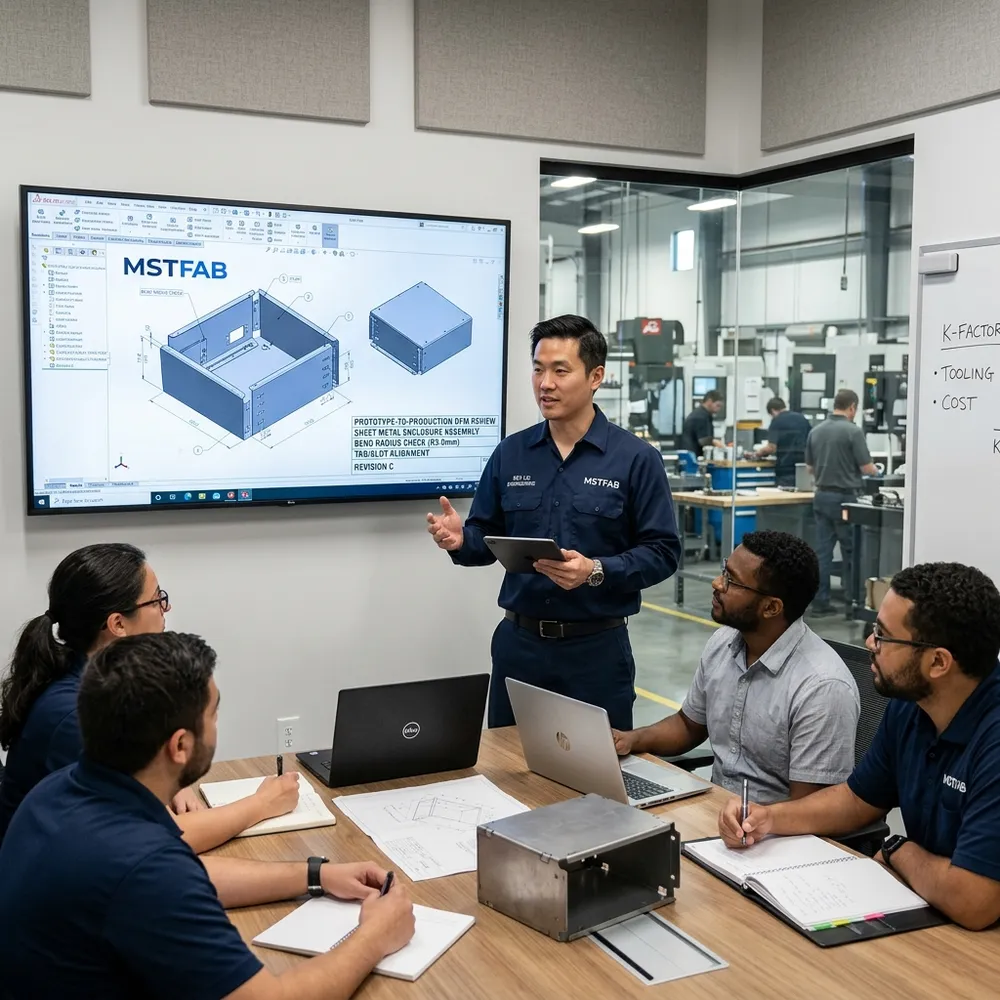
Between the first sample and stable batch production, many enclosure projects fail quietly: the prototype looks acceptable, but the design is hard to repeat. The door closes on the sample but starts drifting in batch production. The coating looks good once but scratches during shipping. The mounting holes work after manual adjustment, but the assembly team cannot repeat that miracle 300 times.
That is the real challenge.
For OEM buyers, engineers, and procurement teams, the goal is not only to build one good enclosure. The goal is to move from prototype to production without turning every sample improvement into a new manufacturing problem.
MSTFAB supports custom sheet metal enclosures from prototype to batch production based on customer drawings, samples, or project requirements. Our process can include DFM review, laser cutting, CNC bending, welding, surface finishing, hardware installation, inspection, packaging, and production planning.
Why Prototype-to-Production Planning Matters
A prototype proves whether the design can become real metal. Production proves whether the design can become real metal again and again without drama.
That second part is where many projects get expensive.
Common problems during the transition include:
- A hand-adjusted prototype that cannot be repeated
- Holes that align only after manual filing
- Doors that need “small corrections” before closing
- Welded frames that twist differently from batch to batch
- Surface finish that looks good once but is hard to control
- Hardware positions that are difficult to install consistently
- Cable entry plates that do not match assembly workflow
- Packaging that works for one sample but fails for bulk shipment
One good prototype is useful. One good prototype that cannot scale is a very expensive decoration.
Stage 1: DFM Review Before the First Prototype
Before cutting metal, the first step should be Design for Manufacturability review.
A 3D model can look beautiful on screen, but sheet metal has its own personality. It bends, stretches, springs back, warps during welding, gains thickness after coating, and occasionally reminds engineers that physics was not invited to the CAD meeting.
A practical DFM review may check material selection, sheet thickness, bend radius, hole-to-bend clearance, flange length, tooling access, bend sequence, welding distortion risk, door and hinge alignment, gasket contact surfaces, hardware installation clearance, cable entry layout, ventilation design, surface finish risk, and packaging protection.
Finding a problem before prototype production is normal. Finding the same problem after 200 finished enclosures is how meetings become very quiet.
Stage 2: Prototype Fabrication
The prototype is where the drawing meets real manufacturing. A good enclosure prototype should test more than overall size. It should help confirm the full assembly logic.
Prototype fabrication can verify panel fit, door alignment, mounting plate position, hinge and lock function, HMI screen cutouts, button and connector holes, cable entry layout, ventilation design, internal bracket positions, gasket contact surfaces, welding distortion, surface finish appearance, hardware installation, and packaging method.
A prototype should answer one serious question: Can this enclosure be manufactured, assembled, finished, and shipped in a way that makes sense for future production?
If the answer is no, good. That is what prototypes are for.
Stage 3: Engineering Samples
After the first prototype, many OEM projects need engineering samples. These samples help test assembly, internal component fit, surface finish, customer approval, and design updates.
This stage is where the enclosure becomes more than a shape. It becomes part of the product system. If the technician still needs to drill, file, or “just make it work,” the design is not ready for production. It is asking for help with a nice powder-coated face.
Stage 4: Pilot Run Before Batch Production
A pilot run is the bridge between sample and production. It is usually larger than prototype quantity but smaller than full batch production. For example, 10, 20, 50, or 100 pieces depending on the project.
A pilot run helps confirm whether the manufacturing process is repeatable. It can test cutting consistency, bending repeatability, welding fixture control, hardware installation speed, surface finishing stability, assembly workflow, inspection standards, packaging method, batch production timing, and supplier communication efficiency.
The prototype proves the part can be made. The pilot run proves the process can be repeated. That difference matters. A sample made by heroic manual correction is not a manufacturing process. It is a magic trick. Magic tricks do not scale.
Stage 5: Batch Production
Batch production requires consistency. The first enclosure, the 50th enclosure, and the 500th enclosure should match the approved design and sample.
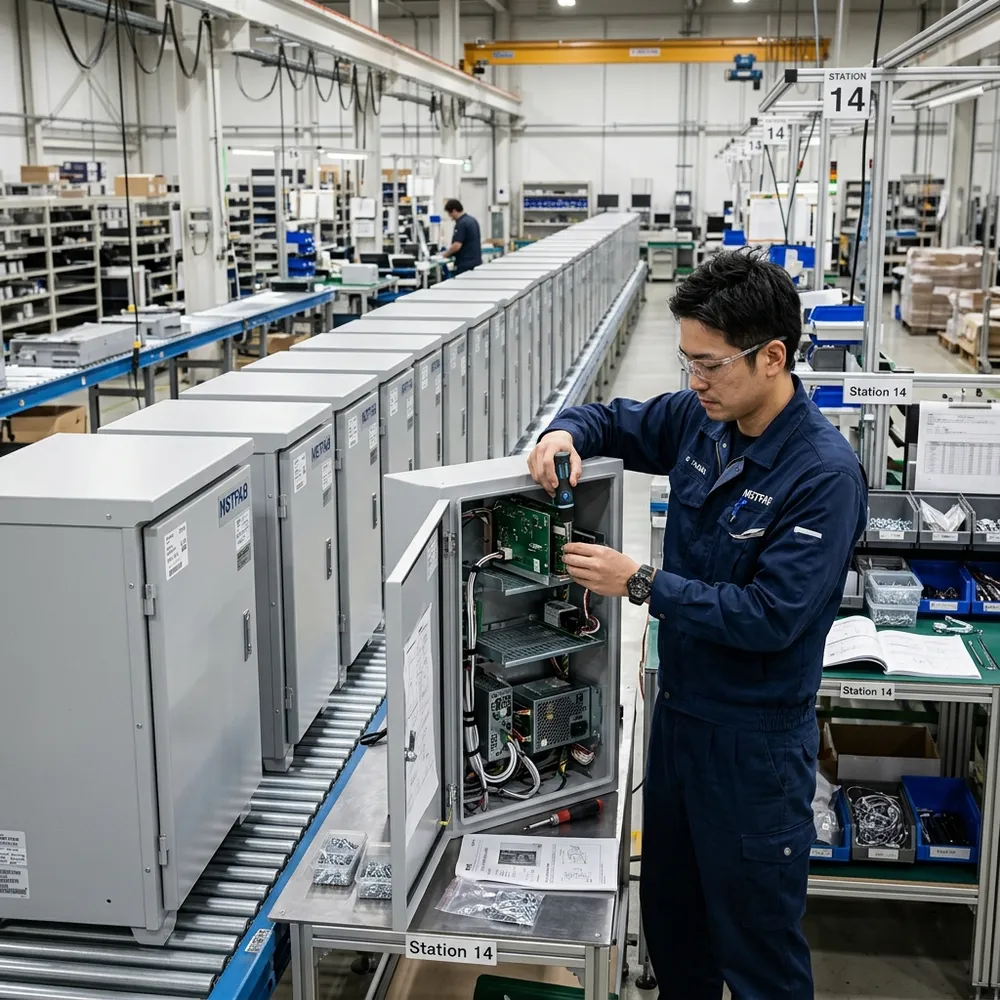
Batch production control may include confirmed drawings, approved sample reference, material control, cutting program control, bending process control, welding fixture control, surface finish control, hardware installation standard, in-process inspection, final inspection, and packaging standard.
This is where many suppliers show their real level. Anyone can make one sample look acceptable with enough manual effort. Stable production requires process discipline.
For OEM buyers, the goal is not “please make it look like the sample if possible.” The goal is “make it repeatably, without surprises.”
Why Prototype Unit Price Is Usually Higher
Prototype pricing is often higher per piece than production pricing. That is normal. Even for one or two enclosures, the manufacturer may still need to handle drawing review, engineering communication, CAM programming, material sourcing, laser cutting setup, CNC bending setup, welding preparation, hardware purchasing, surface finish setup, inspection, and packaging.
In production, setup cost is spread across many units. In prototype work, setup cost has nowhere to hide. That is why comparing a prototype unit price to a mass production unit price is unfair. The prototype is not only a part. It is a manufacturing test with engineering work attached.
Why Production Price Needs Separate Review
Do not assume prototype price equals production price. A useful RFQ should ask for both:
- Prototype quantity: 1–3 pcs
- Pilot run quantity: 10–100 pcs
- Batch production estimate: 200 / 500 / 1000 pcs
This allows the manufacturer to separate prototype setup cost, sample fabrication cost, fixture needs, material purchasing efficiency, batch surface finishing cost, hardware purchasing cost, packaging method, and production lead time.
A prototype quote helps validate the design. A production quote helps validate the business case. You need both. Approving a prototype without understanding future production cost is like buying the first ticket before checking where the train goes.
Material Selection from Prototype to Production
Material choice affects cost, strength, weight, corrosion resistance, forming behavior, welding, finishing, and long-term performance.
- Cold-Rolled Steel: For indoor enclosures, control cabinets, and powder-coated equipment housings.
- Galvanized Steel: For electrical cabinets, telecom enclosures, and semi-outdoor applications.
- Stainless Steel: For corrosion resistance, cleanliness, or premium appearance (SUS304 or SUS316).
- Aluminum: Lightweight and corrosion-resistant. For HMI housings, front panels, and EV charger panels.
- Carbon Steel: For reinforced bases, heavy-duty frames, and structural cabinet parts.
The material used in the prototype should match the production plan whenever possible. Testing one material and producing with another can create surprises. Metal loves surprises. Buyers do not.
Cutting and Bending Consistency
Laser cutting and CNC bending are the foundation of enclosure fabrication. They affect panel size, hole position, door fit, mounting plate alignment, cable entry accuracy, HMI cutout fit, bracket position, gasket contact surfaces, and final assembly.
For prototypes, small manual adjustments may be possible. For production, the process must be repeatable. A hole that is “almost right” on one sample may be corrected by hand. A batch of almost-right holes is not a production plan. It is a slow-motion headache.
Welding Control from Sample to Batch
Welding adds heat, and heat can move metal. If welding is not controlled, enclosures may suffer from warped panels, twisted frames, misaligned doors, uneven gasket contact, shifted brackets, poor visible weld appearance, and difficult assembly.
For prototype work, welding helps test the structure. For production, welding needs process control. This may include welding sequence planning, fixture control, inspection standards, and clear weld requirements on the drawing.
Surface Finish: Prototype Appearance vs Production Reality
For early engineering prototypes, a simple finish may be enough. For customer approval samples, exhibition units, or pilot production, the finish should be closer to final production.
Before production, confirm color, RAL code, texture, gloss level, visible surface requirements, outdoor or indoor coating requirement, and packaging protection after finishing. A production enclosure can be dimensionally correct and still be rejected if the visible surface looks bad.
Hardware Installation and Assembly Readiness
For prototype testing, hardware should be included if the goal is to verify real assembly. For production, hardware installation should be standardized. If the sample uses hand-installed hardware but the batch needs repeatable installation, the process should be reviewed early.
A missing insert or shifted hinge can stop assembly faster than a missing coffee machine stops an office.
Cable Entry and Ventilation Planning
Adding cable holes or ventilation after finishing is not engineering. It is damage control with a drill. The prototype stage is the best time to fix details like cable entry locations, removable gland plates, cable bending space, and functional louvers.
Packaging from Prototype to Production
Packaging is often ignored until the first scratched cabinet arrives. That is too late. A prototype shipment tests whether the packaging method works. Production shipping proves whether it works repeatedly.
A perfect powder-coated cabinet that arrives scratched is no longer a perfect cabinet. It is a logistics problem wearing forklift marks.
Production Scaling: Engineering Partner vs. Standard Job Shop
| Scaling Factor | OEM Production Partner (MSTFAB) | Standard Job Shop |
|---|---|---|
| Prototype Goal | Tests manufacturability to ensure the design can be repeated 500+ times without manual fixes. | Forces one acceptable sample through manual grinding just to secure the production order. |
| Pilot Run Stage | Conducts a 10-50 unit pilot run to lock in welding fixtures and finishing standards. | Skips the pilot run, sending straight to mass production and risking a warehouse of rejected parts. |
| Consistency Control | Implements strict CAM controls and inspection checkpoints so the 500th unit matches the 1st. | Every batch looks slightly different depending on which operator was working that day. |
| Pricing Transparency | Quotes both prototype development and mass production costs upfront for clear budgeting. | Offers a cheap sample, then hikes the production price when you are locked in. |
Quality Control from Sample to Batch
For prototypes, inspection helps verify design. For pilot runs, inspection helps verify process repeatability. For batch production, inspection helps ensure consistency.
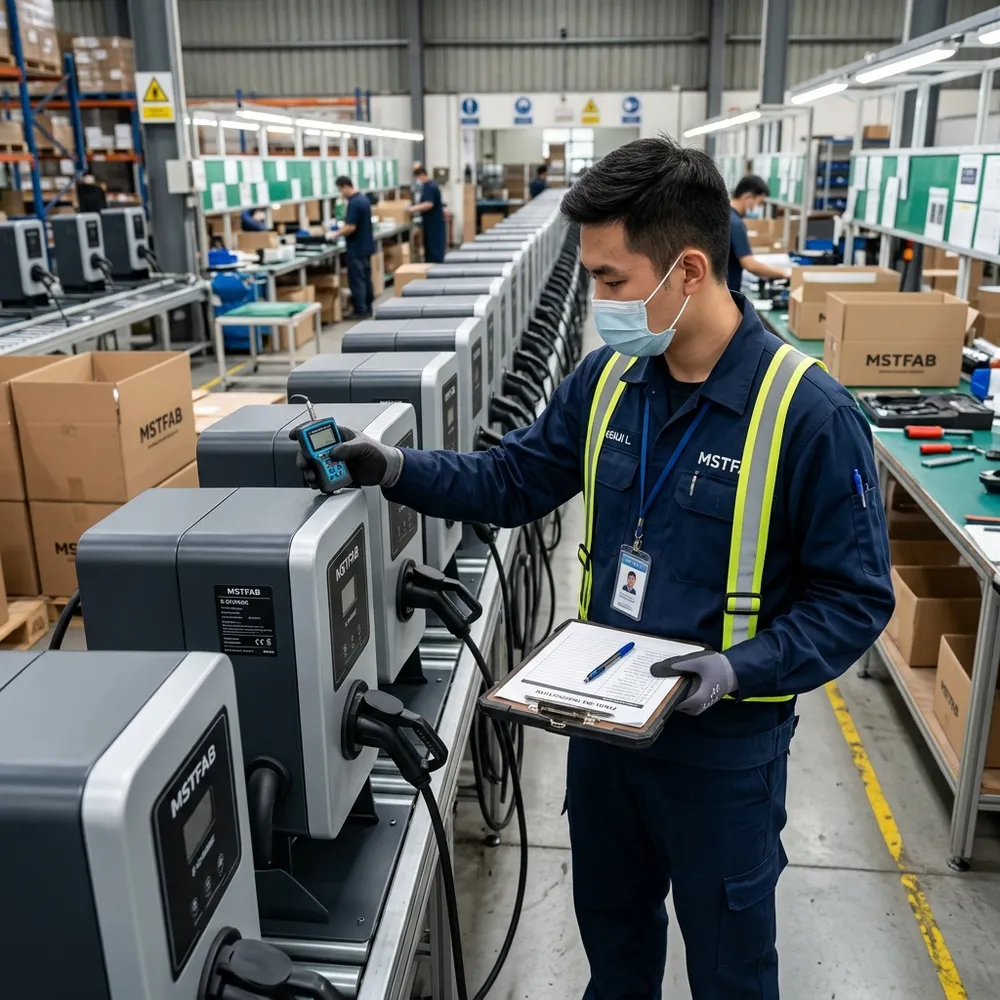
For production, inspection should focus on critical dimensions and assembly interfaces, not just outer appearance. The cabinet needs to look right, fit right, and work right. All three matter.
Clear Manufacturing Scope
MSTFAB focuses on custom sheet metal fabrication and metal structure manufacturing. We manufacture physical metal parts and structures, including sheet metal enclosure prototypes, low volume sheet metal enclosures, electrical cabinets, telecom enclosures, EV charger cabinets, battery storage cabinets, medical equipment housings, custom metal enclosure parts, and mounting plates.
We do not design software. We do not write PLC programs. We do not design circuitry. We do not require proprietary electronic schematics, source code, automation logic, or internal system design.
Our scope is the physical metal enclosure, cabinet, panel, bracket, chassis, frame, or structural component based on customer drawings and project requirements.
Request a Prototype-to-Production Enclosure Quote
Partner with a true OEM manufacturer. Submit your CAD files for a custom sheet metal enclosure quote that includes both prototyping and estimated mass production pricing.
Related engineering resource: If your project involves EV charging infrastructure, review our custom EV charger enclosure fabrication capabilities for outdoor sheet metal cabinet design, powder coating, and export-ready manufacturing.
Related engineering guide: Before releasing a drawing for quotation, review our guide to reading sheet metal drawings for thickness, bend notes, hole dimensions, tolerance callouts, and manufacturability checkpoints.
Related factory capability: For OEM buyers comparing a custom sheet metal enclosure factory, review how MSTFAB handles final assembly, protective packaging, export packing checks, and shipment-ready enclosure delivery.
Frequently Asked Questions
What does prototype to production sheet metal enclosure fabrication mean?
It means developing custom sheet metal enclosures from early samples through pilot runs and batch production, while controlling design, manufacturability, quality, finish, packaging, and repeatability.
Why is prototype fabrication different from production fabrication?
Prototype fabrication verifies design and manufacturability. Production fabrication focuses on repeatability, process control, cost efficiency, inspection standards, and consistent delivery.
Should I request prototype and production pricing together?
Yes. Asking for prototype, pilot run, and batch production pricing helps you understand both development cost and future production cost.
What files are needed for prototype-to-production review?
A 3D STEP file and 2D PDF drawing are recommended, including material, thickness, finish, tolerance, hardware, welding, cable entry, ventilation, quantity, and application environment.
Why is a pilot run important?
A pilot run helps test repeatability before full batch production. It can reveal issues in assembly, welding, finishing, hardware installation, packaging, and inspection.
custom sheet metal enclosure fabrication
MSTFAB manufactures custom sheet metal enclosures, electrical cabinets, control boxes and industrial metal housings for OEM buyers.
 WeChat Contact
 WhatsApp Me Directly