This article belongs to MSTFAB’s OEM buyer education series. Related deep-dives: Custom Sheet Metal Bending OEM Buyer Guide, Why Factories Require Technical Drawings, Precision Welding Guide, Powder Coating Guide, OEM Buyer Pain Points, and Agricultural Sourcing Guide.
1. Why Professional Buyers Judge Bending by Process Control
A low quote looks attractive until assembly operators start forcing parts together. Serious buyers want the supplier who prevents downstream problems before the first sheet is cut.
- Angles must repeat: One accurate sample is not enough. OEM buyers need stable bend angles across the trial run, pilot batch and repeat orders.
- Material behavior matters: Stainless steel, aluminum and galvanized steel do not spring back the same way. Good suppliers know the difference before production starts.
- Bending affects every next step: Laser cutting, bending, welding, coating and assembly are linked. Poor bending creates problems that inspection alone cannot magically remove.
2. OEM Buyer Evaluation Scorecard for Bending Services
This is the compact checklist a technical buyer can use before trusting a supplier with precision bent parts or enclosure structures.
| Evaluation Area | What Buyers Really Need | Weak Supplier Signal | Evidence That Builds Trust |
|---|---|---|---|
| Bend repeatability | Stable angle and flange dimensions from sample to batch. | Only says tolerance is no problem. | CNC press brake capability, inspection records and repeat production examples. |
| Bend sequence planning | A forming route that controls stress, collision risk and final geometry. | Plans the process after material arrives. | DFM comments, bend simulation, sequence review and tooling discussion. |
| Material forming knowledge | Correct radius, tooling and springback compensation for each alloy. | Uses the same rule for stainless, aluminum and carbon steel. | Material-specific bend radius guidance and surface protection plan. |
| Downstream fit-up | Bent parts that weld, assemble and seal without forced correction. | Treats bending as isolated from welding and assembly. | Fixture strategy, flatness checks and cross-process engineering review. |
| Production scalability | Prototype learning transferred into controlled batch production. | Good first sample but unstable mass production. | FAI, process standards, QC checkpoints and export packing discipline. |
3. Where Bending Failures Really Begin
Most bending problems are born before the press brake moves. Technical buyers distrust low-cost bending suppliers because the visible bend is only the final symptom. The real decisions happen earlier: blank orientation, bend order, tooling selection, K-factor assumptions, material lot behavior and whether the part has enough room to form without collision.
If I were sourcing custom sheet metal bending services, I would contact the factory that asks about assembly function first. The supplier that only asks for quantity and target price has already told me what kind of problems I will inherit.
4. Process Details That Attract Engineering-Driven Buyers
Good bending suppliers make their competence visible. They show how precision is created, how surface quality is protected and how the bent part will survive the next process.
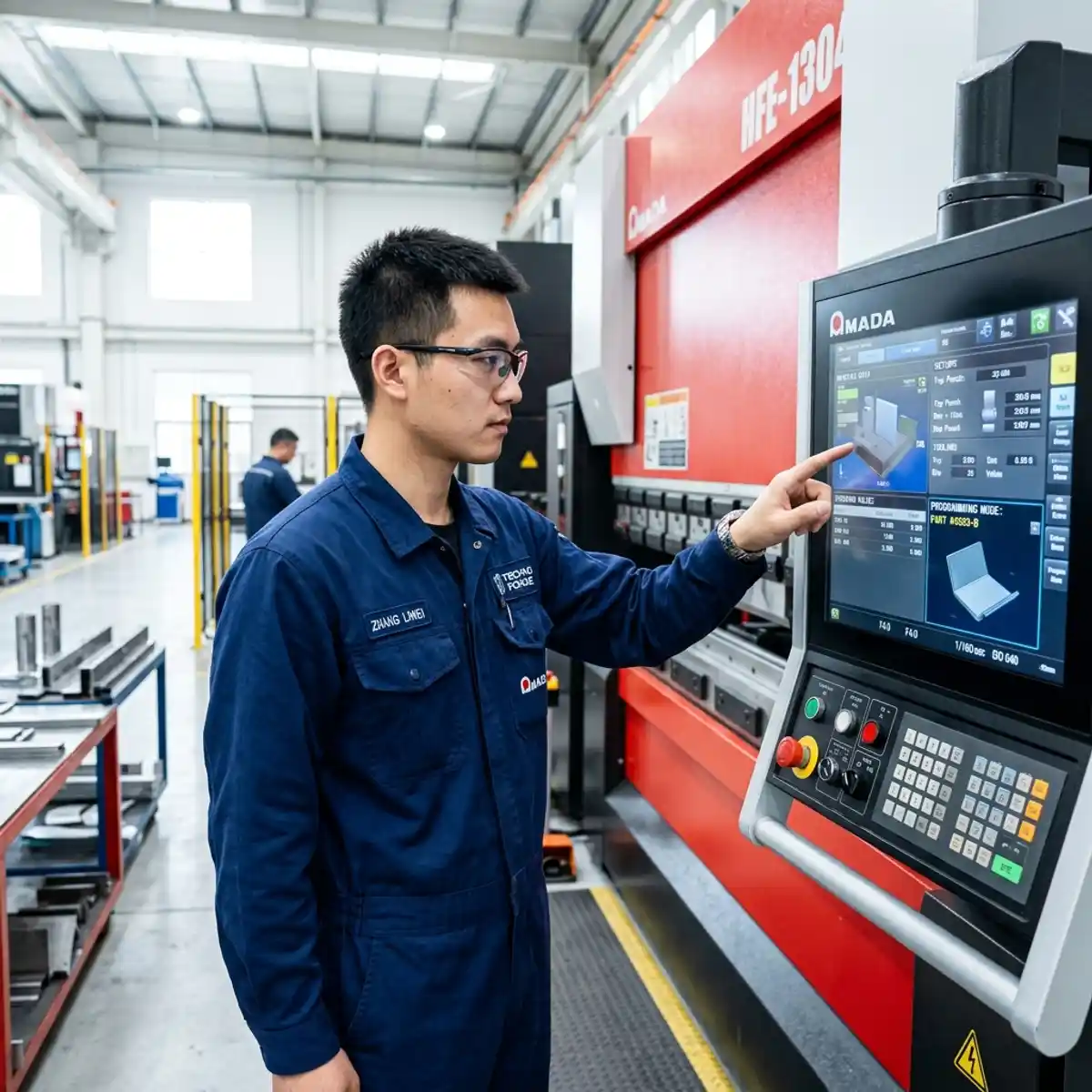
- CNC press brake control: Automated back gauges and programmed bend sequences reduce operator variation and improve batch repeatability.
- Long flange and gasket geometry: Door frames, rain channels and enclosure flanges require consistent angular control to avoid sealing failures.
- DFM review before production: Engineering review catches impossible bends, poor hole-to-bend distances and tolerance stack-up risks before quoting.
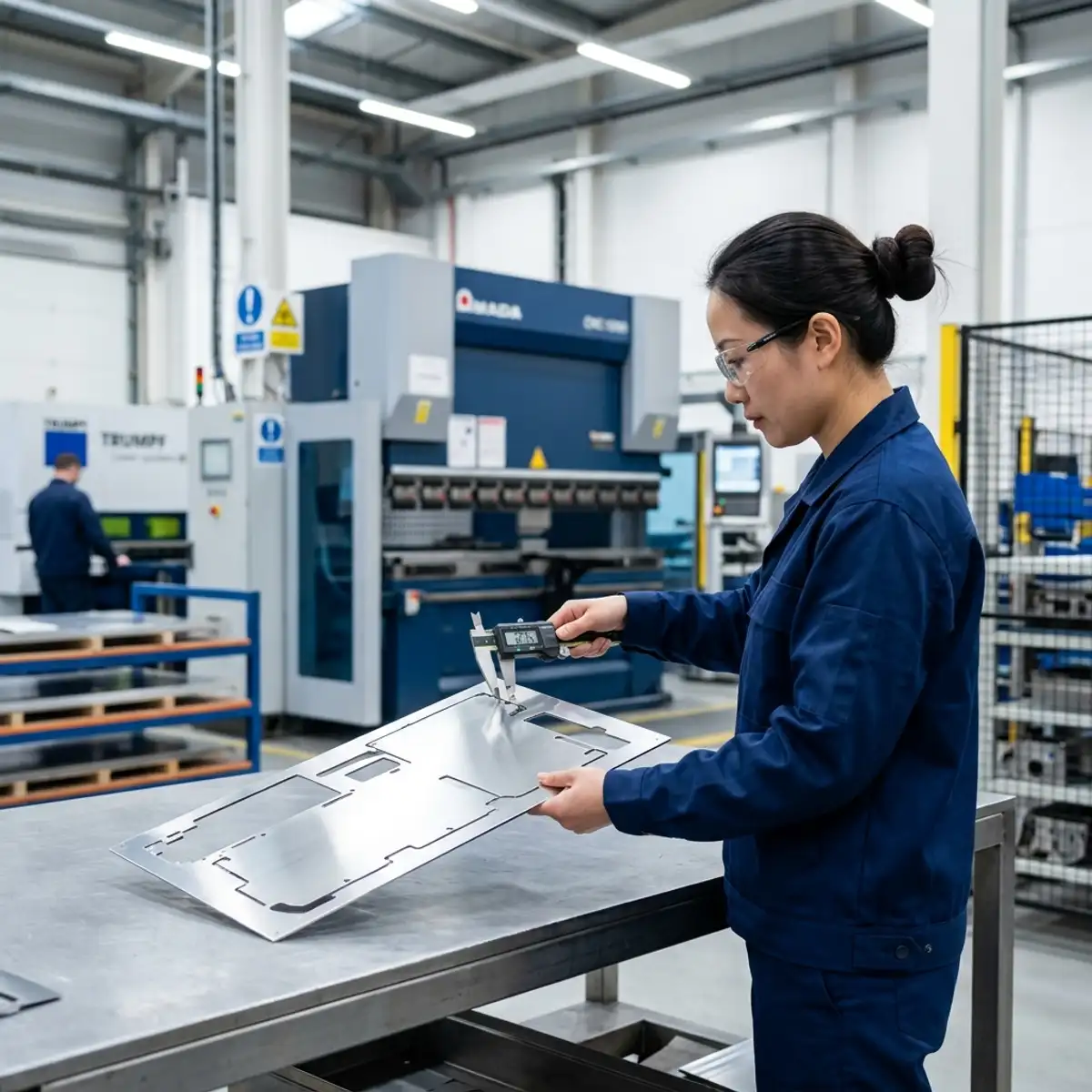
- Flatness and feature inspection: Flatness and position checks matter when bent parts carry electronics, seals, rack rails or precision brackets.
- Bending that improves welding: Accurate formed edges create predictable weld gaps, reducing distortion and cosmetic rework.
- First-article verification: FAI confirms bend angles, dimensions, fit-up and cosmetic surfaces before batch production moves forward.
5. Bending Process-to-Risk Map for OEM Projects
One more table is enough. This connects bending decisions to the problems procurement teams are trying to avoid.
| Bending Decision | Buyer Risk Controlled | What to Ask During RFQ |
|---|---|---|
| Bend radius and tooling | Cracking, surface marks, coating failure and weak fatigue life. | What die opening and inside radius do you recommend for this material and thickness? |
| Bend sequence | Twisting, collision, poor assembly geometry and dimensional drift. | Can you review the forming route before sample production? |
| Springback compensation | Angle variation between material lots and repeat orders. | How do you compensate stainless steel, aluminum and high-strength steel differently? |
| Surface protection | Scratches, pressure marks and cosmetic rejection. | Do you use film protection, non-marking tooling or handling controls for visible surfaces? |
| Inspection strategy | Batch drift, welding mismatch and late assembly problems. | Which bend dimensions are checked at first article and during production? |

6. The Strongest Sales Message is Fewer Unknowns
A serious OEM buyer is not looking for a press brake owner. They are looking for a team that can review drawings, flag bending risks, protect cosmetic surfaces, coordinate welding fit-up and keep the same process stable when the order moves from prototype to production.
- Factory-direct DFM review for STEP, DWG, DXF and PDF drawings.
- Chinese factory process evidence for cutting, CNC bending, welding, inspection and export packing.
- Support for telecom, medical, EV charging, power distribution, energy storage and automation parts.
- Material guidance for stainless steel, aluminum, galvanized steel and carbon steel.
- Export communication for USA, Europe and Australia OEM buyers.
Buyer signal: I would rather pay for the supplier who prevents rework than save a few dollars on the supplier who creates it.
Stop Guessing on Sheet Metal Bend Tolerances. Partner with Engineering Experts.
Send your current program drawings and quality requirements. Within 24 hours we return a DFM red-line and a transparent quote — matching the ideal tooling and bend sequence to your precision parts. NDA on request before any file exchange.
Request a Drawing-First Quote & Free DFM Review
Related engineering resource: If your project involves EV charging infrastructure, review our custom EV charger enclosure fabrication capabilities for outdoor sheet metal cabinet design, powder coating, and export-ready manufacturing.
Related engineering guide: Before releasing a drawing for quotation, review our guide to reading sheet metal drawings for thickness, bend notes, hole dimensions, tolerance callouts, and manufacturability checkpoints.
Frequently Asked Questions
Q1. What do OEM buyers check before choosing a sheet metal bending supplier?
They check CNC press brake capability, bend sequence planning, tolerance control, material forming knowledge, surface protection, inspection discipline and whether the supplier can explain DFM risks before quoting.
Q2. Why is the cheapest sheet metal bending quote often risky?
Cheap bending can become expensive if bend angles drift, flatness is lost, hole positions shift after forming, welding gaps increase or the final assembly requires rework. The real cost is usually found after the first batch arrives.
Q3. Which materials are more difficult to bend accurately?
Stainless steel has strong springback and scratch risk, aluminum needs careful radius and surface protection, and high-strength steel requires correct tooling and tonnage planning. Each material needs a different bending strategy.
Q4. Why does bend sequence matter for OEM sheet metal parts?
Bend sequence affects stress distribution, collision risk, dimensional stack-up and final assembly geometry. A poor sequence can create twist, warped panels or parts that look correct but cannot be assembled efficiently.
Q5. Can precision bending improve welding quality?
Yes. Accurate bent parts create smaller and more consistent welding gaps, reducing heat input, distortion and cosmetic grinding. Bending quality directly affects welding reliability.
Q6. What files should I send for a bending DFM review?
Send STEP or STP files, flat DXF files, PDF drawings, material grade, thickness, surface finish, annual volume and any critical tolerance or cosmetic requirements.
CNC sheet metal bending services
MSTFAB provides CNC press brake bending services for precision sheet metal parts, enclosures, brackets and OEM assemblies.
 WeChat Contact
 WhatsApp Me Directly