
This article belongs to MSTFAB’s OEM buyer education series. Related deep-dives: Custom Sheet Metal Bending OEM Buyer Guide, Why Factories Require Technical Drawings, Precision Welding Guide, Powder Coating Guide, OEM Buyer Pain Points, and Enclosure Materials Guide.
1. What Smart Agribusiness Buyers Should Remember
Agricultural machinery carries loads across uneven ground, often while the part is wet, dusty or chemically exposed. That combination is brutal. A design that looks fine on a clean inspection table can become a warranty claim after the first serious season.
- Vibration is patient: Most bracket failures do not happen in one dramatic movie scene. They start with tiny fatigue cracks that grow every hour the machine runs.
- Fertilizer is not friendly: Nitrogen, ammonia, acids and moisture attack weak coating edges quickly. If pretreatment is lazy, the paint becomes decorative wrapping paper.
- Seasonal delay hurts: A two-week delivery slip during harvest season is not a calendar issue. It can become dealer pressure, warranty claims and lost crop-window revenue.

2. Agricultural Sourcing Risk Matrix for Metal Parts
This table turns field pain into supplier audit questions. It is the kind of screen a procurement team can use before trusting a quote.
| Field Risk | What Buyers See Later | Question to Ask Before PO | Supplier Evidence to Request |
|---|---|---|---|
| Cyclic vibration fatigue | Cracks near weld seams, mounting holes or bend lines after hundreds of field hours. | How do you control weld heat, fixture stability and bend radius for vibrating structures? | Agreed fabrication controls and sample records; a separate buyer-approved durability plan where required. |
| Fertilizer and ammonia attack | Paint bubbles, rust creeps from edges and housings leak after one planting season. | What pretreatment is used before powder coating or galvanizing? | Approved substrate, preparation and coating specification, with exposure-relevant evidence defined by the responsible engineer. |
| Bend radius cracking | Thick chassis channels split on the outer bend radius. | How do you calculate K-factor, tooling radius and springback? | CNC press brake capability, material review and DFM notes before forming. |
| Mud and abrasive wear | Sliding panels jam, covers scrape and hinges wear faster than expected. | Can you design labyrinth folds or protected seams against dirt ingress? | CNC-bent dust channels, hinge protection details and assembly clearance checks. |
| Seasonal delivery pressure | Parts arrive after the machine build window closes. | What are prototype, batch and export delivery commitments? | A project-specific schedule showing drawing approval, material and hardware availability, sample review, production, packing and shipping assumptions. |
3. Process Controls That Reduce Field Failure
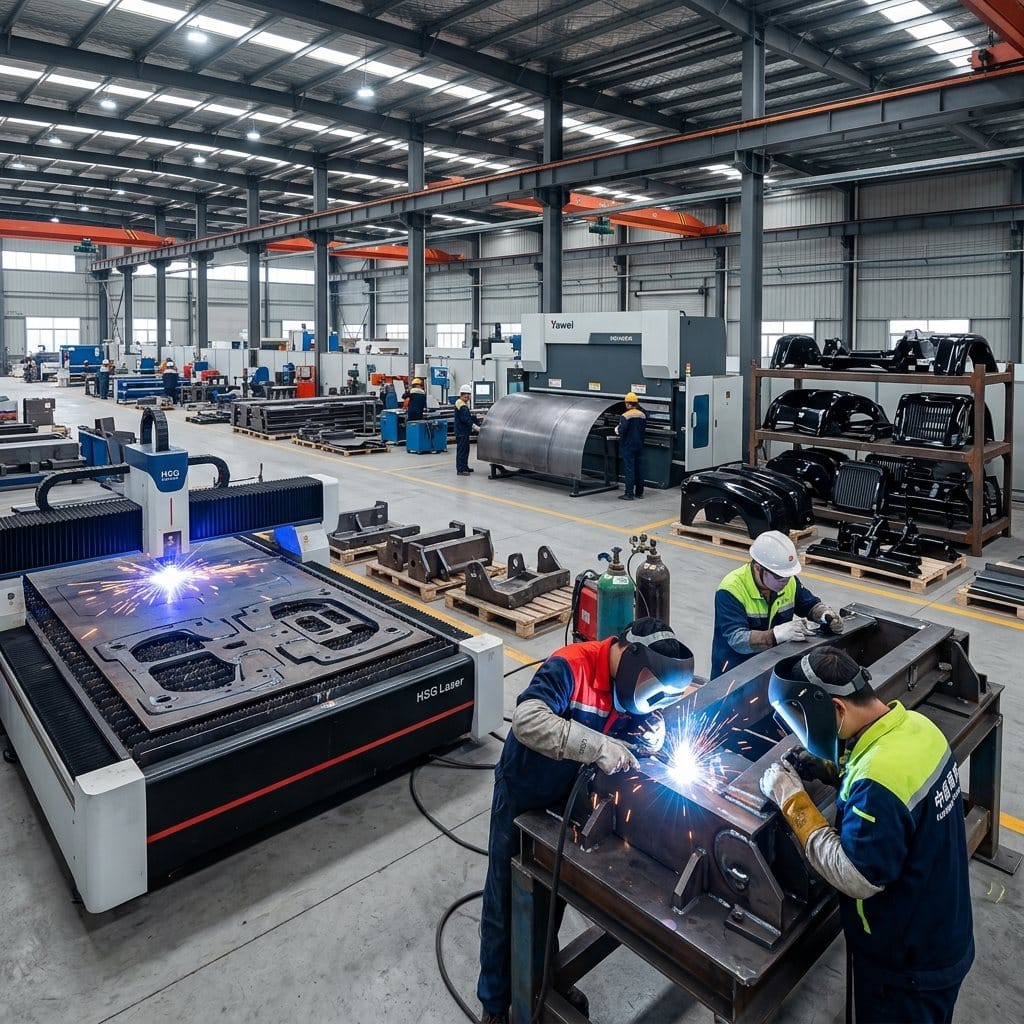
One strong process cannot rescue three weak ones. Agricultural parts need controlled cutting, bending, welding, coating and inspection working together.
CNC bending that respects the grain
Proper radius, springback and bend sequence prevent thick agricultural channels from cracking at the fold.
Welding built for vibration
Specify joint details, materials, welding requirements and any required examination. Fixtures can support alignment; they do not by themselves establish weld metallurgy or fatigue performance. The responsible engineering parties should approve the applicable process and validation.
Coating that survives chemistry
Surface pretreatment and edge preparation help powder coating resist fertilizer, ammonia and wet outdoor storage.
Sprayer housings and chemical exposure
Sprayer covers and control boxes need corrosion planning before the first gallon of fertilizer gets close.
Auger and conveyor sheet metal
Formed troughs, covers and guards need repeatable geometry so moving assemblies do not fight the metal.
Inspection before the field finds it
Dimensional checks and first-article review reduce the chance that the customer becomes your quality department.

4. Material and Finish Selection for Agricultural Sheet Metal
The cheapest material can be expensive if it fails in mud, fertilizer or vibration. Match the metal to the job, not to the lowest spreadsheet cell.
| Material / Finish | Best Use Case | Buyer Benefit | Procurement Check |
|---|---|---|---|
| Galvanized steel / SGCC | Guards, covers, conveyor parts and cost-controlled outdoor structures. | Strong, economical and corrosion-resistant for many farm applications. | Verify cut-edge protection and compatibility with welding and powder coating. |
| Carbon steel + heavy powder coat | Tractor brackets, frames, chassis channels and mounting plates. | High strength and good weldability. | Ask about pretreatment, film thickness and coating performance at edges. |
| Stainless steel SUS304 / SUS316L | Food, dairy, livestock, fertilizer and high-corrosion areas. | Better corrosion resistance and hygienic surface options. | Confirm grade certification, welding route and finishing requirements. |
| Aluminum 5052 / 6061 | Lightweight covers, electronics housings and mobile equipment panels. | Weight reduction and natural corrosion resistance. | Review stiffness, weldability and galvanic corrosion when mounted to steel. |
| Labyrinth folded seams | Bins, covers, access doors and dust-exposed moving panels. | Helps redirect mud and dust away from mating surfaces. | Check bend repeatability, clearance and service access. |

5. Pure-Play Sheet Metal Focus
Some vendors try to look bigger by bundling sensors, wiring and hydraulic hoses. That can blur responsibility. For a mechanical failure in the field, the buyer needs a supplier who owns the metal problem completely.
MSTFAB focuses on precision sheet metal fabrication: laser cutting, CNC bending, welding, powder coating, assembly-ready hardware and inspection. Customers provide proprietary agricultural technology; MSTFAB manufactures the metal structure that protects and supports it.
Plain procurement rule: if a supplier says “paint is paint” or “a bend is a bend,” keep your coffee, smile politely, and audit harder.
6. NPI, Lead Time and Logistics Checks Before Harvest Season
Agricultural OEMs live by production windows. Good sheet metal sourcing must connect engineering review with delivery discipline.
| Execution Topic | Professional Buyer Expectation | Why It Matters |
|---|---|---|
| DFM response | STEP/DWG review with manufacturability comments within 48 hours for qualified RFQs. | Catches bend cracks, weld distortion and coating risks before the first sample. |
| Prototype sample | First article target commonly 2 to 3 weeks after DFM confirmation. | Lets the OEM test fit, vibration exposure and assembly clearance before batch release. |
| Batch production | Typical 4 to 6 week planning window depending on route, quantity and coating. | Protects seasonal machine build schedules and dealer commitments. |
| FOB | Buyer controls freight through preferred forwarders. | Useful for mature procurement teams with existing logistics contracts. |
| DDP | Supplier handles duty-paid delivery where legally feasible. | Reduces customs and paperwork friction for busy purchasing teams. |
| Export packing | Parts protected against scratching, moisture and transit deformation. | Prevents a beautiful part from arriving as an expensive puzzle. |

Separate Manufacturing Acceptance From Field Validation
For each critical part, identify the approved load inputs, mounting interfaces, material and finish, and the party responsible for validating service performance. A first-article dimensional report can confirm agreed geometry. It does not establish fatigue life, chemical compatibility or suitability for every agricultural application.
Illustrative purchasing example: a revised bracket fits the same mounting holes but has a different bend, weld or reinforcement. Do not approve it solely because the bolt pattern matches. Ask the design owner to assess the change, identify any required validation and release the revised drawing before repeat production. This is a review scenario, not a customer case study.
Record sample identification, drawing revision, measured characteristics, discrepancies and the disposition of each open item. If a material, finish or manufacturing change is proposed after approval, assess its effect on the accepted baseline rather than treating it as an interchangeable substitute.
7. Evidence Beats Sales Talk
If I were sourcing agricultural metal parts, I would contact a supplier who reduces risk before the quote. The attractive part is not a low unit price alone; it is the ability to explain where parts fail, show real process evidence, and propose changes before the field finds the weakness.
- DFM feedback on bend radius, mounting holes, weld sequence and coating risk.
- Project-relevant evidence whose origin and scope can be verified; generated or illustrative images are not customer inspection records.
- First-article inspection before batch production.
- Material and finish discussion for SGCC, carbon steel, stainless steel and aluminum.
- Clear FOB/DDP communication for USA, Europe and Australia buyers.
Define the Fabrication Scope Before Ordering
Send the current drawings, quantity, material, finish and required records. State which loads, exposure conditions and validation requirements the OEM has approved. Manufacturing feasibility, quotation timing and any confidentiality arrangements should be confirmed for the project.
Request a Drawing-First Quote & Free DFM Review
Frequently Asked Questions
Q1. Why are agricultural metal parts harder to source than normal industrial parts?
Agricultural parts face vibration, mud, fertilizer, livestock ammonia, moisture and abrasion at the same time. A bracket that survives a clean warehouse may crack or corrode quickly in the field if welding, bending and coating are not controlled.
Q2. Which failure should buyers worry about first: impact or fatigue?
Prioritize risks using the actual part function, loads and operating conditions. The OEM should define the relevant impact and fatigue requirements; a universal ranking is not appropriate for every guard, bracket or support.
Q3. What drawings should I send for agricultural sheet metal parts?
Send STEP or STP files, 2D PDF drawings, material grade, thickness, finish requirement, mounting load, expected vibration exposure and annual quantity forecast. Photos of the installed assembly also help DFM review.
Q4. What surface finish works for fertilizer and livestock environments?
The right finish depends on chemical exposure. Powder coating over proper pretreatment is common, while galvanized steel, stainless steel or aluminum may be better in severe fertilizer, ammonia or coastal environments.
Q5. Can MSTFAB support prototypes before harvest-season production?
Yes. For qualified RFQs with complete drawings, MSTFAB can review manufacturability, build first-article samples and then scale to batch production after approval.
Q6. Does MSTFAB assemble sensors, hydraulics or agricultural electronics?
No. MSTFAB focuses on precision sheet metal fabrication: cutting, bending, welding, surface finishing and metal assembly. Customers supply proprietary electronics, sensors, hoses or control systems.
sheet metal welding services
MSTFAB provides TIG and MIG sheet metal welding services for structural assemblies, cabinets, frames and OEM metal components.
 WeChat Contact
 WhatsApp Me Directly