

This article belongs to MSTFAB’s OEM buyer education series. Related deep-dives: Custom Sheet Metal Bending OEM Buyer Guide, Why Factories Require Technical Drawings, Precision Welding Guide, Powder Coating Guide, Fiber Laser Workshop Guide, and Enclosure Materials Guide.
1. The Failure Pattern Senior Procurement Already Recognizes
Every experienced industrial buyer eventually maps the same failure pattern across “cheap” sheet-metal suppliers. The pattern is so consistent that mature procurement organizations have built RFQ scoring rubrics specifically to detect it. Below is the five-phase failure arc, drawn from real customer recovery work MSTFAB has been called into across telecom, EV charging, BESS, automation and medical-equipment programs:
- Phase 1 (RFQ): Aggressive quote, no DFM commentary, < 4-hour turnaround, no clarifying engineering questions.
- Phase 2 (Sample): First article looks acceptable; surface finish glossy, fits the mating part — sample is hand-finished.
- Phase 3 (First 100 production): Quality drifts; some panels rock on the assembly bench but pass with a rubber mallet. Procurement classifies it as “minor” and ships.
- Phase 4 (Pieces 100–1000): Flatness, hole position and bend-angle drift become systemic. Field-return rate climbs above 3%. Quality team opens corrective actions; supplier blames the drawing.
- Phase 5 (Recovery): Customer airfreights replacements, audits supplier, eventually re-sources. Total cost of “savings”: 35–60% premium over the original “expensive” supplier they rejected at Phase 1.
Procurement diagnostic: If your current sheet-metal supplier’s failure narrative reads like the five phases above — and Phase 5 is where you are now — the problem was not the supplier’s bad week. The problem was a structural mismatch between the supplier’s actual engineering capability and the program’s quality requirements, which was visible at Phase 1 and ignorable only because the price looked good.
The rest of this article unpacks the eight structural failures buyers most often hit, the engineering capability that prevents each one, and the qualifying questions that surface those capabilities before you sign the PO.
2. The Eight Failures That Define “Wrong Supplier” — and the Capabilities That Prevent Them
Table 2.1 — Failure-to-Capability Map: How Engineering-Led Factories Eliminate the 8 Common OEM Sheet-Metal Pain Points
| # | Pain point (buyer experience) | Real upstream root cause | Engineering capability that prevents it |
|---|---|---|---|
| 1 | Cheap quote becomes expensive total cost | Quote built on labor + metal weight only; zero allowance for rework, FAI rejects, or warranty | DFM red-line before quote + Cpk-based pricing + documented FAI process |
| 2 | Parts pass dimensional check individually but fail at assembly | Tolerances chained instead of datum-locked; weld distortion ignored; bend-sequence not simulated | GD&T review + CAM bend-sequence simulation + welding-distortion compensation |
| 3 | Outdoor units rust within 6–18 months of installation | Pretreatment line cuts corners on degrease, phosphate or zinc; powder film below 60 µm; baking under-cured | 7-stage pretreatment with bath chemistry SPC + film-thickness gauge per batch + ISO 9227 salt-spray validation |
| 4 | Engineering questions take 3–7 days to answer; answers are vague | Sales-relay model; no internal engineering; CAD outsourced | In-house engineering with direct engineer-to-engineer line; < 4-hour response SLA |
| 5 | Sample is perfect; mass production drifts | Sample hand-finished; mass production lacks SOP, SPC, ERP traceability or operator certification | SOP-controlled workflow + SPC charts + ERP traveller + IATF 16949 discipline |
| 6 | Products arrive scratched, dented, corroded from sea transport | One-size-fits-all carton; no ISPM-15 crate; no desiccant; no surface protection film | Application-specific export packaging design + ISPM-15 fumigated crates + VCI desiccants + edge protection |
| 7 | Supplier executes drawings literally — never proposes improvements | No DFM culture; engineering team treats customer drawing as sacred not collaborative | Standing DFM workflow returns redacted alternative geometry with cost-down annotation |
| 8 | Engineering changes during program take weeks to implement | Multi-vendor sub-contracting; each sub-shop revalidates separately | Single-roof integrated production (laser + bend + weld + finish + assembly); one engineering rev propagates in one shift |
Notice that seven of the eight root causes are organizational, not equipment-based. The factory’s press brake brand matters less than whether the factory operates around an engineering loop. This is the single insight that most accelerates a procurement organization’s maturity.
3. Total-Cost-of-Ownership Math — Why “Cheap Supplier” Is the Most Expensive Procurement Decision
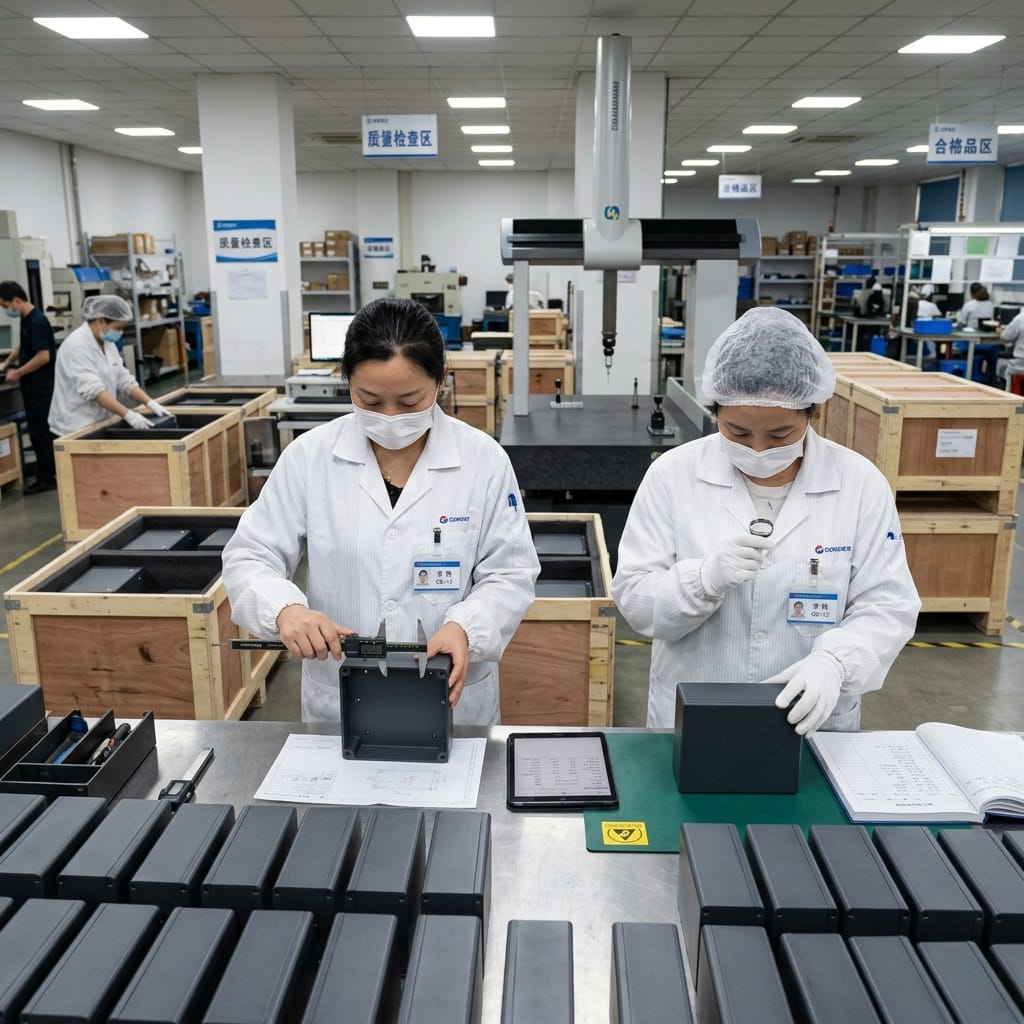
Mature procurement organizations do not evaluate suppliers on unit price. They evaluate on landed cost per acceptable unit — a metric that incorporates rework, scrap, expedite, warranty and engineering overhead. Below is the comparison MSTFAB shares with prospective customers, using a representative 5,000-unit OEM telecom-enclosure program at a 185 baseline unit:
Before scoring individual suppliers, the outsourcing sheet metal fabrication guide helps OEM teams compare the wider make-or-buy case: internal capacity, total cost, drawing maturity, quality responsibility, communication and continuity risk.
Table 3.1 — 5,000-Unit OEM Program: Cheap Supplier vs Engineering-Led Supplier Total Cost
| Cost line | Cheap supplier | Engineering-led supplier |
|---|---|---|
| Quoted unit price | 162 (-12%) | 185 |
| FAI reject rate (typical) | 12% → 600 units re-fabricated | 1% → 50 units re-fabricated |
| Rework labor & material (rejects) | 32,000 | 2,800 |
| Sea-freight delay penalties (1 missed sailing) | 8,500 | 0 |
| Air-freight recovery (partial) | 11,000 | 0 |
| Field-return rate over 12 months | 4.5% → 225 units | 0.4% → 20 units |
| Warranty cost (parts + logistics) | 28,000 | 2,400 |
| Your engineering hours managing CARs (@ 90/h) | 180 h =16,200 | 20 h =1,800 |
| Customer chargeback / SLA penalty | 15,000 | 0 |
| Total program cost | 920,700 | 932,000 |
| Less brand-damage / lost-reorder cost (unquantified) | Negative | Neutral |
| True landed cost per acceptable unit | 193.30 | 186.40 |
The 12% headline discount becomes a 3.7% premium excluding brand damage. Add the cost of one lost reorder relationship and the cheap supplier loses by 15–30%. This is the math senior buyers eventually internalize — and the reason mature procurement departments stop chasing the lowest unit price after the second program failure.
4. The OEM Buyer Maturity Test — A 12-Question Self-Audit
Where your procurement organization sits on the maturity curve directly predicts your annual rework and warranty cost. Use this 12-question self-audit; one point for each “yes”:
- Do you require STEP files (not just PDF) on every sheet-metal RFQ?
- Do you require a written DFM red-line back from the supplier before issuing the PO?
- Do you require EN 10204 3.1 material test reports on every shipment?
- Do you require a documented FAI with CMM measurement signed by a quality engineer?
- Do you require Cpk > 1.33 evidence on critical characteristics?
- Do you have a direct engineer-to-engineer communication channel with your supplier (not via sales)?
- Do you measure landed cost per acceptable unit, not unit price?
- Do you audit your supplier’s pretreatment-bath chemistry SPC, not just final coating thickness?
- Do you require ISPM-15 crating and VCI desiccant for sea-freight shipments?
- Do you specify Powder Coating cure verification (oven profiling or MEK rub) on incoming-QC?
- Do you maintain a backup-supplier qualification cycle on critical parts?
- Do you conduct annual on-site supplier audits with a structured scorecard?
Score interpretation: 0–3 = Stage 1 (price-first; high field-return risk). 4–7 = Stage 2 (drawing-aware; moderate risk). 8–10 = Stage 3 (DFM-enabled; controlled risk). 11–12 = Stage 4 (engineering-partnered; world-class). MSTFAB’s most enduring OEM relationships are with Stage-3 and Stage-4 buyers; a structural part of our engineering value is helping Stage-1 and Stage-2 organizations move up the curve.
5. The Hidden Risks That Only Show Up in Sea Shipping — and the Packaging Engineering That Prevents Them
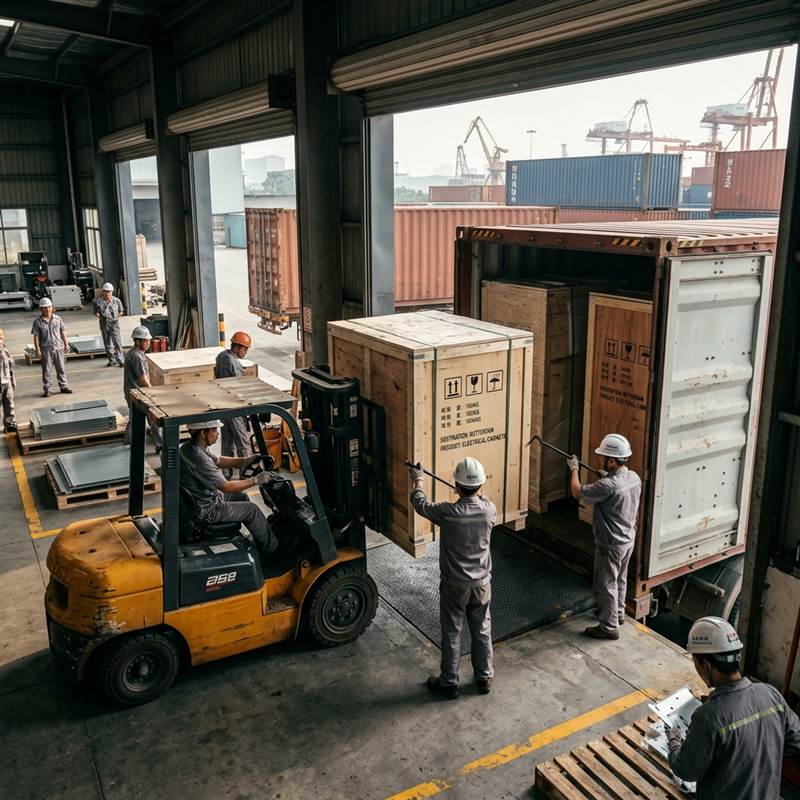
Most buyers underestimate sea-shipping risk until the first 40-foot container arrives with 8% of contents damaged. Sheet-metal enclosures spend 25–45 days in a humid, vibrating steel box; what goes in must survive temperature swings of 25–55°C, condensation cycles, and 1.5g lateral acceleration from container stacking. Packaging that works for inland trucking will fail every one of those exposures.
Table 5.1 — Export Packaging by Product & Route Risk
| Product type | Route & duration | Required protection | Why “carton + foam” fails |
|---|---|---|---|
| Outdoor telecom / EV cabinets (powder-coated, > 80 kg) | China → NA/EU, 28–40 days | ISPM-15 wood crate + steel banding + VCI desiccant + edge foam + protective film | Carton collapses under stacking; coating scuffs at edges |
| Precision instrument housings (polished or anodized) | China → Global, 25–45 days | Anti-static PE bag + foam-in-place + crate + humidity card | Condensation deposits visible spots on polished finish |
| Stainless 304 / 316 enclosures | China → Global, 25–45 days | Protective film + edge guards + ISPM-15 crate; do not use chloride-emitting packaging | Chloride contact causes pitting visible after 30 days |
| Flat-pack network / server cabinets | China → NA/EU, 28–40 days | Crate with internal partitions per panel + corner protection + assembly hardware in sealed bag | Panel-to-panel vibration scratches finish |
| Heavy MCC / BESS skeletons (> 300 kg) | China → Global, 25–45 days | Custom skid + bolt-down + heat-shrink wrap + tilt indicator | Slippage on pallet damages welded joints and door alignment |
MSTFAB designs export packaging as an engineering deliverable, not an afterthought: the packaging is sized per product, the wood is ISPM-15 fumigated for customs clearance into all major markets, and high-value or sensitive finishes get VCI corrosion inhibitor plus humidity indicators inside the wrap. Damage rate on documented MSTFAB shipments has remained below 0.5% over the last 36 months — measurable evidence that packaging engineering pays for itself many times over.
6. The Long-Term-Partner Test — What to Audit at Year 1, Year 2, Year 3 of a Supplier Relationship
A single successful order does not prove a long-term supplier; many factories can deliver Order #1 well and degrade by Order #5. Mature procurement organizations audit a supplier relationship on a rolling basis using a small number of leading indicators:
- Year 1: OTD (on-time-delivery) ≥ 95%; FAI accepted on first submission; CAR closure time < 14 days; engineering response < 4 h; zero documentation gaps.
- Year 2: Cpk on critical characteristics ≥ 1.33 across at least three batches; price stability or controlled escalation tied to raw-material indexes; capacity expansion plan visible; backup-machine redundancy documented.
- Year 3: Proactive cost-down proposals delivered; engineering-change cycle ≤ 5 days end-to-end; supplier-side process improvements presented (e.g. new adaptive bending machine, new pretreatment line); audit findings closed without repeat issues.
Suppliers that pass all three years’ tests are partner-grade. Suppliers that pass Year 1 but degrade at Year 2 are common and indicate organizational capacity limits — not necessarily bad faith, but not partner material either. Suppliers that fail Year 1 should be off the AVL before any second program is awarded.
7. The 10 Qualifying Questions to Ask in the First 30 Minutes of a Supplier Call
You can audit a candidate supplier’s actual engineering depth and program-management capability in a single 30-minute call. These questions have been refined across MSTFAB customer onboarding conversations and consistently separate engineering-led manufacturers from order-taking brokers:
- What is your typical DFM red-line turnaround on a complete STEP + 2D drawing package?
- Can you share a redacted DFM report you returned to another customer in the last 60 days?
- What press-brake make/model do you use for critical work, and does it have laser-angle adaptive measurement?
- How do you trace material from heat number to shipped part? Show me your traveller format.
- Show me a Cpk chart from a long-running OEM program (customer name redacted).
- Who signs the FAI — sales, quality engineer, or production supervisor?
- What is your average OTD over the last 12 months, and how do you measure it?
- Walk me through your pretreatment chemistry SPC — bath titration frequency, replenishment criteria, film-thickness measurement plan.
- How do you package > 80 kg powder-coated cabinets for 35-day sea freight? What is your historical damage rate?
- If we issue an engineering change at week 4 of production, what is your end-to-end revision cycle time?
Real engineering teams answer each question in under 60 seconds with specific numbers, equipment names, and process references. Brokers stall, redirect, or speak in generalities. The differential is striking — and decisive.
8. About MSTFAB — Engineering-Led OEM Sheet-Metal Partner in Guangzhou, China
MSTFAB (Guangzhou Maisituo Sheet Metal Manufacturing Co., Ltd.) is a 1,200 m² precision sheet-metal manufacturer in Guangzhou, China, ISO 9001 / ISO 14001 / IATF 16949 certified, with 23+ years of OEM experience serving European, North American, Australian and Middle Eastern customers across telecom, EV charging, energy-storage, industrial automation, medical equipment and power-distribution programs.
- Engineering-first quotation — every RFQ returns with a DFM red-line; 24-hour DFM, 48-hour fully-tiered quote
- Integrated single-roof production — fiber laser cutting (3 kW & 6 kW) → adaptive CNC bending (Amada / Trumpf 100 t / 170 t) → robotic MIG & manual TIG welding → 7-stage pretreatment + electrostatic powder coating → assembly & export packaging
- Material traceability — EN 10204 3.1 MTR linked to heat number on every shipment
- FAI & SPC discipline — full FAI with CMM measurement; SPC available on long-running programs; Cpk > 1.33 across documented OEM programs
- Engineered export packaging — ISPM-15 crating, VCI desiccants, route-specific protection; documented < 0.5% shipment damage rate over 36 months
- Direct engineer-to-engineer line — < 4-hour response SLA; in-house SolidWorks & AutoCAD team
- Cross-program proof — see also CNC bending OEM guide, drawing-requirement guide, fiber laser workshop guide, powder coating guide
Stop Paying the “Cheap Supplier” Premium. Start Measuring Landed Cost.
Send your current program drawings and quality requirements. Within 24 hours we return a DFM red-line and a transparent quote — including documented FAI, Cpk targets, EN 10204 3.1 traceability, and engineered export packaging. NDA on request before any file exchange.
Request a Drawing-First Quote & Free DFM Review
Frequently Asked Questions
Q1. We are mid-program with a failing supplier. How quickly can MSTFAB onboard a parallel build?
A typical recovery onboarding runs 4–8 weeks from NDA to first-article delivery: Week 1 — NDA + drawing transfer + DFM red-line; Week 2–3 — process planning + tooling + raw material procurement (EN 10204 3.1 traceable); Week 4 — prototype build + full CMM FAI; Week 5–6 — customer FAI sign-off + pilot batch (50–100 pieces); Week 7–8 — first production container ready. Critical-launch programs can be accelerated to 3–5 weeks with expedited engineering and pre-cleared raw materials, at a small expedite fee. We have onboarded several mid-program rescue projects on this schedule.
Q2. How does MSTFAB price relative to lower-cost Tier-3 Chinese factories?
Typically 8–18% higher on unit price, depending on geometry, tolerance and finish complexity. On landed-cost-per-acceptable-unit (the metric senior buyers actually use), MSTFAB is normally equal or 5–15% cheaper because rework, expedite, warranty and engineering-overhead lines disappear from the program P&L. We share the full TCO model openly with prospective customers because the math, not the sales pitch, is what makes the relationship durable.
Q3. What documentation does MSTFAB provide as standard with every shipment?
Standard documentation pack: (1) EN 10204 3.1 material test report linked to each heat number; (2) First-article inspection report with CMM measurements for all GD&T-controlled features; (3) Batch dimensional report per shipment; (4) Powder coating film-thickness report (multi-point per panel); (5) ISPM-15 phytosanitary certificate for crates; (6) Packing list + commercial invoice + COO. PPAP packages (Levels 2–4), IMDS submissions, REACH / RoHS declarations and traceable component traceability are available on customer request as additional services.
Q4. How does MSTFAB protect customer design IP — especially for sensitive products?
Five layers of protection: (1) Mutual NDA signed before any file transfer (we provide a customer-ready template on first contact); (2) Internal-only file handling — engineering team is in-house, no design outsourcing; (3) Need-to-know access — production travellers carry only what the operator needs; (4) Tool segregation — customer-specific tooling never shared between programs; (5) End-of-program file disposition — files returned or destroyed per customer instruction. For highly sensitive designs we accept redacted STEP for initial DFM and full files only after NDA + paid prototype.
Q5. We are a small OEM with low initial volumes. Are we too small to be a meaningful customer to MSTFAB?
No. MSTFAB’s customer base spans prototype-stage start-ups through global Tier-1 OEMs, and a meaningful share of our long-term partnerships started at < 500 units / year and scaled into 10,000+ unit annual programs. We treat low-volume launches as future scale and apply the same engineering discipline (DFM, FAI, traceability) regardless of order size. The trade-offs at low volume are mainly economic, not capability-based: per-piece tooling amortization is higher under 200 units / year. We will discuss these openly during the DFM review and propose volume-tiered pricing that lets the relationship grow with you.
sheet metal welding services
MSTFAB provides TIG and MIG sheet metal welding services for structural assemblies, cabinets, frames and OEM metal components.
 WeChat Contact
 WhatsApp Me Directly