Quick answer: A useful REACH documentation package for custom sheet metal enclosure parts should identify the exact supplied part or configuration, drawing revision, base metal, conversion coating, plating, powder or paint, gasket, adhesive, label, plastic item, purchased hardware, and other buyer-approved constituents. It should state the declaration scope, supplier evidence, relevant Candidate List reference date, known SVHC information, assumptions, exceptions, traceability, review triggers, and change-notification rules. The sheet metal fabricator can collect and organize documentation for materials, finishes, and mechanical parts within its approved supply scope. The OEM, importer, EU legal entity, article supplier, and qualified compliance professionals must determine applicable legal obligations, assess the complete product, communicate required information, make any SCIP submission, and approve market placement.
MSTFAB manufactures unpopulated custom sheet metal enclosure shells and mechanical parts from buyer-approved drawings. Our scope can include enclosure bodies, doors, covers, brackets, mounting plates, installed sheet metal hardware, buyer-specified gaskets or purchased mechanical items, surface finishing, supplier-document collection, configuration records, mechanical inspection, and export packaging. We do not manufacture finished electrical equipment, provide legal advice, issue an official government REACH certificate, determine the buyer’s importer or article-supplier duties, submit SCIP dossiers, certify a complete assembled product, or guarantee substances in components outside our controlled fabrication scope.
A buyer asks for a “REACH certificate.” The supplier sends a one-page statement saying “REACH compliant.” The statement has no part number, no Candidate List date, no coating identity, no gasket, no hardware, and no explanation of what was reviewed. Everyone now owns a PDF. Nobody yet owns a useful answer.
REACH documentation for custom enclosure parts is not a logo hunt. It is a controlled supply-chain exercise: identify what MSTFAB actually supplies, connect every relevant constituent to evidence, state what the evidence does and does not prove, and keep the package current when the Candidate List or approved configuration changes.
This guide is written for European OEM buyers, global sourcing teams, product-compliance specialists, supplier-quality engineers, mechanical designers, and project managers buying custom enclosure shells, panels, brackets, covers, and related fabricated parts. It explains a practical documentation workflow, not a legal conclusion for any specific product. Regulatory roles and obligations depend on the facts, location, quantities, supply chain, and current law, so qualified legal or compliance professionals should review the final determination.
What Does REACH Documentation Mean for Sheet Metal Enclosure Parts?
REACH is the EU Regulation on the Registration, Evaluation, Authorisation and Restriction of Chemicals. It regulates chemicals through duties that can apply differently to manufacturers, importers, downstream users, distributors, and suppliers of articles. A fabricated enclosure shell is generally discussed as an article, but the responsible organization must classify the actual supply and determine its obligations.
The official legal text is available through EUR-Lex Regulation (EC) No 1907/2006. Buyers should use the current consolidated law, ECHA guidance, and professional advice rather than treating any supplier blog as the final legal source.
REACH documentation is evidence, not a certification mark
There is no universal ECHA product certificate that a sheet metal factory downloads after completing a form. Supplier declarations, material statements, Safety Data Sheets, technical data sheets, test reports, purchase records, and traceability documents are pieces of evidence. Their value depends on scope, date, identity, source, and relevance to the delivered configuration.
The supplied part must be named precisely
“Metal enclosure” may mean a bare laser-cut panel, powder-coated welded shell, shell with gasket and hinges, hardware kit, or complete electrical cabinet. Those configurations do not contain the same constituents. The declaration should identify part number, revision, description, finish, included purchased items, and exclusions.
A supplier statement does not replace the buyer’s legal assessment
MSTFAB can describe and document the materials and processes within our supply. The buyer and responsible legal entity must decide how the supplied article enters a complex product, whether communication or notification duties apply, and what evidence is sufficient for the intended market. A fabricator’s declaration should be a reliable input, not a surprise promotion to corporate counsel.
Responsibility Matrix for a REACH Documentation Package
Responsibility should follow knowledge and legal role. MSTFAB knows the approved fabrication BOM and can request evidence from its material, coating, gasket, adhesive, and hardware suppliers. The OEM knows the final product, additional components, market, importer, supply chain, and compliance strategy.
| Decision or work package | Responsible owner | Controlled output |
|---|---|---|
| Applicable REACH duties, legal role, market, exemptions, Article 33 communication, Article 7 assessment, and SCIP obligations | OEM, importer, EU legal entity, and qualified compliance or legal professionals | Approved compliance determination and action plan |
| Final product BOM, complex-object structure, additional electronics, cables, batteries, fluids, labels, and packaging | OEM and final product organization | Complete product substance and article structure |
| Base metal, finish, gasket, adhesive, label, hardware, and mechanical items supplied by MSTFAB | MSTFAB within buyer-approved scope | Controlled fabrication BOM and supplier evidence |
| Supplier declaration scope, reference date, known SVHC information, traceability, and approved exceptions | MSTFAB and sub-tier suppliers for their respective supplies | Part-linked documentation package |
| Laboratory test plan, substance selection, sampling logic, interpretation, and legal conclusion | Buyer and qualified compliance professionals, with agreed supplier support | Risk-based test and assessment records |
| Change notification before material, coating, gasket, adhesive, hardware, or supplier substitution | MSTFAB notifies within contract; buyer approves impact | PCN, updated evidence, and approval record |
Start With the Exact Supplied Article and Configuration
Documentation begins with configuration control. A declaration covering a bare steel prototype does not automatically cover a production shell with powder coating, foam gasket, adhesive label, zinc-plated fasteners, plastic plugs, and protective film.
Identify the commercial line item
Link the package to the purchase-order part number, drawing revision, finish specification, BOM revision, approved supplier configuration, and delivery date or lot where relevant. If one drawing supports several materials or colors, identify which configuration the declaration covers.
Separate individual articles in a complex product structure
ECHA guidance discusses the Candidate List threshold in relation to articles and complex objects. Buyers should review the official ECHA guidance on Candidate List substances in articles and apply it to their actual structure with qualified support. A finished cabinet may contain multiple component articles; averaging everything into one convenient weight can hide the question the law asks.
State exclusions clearly
If MSTFAB supplies only the shell, exclude buyer-installed switches, fans, cables, electronics, batteries, sealants, warning labels, and field hardware. If MSTFAB supplies an approved gasket or fastener kit, include it. A declaration becomes more trustworthy when it says where it stops.
Build a Controlled Material and Process BOM
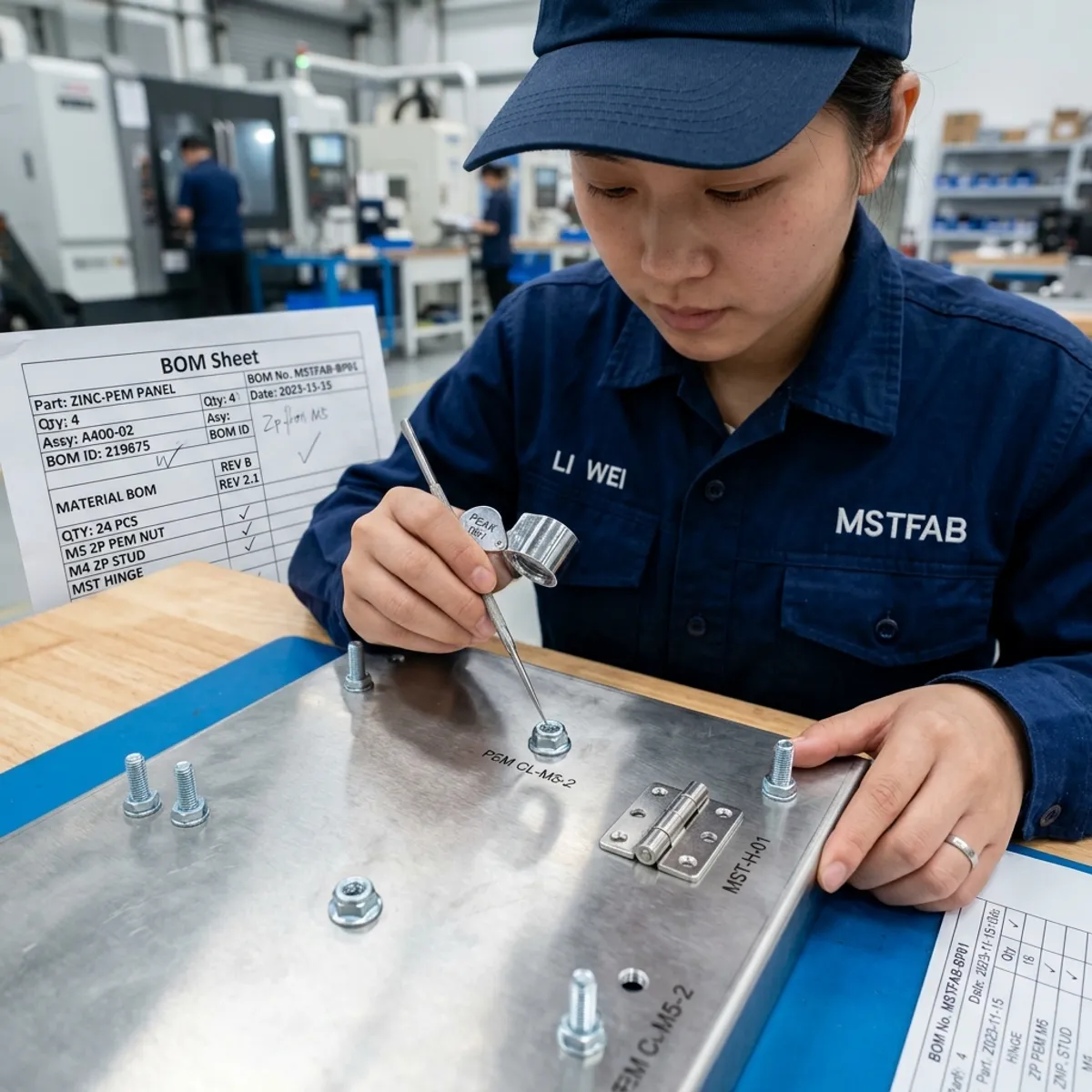
The documentation BOM should describe chemical-relevant constituents, not only parts visible in CAD. A useful structure connects each delivered item to material, surface treatment, purchased product identity, supplier, evidence, and revision status.
| BOM element | Identity to control | Typical evidence or record |
|---|---|---|
| Base sheet, plate, tube, or bar | Grade, standard, condition, mill or service-center source, and permitted substitutes | Material certificate, supplier declaration, purchase and lot records |
| Conversion coating, plating, passivation, or anodizing | Process specification, chemistry or product family, sub-tier processor, and post-treatment | Processor declaration, process specification, SDS/TDS where relevant, and lot record |
| Powder coating, wet paint, ink, or marking | Manufacturer, product code, color variant, primer, hardener, thinner, and approved alternatives | Manufacturer declaration, SDS/TDS, purchase record, and batch reference |
| Gasket, adhesive, sealant, foam, tape, or film | Exact material family, product code, adhesive system, color, and supplier | Supplier declaration, technical data, SDS where applicable, and receiving record |
| Fastener, insert, hinge, latch, DIN rail, plug, or purchased item | Exact part number, substrate, plating or coating, polymer, and approved source | Manufacturer or distributor declaration and purchase record |
| Packaging supplied with the part | Only where the buyer’s scope or separate legal requirements include it | Packaging BOM and supplier evidence |
Connect CAD, drawing, and BOM identities
The 3D model may show a hinge while the 2D drawing says “standard hinge” and purchasing uses a third description. Resolve those identities before requesting declarations. Compliance documentation cannot reliably follow a component that changes name at every handoff.
Include process consumables only when relevant to the delivered article
Not every factory chemical remains in the delivered part. The responsible assessment should distinguish process aids, cleaners, temporary masking, and substances intentionally present in the finished article. MSTFAB can provide process information within agreed scope; the buyer determines what is legally relevant.
Control approved alternatives before production
If the drawing permits equivalent powder, gasket, fastener, or material grades, each approved alternative needs its own evidence and decision rule. “Equivalent” is a purchasing category, not a chemical identity. The Candidate List is equally unimpressed by good intentions.
Document Base Metals Without Overclaiming
Common enclosure materials include carbon steel, zinc-coated steel, stainless steel, and aluminum. A mill certificate can confirm grade, heat chemistry, or mechanical properties according to its scope. It does not automatically answer every REACH question about coatings, oils, passivation, or later processing.
Match evidence to the purchased material form
Identify the actual sheet or coil specification, coating designation, temper or condition, and supplier. For zinc-coated steel, distinguish pre-coated sheet from post-fabrication galvanizing. For stainless and aluminum, control the exact grade and finish. The documentation should follow what was purchased, not the keyword used in the sales page.
Do not confuse a material certificate with an SVHC declaration
A chemical composition certificate normally reports selected alloying elements and limits under a material standard. It may not evaluate the current Candidate List or every surface substance. Use it as identity and traceability evidence, then add the specific supplier declaration or assessment required by the buyer.
Scale lot traceability to risk and contract
Some projects need declaration-level evidence by part family; others require purchase-order, coil, heat, or lot linkage. Define this before quotation. Collecting perfect heat traceability after parts are mixed, welded, coated, and packed is a fascinating administrative sport that buyers rarely enjoy funding.
Control Powder Coating, Paint, Plating, and Conversion Coatings
Surface treatment can introduce additional substances and sub-tier suppliers. Color approval, corrosion performance, and REACH documentation are related controls but not interchangeable controls. A powder can match RAL color and still require separate chemical evidence.
Freeze the exact coating system
Record powder or paint manufacturer, product code, color and texture variant, primer, hardener or thinner where applicable, pretreatment, and approved processor. Generic notes such as “outdoor powder coat” are not enough for documentation continuity.
Understand what SDS and TDS documents can support
A Safety Data Sheet is designed for hazardous chemical communication for substances or mixtures and can help identify the coating product used before cure. A Technical Data Sheet supports product identity and process conditions. Neither document alone necessarily proves the content of every Candidate List substance in the cured coating on the finished article.
Control plating and passivation chemistry through the sub-tier
Zinc plating, nickel plating, chromate conversion, passivation, and sealers need process and chemistry identity. Do not infer a hexavalent-chromium conclusion from coating color alone. The outsourced plating control guide covers quality and process flow-down; this page owns the REACH documentation handoff.


Identify Gaskets, Adhesives, Labels, and Polymer Parts
Non-metal items are easy to miss because they may be installed late, purchased under a generic description, or absent from the main enclosure drawing. They can nevertheless be constituent articles or materials relevant to the buyer’s assessment.
Use exact gasket and foam identities
State material family, grade or product code, color, density or hardness where relevant, adhesive backing, manufacturer, and approved source. “EPDM gasket” is a useful material family but not a complete supplier identity. Different formulations can carry different documentation.
Make adhesives and sealants visible in the BOM
Include structural adhesives, threadlockers, gasket adhesives, double-sided tape, sealants, and marking inks when they remain in the delivered part and fall within the agreed scope. Small quantity does not mean invisible. Threshold and obligation analysis belongs to the responsible compliance team, not to a supplier’s intuition.
Control labels, plugs, caps, and protective items
Permanent labels, plastic hole plugs, caps, feet, windows, and protective films left on delivery should have controlled identities. Temporary transport materials should be separated from permanent article constituents. The distinction saves both missed data and unnecessary declarations.

Control Hardware, DIN Rails, Hinges, and Purchased Mechanical Items
Purchased items may combine metal substrate, plating, passivation, lubricant, polymer insert, or coating. A thread size or general hardware description does not define those constituents.
Request declarations from the correct source
Manufacturer declarations are generally stronger than anonymous distributor statements because the manufacturer controls the product construction. When only distributor evidence is available, record the manufacturer and exact part where possible. A declaration for “fasteners we sell” is broad enough to be comfortable and narrow enough to be unhelpful.
Include installed hardware only within MSTFAB scope
If MSTFAB installs hinges, latches, inserts, studs, nuts, screws, DIN rails, or plugs, include them in the controlled fabrication BOM. If the buyer installs them later, exclude them from our declaration and let the buyer add the relevant evidence to the complete product package.
Do not assume a component marking answers REACH
CE, UL, material-grade, or manufacturer logos serve other purposes and do not automatically provide a current Candidate List assessment. Use the component supplier’s scoped REACH or SVHC information, then connect it to the exact purchased part.
Use the Candidate List Date and 0.1% Threshold Carefully
The ECHA Candidate List changes over time. A supplier statement should identify the list version or publication date it addresses. “Current REACH” becomes stale without a review trigger because current is a moving target wearing a very confident adjective.
Check the official Candidate List
ECHA maintains the official Candidate List of substances of very high concern. Do not copy a substance count into a permanent drawing note; link the assessment to a date and controlled evidence package instead.
Apply the threshold at the correct article level
Article 33 communication is commonly discussed when a Candidate List substance is present above 0.1% weight by weight in an article. The article-level interpretation can matter for complex products assembled from component articles. The buyer’s qualified compliance team should apply current ECHA guidance to the actual product structure and supply chain.
Do not turn “below 0.1%” into an undefined promise
A supplier should state whether the conclusion is based on upstream declaration, formulation knowledge, calculation, targeted testing, or another method, and identify scope and date. “No SVHC” without a list date, threshold, evidence basis, and part identity is not stronger because the sentence is shorter.
Build an Evidence Hierarchy and Use Testing by Risk
No single document type is always sufficient. The right package combines identity, supplier knowledge, traceability, and risk-based verification. Evidence should be evaluated for the actual substance question, not collected by file size.
| Evidence type | What it can support | Important limitation |
|---|---|---|
| Exact manufacturer declaration | Current product-specific Candidate List or REACH statement | Must match part, formulation, date, threshold, and scope |
| Material certificate | Base material identity, heat chemistry, and traceability within the standard | Usually not a complete Candidate List assessment |
| SDS and TDS | Substance or mixture hazards, product identity, and processing information | May not fully disclose composition or prove cured article content |
| Full material declaration or composition data | Detailed risk assessment when reliable and complete | Confidentiality, thresholds, and data quality must be managed |
| Laboratory test report | Selected substances or elements in a defined sample using a stated method | Cannot automatically prove absence of every Candidate List substance |
| Purchase, lot, and change records | Connection between approved evidence and delivered production | Traceability does not improve weak source evidence by itself |
Prefer product knowledge before broad testing
Start with controlled supplier identity, formulation knowledge, declarations, and risk screening. Testing is valuable when evidence is incomplete, the substance risk is credible, the buyer requires verification, or a change creates uncertainty. Random testing without a question can produce a precise answer to the wrong problem.
Understand screening limits
Techniques such as XRF can screen selected elements but do not identify every organic SVHC or distinguish all chemical forms. Other methods are substance-specific. The buyer and qualified laboratory should define analytes, detection limits, sampling, preparation, and interpretation.
Record why the evidence is sufficient
A short evidence rationale should identify risk, source, scope, date, gaps, and decision owner. This is more defensible than filling a folder with every PDF a supplier could locate before lunch.
Keep REACH, RoHS, SCIP, and Product Certification Separate
These terms often appear together in an RFQ, but they have different legal bases, scopes, thresholds, actors, and evidence needs. Combining them into one checkbox can hide missing work.
REACH and RoHS are not synonyms
RoHS restricts specified substances in certain electrical and electronic equipment and uses its own scope, exclusions, exemptions, and homogeneous-material concept. REACH covers a broader chemicals framework with article-related duties among others. A REACH declaration does not automatically prove RoHS compliance, and the reverse is equally ambitious.
For galvanized electrical box shells, chemical documentation is only half of the sourcing decision. Our REACH electrical box evidence and corrosion guide separates SVHC evidence from atmosphere, coating, condensation and service-life questions.
SCIP is a separate EU waste-framework obligation
ECHA explains the SCIP database for information on substances of concern in articles. Whether a submission is required, who submits, what article hierarchy applies, and what data must be included belong to the responsible EU supply-chain actor and compliance team. MSTFAB can provide agreed source data for supplied parts; we do not submit the buyer’s dossier.
Product marks do not replace substance documentation
CE marking, UL certification, IP or NEMA ratings, ISO management-system certificates, and material standards address other scopes. They may be relevant to the finished product or supplier qualification, but they are not automatic substitutes for a part-linked REACH evidence package.
Prepare the Buyer Handoff Package Before Production Approval
The documentation package should be reviewed with the first article or production-release package, not assembled for the first time when the shipment reaches customs or the customer’s compliance portal.
Create a one-page scope summary
List supplier, customer, part numbers, revisions, supplied configuration, Candidate List reference date, declaration basis, known reportable information, exclusions, contact, and approval status. The summary should point to detailed evidence rather than pretending to replace it.
Use an indexed evidence register
For each BOM item, identify supplier, product code, evidence file, issue date, list date, review status, expiry or trigger, and storage location. This lets the buyer find the gasket declaration without opening 47 files named “REACH latest final 2.pdf.”
Link evidence to the approved drawing and BOM revision
A CAD change may not alter substances, while a powder-supplier change may alter documentation without changing CAD. Control both engineering and supply-chain revisions. The sheet metal DFM guide covers manufacturability; this article controls the documentation relationship.
State unresolved gaps before shipment
Flag missing declarations, old Candidate List dates, generic hardware evidence, unapproved substitutes, or pending tests. The buyer can then accept, investigate, test, or hold the configuration. A known gap is manageable. A surprise gap discovered by the customer’s portal at 4:55 p.m. is a different species of project.

Control Supplier, Material, and Process Changes
Change control is what keeps yesterday’s valid package from becoming today’s misleading package. The contract or quality agreement should define notification triggers, lead time, required evidence, buyer approval, and disposition of work in process.
Define chemical-documentation change triggers
Triggers can include base-material source or grade, coating product, color formulation, pretreatment, plating chemistry, passivation, gasket, adhesive, label, plastic part, hardware manufacturer, sub-tier processor, approved alternative, or Candidate List update.
Require notice before implementation
MSTFAB should notify the buyer according to the agreed PCN process before implementing controlled changes. The buyer decides whether updated declarations, testing, sample approval, or regulatory reassessment is required. The separate supplier change-control guide owns the broader PCN workflow.
Review “better” substitutions too
A stronger steel, more durable coating, branded gasket, or faster hardware source can still change substance evidence, corrosion behavior, formability, or product records. The material substitution approval guide explains why a commercial upgrade still needs buyer approval.
Set Retention, Review Dates, and Retrieval Rules
There is no universal retention period for every project. The buyer should define retention based on legal duties, product life, warranty, customer contract, market surveillance, change history, and risk. MSTFAB retains agreed supplier and production records according to contract and its controlled procedures.
Use review triggers instead of pretending declarations never age
Review when the Candidate List changes, evidence expires, supplier or product identity changes, an SVHC issue emerges, the buyer changes market, or the configuration changes. A declaration dated five years ago may still describe the same formulation, but that conclusion needs review, not faith.
Keep records retrievable by part and revision
Index documents so they can be retrieved by customer, part number, revision, material or purchased item, supplier, and date. Email search is a tool, not a document-control strategy. The record-retention guide covers broader retention planning.
Preserve superseded evidence with status
Do not silently overwrite old declarations. Mark superseded files and retain the linkage to lots or configurations they supported. This allows the buyer to investigate historical shipments without applying today’s evidence backward by accident.
RFQ Checklist for REACH Documentation
Buyers should define documentation expectations during quotation because supplier outreach, test plans, traceability, and review effort affect lead time and cost.
| RFQ input | What the buyer should define | Why it matters |
|---|---|---|
| Supplied scope | Part numbers, revisions, configurations, finishes, installed items, kits, and exclusions | Defines what the declaration covers |
| Regulatory reference | Market, current Candidate List date, threshold language, customer specification, and responsible legal owner | Prevents an undefined “REACH compliant” request |
| Evidence level | Supplier declarations, material certificates, SDS/TDS, full material data, tests, and accepted sources | Aligns evidence with risk and customer portals |
| Traceability | Part-family, supplier, purchase order, batch, heat, lot, or shipment linkage | Connects evidence to production |
| SCIP data support | Data fields requested from MSTFAB and the buyer or EU actor responsible for assessment and submission | Separates source data from legal submission duty |
| Change control | Notification triggers, lead time, PCN content, approval, testing, and work-in-process disposition | Keeps the package valid after changes |
| Retention and handoff | File format, index, language, review cycle, retention period, and delivery milestone | Makes records usable after shipment |
For quotation, send the controlled BOM, drawings, finish specification, purchased-item list, target market, customer substance requirements, evidence template, Candidate List reference, traceability level, change-notice rules, and expected quantities. The broader manufacturing service is described on the custom electrical enclosure fabrication page.
Also define the acceptance workflow: who reviews the package, which questions must be closed before first article approval, how exceptions are recorded, and whether shipment depends on a signed review. Name files with the customer part number, revision, document type, supplier, and issue date, then place them in an indexed folder structure that both engineering and purchasing can understand. For repeat orders, identify whether MSTFAB should provide the complete package again, a change-only update, or a declaration tied to the new purchase order. This avoids two costly assumptions: the factory believing an unchanged drawing means no documentation review, and the buyer believing every historical declaration automatically covers the current Candidate List. If a supplier cannot provide an expected document, define the escalation route before production: approved alternative, targeted test, risk acceptance, or commercial hold. That decision belongs with the buyer’s responsible compliance and engineering teams. A clear RFQ may feel less exciting than a last-minute email chain, but it is considerably cheaper and has fewer attachments called “final-final-revised.”
Frequently Asked Questions
Can MSTFAB issue an official REACH certificate?
No universal government REACH product certificate exists for MSTFAB to issue. We can provide a scoped supplier declaration and supporting evidence for materials, finishes, and mechanical items within our approved supply, subject to agreed data availability.
Does “REACH compliant” have enough meaning by itself?
No. A useful statement identifies the part, configuration, Candidate List reference date, threshold or question addressed, evidence basis, exceptions, and issuer. The buyer must determine whether that evidence satisfies its legal and customer requirements.
Is a Safety Data Sheet enough for a finished enclosure part?
Usually not by itself. An SDS can support identity and hazard information for a substance or mixture such as uncured powder or paint, but it may not fully disclose composition or prove the content of the finished cured article.
Is a mill certificate enough for REACH?
A mill certificate supports base-metal identity and specified chemistry. It normally does not address every Candidate List substance, coating, gasket, adhesive, or purchased component in the delivered configuration.
Does REACH apply only to chemicals, not metal parts?
REACH includes duties related to substances in articles. The responsible organization must classify the actual supply, legal role, market, and applicable obligations using current law and guidance.
What is the REACH 0.1% threshold?
Article 33 communication is commonly associated with Candidate List substances above 0.1% weight by weight in an article. How that applies to a complex product and other duties should be assessed by qualified professionals using current ECHA guidance.
Who is responsible for a SCIP submission?
The responsible EU supply-chain actor determines and performs any required submission. MSTFAB can provide agreed information about supplied enclosure parts but does not make the buyer’s legal determination or submit its dossier.
Are REACH and RoHS the same?
No. They have different legal bases, scopes, substances, thresholds, exemptions, and responsible actors. Buyers should request and evaluate each requirement separately.
Does a negative XRF report prove full REACH compliance?
No. XRF can screen selected elements but cannot detect every Candidate List substance or determine every chemical form. Testing must be selected and interpreted against a defined risk question.
Should every enclosure part be laboratory tested?
Not automatically. A risk-based approach uses supplier identity, declarations, formulation knowledge, traceability, and targeted testing where evidence or risk justifies it. The buyer defines the test plan and acceptance.
What items are most often missed in an enclosure BOM?
Common omissions include coating primers, conversion treatments, gasket adhesive, sealant, permanent labels, plastic plugs, protective films, plated inserts, hinges, latches, DIN rails, and loose hardware kits.
When should the documentation be updated?
Review it when the Candidate List, material, coating, gasket, adhesive, hardware, supplier, sub-tier process, drawing, BOM, approved alternative, customer requirement, or target market changes.
Does MSTFAB certify the complete electrical cabinet?
No. MSTFAB supplies custom unpopulated sheet metal enclosure shells and mechanical parts. The OEM or responsible legal entity assesses electronics, wiring, cables, batteries, purchased electrical components, final assembly, and market obligations.
Conclusion: Make the Declaration Match the Delivered Part
Reliable REACH documentation starts with a precisely identified supplied article, controlled BOM, exact material and finish identities, part-linked supplier evidence, Candidate List reference date, transparent limitations, risk-based testing, and change control that keeps the package current.
MSTFAB can manufacture the buyer-approved unpopulated sheet metal shell and mechanical parts, organize documentation for materials and items within our supply, maintain agreed traceability, and notify controlled changes. The OEM, importer, EU legal entity, and qualified compliance professionals retain responsibility for legal interpretation, complete-product assessment, Article 33 communication, SCIP submission, and market approval.
That boundary is useful. It replaces the mysterious one-page “certificate” with evidence a buyer can actually review, and it keeps a powder-coating color chip from being asked to practice European chemicals law.
Written by: MSTFAB Sheet Metal Engineering Team
Technical review: Fabrication and Quality Team
Regulatory note: General supplier-documentation guidance, not legal advice
Last reviewed: August 2026
 WeChat Contact
 WhatsApp Me Directly