
INTELLIGENT TRANSPORTATION (ITS) & TRAFFIC CABINETS — EXECUTIVE TECHNICAL BRIEF
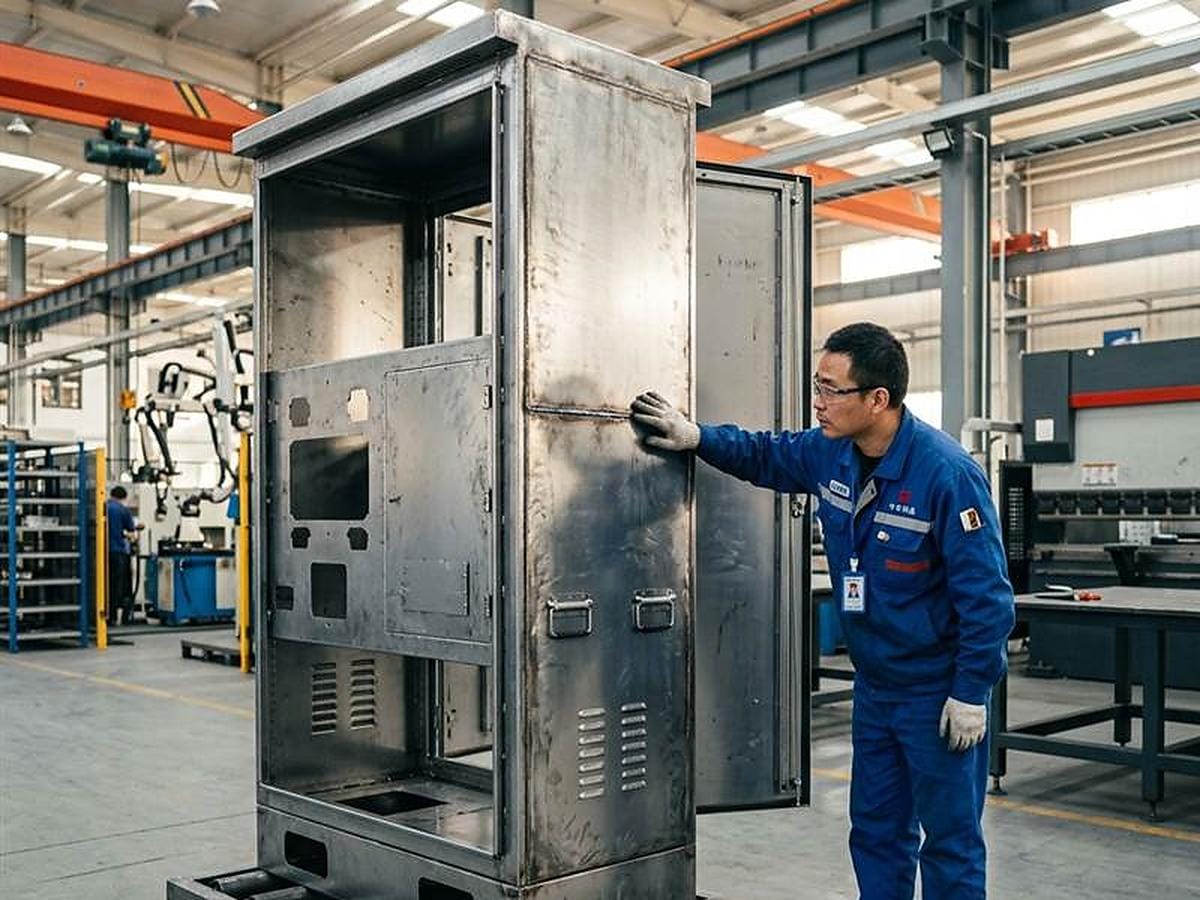
Municipal intersection controllers, highway tolling gantries, variable message signs (VMS), and roadside ITS sensor nodes depend on rugged traffic control cabinet shells (NEMA TS2 Type 1/2 and Caltrans 170/332/334/336 architectures) that survive 20+ years of vehicle splash, solar heat, vandalism, and de-icing salt. MSTFAB fabricates heavy-duty traffic cabinet shells from 3.0–3.2 mm (0.125″) marine-grade 5052-H32 aluminum and 2.0 mm 304/316L stainless steel—complete with 3-point stainless deadbolt latches, recessed police-panel sub-doors, louvered MERV filter plenums, and adjustable 19-inch EIA-310 rack cages.
- 3.2 mm (0.125″) 5052-H32 Marine Aluminum Unibody: High-strength, corrosion-proof 5052-H32 aluminum shells TIG-welded with ER5356 filler wire deliver NEMA 3R / IP55 weather protection at 55% less weight than steel.
- Dual-Door Architecture + Recessed “Police Panel” Door: Front/rear full-height equipment doors paired with an auxiliary flush-mounted small “police door” for manual flash/auto intersection override switches.
- 3-Point Stainless Roller-Cam Latch & Corning/Best Lock Cutouts: Heavy-duty 304 stainless steel 3-point rod mechanisms with padlockable handles and standard traffic barrel-lock / Corbin #2 key cylinders.
- Removable 19-Inch EIA-310 Rack Cage & Corbin Plinth Mounts: Internal 19-inch rack frames with generator transfer-switch shelves and standard concrete foundation anchor-bolt footprints.
Every project at MSTFAB includes a complimentary 24-hour CAD Design-for-Manufacturing (DFM) audit, heat-number-traceable EN 10204 3.1 mill certificates, and a ballooned First Article Inspection (FAI) report prior to volume release.
01 / Engineering Specifications & Comparison Matrix
Engineering Specifications, Tolerances & Verification Matrix: Traffic Control Cabinet Shells
Municipal intersection controllers, highway tolling gantries, variable message signs (VMS), and roadside ITS sensor nodes depend on rugged traffic control cabinet shells (NEMA TS2 Type 1/2 and Caltrans 170/332/334/336 architectures) that survive 20+ years of vehicle splash, solar heat, vandalism, and de-icing salt. MSTFAB fabricates heavy-duty traffic cabinet shells from 3.0–3.2 mm (0.125″) marine-grade 5052-H32 aluminum and 2.0 mm 304/316L stainless steel—complete with 3-point stainless deadbolt latches, recessed police-panel sub-doors, louvered MERV filter plenums, and adjustable 19-inch EIA-310 rack cages. When sourcing custom sheet metal components and enclosures at industrial OEM scale, verbal assurances cannot substitute for drawing-locked process controls. Below is the engineering specification matrix governing raw material selection, dimensional tolerances (per ISO 2768-mK / fH), surface treatment durability, and metrology verification at MSTFAB.
Each parameter is verified during incoming raw material quarantine, in-process CNC stage checks, and final First Article Inspection (FAI) before shipment release:
| Engineering Parameter / Zone | Material & Process Specification | Target Tolerance / Performance Standard | Inspection Method & OEM Value |
|---|---|---|---|
| Cabinet Skin & Roof Material | 3.0–3.2 mm (0.125″) AA 5052-H32 Aluminum or 2.0 mm SS304/316L | Tensile ≥ 210 MPa; Zero weld cracking | OES alloy analyzer + dye-penetrant corner check: Meets DOT / Caltrans / NEMA TS2 structural rigidity and salt-fog standards |
| Weather & Intake Louver System | Labyrinth rain-shielded intake louvers + pleated aluminio/mesh filter rack | UL 50E Type 3R / IP55 wind-driven rain exclusion | Pressurized hose-down spray test (IEC 60529): Flows ≥ 100–300 CFM via roof exhaust plenum fans while blocking road splash |
| 3-Point Security & Police Door | SS304 3-point rod latch with nylon rollers + recessed police sub-door | Pry-resistant hemmed door edges; 3-position wind-stop bar | 500-cycle latch test + gasket compression check: Allows traffic police manual control access without exposing high-voltage terminals |
| Internal 19″ EIA-310 Cage | Welded aluminum or galvanized 19-inch rack frame (332 / 334 / custom U) | 465.1 ± 1.0 mm rail aperture; 10-32 tapped or cage-nut holes | CMM / laser scale rail pitch verification: Holds ATC controllers, conflict monitors (MMU), UPS batteries, and fiber switches |
| Exterior Anti-Graffiti & Solar Finish | Natural brushed grain, clear anodize, or RAL 7035/9003 UV polyester powder | Solar reflectance ≥ 0.70; 1,000h ASTM B117 salt spray | Elcometer DFT + ASTM D3359 5B cross-hatch test: Reduces internal solar heat load and resists urban graffiti solvents |
02 / Sheet Metal DFM & Structural Controls
Critical Sheet Metal DFM Rules & Field Failure Prevention
Most cost overruns, assembly fit-up delays, and field corrosion failures originate from subtle CAD geometry details or ambiguous drawing notes. Implementing these Design-for-Manufacturing (DFM) controls before releasing your files eliminates tool collisions, thermal warpage, and rework:
Forming 3.2 mm Aluminum Traffic Doors from 6061-T6 Instead of 5052-H32
Failure Mechanism: 6061-T6 cracks along the outer heel when bent to the tight 90° return-flange channels required for traffic cabinet doors and rain gutters.
Engineering Solution: Always specify AA 5052-H32 for formed traffic cabinet skins, doors, and shelves (with inside bend radius R = 1.0t to 1.5t).
Verified Outcome: Crack-free forming and superior marine/road-salt corrosion resistance
Welding Unbaffled Roof Exhaust Vents That Let Wind-Driven Rain Drip onto the 19-Inch Rack
Failure Mechanism: Mounting an exhaust fan directly under a flat perforated roof plate allows wind-blown rain to drip straight onto the intersection controller shelf when the fan is off.
Engineering Solution: Fabricate an overhanging pitched roof canopy with downward-facing perimeter exhaust slots separated from the main cabinet ceiling by a raised collar neck.
Verified Outcome: 100% gravity and wind-driven rain exclusion into the top fan plenum
Omitting Door-Hold-Open Wind Stops on Roadside Cabinets
Failure Mechanism: Highway truck slipstreams (80+ km/h) slam unlatched cabinet doors shut onto a technician’s arms or laptop during intersection maintenance.
Engineering Solution: Install heavy-duty 304 stainless steel bottom/top mechanical wind-stop hold-open rods that automatically latch at 90°, 120°, and 165° open positions.
Verified Outcome: Safe roadside technician access in high-wind corridors
Manufacturing Scope Boundary: Inaccurate Bottom Anchor-Bolt Slot Patterns Failing to Match Existing Concrete Traffic Pads: Municipalities retrofitting older intersections require the new cabinet base flange to bolt directly onto existing cast-in-place 332/334/NEMA P/M/R concrete anchor bolts. — Engineering Fix: Laser-cut the bottom internal mounting flange from a single template with generous slotted anchor holes and reinforced 5.0 mm corner gussets. (Drop-in retrofits onto standard DOT concrete foundations without redrilling). MSTFAB manufactures custom sheet metal parts and empty mechanical enclosure shells strictly to your 3D STEP and 2D PDF drawings.
03 / Representative Engineering Scenario & Process Control
Representative OEM Engineering Scenario: Smart-City ITS Integrator Deploys 420 Custom 3.2mm 5052-H32 Caltrans-Style Cabinets Across Highway Corridors
Project Profile: Intelligent Transportation (its) & Traffic Cabinets project reviewed by the MSTFAB DFM engineering team
OEM Engineering Challenge: A highway ITS systems integrator needed 420 custom dual-door 5052-H32 aluminum roadside cabinets (modified 332 footprint with an auxiliary side battery compartment and generator plug door) delivered on a tight 10-week municipal schedule.
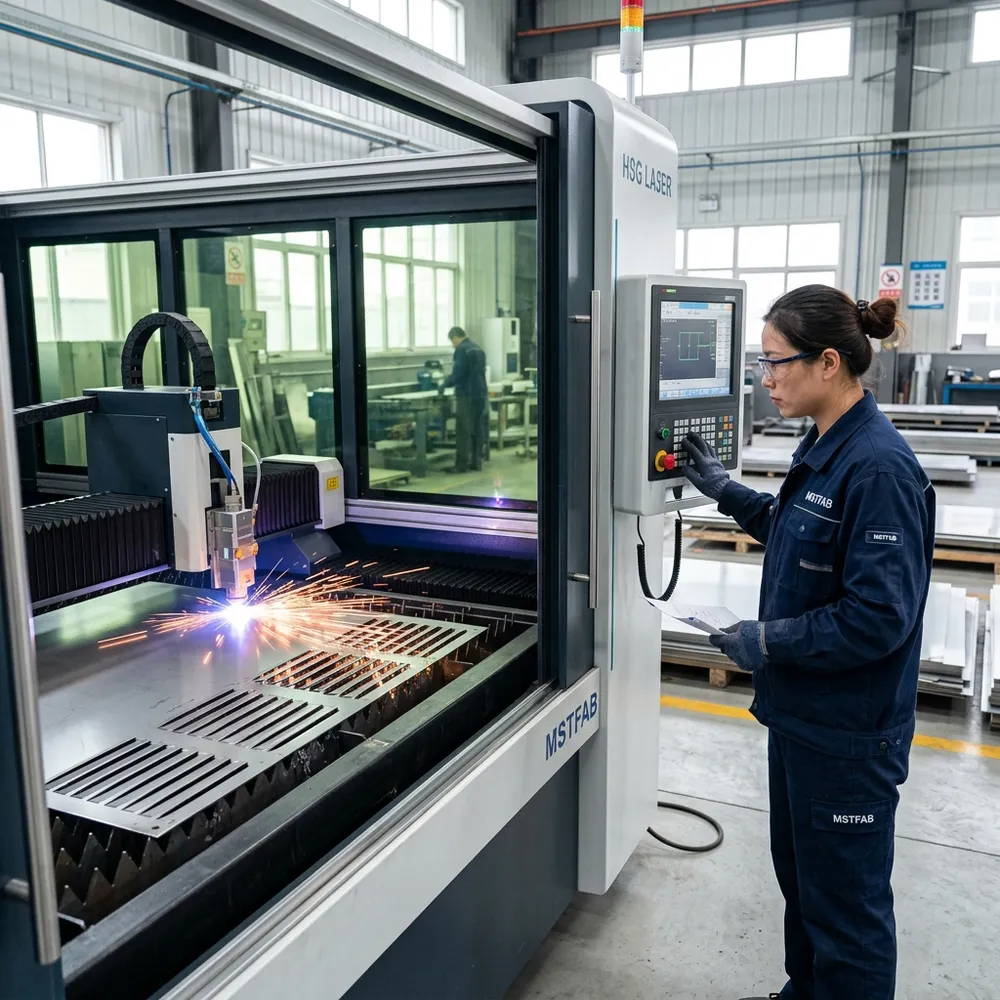
MSTFAB Manufacturing Solution: MSTFAB engineered a modular laser-cut and TIG-welded 3.2 mm 5052-H32 cabinet shell with robotic FIP polyurethane door gaskets, recessed police and generator doors, stainless 3-point roller latches, and solar-reflective white TGIC-free polyester powder coating.
- 100% NEMA 3R & IP55 Approval: Passed third-party wind-driven rain and salt-fog validation on the first article.
- Zero Foundation Anchor Mismatches: All 420 cabinets bolted directly onto existing roadside concrete pads.
- 28% Cost Savings vs. Domestic Catalog Shells: Delivered complete with pre-installed 19-inch EIA racks, filter retainers, and door-open switches.
Every production lot is archived with locked CNC laser nests, press-brake bend programs, weld fixture setups, and signed golden samples to guarantee identical repeatability across multi-year reorders.
04 / Quality Verification, Traceability & Surface Finishing
4-Stage Manufacturing Workflow, Surface Treatment & Metrology Control
To maintain Cpk ≥ 1.33 on critical-to-quality (CTQ) dimensions from prototype through series production, MSTFAB executes a closed-loop four-stage fabrication protocol:
Step 01 — Drawing & DFM Review: Engineers check the 3D STEP and 2D PDF for bend reliefs, hole-to-bend distances, hardware callouts, tolerance stack-up and finish masking before any material is released.
Step 02 — Cutting & Forming: Parts are fiber-laser cut or CNC punched, deburred, then formed on CNC press brakes using bend programs verified on the first piece.
Step 03 — Joining & Hardware: Welding, spot welding or self-clinching hardware insertion is completed in fixtures, followed by weld dressing where the drawing defines cosmetic zones.
Step 04 — Finishing, Inspection & Packing: Pretreatment and coating are applied to the specified system, then CTQ dimensions, coating thickness, adhesion and fit are checked before protective export packing.
All raw sheets (SPCC, SGCC, SECC, SUS304/316L, Al 5052-H32/6061-T6) are verified via optical emission spectrometry (OES) or XRF upon arrival and linked by barcode to your purchase order.
Prior to export crating in ISPM-15 fumigated plywood boxes, our quality lab conducts ballooned dimensional FAI checks, dry-film thickness (DFT) mapping, ASTM D3359 cross-hatch adhesion testing, and ground-continuity verification.
05 / 8-Point OEM RFQ Checklist & Topic Cluster Hub
OEM Engineering RFQ Checklist & Connected Fabrication Hubs
Include these eight drawing and specification controls in your RFQ package so our engineering team can lock down tooling, material traceability, and inspection fixtures on day one:
- RFQ Requirement 013D STEP/IGES model plus a released 2D PDF drawing with revision letter and datum scheme.
- RFQ Requirement 02Material grade and thickness (e.g. SPCC, SGCC, SUS304/316L, Al 5052-H32) and any substitution rules.
- RFQ Requirement 03Critical-to-quality dimensions and general tolerance standard (e.g. ISO 2768-mK).
- RFQ Requirement 04Hardware list: PEM nuts/studs/standoffs, hinges, latches, gaskets and grounding points.
- RFQ Requirement 05Surface finish, RAL color, gloss/texture, masking areas and cosmetic class.
- RFQ Requirement 06Environmental target if applicable (IP code or NEMA type) and who is responsible for verification.
- RFQ Requirement 07Prototype quantity, production batch size, annual volume and target delivery dates.
- RFQ Requirement 08Inspection documents required (FAI report, material certificates) and packing/destination terms.
Explore Connected Sheet Metal Fabrication Services & Enclosure Hubs
CNC Press Brake Sheet Metal Bending & Forming
TIG / MIG / Robotic Sheet Metal Welding Services
Powder Coating, Passivation & Anodizing Finishes
Precision CNC Machining & Hybrid Metal Assemblies
Custom Electrical Enclosures & OEM Equipment Shells
Upload 3D STEP + 2D PDF for 24-Hour DFM & Price Quote
ISO 9001 & IATF 16949 Certified Factory Fact Sheet
06 / OEM Buyer & Engineer FAQ
Frequently Asked Questions: Traffic Control Cabinet Shells
Can MSTFAB fabricate standard Caltrans 332, 334, 336S, and NEMA TS2 Type 1/2 cabinet footprints?
Yes. We manufacture empty mechanical cabinet shells and internal 19-inch rack cages built to match standard Caltrans (332, 334, 336, 336S) and NEMA TS2 (Size 2 through Size 7 / Type P, M, R) foundation anchor patterns, as well as fully customized smart-city pole and pad-mount enclosures.
Do you offer both natural brushed/anodized aluminum and powder-coated traffic cabinets?
Yes. Many DOT specs call for either grain-brushed/anodized bare 5052-H32 aluminum or chromate-pretreated aluminum coated in solar-reflective white, silver, gray, or municipal green UV-stable polyester powder (plus optional clear anti-graffiti topcoats).
Can you include the internal 19-inch rack cage, pull-out laptop drawer, and fan/thermostat brackets?
Yes. We supply the complete mechanical package including adjustable 19-inch EIA-310 rack rails, ball-bearing pull-out laptop/document drawers, removable filter cages, roof fan mounting shrouds, and copper grounding busbars.
What is your lead time for custom traffic control cabinet shells?
First Article prototype cabinets ship in 10–14 business days, and volume production runs of 20–200+ cabinets ship in 3–4 weeks.
International Standards & Engineering References
- ISO 2768-1 / 2768-2 — General Linear, Angular and Geometrical Tolerances for Sheet Metal Fabrication
- IEC 60529 / NEMA 250 — Degrees of Protection Provided by Enclosures (IP Code & Environmental Sealing)
- ISO 9001:2015 & IATF 16949:2016 — Quality Management Systems & Production Part Approval Process (PPAP)
Ready to Quote Your Custom Sheet Metal Enclosure or Fabrication Project?
Upload your 3D STEP models and 2D PDF drawings. MSTFAB will review your tolerances, material specs, and DFM details to deliver a transparent factory quote within 24 hours.
Request Your 24-Hour DFM & Custom Quote →
Direct engineering desk: caroline@mstfab.com | ISO 9001 & IATF 16949 Certified Factory in Guangzhou, China
 WeChat Contact
 WhatsApp Me Directly