A cooling decision is only as reliable as its heat-load input package. Freeze equipment dissipation by operating state, ambient and solar exposure, cabinet construction, allowable internal limits, site conditions, redundancy and validation ownership before releasing the enclosure interfaces.
A single heat-load figure does not describe every operating state. Give the responsible engineer traceable equipment data, site conditions and assumptions, and review them when a component or installation site changes.
Move from thermal inputs to a released mechanical interface.
Each stage answers a different procurement question. Keeping the stages separate prevents an empty sheet metal shell from being described as a tested climate-control system.
Build the input baseline
Record equipment states, site conditions, solar exposure, enclosure construction, operating limits and assumptions for approval by the responsible thermal designer.
Compare cooling methods
Use the cooling-architecture comparison guide after the input baseline is approved.
Release the airflow path
Use the airflow-path and ventilation release guide for openings, pressure zones, filters and baffles.
Release selected hardware
Use the cooling-hardware interface checklist for cutouts, loads, seals, drains and service access.
Name the owner of every input, decision and test.
The thermal designer needs credible equipment and site data. The shell fabricator needs released mechanical requirements. The validation party needs a complete installed configuration and acceptance criteria.
Equipment owner
Provides dissipation by mode, limits, duty cycle, efficiency or charging states, layout, airflow direction and change history.
Thermal or system designer
Controls the heat balance, assumptions, cooling method, capacity, controls, margins, redundancy and acceptance criteria.
Shell fabricator
Reviews manufacturability and fabricates released sheet metal panels, empty double-wall cavities, shields, openings, mounts and baffles. Insulation supply and installation remain with the buyer or integrator.
Integrator or test party
Installs equipment and controls, confirms field configuration, and performs the responsible system-level verification.
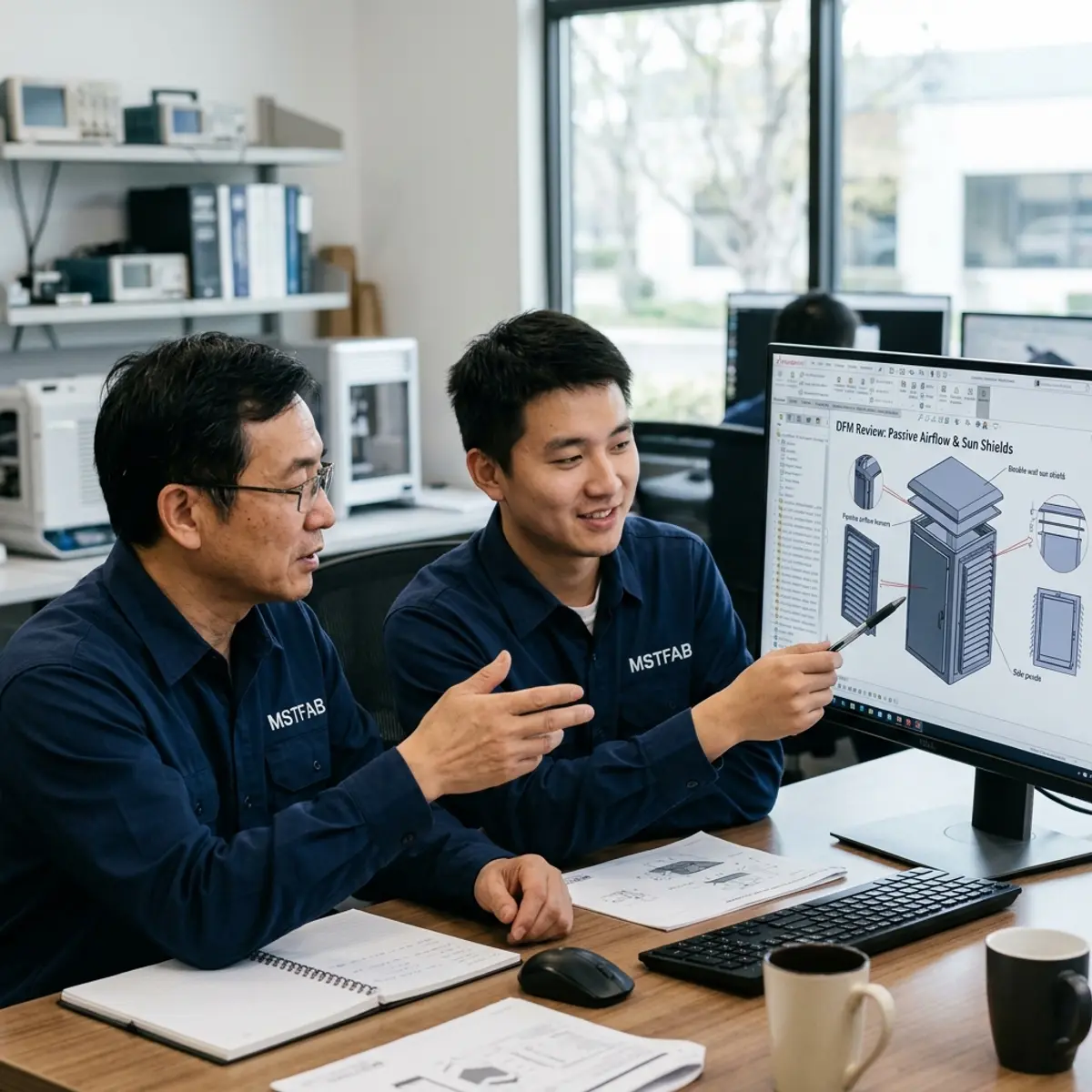
Control the assumptions before calculating capacity.
The responsible thermal engineer decides the model and margin. Procurement can make that work auditable by requesting the inputs below and recording where each value came from.
| Input group | What the buyer should provide | Decision or evidence affected |
|---|---|---|
| Equipment heat | Dissipation for normal, peak, standby, startup, charging and fault-recovery states, with source data and revision. | Heat balance, component selection, control sequence and scenario coverage. |
| Ambient environment | Site-specific temperature and humidity profiles, altitude when relevant, dust or salt exposure, wind and installation location. | Cooling architecture, derating, condensation analysis, material and maintenance strategy. |
| Solar exposure | Orientation, shade, roof and wall exposure, exterior color or finish, nearby surfaces and solar-shield assumptions. | External gain, surface treatment, shield geometry and test boundary. |
| Cabinet construction | Overall dimensions, material, wall build-up, insulation type and thickness, compartments, leakage strategy and internal layout. | Heat transfer, usable volume, interface geometry, weight and assembly sequence. |
| Allowed equipment envelope | Minimum and maximum operating limits, local hot-spot limits, humidity or dew-point limits, alarm thresholds and recovery rules. | Control targets, sensor positions, operating states and acceptance criteria. |
| Site and service state | Wall clearance, pole or pad mounting, door-open service duration, filter maintenance, cable changes and replacement access. | Air path, derating, removal envelope, service assumptions and field instructions. |
| Power and resilience | Available supply, startup current, backup operation, redundancy target, degraded mode and remote monitoring ownership. | Cooling choice, electrical architecture, failover logic and responsible integration test. |
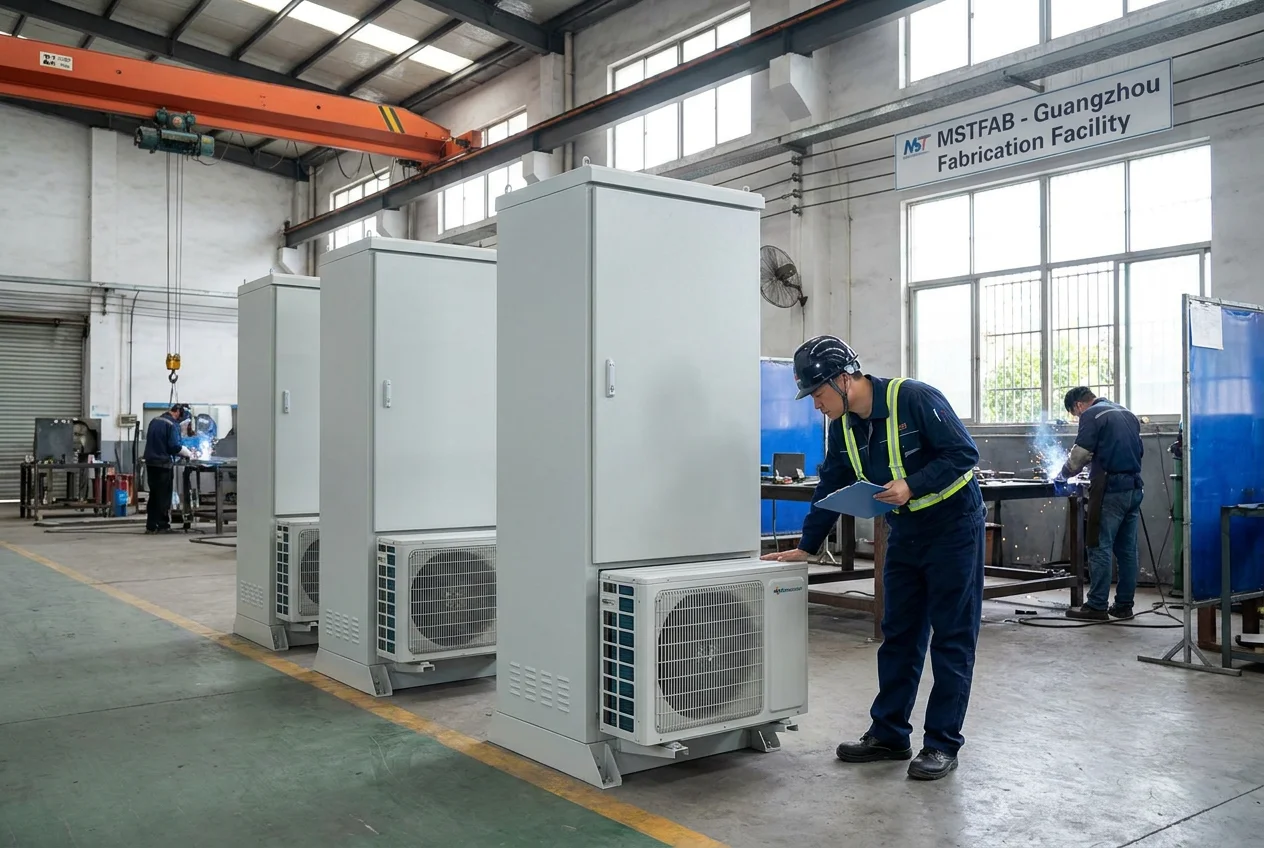
Use operating states, not one optimistic design point.
Peak heat, peak solar exposure and peak ambient conditions may not occur together, but assuming they never do is also a decision. Record the combination rules and the party who approved them.
Expected traffic or equipment duty, closed cabinet, maintained filters and normal power.
Maximum credible load, charging or transmit state and any short-duration limit.
Design ambient, solar exposure, altitude and installation clearance for the named location.
Filter loading, one failed unit, reduced power or alarm mode when the project requires resilience.
Door-open duration, temporary airflow disruption, technician access and restart assumptions.
Translate the thermal decision into mechanical requirements.
After the responsible engineer selects an architecture, the enclosure drawing must capture what fabrication can control. Method names alone do not define a buildable cabinet.
Passive or filtered ventilation
Release opening geometry, perforations or louvers, filters, rain protection, pressure zones, baffles and service access.
Air-to-air heat exchanger
Release the selected unit, cutout, mount, mass, gasket land, separate airflow loops, connector and removal path.
Air conditioner or TEC
Release component geometry, support path, fasteners, seal, drain, cable route, door state and finished-condition fit check.
Heating or condensation control
Release heater and sensor mounting, cable interfaces, insulation cavities, drains and responsible control logic without assigning system performance to the shell.
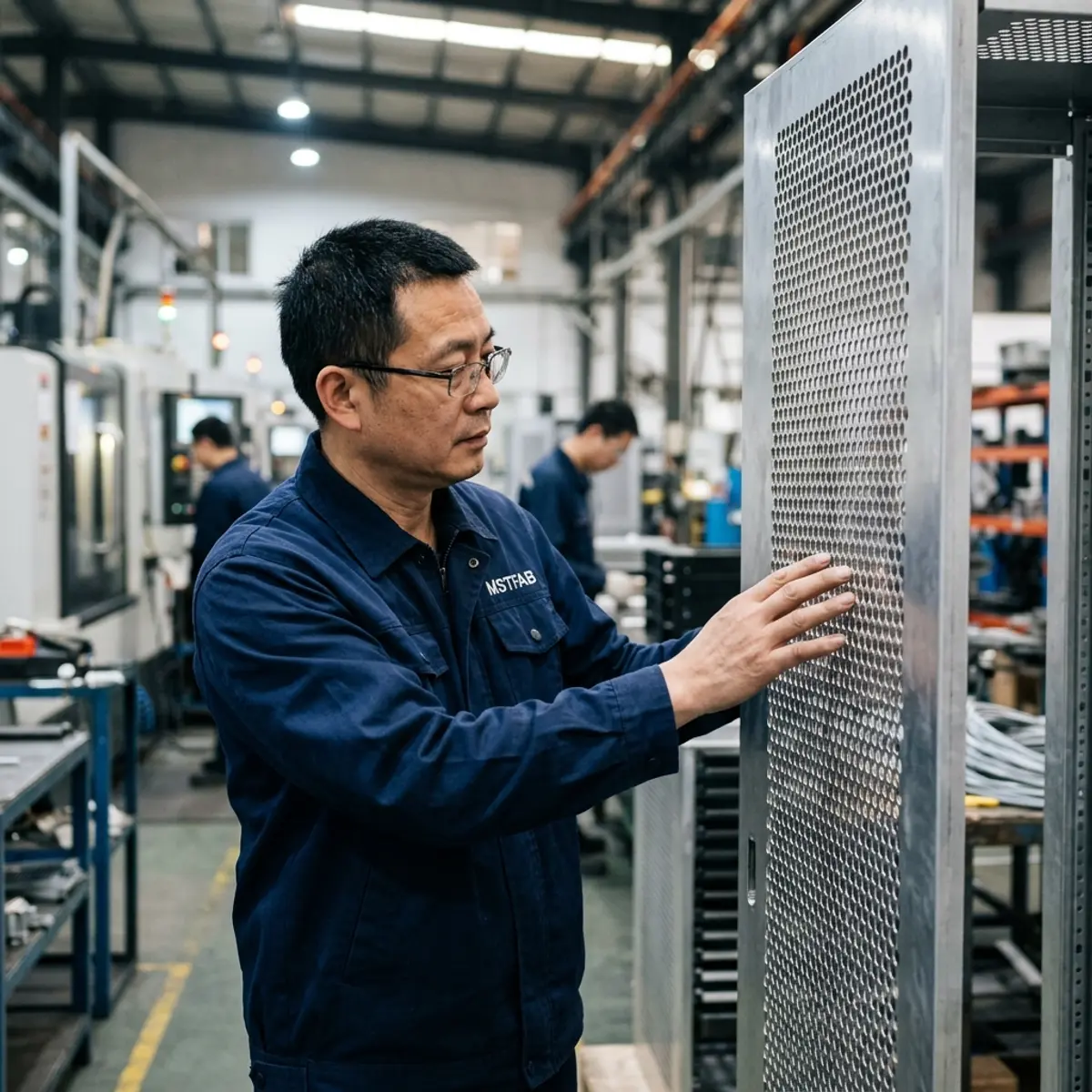
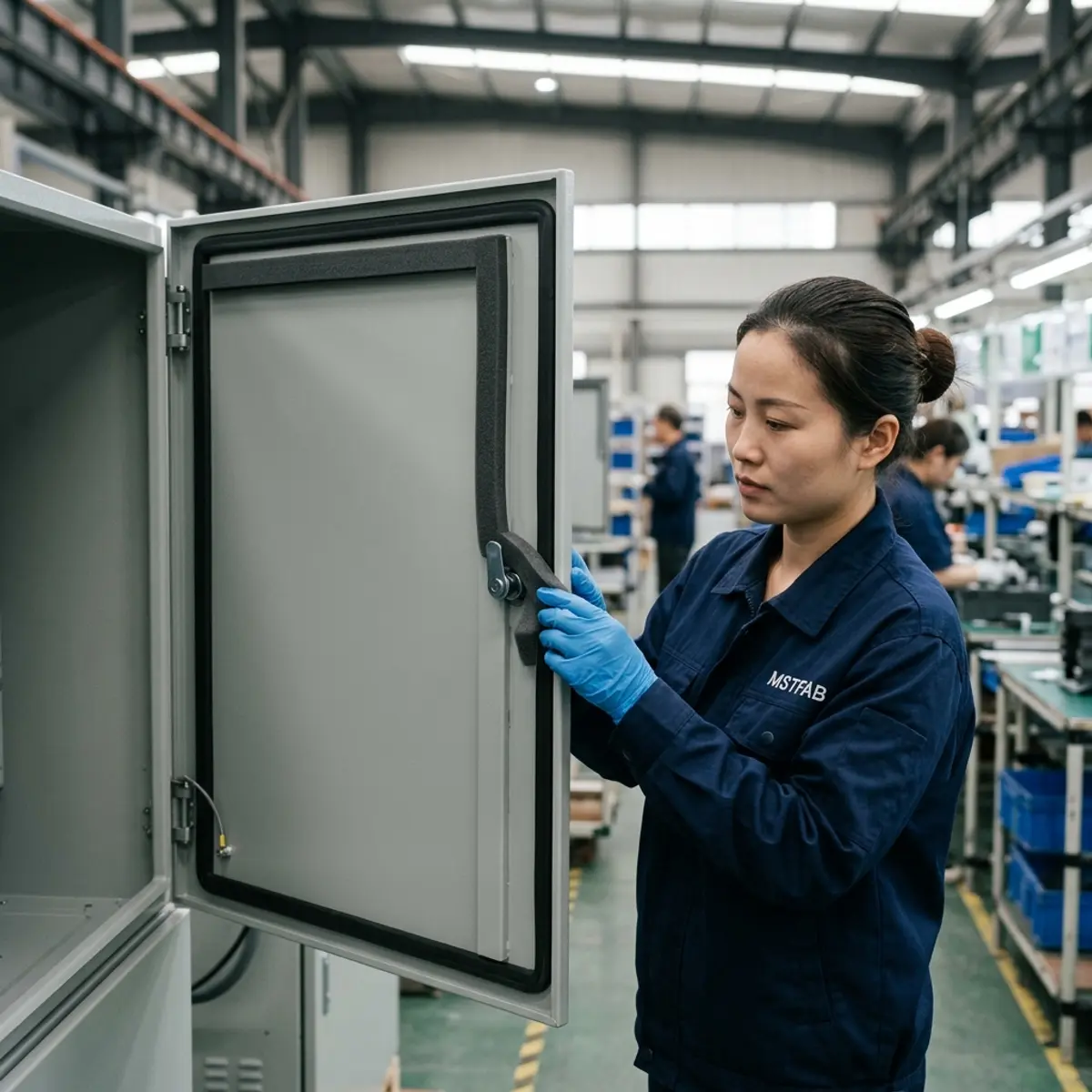
Model the boundary conditions the cabinet will actually see.
Cooling can create cold surfaces, and outdoor exposure can heat selected walls far above the surrounding air. The responsible analysis should cover both rather than treating ambient temperature as the entire environment.
Dew-point risk
Record humidity, temperature transitions, cold surfaces, air exchange, drains, heater or dehumidification ownership and sensor strategy.
Solar orientation
Record exposed faces, color, nearby reflective surfaces, roof condition and whether a shield or air gap is included in the model.
Insulation boundary
Define material, thickness, joints, adhesive or retention, compression, fire requirements and which surfaces are included.
Acceptance boundary
Name the instrument locations, operating states, duration, pass criteria, deviations and responsible test party.
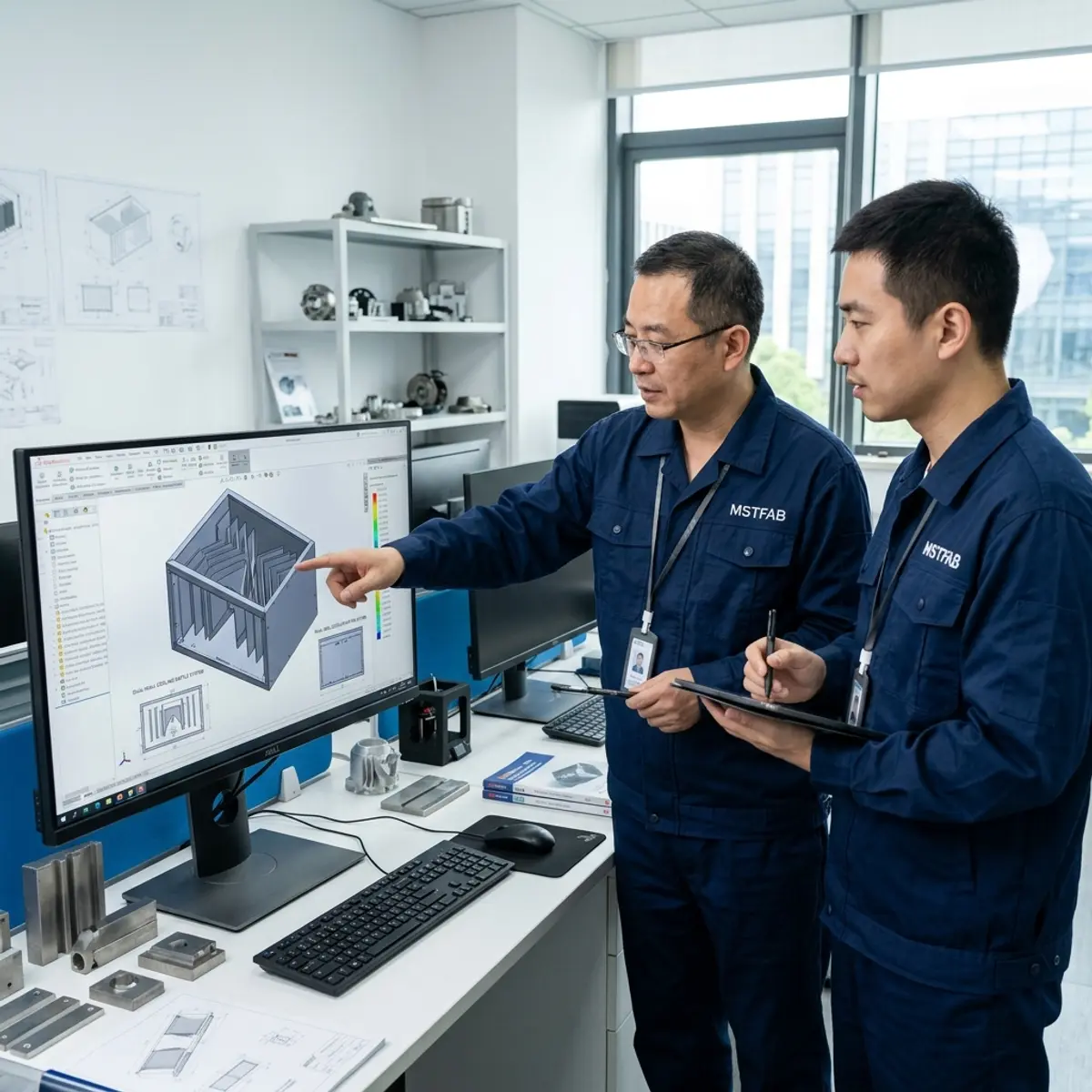
Ask for a traceable handoff, not a magic capacity number.
Useful evidence connects source data, assumptions, decisions, mechanical drawings and acceptance criteria. That chain helps procurement understand what changes require review.
Freeze source data
List equipment and site inputs, revisions, missing data, conservative assumptions and the responsible approver.
Release mechanical outputs
Translate the selected architecture into drawing-defined openings, mounts, seal interfaces, baffles, empty panel cavities and service clearances.
Verify the completed system
Test or validate the installed configuration against buyer-defined conditions and record changes or deviations.
For recorded mechanical measurements, review the dimensional inspection report guide.
Send the thermal inputs with the cabinet drawings.
Provide a STEP or STP assembly, a controlled 2D PDF, and DXF or DWG data when buyer controlled. Add a separate thermal-input sheet so sourcing, design and fabrication are discussing the same operating states.
- Equipment heat by operating state
- Ambient, humidity and altitude inputs
- Solar exposure and exterior finish
- Cabinet construction and insulation
- Internal limits and alarm states
- Power, controls and redundancy owner
- Selected component data when released
- Quantity and required FAI evidence
MSTFAB does not publish one MOQ, lead time or tolerance for every enclosure. Cabinet size, material, double-wall geometry, mounting interfaces, welding, hardware, seal interfaces, finishing route, inspection, quantity and packing affect the quotation. Selected finishing processes may be completed by qualified long-term partners and are identified through the approved project scope.
Telecom enclosure heat-load input FAQ
What belongs in a telecom enclosure heat-load input package?
Include equipment dissipation by operating state, ambient temperature and humidity profiles, altitude when relevant, solar exposure, cabinet geometry and finish, insulation, allowable internal limits, ingress strategy, installation clearances, duty cycle, power budget, redundancy, maintenance assumptions and the responsible validation plan.
Can MSTFAB select or size the cooling equipment?
The responsible OEM or thermal designer should own the heat-load model, cooling-method selection, capacity, controls and acceptance criteria. MSTFAB can review the released mechanical implications and fabricate the approved enclosure shell, openings, mounts, baffles, brackets and related interfaces.
Is equipment nameplate input power the same as cabinet heat load?
Not automatically. Some input power leaves through cables, radio output, useful mechanical work or another path, while efficiency losses and charging states can add heat. Use manufacturer data and operating scenarios approved by the responsible engineer rather than assuming one conversion for every device.
Does a sealed telecom cabinet always require an air conditioner?
No. The suitable method depends on heat load, allowable internal temperature, ambient conditions, solar exposure, contamination limits, power budget and maintenance strategy. The responsible thermal team should compare the available architectures for the actual site and equipment.
Which files should accompany the heat-load handoff?
Send a STEP or STP cabinet assembly, a controlled 2D PDF, and DXF or DWG data when buyer controlled. Add the equipment layout, thermal input sheet, cooling-component data when selected, airflow ownership, service states, materials, finish, quantities, CTQs and required first-article evidence.
Does MSTFAB publish one MOQ, lead time or tolerance for every climate-controlled cabinet?
No. Cabinet size, material, insulation architecture, cooling interfaces, welding, hardware, sealing, finishing route, inspection scope, quantity and packing affect the project. Feasible tolerances, quantity and schedule are confirmed from the released package and quotation.
Release the thermal assumptions before the cabinet interfaces.
Send the cabinet assembly, equipment-state heat data, site conditions, limits, selected hardware when available and mechanical CTQs. MSTFAB will review the drawing-defined sheet metal scope and return project-specific questions for quotation.
 WeChat Contact
 WhatsApp Me Directly