Use this page for audit evidence, not the main service keyword
The main service page should carry the broad sheet metal fabrication intent. This article is for buyers auditing a factory before they choose a manufacturer.
This page has been separated from the main custom sheet metal fabrication service page so Google and buyers can see the job of this article clearly. The useful question here is not “can someone make metal parts?” It is: what should a buyer check before sending drawings, approving a quote or moving into production?
- Verify cutting, bending, welding and QC evidence.
- Ask whether production is in-house or subcontracted.
- Review sample inspection reports and material traceability.
- Check export packing photos for similar parts.
- Compare supplier answers against the same RFQ package.
| 1 | Verify cutting, bending, welding and QC evidence. |
| 2 | Ask whether production is in-house or subcontracted. |
| 3 | Review sample inspection reports and material traceability. |
| 4 | Check export packing photos for similar parts. |
| 5 | Compare supplier answers against the same RFQ package. |
Sheet Metal Fabrication Manufacturer Checklist
Choosing a sheet metal fabrication manufacturer is not the same as choosing whoever replies first. A fast quote is nice. A cheap quote is nicer. But if the enclosure arrives with warped welds, blocked threads, scratched panels, and mystery material, the “saving” has left the building with your sleep schedule.
Quick answer: a reliable sheet metal fabrication manufacturer should prove six things before you place the PO: drawing review, real process capability, material control, tolerance and inspection planning, secondary fabrication control, and export packaging. For OEM enclosure parts, you are not buying “metal.” You are buying repeatable metalwork that fits your assembly.

What a Sheet Metal Fabrication Manufacturer Actually Does
A true fabrication manufacturer turns engineering files into physical metal parts through controlled operations: DFM review, material preparation, fiber laser cutting, deburring, CNC bending, welding, hardware insertion, surface finishing, inspection and packing. That chain matters because one weak operation can ruin the whole part.
For OEM buyers, the question is not “Can you cut metal?” Almost every shop can cut metal. The better question is: Can you control the part from drawing to repeat order? That is where real suppliers separate from quote factories.
What MSTFAB Manufactures
Custom enclosure shells
Empty sheet metal housings, chassis, covers, doors, lids and cabinet metalwork made from your drawings.
Panels and mounting plates
Laser-cut front panels, rear panels, DIN rail plates, internal partitions, gland plates and mounting plates.
Brackets and formed parts
CNC-bent brackets, guards, supports, frames, covers and structural components for industrial equipment.
Assembly-ready metalwork
Parts with PEM hardware, studs, tapped holes, hinges, locks, grounding points, finish and packing control.

Start With Drawing Review, Not Price Guessing
A supplier that quotes a complex enclosure without asking questions is not “efficient.” It is guessing in a nice font. Before quoting, MSTFAB reviews material, thickness, bend radius, hole-to-bend distance, tolerance notes, hardware, finish, inspection points and packaging needs.
If your drawing is early-stage, that is fine. Send the files and mark what matters. The point of review is to catch trouble before the laser makes it expensive. For common design traps, read our sheet metal DFM rules.
Core Manufacturing Process
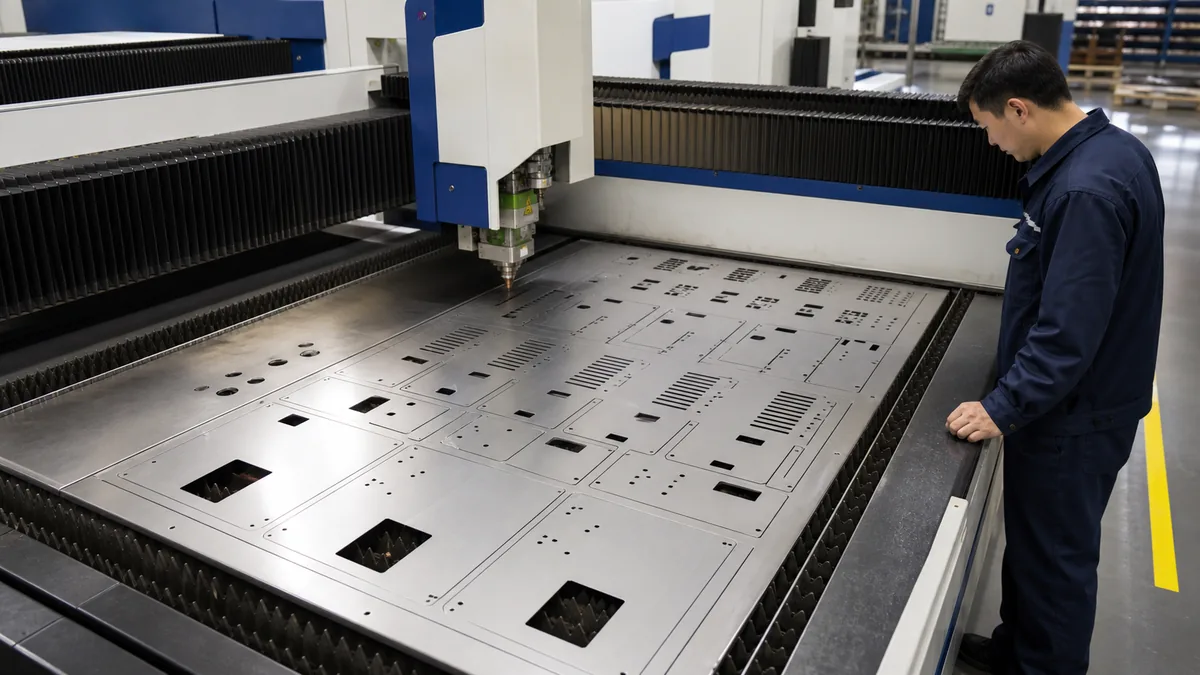
Fiber Laser Cutting
Fiber laser cutting creates the flat geometry: vents, mounting holes, slots, windows, cable entries and panel outlines. For enclosure parts, the cutting file must match the forming plan. A perfect flat panel can still fail after bending if the bend allowance and hole positions were not reviewed together.

CNC Bending and Forming
Bending decides whether covers close, rails align and brackets fit. We check bend direction, tooling access, flange height, bend radius and sequence. This is where many “cheap laser cutting only” quotes get exposed, usually while everyone is suddenly very interested in who approved the drawing.

Welding and Fixture Control
Welded enclosure shells need control over heat distortion, squareness and visible seam quality. We use fixture planning and weld sequence review so the part remains useful after welding, not just shiny in a photo.
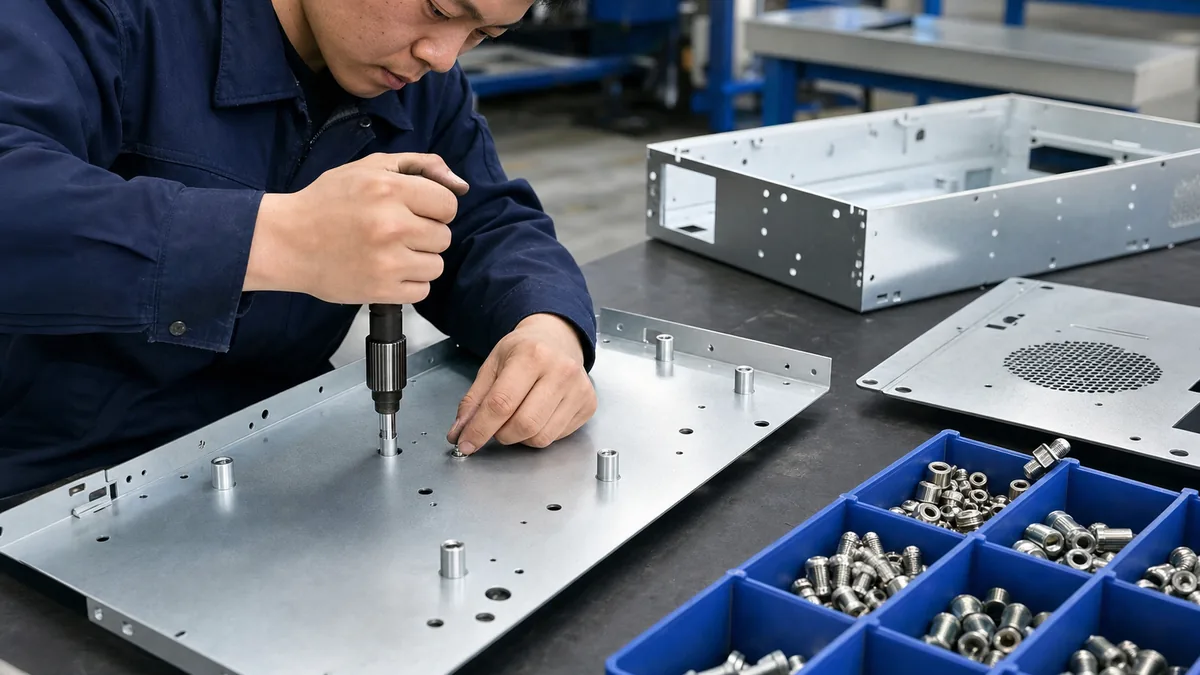
PEM Hardware, Tapping and Assembly-Ready Details
Threaded inserts, studs, standoffs, tapped holes, hinges, locks and grounding points should be defined in the RFQ. These details affect cost, lead time and fit. If they are missing from the quote, they will return later like a small invoice-shaped surprise.

Surface Finishing
Powder coating, brushing, plating, anodizing and passivation must match the material and use environment. For enclosure metalwork, we also check masking points, threaded holes, gasket surfaces and cosmetic sides. Finish is not just appearance; it can change assembly fit.

Quality Control That Buyers Can Verify
Quality control should not be a slogan. It should create evidence: material confirmation, first article checks, dimension photos, inspection records and clear handling rules. When the part has critical fit features, mark them on the drawing and ask how they will be measured.
For tight fit parts, do not tolerance everything like a watch component unless it truly needs it. Tight tolerances increase setup time, inspection time and scrap. Our sheet metal tolerance guide explains how to tighten by function instead of fear.
Trust Table for OEM Buyers
Use this table when comparing sheet metal fabrication manufacturers. It moves the conversation from “trust us” to “show me how you control it.” Much healthier. Fewer surprises.
| Buyer concern | What can go wrong | What to verify | Evidence to request |
|---|---|---|---|
| Drawing review | Part cannot bend, weld, finish or assemble as drawn | DFM feedback before quotation | Marked-up drawing comments or engineering notes |
| Material control | Wrong grade, thickness or surface condition | Material grade, thickness, stock and substitution rules | Material confirmation or certificate when required |
| Laser cutting | Burrs, wrong cutouts, nesting waste or edge defects | File match, kerf, burr control and edge quality | Cut sample photos or first article checks |
| Bending | Holes shift, flanges clash, enclosure does not close | Bend radius, bend sequence and bend-to-hole distances | Bend angle and fit photos |
| Welding | Warped shell, poor seam, poor repeatability | Fixture plan, weld sequence and squareness checks | Weld fixture photos and inspection record |
| Hardware | PEM inserts on wrong side or threads blocked by coating | Hardware BOM, side, insertion order and masking | Close-up hardware inspection photos |
| Finish | Scratches, color mismatch, coating buildup, corrosion risk | Finish spec, coating allowance, masking and handling | Finish sample or final inspection photos |
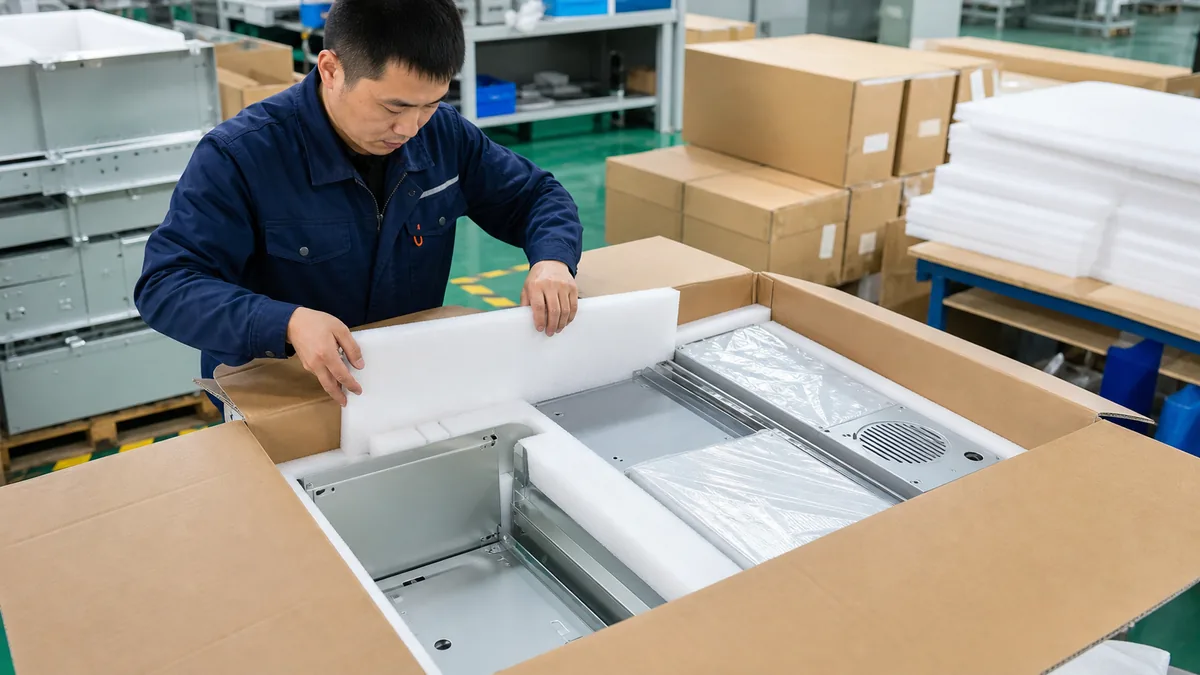
| Packing | Parts arrive bent, rubbed or scratched | Foam, film, corner protection and carton/crate plan | Packing photos before shipment |
What to Send for a Reliable Quote
- 2D PDF drawing with revision number, material, thickness, finish and tolerances.
- DXF or DWG flat pattern for laser-cut parts if available.
- STEP or STP model for bent parts, welded shells or enclosure assemblies.
- Prototype, pilot and expected repeat quantities.
- Hardware list: PEM inserts, studs, standoffs, hinges, locks, latches and grounding points.
- Critical dimensions and required inspection evidence.
- Surface finish code, color, masking areas and cosmetic surface notes.
- Packaging and shipping destination.
If you want to make quotes easier to compare, use our sheet metal quote checklist before sending files. For hidden quote items, see how to read a sheet metal quote.
Red Flags When Choosing a Manufacturer
- They say “yes” to every drawing without one DFM question.
- They quote only the unit price and skip setup, hardware, finish, inspection and packing.
- They show finished product photos instead of manufacturing-process evidence.
- They cannot explain how prototype parts move into repeat production. This prototype-to-production workflow is useful if your part will scale later.
- They avoid discussing material substitution, tolerance assumptions or packaging damage.
- They promise “same as drawing” but cannot tell you how they will measure it.
When MSTFAB Is a Good Fit
MSTFAB is a good fit when your team has drawings and needs a manufacturing partner for custom sheet metal enclosure parts, panels, brackets, welded shells, chassis and assembly-ready metalwork. We are especially useful when the part needs more than one operation: cutting plus bending, hardware, welding, finish, inspection and export packing.
If you only need a standard catalog box or a finished certified electrical product, we are not the right supplier. That is not a weakness; it is scope discipline. We stay in the lane where we can control the metalwork.
When several factories pass the audit, use the sheet metal manufacturer comparison scorecard to normalize RFQ scope, evidence, quote exclusions and pilot-order risk.
Need a Sheet Metal Fabrication Quote?
Send your drawing package and target quantity. MSTFAB will review manufacturability, material, bending, hardware, finish, inspection and packaging before quoting, so the price is tied to a real process.
Frequently Asked Questions
What does a sheet metal fabrication manufacturer make?
A sheet metal fabrication manufacturer makes custom metal parts from drawings: laser-cut panels, CNC-bent covers, brackets, chassis, welded shells, mounting plates and enclosure components. MSTFAB does not sell finished electrical devices or complete machines.
How do I know if a supplier is reliable?
Ask for DFM feedback, process capability, material confirmation, inspection evidence, finish control and packing photos. A reliable supplier explains risks before the PO, not after the parts fail inspection.
Should I choose the cheapest quote?
Only if the scope is complete. A cheap quote that excludes hardware, finishing, inspection or packing is not cheaper; it is incomplete. Compare total scope and landed risk, not just unit price.
Can MSTFAB support prototypes and repeat orders?
Yes. We can support prototype, pilot and repeat OEM fabrication when drawings and requirements are clear. The key is controlling revision, process route and inspection points from the first batch.
What files do you need?
Send PDF drawings, DXF/DWG flat files, STEP/STP models, material and thickness, finish, quantity, critical tolerances, hardware list and shipping destination. Clear files make faster and safer quotes.
Updated: July 26, 2026. This guide is written for OEM buyers sourcing custom sheet metal fabrication manufacturers for enclosure parts, panels, brackets, chassis, welded shells and assembly-ready metalwork.
 WeChat Contact
 WhatsApp Me Directly