Treat the Enclosure as a Controlled Mechanical Interface
A medical equipment enclosure must fit the device, support cleaning and service access, protect cosmetic surfaces and arrive with the evidence the purchase order requires. Those results come from defined inputs, not from adding a medical label to an ordinary box.
MSTFAB is the international brand of Guangzhou Maisituo Sheet Metal Manufacturing Co., Ltd. We fabricate drawing-based mechanical parts, panels, frames and empty enclosure shells in Guangzhou, China.
Define the environment
Cleaning agents, contact time, humidity, corrosion exposure and thermal conditions guide the material and finish review.
Control the interfaces
Mounting holes, display openings, doors, internal frames, cable paths and service clearances need drawing-defined acceptance.
Agree on evidence
First-article checks, dimensional records, cosmetic references and packing requirements should be priced before release.
Separate Fabrication Scope From Device Responsibility
The enclosure supplier can control the manufactured shell only when the equipment OEM supplies clear design inputs. Electrical safety, clinical use and regulatory decisions cannot be inferred from an empty housing.
| Decision | Buyer or device OEM defines | MSTFAB confirms for the order |
|---|---|---|
| Intended use | Device function, users, hazards, cleaning protocol and target market | Fabrication questions that affect the released mechanical design |
| Material and finish | Grade, thickness, exposed surfaces, chemicals and acceptance criteria | Availability, forming route, finish route and drawing-specific risks |
| Mechanical interfaces | Critical dimensions, mating parts, loads, clearances and tolerance scheme | Manufacturability, tooling access and agreed inspection method |
| Product compliance | Device-level safety, EMC, cleaning validation and final device certification | Requested material, process and inspection records within the approved scope |
| Change control | Authorized drawing revision and approval of deviations | Revision identification and production against the released files |
Choose From the Cleaning Environment Backward
Material selection starts with exposure, not appearance alone. A brushed stainless panel, a coated steel cabinet and an aluminum cover can all be appropriate, but not for the same cleaning chemicals, weight target or assembly design.
| Material route | Why buyers consider it | Questions to resolve |
|---|---|---|
| 304 stainless steel | Corrosion resistance and an uncoated visible surface for many indoor housings | Cleaning chemistry, grain direction, weld treatment, passivation requirement and cosmetic reference |
| 316 stainless steel | Considered when the specified environment presents more demanding corrosion exposure | Actual chemicals, concentration, contact time, grade verification and finish acceptance |
| Aluminum | Lower mass and useful thermal conductivity for covers and instrument housings | Thread strategy, galvanic interfaces, anodizing or coating, stiffness and heat path |
| Coated steel | Cost and stiffness for applications where a specified coating system is suitable | Edge coverage, masking, color, texture, cleaning compatibility and corrosion expectation |
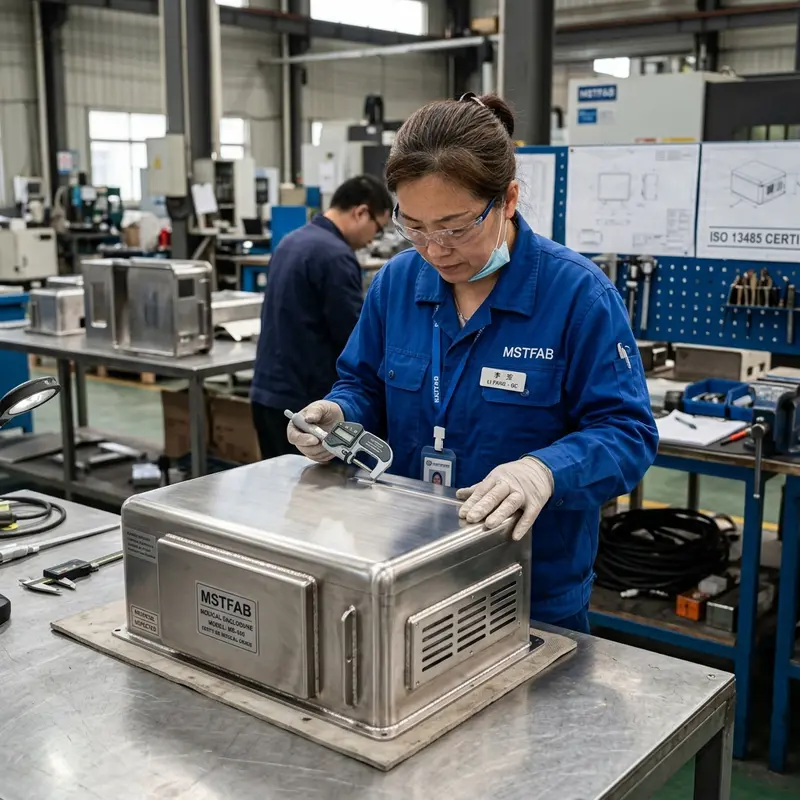
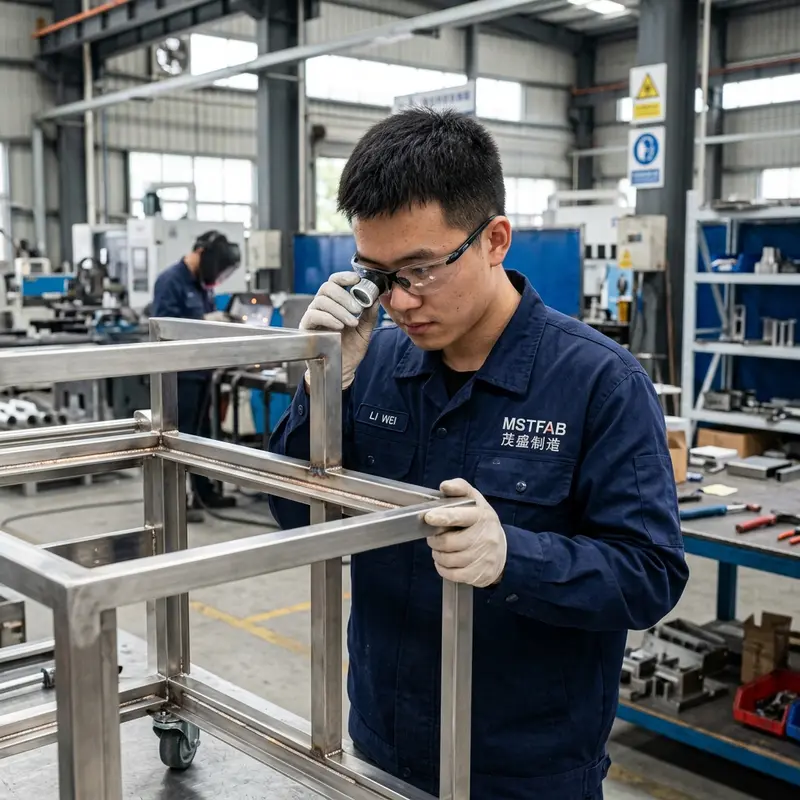

Make Wipe Paths Visible in the Drawing
Cleanability is not a coating adjective. It depends on the equipment design, cleaning protocol and details such as seams, gaps, exposed fasteners, corners and drainage. The OEM should define the method; the fabricator should flag geometry that conflicts with it.
Review these features before release
- Horizontal ledges and pockets that may retain liquid or debris
- Tight gaps around hinges, latches, handles and removable panels
- Unsealed seams, intermittent welds and inaccessible internal corners
- Exposed threads, sharp transitions and unfinished cut edges
- Gasket lands, compression, joint continuity and replacement access
- Labels, adhesives and surface treatments exposed to the cleaning process
A familiar procurement trap
“Easy to clean” sounds clear until engineering asks: with what chemical, at what concentration, for how long, and which surfaces are actually touched? Put those answers in the design input before asking a fabricator to price the shell.
Use the detailed medical enclosure cleanability and cosmetic finish checklist to turn those questions into drawing notes and first-article checks.
Protect the Interfaces That Stop Assembly When They Move
Not every dimension deserves the same inspection effort. Identify the features that locate displays, PCBs, pumps, brackets, doors, casters, handles and mating panels, then connect each one to a datum and an acceptance method.
Match revisions
Confirm that the 3D model, 2D drawing, BOM and purchase order reference the same release.
Expose conflicts
Review bend access, hardware clearances, weld sequence, coating allowance and measurement access.
Verify interfaces
Check critical dimensions, panel fit, hardware, cosmetic faces and agreed assembly conditions.
Protect function
Mask threads, grounding points, gasket lands and precision fits when the drawing requires it.
Record what matters
Use the approved inspection scope rather than measuring many noncritical features and missing one key interface.
Preserve the result
Separate cosmetic surfaces, restrain removable parts and define the delivery condition before shipment.
Ask for Records That Match the Risk
A large document package is not automatically a useful one. Buyers should request evidence tied to the drawing, the application risk and the purchase order instead of collecting certificates with no clear connection to the part.
| Evidence | Useful when | Define before quotation |
|---|---|---|
| Material record | Grade or heat traceability is required by the buyer’s control plan | Document type, lot linkage and retention requirement |
| First article report | New design, new revision, new tooling route or buyer-defined trigger | Ballooned drawing, characteristics, sample quantity and report format |
| Dimensional report | Critical interfaces need recorded measurements | Datums, method, sampling and acceptance limits |
| Cosmetic approval | Visible surfaces, grain or color strongly affect buyer acceptance | Reference sample, viewing distance, lighting and allowable marks |
| Packing approval | Finished surfaces or assemblies can be damaged in transit | Film, separators, restraint, carton or crate and receiving condition |
For a broader sourcing review, use the medical enclosure supplier checklist and the guide to a drawing-linked dimensional inspection report.
Send Enough Information to Remove Expensive Guesswork
A quote can be fast and still be wrong. The useful target is a comparable quotation in which material, process, inspection and packing assumptions are visible before a purchase order is issued.
Recommended quotation inputs
- STEP/STP model and controlled 2D PDF drawing
- DXF or DWG when buyer-controlled profiles are supplied
- Material grade, thickness and approved substitutions
- Visible surfaces, finish, color and cosmetic reference
- Critical dimensions, datums, hardware and mating parts
- Cleaning environment, service access and thermal inputs
- Prototype and production quantities
- FAI, inspection, identification and packing requirements
Clear supply boundary
MSTFAB supplies drawing-based fabricated mechanical parts and empty enclosure shells. Electrical components, wiring, software, biocompatibility decisions, intended-use validation, device-level testing and final device certification remain buyer- or OEM-controlled unless expressly included in the approved scope.
Selected powder coating, anodizing, passivation and other finishing processes may be completed by qualified long-term partners under the approved order scope. The planned route and inspection responsibility are confirmed before release.
Medical Equipment Enclosure FAQ
Concise answers about quotation files, materials, cleanability, first articles, finishing routes and the boundary between shell fabrication and finished-device responsibility.
What files should an OEM send for a medical equipment enclosure quote?
Send a STEP/STP model, a controlled 2D PDF, and DXF or DWG files when the buyer controls the flat patterns. Include material and thickness, visible surfaces, finish, critical dimensions, hardware, quantities, inspection expectations, cleaning environment and packing requirements.
Does MSTFAB manufacture complete medical devices?
No. MSTFAB supplies drawing-based fabricated mechanical parts, panels, frames and empty enclosure shells. Electrical components, wiring, software, intended-use validation, device-level testing and final device certification remain under the buyer or medical-device OEM unless a different responsibility is expressly included in the approved scope.
Which material is best for a medical equipment enclosure?
There is no universal best material. The choice depends on the cleaning agents, corrosion exposure, weight, thermal design, cosmetic requirement, forming geometry and budget. The buyer should define the environment; the supplier can then review 304 or 316 stainless steel, aluminum, or coated steel against the drawing.
Can an enclosure supplier validate cleanability?
The equipment OEM defines the cleaning method, chemicals, contact time and acceptance criteria. A fabricator can review seams, gaps, exposed hardware, drainage, edge conditions and surface requirements against those inputs, but cleanability and intended-use validation remain device-level responsibilities.
What should a first article inspection cover?
The first article scope should identify critical dimensions, mounting interfaces, door and panel fit, hardware, cosmetic surfaces, finish, labels or part identification, and any buyer-required records. The released drawing and agreed inspection plan determine what is measured and reported.
How are outsourced finishing processes handled?
Selected finishing processes may be completed by qualified long-term partners when required by the approved order scope. MSTFAB confirms the planned process route, drawing revision, acceptance criteria and inspection responsibility before production instead of representing every finish as an in-house operation.
Need an Enclosure Drawing Review?
Send the released files, critical interfaces, cleaning environment, finish reference, quantity and inspection expectations. MSTFAB will review the fabrication route and identify assumptions before confirming the quotation.
Authored and technically reviewed by the MSTFAB Sheet Metal Engineering Team. Updated October 2026. This page describes a typical fabrication review; the released drawing, purchase order and approved scope control production. The images illustrate production checks and do not establish approval of a finished medical device.
 WeChat Contact
 WhatsApp Me Directly