Define the Empty Battery Cabinet Shell Before Pricing
Guangzhou Maisituo Sheet Metal Manufacturing Co., Ltd. operates as MSTFAB and manufactures the sheet metal enclosure, not the battery system. Use this checklist to define structural, sealing, thermal-interface and packing inputs before requesting a quote.
For battery-cabinet thermal and structural engineering inputs, use the BESS enclosure design checklist. This page focuses on the information a sheet metal supplier needs to quote the empty shell without guessing.
- Confirm that the order covers enclosure metalwork only.
- Mark ventilation, cable-entry and mounting-plate interfaces.
- Define coating and corrosion requirements for the installation environment.
- Control door gap, gasket path and mechanical hardware fit.
- Specify inspection records and export-packing evidence.
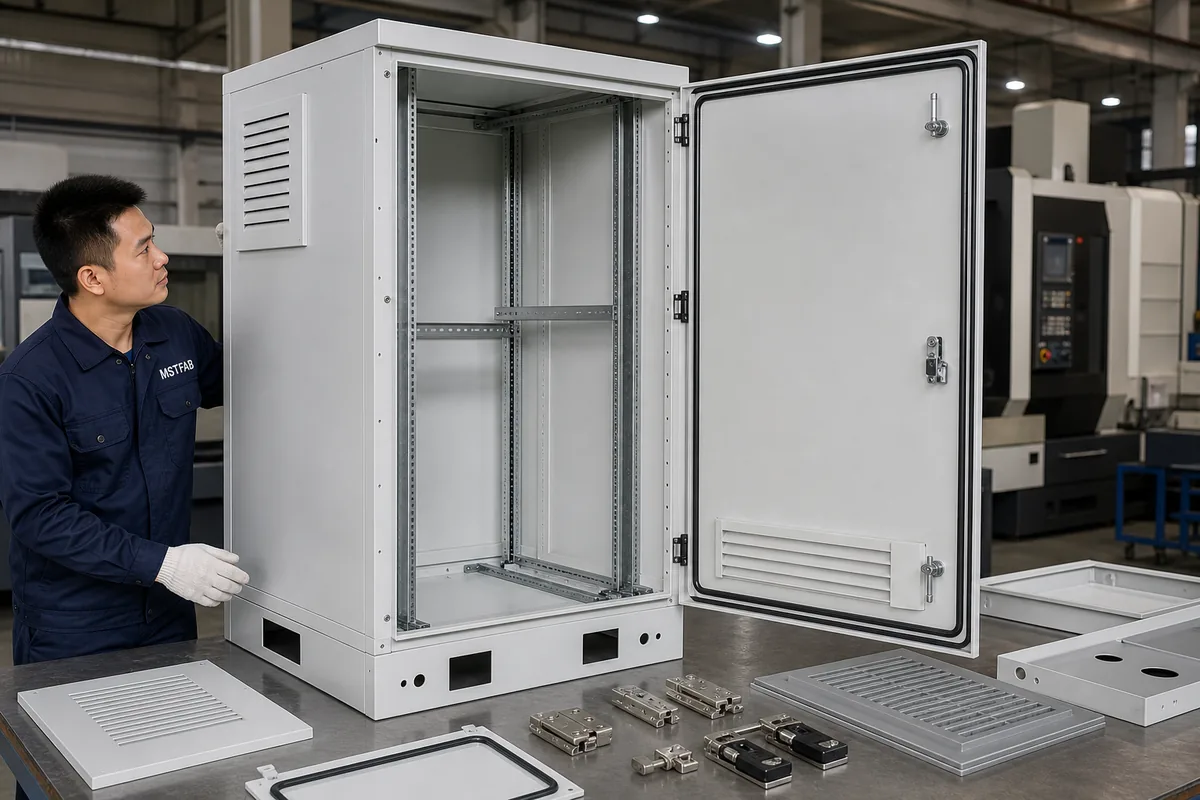
Quick answer: MSTFAB provides custom solar battery enclosure fabrication for OEM battery storage projects that need strong, weather-ready sheet metal cabinet shells before electrical integration. We make the metal enclosure: welded frames, doors, panels, mounting rails, louvers, cable-entry plates, hinges, locks, gaskets, surface finishing, QC and export packing.
Important scope note: We do not manufacture lithium cells, battery modules, BMS electronics, inverters, wiring harnesses, chargers, complete BESS units or certified finished energy storage systems. If you need the metal cabinet shell that protects those components, good, you are in the right place. If you need a complete plug-and-run battery system, this page would be a very tidy wrong turn.
Solar battery enclosure buyers usually do not lose sleep over the word “enclosure.” They lose sleep over payload, sealing, corrosion, thermal openings, door alignment, transport damage and whether the supplier quietly guessed at the drawing. This guide cuts the fluff and focuses on what OEM buyers should check before placing an order for sheet metal battery cabinet fabrication.
What MSTFAB Makes for Solar Battery Enclosure Projects
Think of MSTFAB as the sheet metal manufacturing side of the project. Your engineering team owns the battery system; we build the enclosure metalwork that lets your team install the electrical content later.
- Outdoor cabinet shells: empty solar battery storage cabinets, doors, side panels, roof covers, base plates and removable access panels.
- Heavy-duty welded structures: base frames, reinforcement ribs, lifting points, internal supports and mounting frames.
- Thermal and access features: louvered panels, filtered vents, fan cutouts, drainage paths, cable-entry openings and service-door layouts.
- Mechanical hardware: hinges, compression locks, handles, PEM nuts, studs, standoffs, brackets, gasket channels and cable gland plates.
- Surface treatment: powder coating, galvanizing-compatible fabrication, masking, coating thickness checks and finish protection.
- QC and packing: first-article checks, fit photos, door operation checks, coating checks and export packing photos.
That list sounds plain because it is supposed to. Industrial buyers do not need poetry from a cabinet. They need it square, sealed, coated, packed properly and repeatable in the next batch.

What We Do Not Supply
This article has to be very clear here because the solar and battery industry is full of words that can accidentally promise too much. A battery enclosure is not a battery system. A cabinet shell is not a certified energy storage unit.
| MSTFAB supports | Not included in this service |
|---|---|
| Custom sheet metal cabinet shells, panels and doors | Lithium cells, battery packs, battery modules or racks loaded with cells |
| Welded base frames, mounting rails and mechanical brackets | BMS, inverter, PCS, EMS, firmware, wiring or electrical design |
| Louvers, cable-entry plates, gasket channels and ventilation cutouts | Thermal simulation ownership for the complete battery system |
| Powder coating, hardware assembly, inspection and export packing | UL/IEC certification for finished battery energy storage equipment |
A focused supplier is easier to audit. If a metal shop says it can also handle every cell, software and certification question without blinking, the blinking may happen later, usually after your deposit has left the building.
OEM Buyer Priorities Before Quotation
A useful quote starts with a useful RFQ. The goal is not to send a giant document for fun. The goal is to stop the supplier from filling gaps with assumptions. Assumptions are cheap in email and expensive in production.
| Decision area | What to define | Why it matters |
|---|---|---|
| Material and thickness | SGCC, SPCC, stainless, aluminum, galvanized sheet, thickness and structural load notes | Controls strength, corrosion resistance, bending route and cost |
| Outdoor rating target | IP target, gasket path, drainage details, door compression and exposed environment | Prevents water paths, warped doors and vague sealing claims |
| Thermal openings | Louvers, fan cutouts, filter openings, spacing, airflow direction and removable covers | Keeps fabrication aligned with your battery system cooling design |
| Mechanical hardware | Hinges, locks, handles, PEM hardware, studs, rails, gasket and cable gland plates | Stops missing hardware and wrong installation direction |
| Finish and masking | Powder coat color, texture, thickness, masked threads and bare grounding zones | Avoids painted threads, poor fit and corrosion risk |
| Packing and shipment | Foam, corner protection, pallet, carton, door protection and photo record | Protects painted surfaces during long export transit |
If your drawing package is still young, ask for a DFM review early. The same principles in DFM Design Rules for Sheet Metal Parts apply here: hole distance, bend radius, weld distortion and hardware clearance are cheaper to fix before cutting metal.

Structural Frame and Payload: The Cabinet Cannot Flinch
Battery storage cabinets are heavy even before your team installs the battery modules. The enclosure shell needs a base frame and internal structure that can survive handling, transport and installation. A pretty door does not rescue a cabinet that twists when lifted.
- Base-frame rigidity: welded base frames, reinforced corners and load paths should match the expected payload and lifting method.
- Door and panel stability: large doors need hinge reinforcement and controlled flatness so they do not become metal sails with locks.
- Mounting rails: hole positions, PEM studs and internal supports must align with your downstream assembly process.
- Transport handling: pallet points, lifting eyes and packaging support should be planned before the cabinet enters a container.
For high-load cabinet shells, we prefer to review the load path and frame weld locations before quotation. That prevents the classic surprise where the buyer wanted heavy duty and the quote quietly priced “looks heavy enough.”
Sealing, Louvers and Cable Entries
Outdoor battery enclosures live in a less polite world: rain, dust, sun, temperature swings and installation crews in a hurry. The sheet metal design has to manage openings without turning every opening into a leak invitation.
- Gasket path: continuous compression matters more than a heroic-looking strip of rubber.
- Door compression: hinges and locks must pull the door evenly against the gasket.
- Louvers and filters: ventilation features must match your airflow plan and should be easy to manufacture repeatedly.
- Cable entry plates: removable gland plates make field service easier and keep the cabinet shell flexible for different markets.
- Drainage details: small design choices decide whether water leaves the enclosure or applies for residency.
Mechanical Assembly Scope
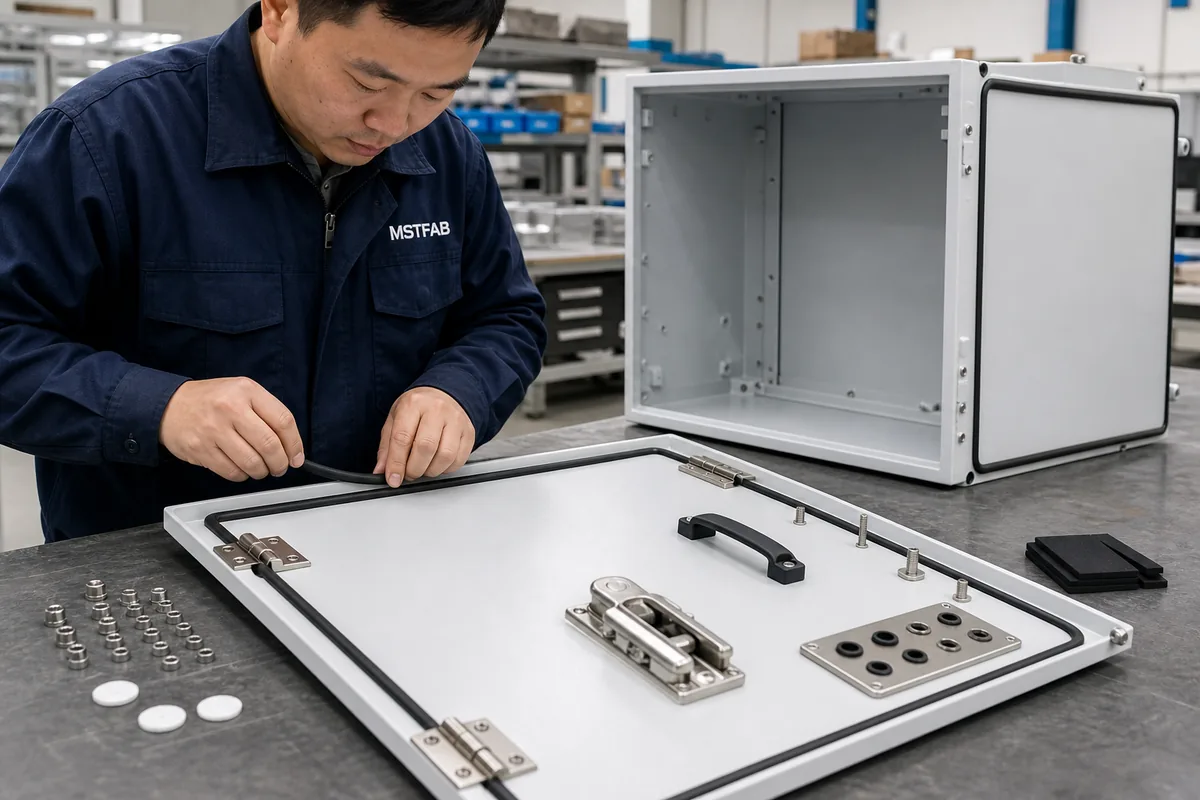
MSTFAB can ship loose sheet metal parts, partly assembled subassemblies or cabinets with mechanical hardware installed. The best option depends on freight cost, finish risk and how much assembly your own line wants to handle.
| Assembly item | What we can install | Buyer check |
|---|---|---|
| Door hardware | Hinges, locks, handles, latch plates and door stops | Confirm door swing direction, lock model and operating clearance |
| Threaded hardware | PEM nuts, studs, standoffs, rivet nuts and brackets | Confirm thread size, insert type and inspection method |
| Sealing parts | EPDM gasket, foam seals, gasket channels and adhesive-backed strips | Confirm material, joint location and compression target |
| Panels and plates | Removable gland plates, louver panels, filters and internal mounting plates | Confirm whether they ship installed or packed separately |
Assembly is useful when it removes work from your line. It becomes risky when the quote simply says “assembly included” and nobody knows exactly which hardware that means. Give us the hardware BOM and exploded view. The cabinet will thank you by closing properly.

Outdoor Finish and Corrosion Control
Solar battery cabinet shells often need powder coating, galvanized material, stainless hardware or corrosion-aware design. The right finish depends on where the cabinet lives: indoor utility room, sheltered outdoor installation, coastal site, industrial site or desert heat. One finish does not rule them all, despite what the budget spreadsheet may hope.
- Powder coating: common for outdoor cabinet shells, but thickness and masking must be controlled.
- Galvanized steel: useful for corrosion resistance, especially when combined with proper coating and edge design.
- Stainless hardware: often worth specifying for exposed hinges, locks and fasteners.
- Masked areas: threads, grounding points and gasket surfaces may need protection during coating.
- Coating inspection: coating thickness and surface finish should be checked before packing, not after the parts cross an ocean.
For finish options and trade-offs, see Sheet Metal Surface Finishing Guide. The short version: choose the finish by environment and function, not by the nicest sample card in the meeting room.
Trust Table: Evidence Buyers Should Ask For
Trust is not built by saying “high quality” in a bigger font. It is built by showing the buyer what was checked, when it was checked and what the result looked like.
| Buyer concern | Evidence to request | What it proves |
|---|---|---|
| Will the cabinet stay square? | First article photos, key dimension checks, fixture photos if needed | Frame, door openings and mounting zones are controlled |
| Will it seal outdoors? | Door fit photos, gasket installation photos, lock/hinge operation check | Gasket path and compression are not just theoretical |
| Will the finish survive shipment? | Coating thickness readings, masking photos and packing photos | Finish quality and protection are planned before export |
| Will hardware match the BOM? | Hardware confirmation, assembly photos and packed accessory photos | Hinges, locks, PEM inserts and gasket parts are not swapped or missed |
| Will repeat orders match the sample? | Approved sample record, inspection checklist and revision control | Production is based on a controlled standard, not memory |
For inspection terms like FAI, CMM and SPC, see Sheet Metal Quality Control: FAI, CMM and SPC Explained. Not every surface needs a laboratory report, but critical fit features should have an inspection plan.

Export Packing: Where Beautiful Cabinets Go to Get Tested
Shipping is not a formality. It is a mechanical event with paperwork. Large powder-coated enclosure shells can be scratched, dented or twisted if packing is treated as an afterthought. The cabinet may leave the factory perfect and arrive looking like it had a difficult personal journey.
- Protect door corners, painted faces and exposed hardware.
- Separate loose panels with foam or protective film.
- Block large cabinets so they cannot shift inside the carton or pallet crate.
- Photograph packing before shipment for buyer confidence and dispute prevention.
- Confirm pallet dimensions and loading method before freight is booked.
Common Mistakes That Waste Money
- Buying a cabinet shell from a finished-product supplier: you may pay for integration capability you do not need.
- Sending only a 3D model: without material, finish, tolerance and hardware notes, the quote becomes a guessing contest.
- Ignoring coating thickness: a thick finish can block threads, hardware and gasket fit.
- Putting vents wherever they look tidy: thermal openings need to follow your airflow design and manufacturing limits.
- Leaving packing out of the quote: export damage is expensive, boring and very preventable.
- Changing hardware after sample approval: a new latch or gasket can change fit, compression and assembly time.
What to Send for a Useful Quote
A clean RFQ helps MSTFAB quote the real project instead of the cheerful imaginary version.
- 2D drawings with material, thickness, tolerances, finish and critical dimensions.
- STEP files for cabinet shell, doors, panels, base frame, brackets and rails.
- Annual volume, prototype quantity and target batch size.
- Expected environment: indoor, outdoor, coastal, high humidity, industrial, hot climate or sheltered installation.
- Hardware BOM: hinges, locks, handles, PEM inserts, studs, gaskets, filters and cable gland plates.
- Assembly scope: loose parts, partial subassembly or cabinet shell with mechanical hardware installed.
- Inspection and packing requirements, including photo evidence if required.
Need a Solar Battery Enclosure Shell Quoted?
Send your drawings, STEP files, material, finish, quantity and assembly scope. MSTFAB will review the metalwork, DFM risk, finish route and packing needs before pricing.
Key Takeaways
- MSTFAB makes custom solar battery enclosure sheet metal shells, not finished battery systems.
- The main buyer risks are payload, sealing, ventilation, corrosion, hardware fit and export damage.
- Define material, thickness, finish, gasket path, hardware BOM and packing before quotation.
- Ask for evidence: FAI photos, dimension checks, coating readings, assembly photos and packing photos.
- A focused sheet metal supplier is the right choice when your OEM team owns the electrical integration.
FAQ: Custom Solar Battery Enclosure Fabrication
Can MSTFAB build the complete solar battery system?
No. MSTFAB fabricates the sheet metal enclosure shell and mechanical parts. We do not supply lithium cells, battery modules, BMS, inverters, wiring, software or finished energy storage products.
Can you make outdoor battery cabinet shells?
Yes. We can fabricate outdoor cabinet shells with welded frames, louvered panels, cable-entry plates, gasket doors, powder coating and export packing. Your team should define the target environment and system requirements.
Can you install hinges, locks and gaskets?
Yes. Mechanical assembly can include hinges, compression locks, handles, PEM hardware, gasket installation, cable gland plates and packed accessories when the BOM and assembly drawing are clear.
What files help you quote faster?
Send 2D drawings, STEP files, material and thickness, finish notes, hardware BOM, quantity, annual volume, critical dimensions and packing expectations.
Can you support prototype and batch production?
Yes. A prototype or first article helps lock the enclosure structure, hardware fit, finish and packing method before repeat production.
Do you provide inspection reports?
For critical projects, buyers can request first-article photos, key dimension records, coating thickness checks, assembly photos and packing photos. The inspection scope should be agreed before production.
 WeChat Contact
 WhatsApp Me Directly