Short answer: A sheet metal prototype is ready for repeat production only when the buyer has approved the drawing revision, material, process route, critical dimensions, finish, hardware, inspection evidence and packing method. A good sample is useful; an uncontrolled sample is just a very persuasive surprise.
There is no site-wide 15-day schedule, universal minimum order quantity or single tolerance for every custom part. Lead time and price depend on the released files, geometry, material availability, tooling, finishing, required records, quantity and destination. Ask for a project-specific quotation and milestone plan.
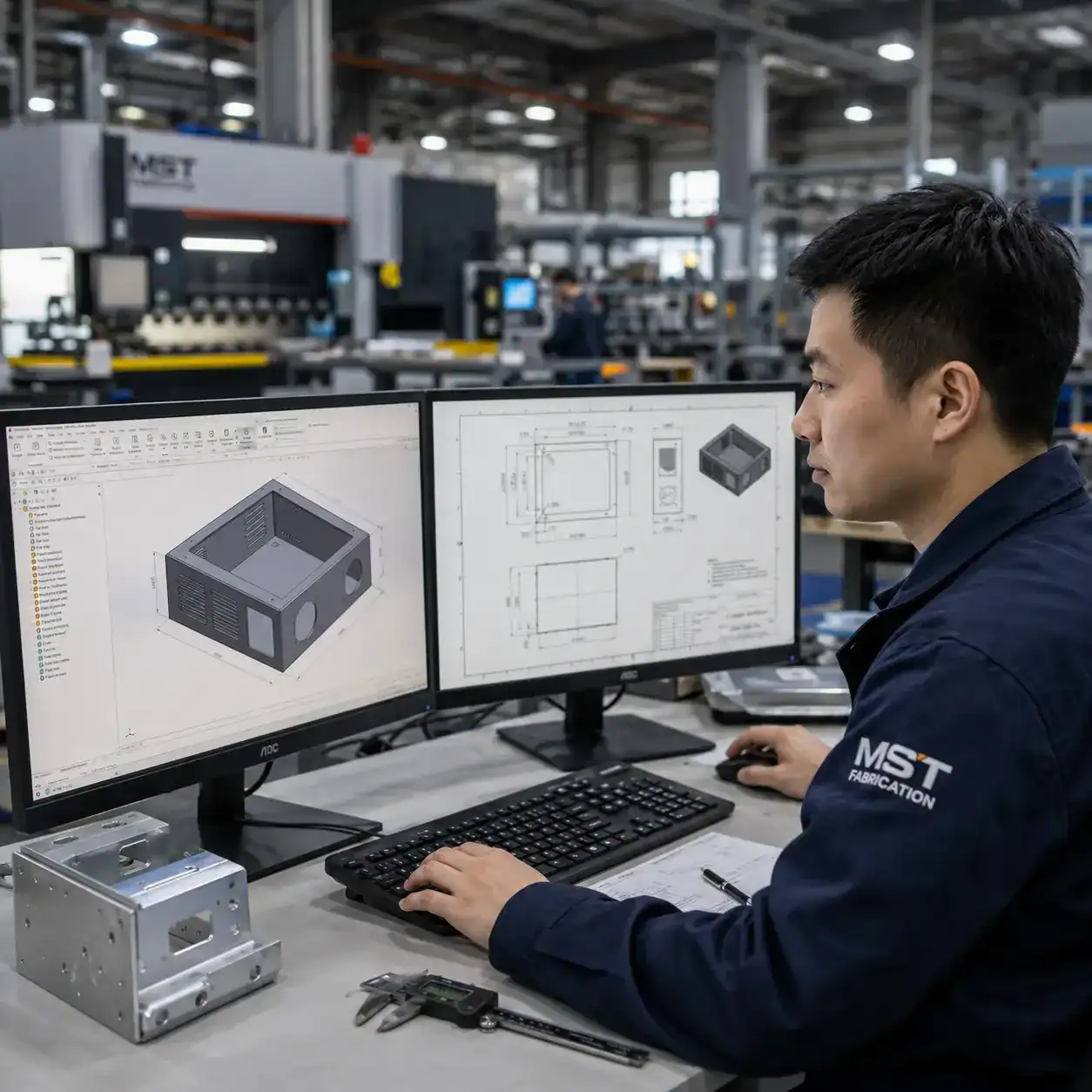
Manufacturing scope: MSTFAB (Guangzhou Maisituo Sheet Metal Manufacturing Co., Ltd.) supplies drawing-based sheet metal parts and empty mechanical enclosure shells. The OEM or integrator owns the finished equipment design, electrical integration and product validation. Selected surface finishes may be completed by qualified long-term partners when included in the approved quotation.
Decide what the prototype must prove
Not every prototype has the same job. A fit mockup can expose an access problem without using the final finish. A process-representative first article should use the agreed material, forming route, hardware and measurement method. A pilot lot checks whether those controls survive repeat production. Label the sample accordingly; do not call a fit-only mockup “production approved” because it closes a door.
| Stage | Buyer decision | Evidence before moving on |
|---|---|---|
| RFQ and drawing release | Which revision, material, quantity and finish are being priced? | Controlled 2D PDF, matching STEP/STP model and a list of open questions. |
| DFM review | Can the proposed cut, bend, weld and hardware route make the critical interfaces? | Agreed clarifications for bend access, datums, weld sequence, coating allowance and inspection scope. |
| Prototype or first article | Does the actual part fit and meet the approved drawing? | Measurements of critical features, fit check, visual standard and documented deviations. |
| Pilot or repeat setup | Can the approved process be repeated without changing the accepted part? | Revision-controlled files, setup notes, fixture checks and an agreed sampling plan. |
| Production release | What must be checked and delivered with each order? | Lot identification, final inspection evidence, finish checks where specified and packing approval. |
Freeze the drawing before buying production quantity
The quotation should repeat the part number and revision. If the PDF, STEP model or cut-profile file disagrees, request a corrected package rather than letting the shop guess. A change to a hole, finish or latch after first-article approval can affect price, tooling, inspection and delivery. Record who approved the change and whether the first article must be repeated.
The OEM drawing package checklist names the files and acceptance notes buyers should supply. The enclosure DFM guide helps identify manufacturing questions while they are still inexpensive to answer.
Keep inspection proportional to the part
Some critical features may require a first-article report, a fit fixture or additional sampling. Others can be checked with an agreed gauge or visual standard. A CMM is one possible measuring method, not a default requirement for every piece. The measurement plan should name the feature, datum, instrument, sample frequency and acceptance rule.
For a particularly tight feature, ask for evidence of feasibility rather than accepting a blanket ±0.05 mm claim. A passing prototype does not establish a capability index for every later lot. The OEM inspection checklist explains the evidence to define before shipment.
Quote the whole route, including the handoffs
A low unit price is difficult to compare if it excludes fixtures, hardware, finish, first-article work or export protection. Ask whether setup charges recur on a reorder, who approves the finish sample, and what happens if a part is damaged in transit. Where a qualified partner performs a selected finish, the quotation should name the scope and expected acceptance evidence.
What to send for a useful RFQ
- The released PDF drawing and matching STEP/STP model; DXF/DWG if cut-profile review is needed.
- Material grade, thickness, finish, cosmetic faces and any masking or grounding areas.
- Prototype quantity, expected repeat quantity and the destination for packing and freight planning.
- Critical dimensions, mating parts, hardware and required first-article or lot records.
- The decision owner for drawing approval, sample sign-off and finished-equipment validation.
Questions buyers ask before release
Is a prototype automatically the same as a production part?
No. Confirm whether the prototype used the intended material, tooling, forming route, finish and inspection method. Any difference should be documented before treating it as a production reference.
Can MSTFAB promise a standard 15-day delivery or zero MOQ?
No single schedule or minimum quantity fits every drawing. Both are project-specific and should be confirmed in the quotation after material, processes, finishing, inspection and destination are known.
Does every part need a CMM report?
No. The buyer should define which features need recorded measurements, the inspection frequency and the acceptable method. Do not pay for a report that does not answer the assembly risk.
Release the next stage with evidence
Send the drawing package, quantity and the features that can stop assembly. MSTFAB can review the fabrication and inspection scope, then quote milestones for this specific project.
 WeChat Contact
 WhatsApp Me Directly