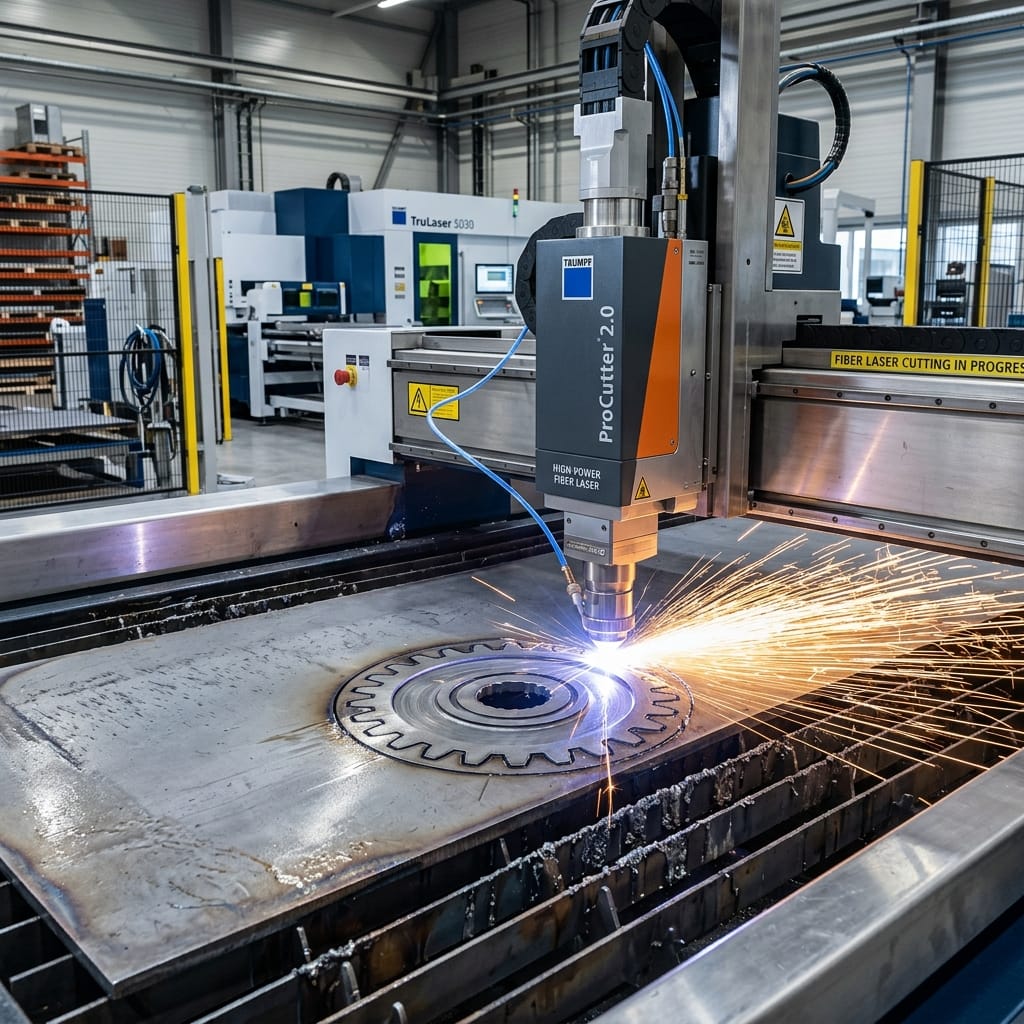
Key Takeaways — Professional Laser Cutting Services
- High Precision: Fiber laser cutting delivers exceptional tolerances (±0.1 mm to ±0.2 mm) and smooth edge quality, minimizing the need for secondary deburring or finishing.
- Material Versatility: Handles a wide range of metals including stainless steel (304/316), aluminium (5052/6061), carbon steel (SPCC/Q235), copper, and brass.
- Cost Optimization: Automated software nesting maximizes raw sheet metal utilization, dramatically lowering per-part material costs.
- Full-Service OEM: MSTFAB combines state-of-the-art fiber lasers with CNC bending, TIG/MIG welding, and powder coating lines to deliver ready-to-assemble custom enclosures and frames.
📑 Table of Contents
- What Are Professional Laser Cutting Services?
- How Laser Cutting Works in Sheet Metal Fabrication
- Materials Used in Laser Cutting Services
- Advantages of Professional Laser Cutting Services
- Fiber Laser Cutting vs Traditional Cutting Methods
- Custom Laser Cutting Services for OEM Manufacturing
- How to Choose a Reliable Laser Cutting Services Supplier
- OEM Fabrication Workflow & Lead Times
- Frequently Asked Questions
Professional laser cutting services help OEM buyers turn CAD drawings into accurate custom sheet metal parts with fast lead times, clean edges and repeatable quality.
In modern manufacturing, precision, speed and consistency are critical for industrial buyers looking for reliable sheet metal solutions. Fiber laser cutting is one of the most efficient methods for producing stainless steel enclosures, aluminum brackets, industrial cabinets and OEM machinery components.
1. What Are Professional Laser Cutting Services?
Laser cutting services use high-powered laser beams controlled by CNC systems to cut metal sheets into precise shapes and dimensions. Compared with traditional cutting methods, laser cutting provides higher precision, faster production speed, cleaner cutting edges, lower material waste and better repeatability for complex designs.
2. How Laser Cutting Works in Sheet Metal Fabrication
The transition from a raw concept to a finished metal component involves several critical engineering phases:
- Engineering Drawing Review: Evaluating 2D and 3D sheet metal drawings for bend clearances, hole tolerances, and flat layouts.
- Material Selection: Selecting the best metal substrate based on environmental and structural requirements.
- CNC Programming: Translating the CAD data into G-code for the laser cutting system, utilizing nesting software to maximize sheet utilization.
- Fiber Laser Cutting: Directing a focused laser beam assisted by oxygen, nitrogen, or compressed air to melt and blow away the metal.
- Deburring and Inspection: Removing micro-burrs and verifying dimensional accuracy.
- Secondary Fabrication: Performing CNC bending, tapping, press-nut insertion, or welding.
- Surface Finishing: Applying liquid paint, anodizing, or powder coating, and final packaging.
3. Materials Used in Laser Cutting Services
Professional laser cutting services support stainless steel, aluminum, carbon steel, copper and brass for industrial manufacturing applications. The material properties drive the cutting parameters and nesting layouts. To understand the processing differences between common substrates, read our guide on stainless steel vs carbon steel cabinets.
| Material | Typical grades | Common applications | Buyer notes |
|---|---|---|---|
| Stainless steel | SUS304, SUS316, SUS430 | Medical devices, food equipment, electrical enclosures, industrial cabinets | Excellent corrosion resistance and clean visible finish; nitrogen cut prevents oxide layer. |
| Aluminum | 5052, 6061 | EV charging cabinets, electronics housings, communication equipment | Lightweight and corrosion resistant, often combined with anodizing or powder coating. |
| Carbon steel | SS400, SPCC, Q235 | Machine frames, equipment covers, structural supports, construction components | Cost-effective strength; oxygen assist speeds up cutting thick plates; requires powder coat protection. |
| Copper and brass | C1100, C260, C360 | Grounding parts, conductive brackets, decorative plates, electrical components | Reflective materials require experienced fiber laser parameter control to prevent back-reflection damage. |
4. Advantages of Professional Laser Cutting Services
Key buyer benefits include tight tolerances, faster lead times, clean cutting edges and lower manufacturing costs through optimized nesting and automated production. By avoiding the expensive tooling costs associated with stamping dies, laser cutting is the ideal process for custom batches and rapid prototyping.
5. Fiber Laser Cutting vs Traditional Cutting Methods
When selecting a fabrication method, comparing speed, finish quality, and dimensional capabilities helps determine the most economical route.
| Feature | Fiber laser cutting | Traditional cutting (Stamping/Shearing) |
|---|---|---|
| Precision | High (within ±0.1 mm) | Medium (±0.5 mm to ±1.0 mm) |
| Edge quality | Smooth, low burr | Rougher, more secondary work required |
| Material waste | Low with nesting software | Higher scrap rates |
| Production speed | Fast for prototypes and batches | Slow setup (tooling required) |
| Complex shapes | Excellent (virtually unlimited design freedom) | Limited by tooling or manual process |
| Tool wear | Minimal (no contact process) | High tool wear and replacement costs |
6. Custom Laser Cutting Services for OEM Manufacturing
OEM buyers often need more than cutting. A complete sheet metal supplier should support laser cutting, CNC bending, welding, tapping, riveting, powder coating and final assembly. Combining these steps under one roof reduces logistics delays and ensures a single point of quality responsibility. For post-cutting finishes, review our powder coating validation guide to see how we guarantee finish lifespan.
7. How to Choose a Reliable Laser Cutting Services Supplier
Evaluate manufacturing experience, equipment capability, quality control systems and engineering support before placing OEM production orders. Ensure the supplier utilizes modern fiber lasers (from brands like IPG or Bystronic) and maintains strict tolerances. If your parts must withstand harsh environments, confirm they have experience in IP65 / NEMA 4X design to prevent sealing failures at the laser cut edges.
8. OEM Fabrication Workflow & Lead Times
MSTFAB optimizes the production lifecycle at our Guangzhou facility:
- Quote Turnaround: DFM review and pricing within 24 to 48 hours.
- Prototyping: Laser-cut samples delivered in 3 to 5 days.
- Production Batches: Mass production batches completed in 15 to 30 days depending on component assembly requirements.
Looking for Custom Laser Cutting & Sheet Metal Services?
23+ years OEM experience, 5,000 m² Guangzhou plant, Bystronic fiber lasers. ISO 9001 + ISO 14001 + IATF 16949 certified. Exporting globally.
Request a Laser Cutting & Fabrication Quote
Send us your DXF/STEP drawings, raw material specifications, and annual volumes. Our engineers will provide a detailed DFM feedback report and pricing sheet within one business day.
9. Frequently Asked Questions
Q1. What file formats are used for laser cutting services?
DXF is generally preferred for CNC laser cutting. DWG, STEP, PDF and other engineering files can also be reviewed during the quotation stage. To avoid drawing interpretation errors, see our checklist for reading sheet metal drawings.
Q2. What is the typical tolerance for laser cutting?
Professional laser cutting tolerances are commonly within ±0.1 mm to ±0.2 mm, depending on material type, thickness, part size and design complexity. If you are reviewing the energy efficiency of this process, read our analysis on laser cutting power consumption.
Q3. Can laser cutting process thick metal sheets?
Yes. Fiber laser machines can process both thin and thick metal sheets, depending on machine power, material type, assist gas and edge-quality requirements.
Q4. Is laser cutting suitable for prototype manufacturing?
Yes. Laser cutting is highly suitable for rapid prototyping because it requires minimal tooling and supports fast design modifications.
Q5. What secondary processes are available after laser cutting?
Common secondary services include CNC bending, welding, tapping, riveting, powder coating, silk printing, polishing and final assembly.
sheet metal laser cutting services
MSTFAB provides precision sheet metal laser cutting services for OEM panels, brackets, enclosures and custom metal parts.
 WeChat Contact
 WhatsApp Me Directly