OEM EMPTY DC FAST CHARGING EQUIPMENT SHELL GUIDE
Quick answer: Before releasing a DC fast charger enclosure shell, check equipment removal paths, selected cooling-device openings, cable-entry interfaces and the dimensions to inspect after welding and finishing. Record the controlling drawing revision and agree first-article acceptance criteria. A correctly fabricated empty shell does not establish charger performance or certification.
Use this checklist for the internal mechanical interfaces of a DC fast charger shell. For foundation, anchor and installation coordination, use the outdoor cabinet site guide only if its interface scope matches the project.
1. Define the empty enclosure shell scope first
For MSTFAB, a fast charging cabinet means the fabricated metal housing and agreed mechanical parts, not a working charger.
| MSTFAB fabrication scope | Outside MSTFAB scope | EVSE OEM or integrator owns |
|---|---|---|
| Frame, doors, panels, roof, base, partitions, brackets, gland plates, cutouts, hardware, gasket channels, finishing-process coordination and agreed mechanical inspection | Power modules, switchgear, busbars, wiring, cables, connectors, displays, cooling devices, firmware and complete charger testing | Electrical and thermal design, component selection, controls, final ingress validation, certification, listing, commissioning and market release |
2. Release a controlled drawing package
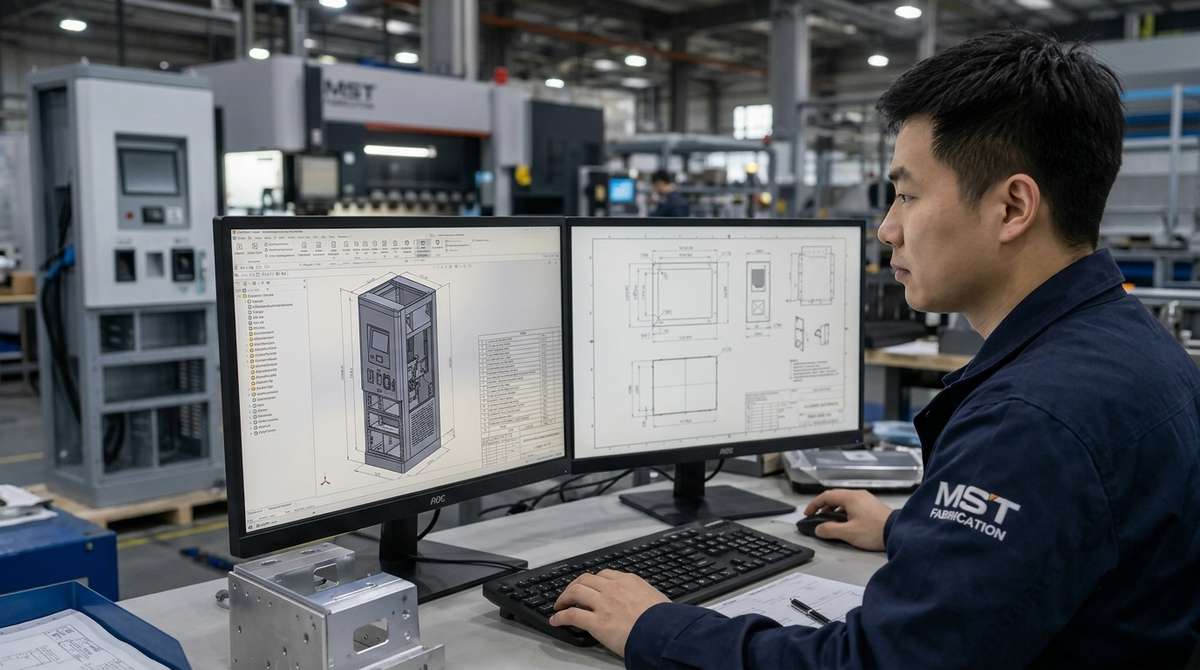
Send a STEP or STP model plus a revision-controlled 2D drawing. The drawing should control material, thickness, datums, critical dimensions, threads, hardware, welds, finish, masking and inspection. Use marked-up screenshots to explain questions, then incorporate approved decisions into the controlled release documents.
Translate every customer-selected component into metal requirements: cutout, hole pattern, stud height, bracket load, seal width and installation access. MSTFAB reviews whether those features are cuttable, bendable, weldable and inspectable; it does not approve the electrical component.
“Manufacture the empty shell to revision C and verify the highlighted interfaces” is clearer than “build our 180 kW charger cabinet,” which quietly contains an entire engineering department.
3. Treat doors, panels and the base as one structure
Door weight acts through hinges into the frame, while the base carries the cabinet into the customer foundation. Define front and rear access, opening direction, removable panels, hinge axis, latch points, gasket channel, door stay and tool clearance.
For the base or plinth, release anchor datums, bottom openings, lifting points, forklift access and drain paths. If it ships separately, define alignment and fastener access.
4. Plan laser cutting and CNC bending around interfaces
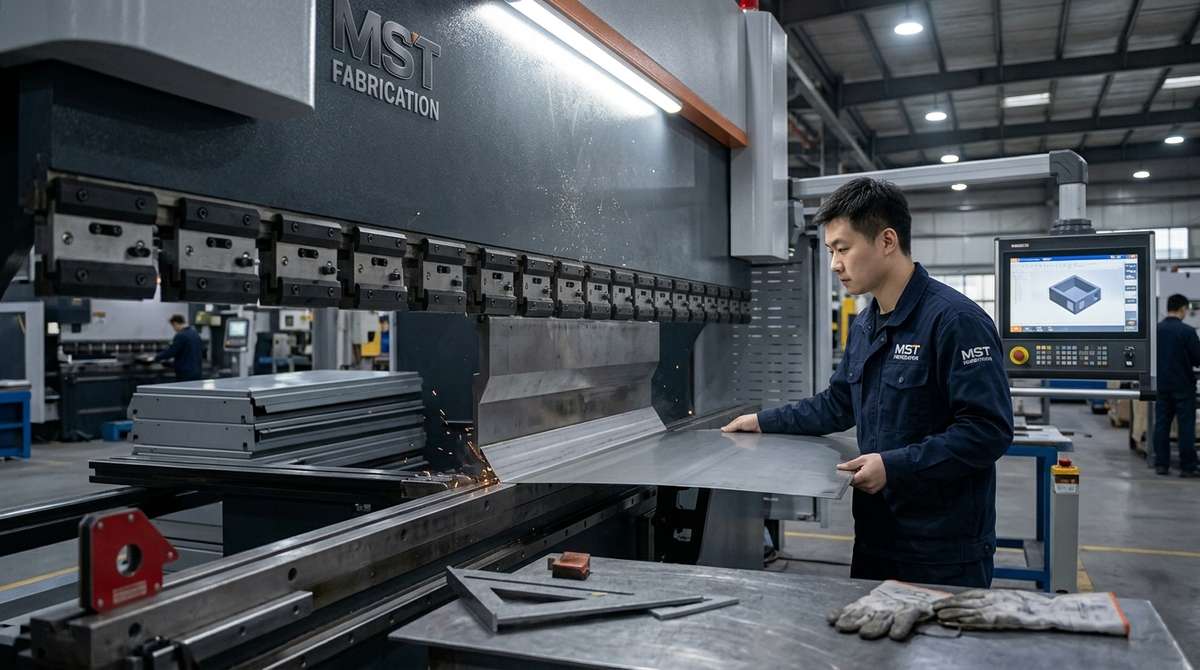
Fiber laser cutting creates profiles, service openings, vents, slots and mounting features. Files should be checked for scale, open contours, duplicate lines, small features and revision consistency before nesting.
Dimension important cutouts from functional datums. Large openings may reduce panel stiffness and need return flanges, brackets or reinforcement. MSTFAB proposes a manufacturable route for customer approval.
CNC bending creates returns, channels, offsets, rain hoods and base parts. Review bend radius, flange length, hole distance, tooling access, grain direction and springback. For multi-bend panels, review accumulated variation along the dimensions that control assembly.
5. Control welding, hardware and first assembly fit

Welding joins the frame, base, brackets and partitions while introducing heat and distortion. Fixtures, balanced weld sequence and intermediate checks protect squareness, door openings and panel fit.
State weld location, size, finish and cosmetic expectation. Coordinate PEM nuts, studs, rivet nuts, hinges and locks with bending and coating. Check insertion access, edge distance, masking and tool clearance. A fastener that exists in CAD but cannot meet a wrench is not fully designed.
Trial-fit agreed doors and removable panels on the first article. Record door gap, hinge alignment, latch engagement and interchangeability where required. Final charger assembly remains the customer’s job.
6. Convert outdoor, cable and thermal needs into metal geometry
Outdoor protection begins with sloped roofs, rain hoods, drip edges, door returns, gasket channels and drains. MSTFAB can inspect those features, but an empty shell cannot guarantee an IP or NEMA rating; installed devices and final assembly affect the result.
For cable entry, specify gland-plate size, hole pattern, edge protection, bend-radius clearance and connector access. For thermal interfaces, release louvers, perforations, fan or heat-exchanger cutouts, baffles and brackets. The buyer owns cables, heat load, airflow, devices, controls and validation.
7. Select material and finish for the actual environment
Choose cold-rolled or galvanized steel, stainless steel 304/316, or aluminum 5052/6061 from load, corrosion, weight, forming, finish and cost requirements.
Powder coating and other selected finishes may be completed by qualified long-term partners under the approved order scope. Define pretreatment, color, texture, visible faces, film thickness, masking and required records in the drawing and purchase order. Protect threads, gasket lands, grounding points and close fits. Confirm final clearances in the specified coated condition.

8. Build the RFQ around inspection and shipping evidence
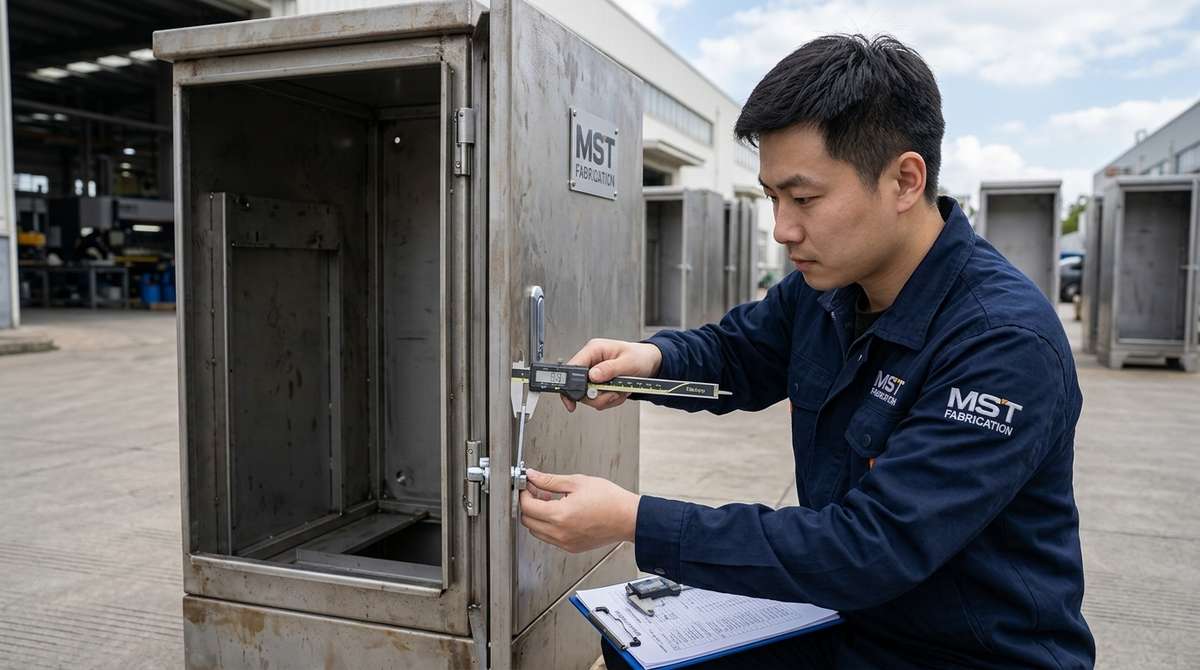
First-article inspection should focus on squareness, doors, base interface, cutouts, mounting patterns, brackets, gasket channels and coated clearances. Final tolerances must be confirmed from the drawing, material, geometry, tooling and measurement method.
| Characteristic | Possible evidence | Responsibility boundary |
|---|---|---|
| Frame, door, base and cutouts | Dimensional report, gap record, fixture or customer gauge | MSTFAB verifies agreed metal geometry |
| Finish and packing | Coating record, masking check, packing photos and hardware list | Customer validates the complete charger |
For quotation, send models, drawings, material, thickness, quantities, interfaces, weld and hardware notes, finish, inspection points, packing and destination. Separate prototype and production quantities so setup cost is not disguised as a strange unit price.
Use foam separation, protected corners, secured doors and labeled loose hardware. A complete DC fast charging enclosure shell manufacturing checklist lets MSTFAB quote the metal work while charger-system authority stays with the OEM.
Frequently asked questions
Does MSTFAB manufacture complete DC fast chargers?
No. MSTFAB supplies empty shells and agreed mechanical parts, not charger electronics, cables, cooling devices or controls.
Can MSTFAB make device and cable openings?
Yes, from customer-controlled interface drawings. MSTFAB verifies metal geometry, not device performance.
Can the empty shell guarantee an IP or NEMA rating?
No. The finished-product owner validates ingress after all devices and cables are installed.
Who owns UL 2594 or UL 2202 certification for the finished charger?
The EVSE OEM or responsible integrator owns the final certification project, listing decisions, complete-system testing and market release. MSTFAB supplies drawing-controlled mechanical enclosure parts within the approved scope; an empty shell is not a UL Listed charger.
What belongs in first-article inspection?
Check doors, base, cutouts, brackets, gasket channels, hardware, masking and coated clearances.
What files are needed for quotation?
Send models, controlled drawings, material, quantities, interfaces, finish, inspection, packing and destination.
Send the enclosure shell drawing package
Share the model, drawings, material, quantity, interfaces, finish and inspection requirements.
 WeChat Contact
 WhatsApp Me Directly