How OEM buyers can specify an empty galvanized distribution box shell for an IP66 target without confusing sheet metal fabrication with a finished, tested electrical assembly.
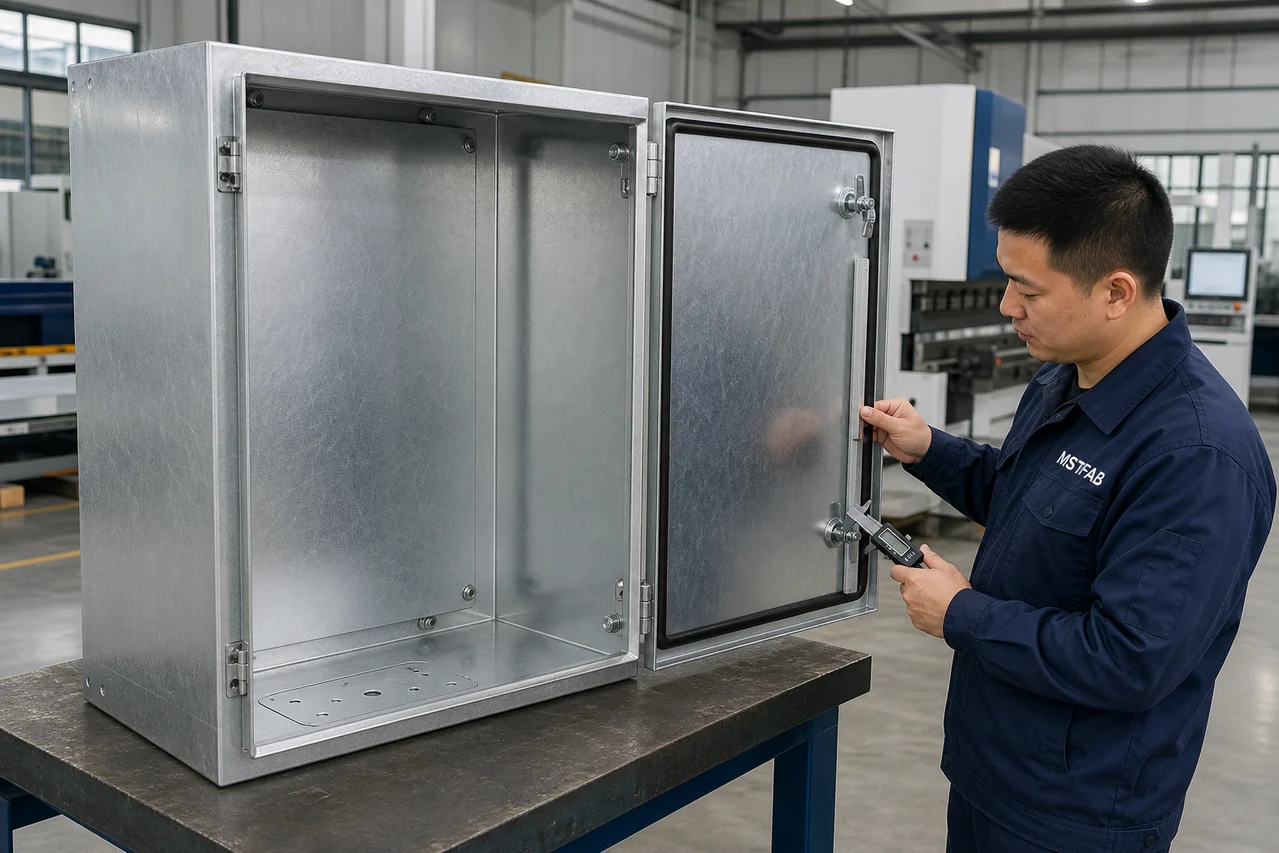
IP66 is a target for the completed enclosure configuration, not a coating claim.
An IP66 galvanized steel distribution box is intended to be dust-tight and protected against powerful water jets under IEC 60529. The galvanized substrate may support corrosion resistance, but it does not create the IP rating. Door geometry, gasket, closures, seams, cable entries and every installed fitting must work together in the tested configuration.
MSTFAB laser cuts, CNC bends, welds, finishes and inspects the empty sheet metal shell to the buyer’s released drawings. The buyer, panel builder or certification owner selects the electrical components and sealing hardware, controls final assembly, and validates the completed enclosure.
One enclosure, two clear responsibilities
This boundary keeps the quotation accurate and prevents an empty fabricated shell from being sold as a finished electrical product.
MSTFAB can fabricate
- Empty galvanized bodies, doors and removable panels
- Laser-cut openings, blank gland plates and mounting datums
- CNC-bent returns, sealing lands and reinforcement
- Welded seams, studs, nuts and buyer-defined brackets
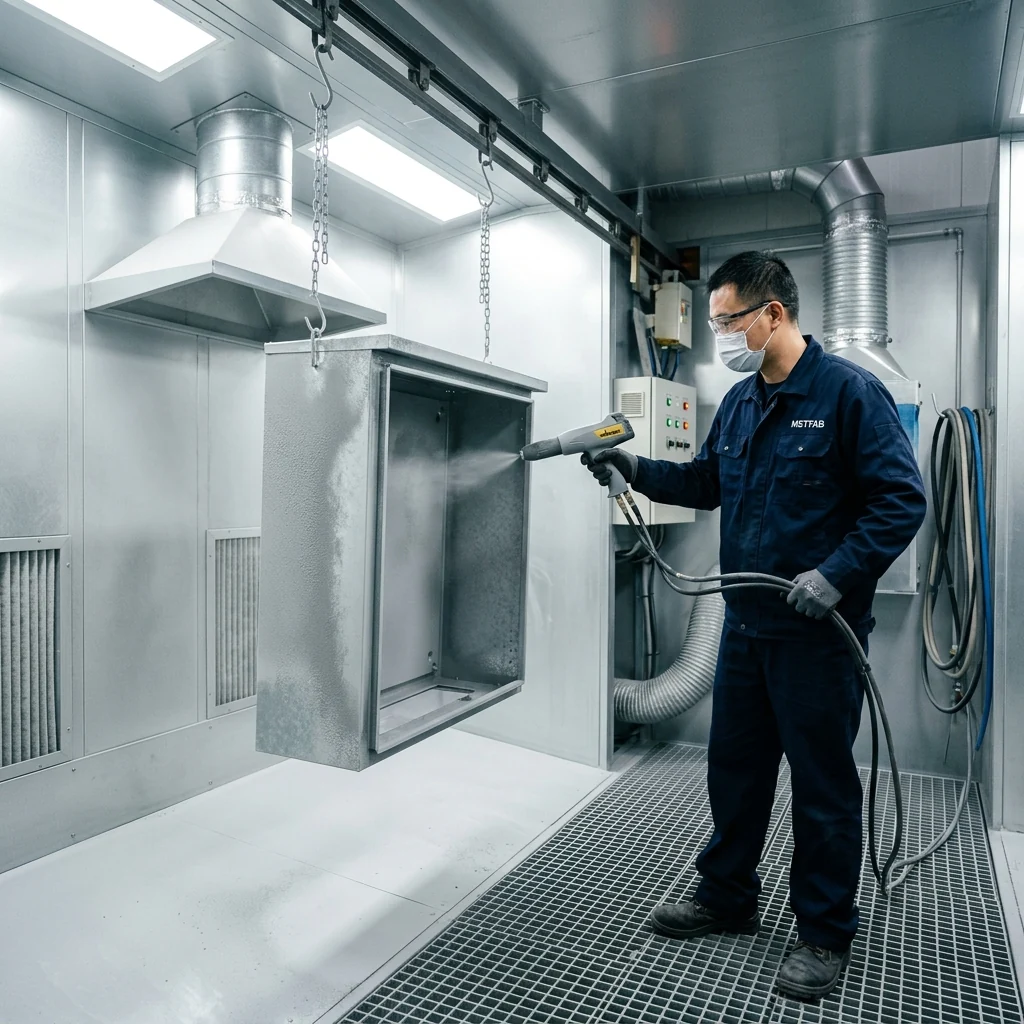
- Specified powder coating, masking and surface treatment
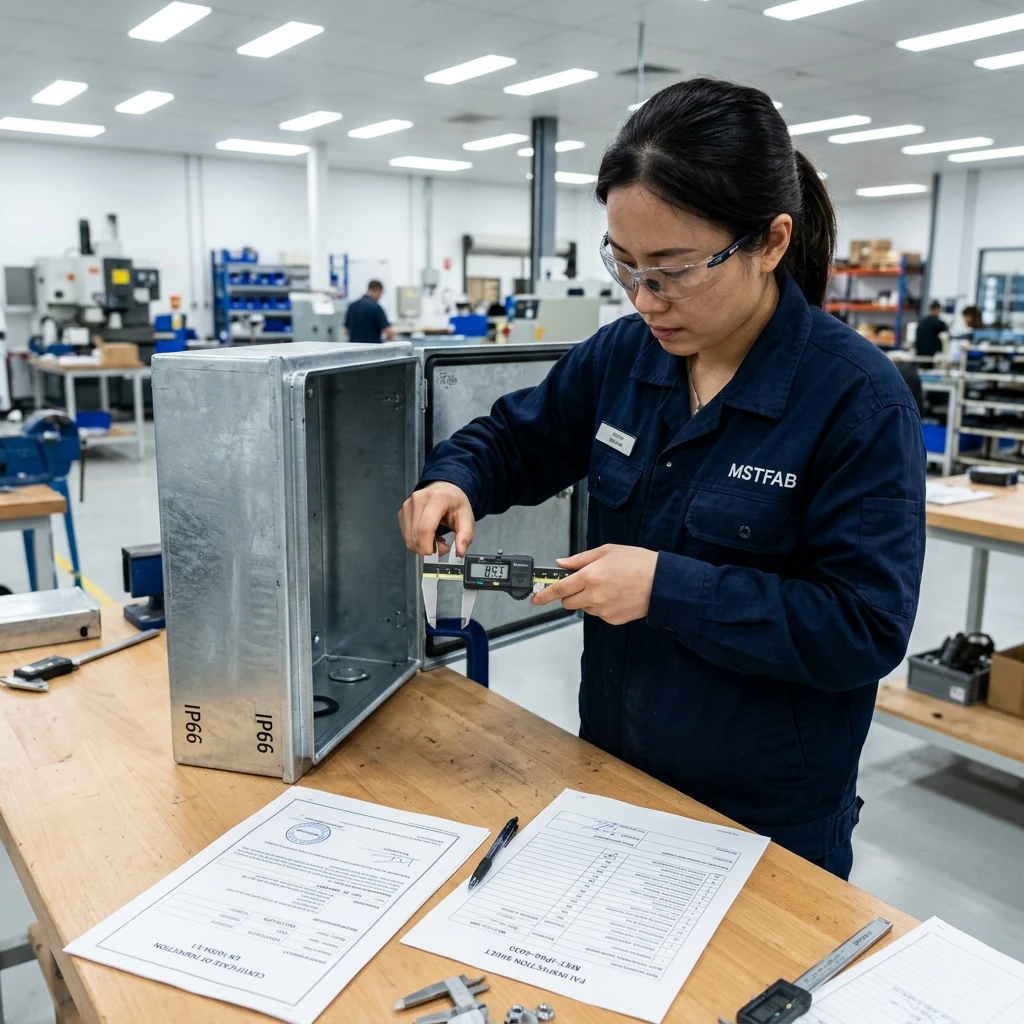
- Mechanical FAI, dimensional records and export packing
Buyer or integrator owns
- Electrical architecture, protection devices and ratings
- Gasket, glands, connectors and sealing-hardware selection
- Busbars, breakers, terminals, wiring and electronics
- Final assembly torque and field installation method
- Completed-enclosure IP testing and certification evidence
- Finished-equipment safety and market approval
Confirm these three inputs before asking for an IP66 shell quote
Real exposure
Define dust, spray direction, cleaning practice, outdoor exposure and any temporary immersion risk. Do not select the rating from a product title alone.
Controlled configuration
Freeze the door, gasket land, latch, hinge, gland plate and cable-entry construction that will be used for validation.
Evidence owner
Name the party responsible for testing and marking the completed enclosure. Empty shell fabrication is evidence input, not the final rating decision.
Match the enclosure path to the installation condition
How the empty distribution box shell is produced
The enclosure is manufactured from the released STEP/STP model and controlled 2D drawing. Each process protects a different interface needed by the buyer’s later assembly.
DFM review
Check bends, seams, sealing lands, gland plates, hardware and inspection datums.
Laser cutting
Cut repeatable openings, mounting patterns and blank cable-entry interfaces.
CNC bending
Form door returns and cabinet flanges while controlling the sealing plane.
Welding
Join seams and reinforcement using a sequence that limits heat distortion.
Finish and FAI
Apply the specified finish, then inspect the completed empty metalwork.

Four places where the IP66 construction can be lost
Door sealing land
Weld pull or a distorted return can prevent even gasket compression. Define flatness and inspect it after the process that can move it.
Hinge and latch relationship
The door must approach the frame consistently. Hardware part numbers, grip range and installed orientation belong in the released package.
Cable-entry interface
A blank gland plate can be fabricated accurately, but the buyer must define the final glands, connectors, hole pattern and sealing method.
Finish and contact areas
Galvanized material, powder coating, masked zones and cut-edge treatment are separate drawing inputs. IP66 does not define the corrosion system.
The phrase “make it IP66” does not tell the laser where to cut, the press brake where to bend or QC what to measure. Release the mechanical interfaces first.
What a useful supplier file should connect
| Evidence | What it should prove | Buyer action |
|---|---|---|
| Released drawing package | STEP/STP, PDF, part number and revision describe one configuration. | Resolve conflicts before PO. |
| Material record | The galvanized steel route, grade, thickness and requested documentation match the order. | State the required record in the RFQ. |
| Mechanical FAI | Critical sealing, mounting and cable-entry interfaces match the approved drawing. | Define CTQs and report format. |
| Finish evidence | Coating, masking and surface requirements follow the controlled specification. | Approve samples or measurable criteria. |
| Change notification | Controlled material, hardware, process or location changes are reviewed before production. | Put approval rules in the PO or quality agreement. |
| Packing record | Door geometry, surfaces and protruding hardware are protected for export shipment. | Approve the packing method for repeat orders. |
Keep the quote focused on the actual manufacturing job
| Item | MSTFAB scope | Buyer / panel builder scope |
|---|---|---|
| Enclosure body and door | Fabricate to released drawing | Define architecture and environmental target |
| Gasket land and flange | Manufacture and inspect defined geometry | Select sealing system and compression requirement |
| Gland plate | Fabricate blank or drawing-defined metal plate | Select glands, connectors and cable system |
| Mounting plate and brackets | Fabricate mechanical parts | Define electrical component layout and loads |
| Electrical components | Not supplied | Supply, install and validate |
| IP66 validation | Provide agreed fabrication evidence | Own completed-configuration test and marking |
Send enough information to quote the shell once
- STEP/STP enclosure assembly
- Controlled dimensioned PDF
- Part number and revision
- Installed orientation and environment
- Galvanized material route and thickness
- Finish, color and masking requirements
- Door, hinge and latch hardware data
- Gasket land and compression inputs
- Gland plate and cable-entry geometry
- Mounting plate and bracket drawings
- CTQs and FAI report format
- Prototype and production quantities
- Change-notification requirements
- Export packing requirements
Useful scope sentence: “MSTFAB shall fabricate the drawing-defined empty galvanized distribution enclosure shell and mechanical sheet metal interfaces only. Buyer owns electrical integration, sealing hardware and completed-enclosure IP66 validation.”
IP66 distribution box shell questions
Does galvanized steel automatically make a distribution box IP66?
No. Galvanized steel is a material and corrosion-control input. IP66 concerns protection against dust and powerful water jets in the completed enclosure configuration.
Can MSTFAB supply the complete electrical distribution box?
No. MSTFAB fabricates drawing-based empty sheet metal bodies, doors, panels, brackets and mounting plates. Breakers, busbars, terminals, wiring and energized testing remain with the buyer or panel builder.
Can an empty shell itself carry the final IP66 claim?
The project must follow the applicable test and certification route for the controlled completed configuration. An empty shell supplier can manufacture the approved mechanical construction and provide agreed inspection evidence, but open entries and buyer-installed parts still affect final performance.
Is IP66 the same as NEMA Type 4X?
No. They come from different standards and should not be treated as automatically equivalent. NEMA Type 4X includes additional considerations such as an added degree of corrosion protection.
What should first-article inspection check?
Project-specific CTQs may include the door opening, sealing-land flatness, hinge and latch positions, gland-plate opening, mounting datums, welded hardware, finished coating condition and mechanical fit.
What is the biggest sourcing mistake?
Buying the keyword instead of releasing the interfaces. A supplier cannot control an IP66 construction when the gasket, closures and cable-entry method are still undecided.
Standards context used in this guide
Official IEC publication page for the IP Code covering degrees of protection provided by enclosures.
Official NEMA reference showing why Type designations include environmental considerations beyond a simple IP label.
Related MSTFAB guidance: galvanized enclosure fabrication, IP66 versus NEMA 4X, and distribution box grounding and EMC DFM.
Request an empty distribution enclosure shell review
Send the released STEP/STP model, controlled PDF, galvanized material specification, environmental target, CTQs and quantities. MSTFAB will review the sheet metal route from laser cutting and CNC bending through welding, finishing, FAI and export packing.
 WeChat Contact
 WhatsApp Me Directly