How to Buy Custom Metal Brackets
Custom metal brackets manufactured from your drawings with laser cutting, CNC bending, welding, finishing, hardware installation, and DFM support.
Custom metal brackets are used in almost every industrial product.
They support equipment, connect structures, hold panels, reinforce frames, mount electrical components, and keep assemblies stable during operation. A small bracket may look simple, but if the material, thickness, hole position, bend angle, or surface finish is wrong, it can create serious assembly problems.
For OEM buyers, engineers, and procurement teams, buying custom metal parts is not only about asking for the lowest price. The real goal is to find a fabrication supplier that can understand drawings, review manufacturability, control dimensions, and deliver consistent parts from prototype to batch production.
MSTFAB provides sheet metal bracket fabrication based strictly on customer drawings, samples, or project requirements. Our manufacturing process encompasses precision laser cutting, CNC bending, stamping, welding, surface finishing, hardware installation, and detailed inspection.

What Are Custom Metal Brackets?
Custom metal brackets are structural metal components designed to support, connect, mount, or reinforce other assemblies.
They are heavily utilized for:
- Equipment mounting and anchoring
- Custom sheet metal enclosures
- Electrical and control cabinets
- Telecom cabinets and server racks
- Industrial machinery framing
- Automotive and heavy truck parts
- Agricultural machinery components
- Medical equipment chassis
- EV charger systems
- Structural frames and wall-mounted assemblies
Depending on the mechanical application, brackets may be flat, multi-axis bent, welded, slotted, ribbed for reinforcement, perforated, or assembled with embedded hardware like PEM nuts.
Step 1: Confirm the Application
Before requesting a quote, precisely define how the bracket will function in the real world.
Critical questions include:
- What exact weight or load will the bracket support?
- Is it utilized indoors in a climate-controlled room or outdoors in coastal weather?
- Will it endure continuous vibration (e.g., generator mounts)?
- Does it require heavy structural welding?
- Does it mandate tight hole alignment for mating parts?
- Will it be cosmetically visible after final assembly?
Step 2: Choose the Right Material
Material selection defines the bracket’s strength, longevity, and unit cost.
- Carbon Steel: Extremely strong and cost-effective. Ideal for hidden industrial frames, heavy machinery brackets, and welded structural supports.
- Cold-Rolled Steel (SPCC): Exceptional surface quality. Suitable for indoor brackets, cabinet mounting rails, and powder-coated visible components.
- Galvanized Steel (SGCC): Provides an inherent layer of zinc corrosion resistance. Excellent for electrical cabinets, outdoor brackets, and telecom equipment.
- Stainless Steel (SUS304/316L): Mandatory for medical devices, food processing equipment, and highly corrosive marine environments.
- Aluminum (AL5052/AL6061): Lightweight and highly formable. Perfect for aerospace, EV applications, and cosmetic anodized brackets.
Step 3: Define Thickness and Strength Requirements
Bracket gauge (thickness) directly impacts tensile strength, mass, cost, and bending feasibility.
- 1.0 mm to 1.5 mm: Light-duty brackets for electronics and PCB mounting.
- 2.0 mm to 3.0 mm: General industrial brackets, chassis mounts, and rack ears.
- 4.0 mm to 6.0 mm+: Heavy-duty structural brackets for automotive and agricultural applications.
However, thicker material is not the only way to increase rigidity. Strength can be exponentially improved by engineering flanges, stamped rib structures, return bends, welded gussets, or optimizing the mounting hole layout.

Step 4: Prepare Drawings or Samples
For an accurate, fast quotation, native CAD files are highly recommended.
The optimal Request for Quote (RFQ) package includes:
- 3D STEP File: Helps the CAM engineers understand the spatial structure.
- 2D PDF Drawing: Dictates the manufacturing tolerances, tapped hole specifications, and surface finish requirements.
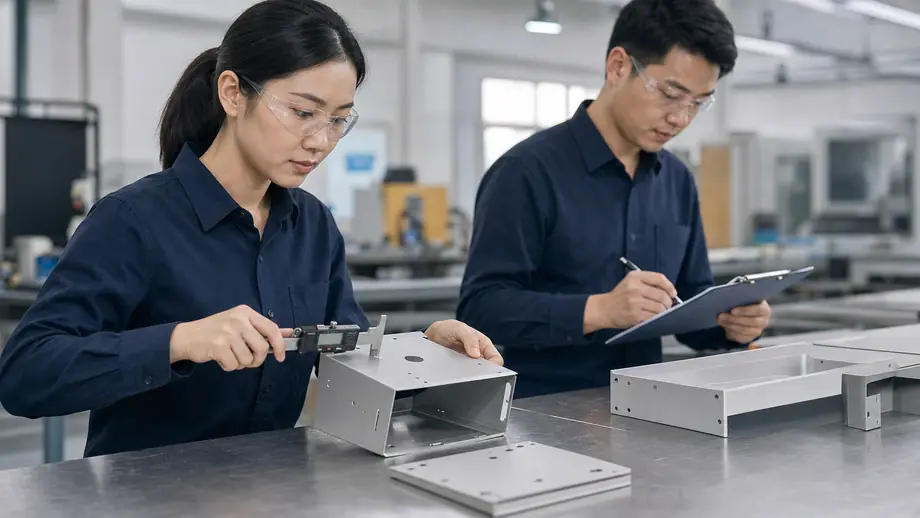
Step 5: Check Hole Positions and Tolerances
For metal brackets, precise hole alignment is often far more critical than the outer cosmetic shape. Mounting holes must mate perfectly with adjoining parts during your final assembly. If holes stretch or shift after bending, the bracket is useless.
Critical details include:
- Hole diameter and slotted clearances
- Hole-to-edge and hole-to-bend distances
- Countersink angles and depth
- Threaded tapping or blind stud requirements
Step 6: Review Bending and Forming Feasibility
Nearly all custom brackets require press brake bending. Before production, the flat pattern design must be analyzed for manufacturability.
If holes are designed too close to a bend line, they will distort into an oval shape during forming. If the specified bend radius is too sharp for the material thickness, the metal will fracture along the grain axis. Our DFM (Design for Manufacturability) review isolates and eliminates these geometric impossibilities before a single laser is fired.
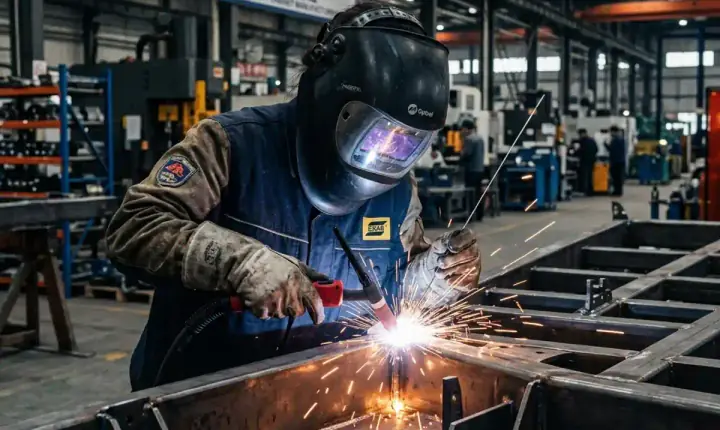
Step 7: Decide Whether Welding Is Needed
While many brackets are formed from a single piece of sheet metal, heavy-load applications require welded gussets or multi-part reinforced structures.
Important welding parameters include:
- Spot welding vs. full-seam structural TIG/MIG welding
- Grinding and cosmetic polishing after welding
- Fixture requirements to eliminate thermal distortion
Step 8: Choose the Right Surface Finish
Surface finishing seals the metal from oxidation and defines the aesthetic.
- Powder Coating: Extremely durable, scratch-resistant, and available in any RAL color.
- Zinc Plating: Cost-effective corrosion protection for internal mounting brackets.
- Anodizing: Specifically for aluminum brackets to harden the surface and add color.
- Electropolishing / Passivation: Required for stainless steel medical and food-grade brackets to remove free iron.
Step 9: Ask for Prototype or First Article Inspection
For entirely new OEM bracket designs, prototyping is a mandatory risk-reduction step. A physical prototype verifies dimensional accuracy, hole alignment, assembly fitment, and structural load-bearing capacity. Once the First Article is approved, we transition your bracket into stable, high-volume batch production.
Step 10: Evaluate the Supplier’s Manufacturing Scope
At MSTFAB, we specialize exclusively in physical metal structures. We do not manufacture or request your proprietary software or internal circuitry. We strictly build the mechanical metal bracket, frame, or chassis according to your exact mechanical drawings, ensuring your Intellectual Property remains completely isolated and protected.
FAQ: Custom Metal Brackets
How do I buy custom metal brackets?
To buy custom metal brackets, provide your 3D/2D CAD drawings, confirm the exact material grade, thickness, surface finish, quantity, and tolerance requirements. Our engineering team will review the manufacturability and provide a quote.
What materials are used for custom metal brackets?
Common materials include carbon steel, cold-rolled steel, galvanized steel, stainless steel, and aluminum, heavily dependent on the structural load and environmental application.
Can metal brackets be customized according to drawings?
Yes. Every custom metal bracket we manufacture is fabricated strictly according to your native 3D STEP files, 2D PDF drawings, or physical reference samples.
Can you make heavy-duty welded brackets?
Absolutely. Heavy-duty welded brackets, structural supports, and reinforced metal frames for trucks, agricultural machinery, and industrial equipment are fabricated using certified TIG and MIG welding processes.
Get a Free Sheet Metal Assembly DFM Quote — in 24 Hours
Upload your CAD drawings today for a comprehensive DFM review and factory-direct quotation.
- ✅ 5,000 m² Guangzhou factory — fiber laser, CNC bend, robot weld, powder coat in-house
- ✅ ISO 9001 certified — strict DFM, precision tolerances, and quality control
- ✅ 23+ years exporting custom enclosures to EU, US, AU OEMs
sheet metal welding services
MSTFAB provides TIG and MIG sheet metal welding services for structural assemblies, cabinets, frames and OEM metal components.
 WeChat Contact
 WhatsApp Me Directly