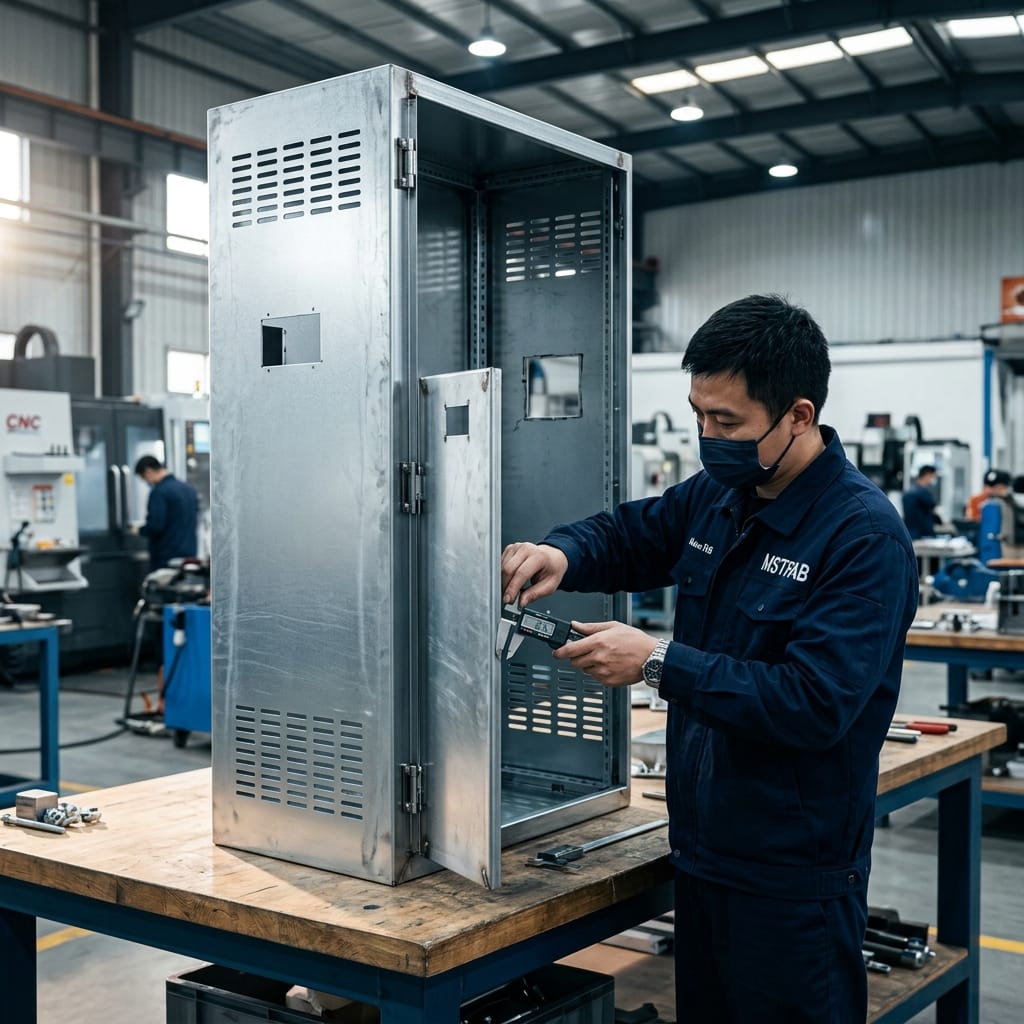
Buyer Guide | Empty Enclosure Shells Only
A practical change-control guide for OEM buyers adding cutouts, doors, gland plates, ventilation or material changes to an enclosure tied to a UL-certified design.
Quick answer
Yes, an industrial enclosure shell can be customized physically. Whether a UL certification still covers the changed configuration is a separate decision. The UL file holder should confirm with UL Solutions whether the proposed change remains within the certified construction or needs approval or evaluation before manufacture. The Authority Having Jurisdiction may determine whether the completed installation is acceptable under the adopted code; it does not rewrite the certification file.
MSTFAB fabricates empty sheet metal shells to buyer-controlled drawings. We do not select breakers, wire panels, calculate the finished assembly SCCR, energize equipment, apply a UL Mark or certify the completed control panel.
This distinction saves expensive confusion. A laser can cut a perfect hole in seconds; it cannot tell you whether that hole belongs inside a certification file. A hole saw is an excellent employee, but a terrible compliance manager.
What MSTFAB can manufacture
- Empty enclosure bodies, doors and removable panels
- Mounting plates, gland plates, brackets and reinforcements
- Buyer-specified cutouts, louvers, studs, hinges and gasket channels
- Powder coating, plating, dimensional inspection and export packing
What remains outside our scope
- Electrical engineering, component selection and wiring
- Busbar integration, panel assembly and functional testing
- Finished-equipment SCCR calculations or panel labeling
- UL certification ownership, approval or application of a UL Mark
How this guide avoids duplicating our other standards articles
UL Listed vs. UL-Ready Enclosure Shells explains labeling language and supplier claims.
UL 508A vs. IEC 61439-2 Enclosure Shell Inputs compares the mechanical information needed before panel integration.
This article owns a narrower question: how an OEM controls sheet metal changes after a certification baseline or reviewed design already exists.
Start with the controlled baseline, not the desired cutout
Before asking a metal factory to customize a UL-certified industrial enclosure, identify exactly what is certified and who controls that certification. The answer may be a listed empty enclosure, a complete industrial control panel, a component used under conditions of acceptability, or another product category. Those are not interchangeable labels wearing different hats.
Use UL Product iQ to verify certification information such as the file number, category, model family and available guide information. Then obtain the controlled documents from the certification owner. A logo in a brochure is not a construction record.

| Baseline item | What the buyer should record | Why it matters to fabrication |
|---|---|---|
| Certification owner | Company, file number, product category and model family | Identifies who can confirm whether a change is covered |
| Approved revision | Drawing number, revision, approval date and change history | Prevents production from following an obsolete email attachment |
| Enclosure rating target | Type or other environmental target defined by the responsible engineer | Drives gasket, seam, opening and hardware requirements |
| Material construction | Grade, thickness, coating, weld route and permitted alternatives | Controls strength, corrosion, forming and repeatability |
| Marking responsibility | Who may apply which mark, and at what manufacturing location | Keeps the metal supplier from making a claim it does not own |
Three practical approval paths for a requested change
Already covered
The exact option, size, material, accessory or hole pattern is documented within the certification owner’s controlled construction.
Approved before fabrication
The change is not yet released, but the file holder or certification body reviews and incorporates it before the factory receives the production revision.
Outside the baseline
The change may require redesign, another certification route or a field evaluation. UL notes that customized or modified equipment may need field evaluation for the applicable installation.
UL Solutions describes field evaluation as an on-site assessment for new, unlabeled or modified equipment and notes that AHJs may require it before equipment is energized. See the official UL Field Evaluation Services overview. This article cannot decide which path applies to your project; it helps you gather the mechanical evidence needed for that decision.
12 enclosure shell changes that deserve written review
1. Material grade
Changing carbon steel, galvanized steel, stainless or aluminum affects corrosion, forming, welding and finish behavior.
2. Sheet thickness
Thickness changes alter bend deductions, thread engagement, stiffness, weld heat and hardware selection.
3. Overall dimensions
A larger shell can change door sag, lifting loads, seam length, reinforcement and installation clearances.
4. Door and hinge layout
Hinge count, latch location and opening angle influence compression, alignment and access.
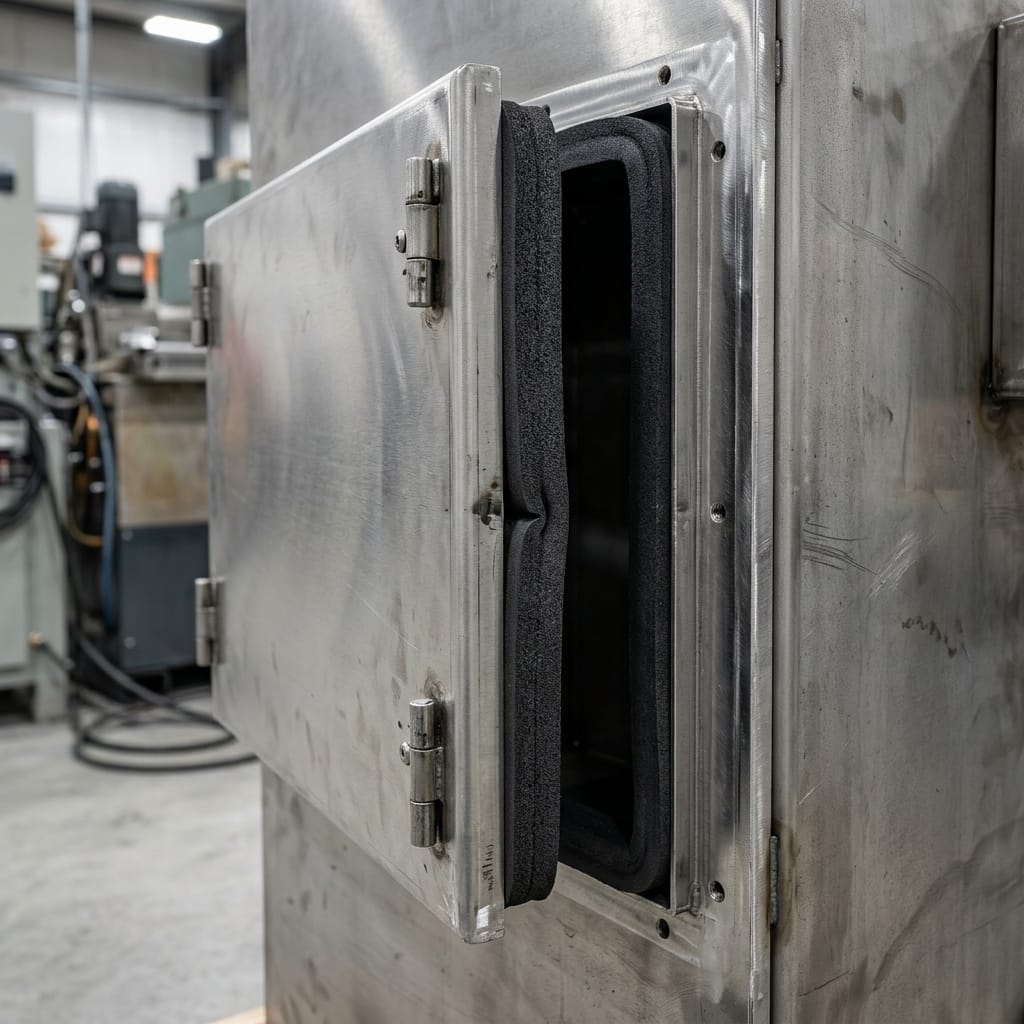
5. Gasket and sealing flange
Flange width, corner continuity, weld cleanup and compression determine whether the seal has a fair chance.
6. HMI and window cutouts
Large openings reduce panel stiffness and can interfere with gasket lines, hinges or reinforcement.
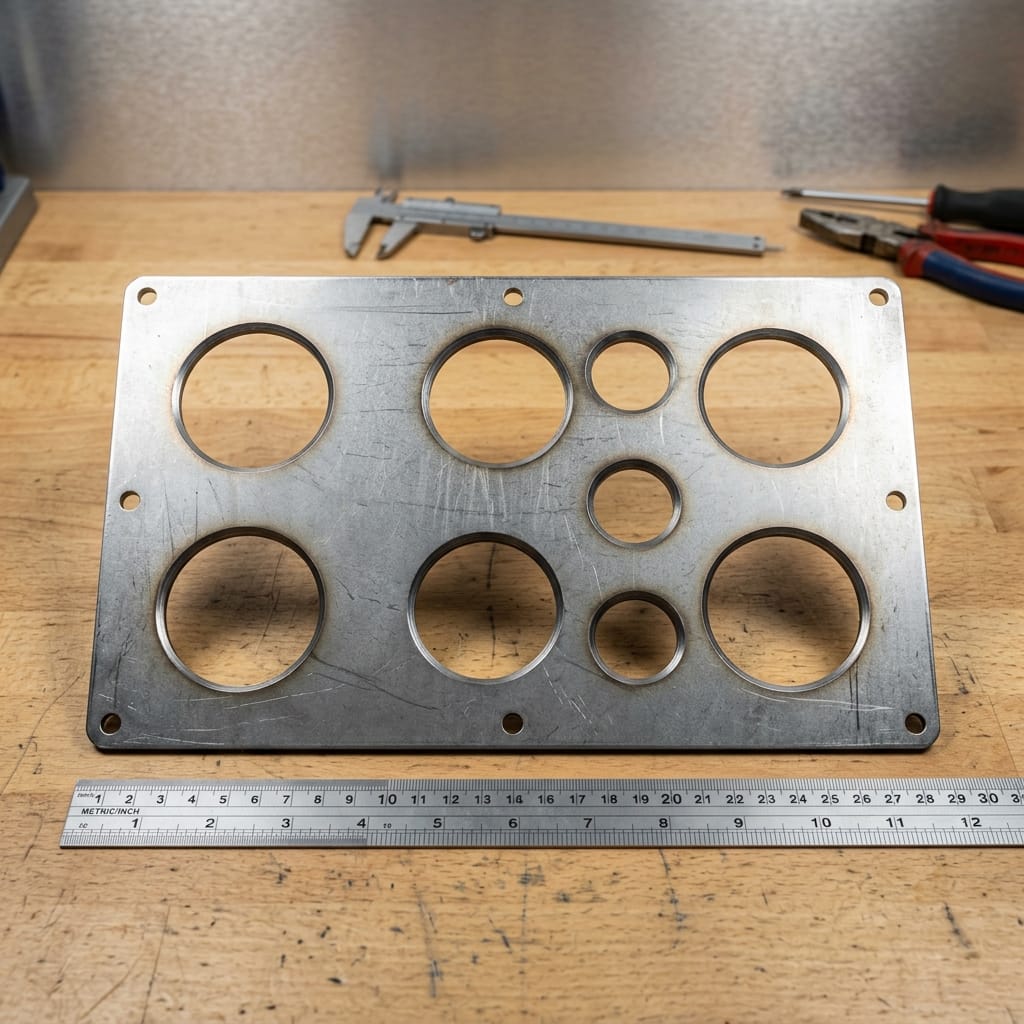
7. Cable and conduit entries
Define opening size, edge distance, accessory, seal, torque and inspection responsibility.
8. Ventilation and cooling
Fans, filters, heat exchangers and air-conditioner openings can change environmental and thermal behavior.
9. Gland plates
Plate thickness, fastener spacing, gasket path and opening schedule need their own controlled drawing.
10. Studs and grounding points
Weld studs and bonding provisions affect distortion, coating masks and later panel-shop access.
11. Base and lifting features
Plinths, casters, lifting eyes and fork pockets must match actual transport and installation loads.
12. Finish system
Powder, plating, passivation, masking and film protection can affect contact areas and corrosion performance.
Translate certification controls into manufacturable drawings
Once the responsible certification party confirms the permitted construction, the next risk is translation. The factory needs measurable requirements, not a cloud of comments spread across six emails. A redlined PDF sent after welding is not change control; it is a plot twist.

RFQ package for an empty enclosure shell
- Released 3D model plus dimensioned 2D PDF, with matching drawing numbers and revisions
- Material grade, sheet thickness, grain direction or cosmetic-face notes where relevant
- Cutout schedule with datum scheme, tolerances, corner radii and accessory references
- Door, hinge, latch, gasket and removable gland-plate details
- Weld symbols, acceptable cleanup, stud locations and protected contact areas
- Finish specification, color, texture, coating thickness and masking map
- Critical-to-quality dimensions and first-article inspection format
- Written certification boundary: who owns approval, marking and final equipment compliance
DFM pain points that become expensive after cutting
| Buyer pain point | Typical shell risk | DFM action before release |
|---|---|---|
| Cutout near a bend | Hole distortion or insufficient tooling clearance | Review bend radius, edge distance and forming sequence |
| Large door opening | Door oil-canning, sag or weak gasket compression | Add return flange or reinforcement and verify latch spacing |
| Dense gland pattern | Weak plate, seal interference or tool access problems | Check ligament width, plate thickness and accessory envelope |
| Heavy weld concentration | Twist, shifted holes and poor door alignment | Use fixtures, balanced weld sequence and post-weld checks |
| Coating after assembly | Covered grounding points, threads or gasket lands | Release a masking map and protected-surface checklist |
| Late revision | Correct finish applied beautifully to the wrong part | Freeze revision before material nesting and maintain change log |

Responsibility matrix: who decides what?
| Party | Primary responsibility | Not safe to assume |
|---|---|---|
| OEM buyer / design authority | Defines requirements, intended use, target rating and released revision | That a supplier will infer missing compliance decisions |
| UL file holder / certification owner | Controls certified construction, approved options and marking authorization | That every custom configuration is automatically covered |
| NRTL / field evaluation body / AHJ | Performs or accepts applicable evaluation and installation decisions | That the metal factory can replace this authority |
| Panel shop / integrator | Electrical design, components, wiring, assembly, tests and finished-panel records | That an empty certified enclosure certifies the assembled panel |
| MSTFAB | DFM, laser cutting, bending, welding, hardware, finishing, inspection and packing of empty shells | That MSTFAB provides finished electrical equipment or a UL Mark |
UL Standards & Engagement describes UL 508A as addressing complete industrial control panel assemblies. That is why a sheet metal shell supplier should not blur its work with the panel builder’s electrical and certification scope.
A seven-step buyer workflow before production
Classify the product and certification boundary
Confirm whether the controlled item is an empty enclosure, a complete panel or another product category.
Identify the file holder and approval authority
Record who owns the certification, who may approve changes and who may apply markings.
Freeze the mechanical requirement
Close dimensions, material, cutouts, door hardware, gaskets, finish and inspection requirements.
Classify every requested change
Mark each item as already covered, pending written approval or outside the existing baseline.
Run fabrication DFM
Review bend limits, tool access, weld distortion, coating masks, tolerance stack and packing risks.
Inspect a representative first article
Use production material and hardware, then document critical dimensions, fit and cosmetic condition.
Release repeat production under revision control
Reference the approved drawing revision and require written review before future changes.
Red flags that should pause the purchase order
- “The standard enclosure was listed, so every custom version is listed.” Ask for the exact covered construction and model relationship.
- “Any hole is fine if the gland is rated.” The opening, accessory, mounting method, location and enclosure construction work as a system.
- “The electrical parts are UL Recognized, so the finished panel is UL Listed.” Component status does not automatically certify the completed assembly.
- “We will sort the certification after the first batch.” This is how useful metal becomes very organized scrap.
- “MSTFAB will put the UL label on it.” We will not. Our scope is the empty fabricated shell and mechanical parts.
How MSTFAB supports the mechanical side
For buyer-controlled enclosure shell projects, MSTFAB can review the manufacturing route across laser cutting, CNC bending, welding, hardware installation, surface finishing and dimensional inspection. Our broader sheet metal fabrication service page explains the build-to-print workflow.
We can manufacture to a drawing that the responsible design and certification parties have approved. We cannot convert an unapproved concept into a certified finished panel by adding confidence to the quotation. Confidence is useful; controlled evidence travels better.
Frequently asked questions
Can MSTFAB certify a finished industrial control panel to UL 508A?
No. MSTFAB fabricates empty sheet metal enclosure shells and mechanical components. We do not provide panel wiring, electrical integration, finished-panel testing, UL marking or certification ownership.
Can cutouts be added to an enclosure tied to a UL-certified design?
They can be fabricated when the buyer supplies an approved controlled drawing. Whether the cutout is already covered or needs additional review must be confirmed by the certification owner or other responsible authority.
Does a UL-certified component make the completed panel certified?
No. Component certification or recognition does not automatically certify the final assembly. The finished equipment must follow the applicable product and certification route.
What should an OEM send for an enclosure shell quotation?
Send matching 3D and 2D files, drawing revision, material and thickness, cutout schedule, door and gasket details, finish specification, critical dimensions, quantity and the written certification boundary.
Who should approve a change to a controlled enclosure design?
The approval path depends on the product and installation. The UL file holder, certification body, qualified panel shop and AHJ may all have roles. The metal fabrication supplier should not make that decision alone.
Sources and review method
This buyer guide combines MSTFAB’s practical enclosure RFQ and DFM experience with primary information from UL organizations. It is educational manufacturing guidance, not legal advice or a certification decision.
- UL Solutions: Field Evaluation Services
- UL Solutions: Product iQ Certification Database
- UL Standards & Engagement: UL 508A and Complete Industrial Control Panels
- MSTFAB factory photos and manufacturing environment
UL® and UL 508A are referenced for buyer education. MSTFAB is not affiliated with UL Solutions and does not claim authorization to certify or mark finished industrial control panels.
Send the approved shell revision, not a certification guess
Share your released CAD, material, finish, quantity and mechanical inspection requirements. MSTFAB will review manufacturability for the empty enclosure shell before quotation.
 WeChat Contact
 WhatsApp Me Directly