Buyer answer: laser cutting is usually the flexible starting point when geometry may change or quantity is uncertain. Stamping becomes worth evaluating when the design is stable and the expected volume can justify tooling. Neither process guarantees a finished-part tolerance on its own; bending, hardware, welding and finishing can change the result.
MSTFAB, operated by Guangzhou Maisituo Sheet Metal Manufacturing Co., Ltd., makes drawing-based metal parts and empty enclosure shells. This is a process-selection guide, not a promise of a universal tolerance, minimum order or lead time. Your approved drawing and inspection plan define acceptance.

Laser cutting or stamping: which belongs in the RFQ?
A low unit price means little if a later revision makes the tooling unusable, or if a cheap flat blank needs expensive handwork before assembly. Ask suppliers to quote the whole route against the same drawing revision.
| Buyer check | Laser cutting | Stamping or punching |
|---|---|---|
| Upfront cost | Laser cuttingProgramming and setup; usually no dedicated profile die. | Stamping or punchingDedicated tooling may be needed; confirm who owns and maintains it. |
| Design revisions | Laser cuttingOften easier to update the cut program after drawing approval. | Stamping or punchingDie changes can add cost and time; freeze interfaces before tooling release. |
| Volume fit | Laser cuttingUseful for prototypes, pilot batches and changing part families. | Stamping or punchingWorth evaluating for stable repeat volumes when tooling cost can be recovered. |
| Inspection focus | Laser cuttingEdge condition, hole position, heat effects and downstream fit. | Stamping or punchingTool wear, burr direction, formed features and repeatability over the run. |
The crossover quantity depends on the part, material, die complexity and revision risk. Anyone offering a single magic number without a drawing is selling confidence, not an estimate.
Laser cutting: flexible does not mean inspection-free
Laser cutting suits detailed profiles and changing designs. It can also leave dross, a heat-affected edge or a burr that matters to a gasket, coating or operator touch point. Specify which edges are functional and how they should be finished. See MSTFAB’s laser cutting capability for the manufacturing scope.


Stamping: price the tool and the change risk
Stamping can make sense when a repeat part is stable enough to justify a die. Ask for the tool cost separately from piece price, along with ownership, maintenance, expected life and the cost of a drawing revision. If a bracket is likely to move two holes next month, approve the prototype before locking the tool.
The right comparison is not “laser price versus stamped price” on a single unit. It is total cost for the expected program quantity, including tooling, samples, secondary operations, inspection, packaging and probable changes. For drawing-based stamped components, review MSTFAB’s custom stamping parts scope.
Bending and hardware can overturn a perfect flat pattern
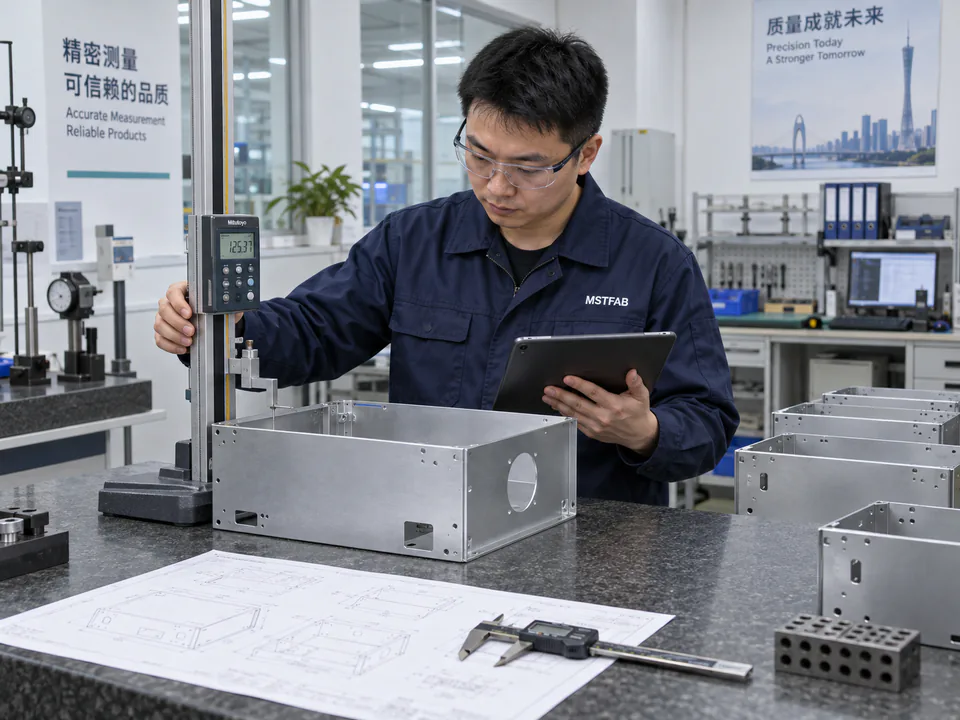
A hole may be accurately cut and still shift relative to a mating part after bending. Short flanges, deep returns, springback and tooling access can also change the manufacturing route. State the assembled datums and critical-to-fit features on the 2D drawing; a STEP file alone rarely tells the inspector what must be accepted.

Finish and inspection need their own scope
Powder coating does not hide a bad weld or correct a misaligned door. Define the cosmetic face, edge preparation, coating color and texture, masking points and any electrical bonding surfaces. MSTFAB can coordinate specified finishing with long-term partners when that is the agreed production route; do not assume every treatment is performed in-house.

Agree which dimensions, edges and visible surfaces need first-article evidence. Material certificates, coating records or dimensional reports should be requested in the purchase specification when needed; their availability depends on the approved project scope.
What to send for a comparable quote
- 2D PDF or DWG drawing plus STEP/STP or DXF geometry, with the current revision.
- Material grade, thickness, finish and any prohibited substitutions.
- Prototype quantity, expected repeat demand and likely design-change points.
- Critical dimensions, mating parts, edge requirements, hardware and cosmetic faces.
- Inspection evidence, packing requirements and destination.
With that package, a supplier can compare process routes honestly. Without it, the cheapest quote may simply be the one that assumed the least.
Common buyer questions
When is stamping cheaper than laser cutting?
After tooling and revision costs are spread across a stable production quantity. The break-even point is part-specific and should be calculated from the same released drawing.
Can you promise one tolerance for every part?
No. Material, thickness, size, cut geometry and downstream operations all matter. Mark the critical features and agree on a feasible inspection method before purchase.
Does MSTFAB supply the finished electrical equipment?
No. MSTFAB supplies drawing-defined metal parts and empty enclosure shells. The buyer controls electronics, wiring and final equipment certification unless a separate approved scope states otherwise.
Compare the process on your actual drawing
Send the revision, quantities and critical features. MSTFAB will review whether laser cutting, stamping or a mixed route makes sense before quoting.
 WeChat Contact
 WhatsApp Me Directly