Written by: Frank, Sheet Metal Manufacturing Specialist
Technical Review: David Chen, Senior Quality Engineer
Last Reviewed: August 2026
Manufacturing Scope: Drawing-based empty sheet metal terminal box shells only. No terminals, no wiring, no finished electrical assembly.
Looking for an ISO 9001 galvanized steel terminal box manufacturer? Here is the simple version.
The ISO 9001 certificate matters, but the certificate is not the terminal box.
What really matters to your electrical assembly team is whether:
- the cover fits;
- the gland holes are in the right place;
- the mounting plate goes in without a fight;
- the grounding point is where the drawing says it should be;
- the edges are properly deburred;
- the hardware matches the approved BOM;
- and batch 500 still looks and fits like the approved first article.
ISO 9001 gives a manufacturer a quality-management framework for controlling its processes, customer requirements, documented information, evaluation and improvement. It does not automatically certify the terminal box for waterproofing, electrical safety, IP rating, NEMA Type, UL listing or RoHS compliance.
At MSTFAB, we manufacture the empty sheet metal shell.
That can include: galvanized steel terminal box body; removable cover; hinged door; blank mounting plate; DIN-rail support features; cable-gland openings; connector cutouts; gland plates; welded studs; weld nuts; PEM hardware; grounding-interface features; brackets; specified finish; dimensional inspection; and export packaging.

We do not supply the finished electrical terminal box.
- No terminals.
- No wiring.
- No breakers.
- No energized testing.
- No surprise electrician hiding in the shipping carton.
Your panel builder installs the electrical parts. We make the metal around them.
Why This Page Is About the Box, Not the Certificate
A common RFQ looks like this:
Need ISO 9001 galvanized terminal box. Please quote.
That is enough information for Google. It is not enough information for a factory.
ISO 9001 tells us something about the supplier’s quality system. It does not tell us: box size, material thickness, cover design, gland-hole layout, mounting method, hardware, finish or quantity.
So if you want a quotation that means something, start with the actual part. Send: STEP + PDF + material + thickness + finish + quantity. Then add whatever inspection or quality documents your project needs.
The steel cannot read your mind. It is surprisingly traditional that way.


1. The Cover Has One Job: Fit the Box
A terminal box cover looks simple. That is why people forget how many things can go wrong with it.
The cover may be: screw-fixed, hinged, latched, removable, gasketed, or part of another customer-defined closing system.
The important point is that the finished cover has to match the finished box, not just the CAD model. Check: cover dimensions, hole alignment, screw positions, hinge alignment, door gap, flange relationship, corner geometry, and gasket-contact area where applicable.
If the box is welded, inspect the relationship after welding. A perfectly cut cover does not help much if the enclosure opening moved during fabrication. The laser did its job. The finished box still has to do its job.
2. Cable Gland Holes: Small Holes, Big Arguments
This is one of the most common terminal-box purchasing problems.
The buyer says: Six cable holes at bottom. The factory says: Okay.
Then assembly starts. One gland is too close to the wall. Two glands cannot be tightened side by side. The cable bend hits the mounting plate. And suddenly everybody becomes very interested in a hole that cost almost nothing to laser cut.
Before releasing the drawing, confirm: gland size, actual cutout diameter, hole spacing, distance from bends, distance from the cover, internal clearance, tightening-tool clearance, and cable bend space.
If you have a selected gland or connector, send the manufacturer drawing. Do not make the sheet metal factory guess. Our laser cutting machine is accurate. It is not a mind reader.
3. Do Not Put a Gland Hole Too Close to a Bend
Flat CAD geometry can be misleading. A hole may look far enough away from the edge. Then the part gets bent. Now you have: bend radius, flange, tooling clearance, gland body, washer, locknut, and someone’s hand trying to tighten everything.
That nice-looking 10 mm clearance can disappear very quickly. This is why a terminal-box DFM review should check the finished geometry, not just the flat pattern.
A simple rule: Design the hole around the real hardware, not around the circle on the drawing.
4. Decide What Goes Inside Before Freezing the Box
MSTFAB does not install the electrical components. But we still need to know the mechanical space they require.
Your terminal box may later contain: terminal blocks, DIN rail, grounding terminals, connectors, small relays, cable clamps, or other buyer-selected equipment.
Before releasing the enclosure, check: usable internal width, usable internal depth, rail/mounting position, component height, wire bend space, tool access, and cover clearance.
A box can have the correct outside dimensions and still be useless inside. The outside dimension will not apologize.
5. DIN Rail: Tell Us Where It Goes, Not What You Plan to Wire
If your design uses DIN rail, separate the mechanical work from the electrical work.
MSTFAB can manufacture drawing-defined: rail mounting holes, support brackets, studs, mounting plates, or other mechanical rail interfaces.
Your electrical team controls: terminal blocks, relays, wiring, component spacing, electrical clearances, and final assembly.
For the metalwork, give us the mechanical position. For example: DIN rail mounting holes referenced from Datum A and Datum B. That is useful. This is less useful: Please leave enough space for terminals. “Enough” is a difficult dimension.

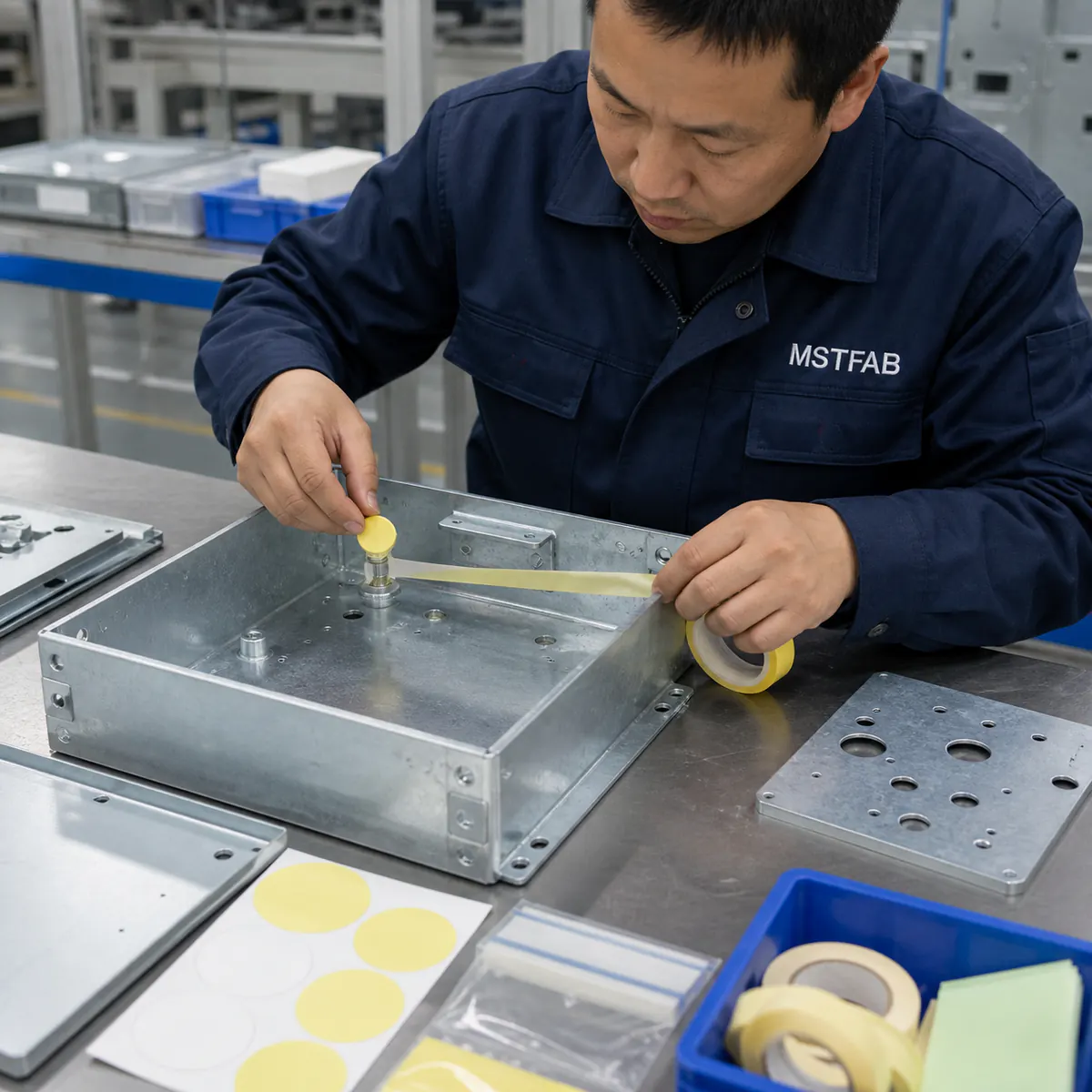
6. The Mounting Plate Must Go Into the Box
This deserves its own section because CAD occasionally has a sense of humor. A mounting plate can fit inside the enclosure perfectly in the 3D model. The problem is getting it through the opening.
Before manufacturing, check: plate width and height, enclosure opening, door flange, internal studs, insertion angle, mounting screws, tool clearance, and removal path.
If the electrical assembler needs to tilt the plate 73 degrees, rotate it around an invisible axis and temporarily violate the laws of physics, the design may need another look. A removable mounting plate should actually be removable.
7. Grounding Studs: Please Do Not Hide Them Under Powder
If your terminal box uses a mechanical grounding or bonding point, show it clearly on the drawing.
Possible requirements include: welded stud position, stud thread, masked contact area, bare-metal zone, washer location, or other mechanical contact features.
MSTFAB can manufacture those mechanical interfaces. Your electrical designer owns the completed grounding system and electrical verification. If the enclosure is powder coated, mark the areas that should remain uncoated. Otherwise the coating team may do an excellent job. Too excellent.
8. Burrs Matter More Than They Look
Terminal boxes contain cables and wiring later in the assembly process. That means an ugly edge is not just ugly. It can make: assembly uncomfortable, cable routing difficult, gland installation awkward, or downstream handling unsafe.
Specify deburring where required. For cable openings and service-access edges, the buyer may define: deburred edges, edge break, radius, hem, protective edging, or another controlled finish.
Do not just write: No sharp edges. It is understandable. But different people have different opinions about what “sharp” means. Metal is better behaved when the requirement is clearer.
9. Galvanized Steel Needs More Than One Word on the Drawing
“Galvanized steel” is a good starting point. It is not a complete material specification.
Depending on your project, define: steel grade, thickness, coating route, coating designation where relevant, surface condition, visible side, additional powder coating, weld-area treatment, cut-edge requirement, and required material evidence.
This matters because different galvanized sheet routes can look similar while having different fabrication and surface requirements. The drawing should tell production what is approved. Not: Use something similar. “Similar” is a friendly word. Purchasing specifications should be slightly less friendly.
10. ISO 9001 Does Not Automatically Mean “Give Me PMI”
This is one point I would correct from many supplier articles online.
ISO 9001 is a quality-management-system standard. It requires organizations to control the processes needed to meet customer requirements, but it does not automatically say: Every galvanized terminal box needs PMI, heat-number traceability and an EN 10204 3.1 certificate.
ISO’s current description of ISO 9001 focuses on establishing, maintaining and continually improving the QMS and controlling processes needed to meet customer requirements. For your RFQ, request the material evidence that your project actually needs. That might be: supplier material certificate, mill certificate, batch record, EN 10204 documentation, or other agreed evidence.
PMI may make sense for certain materials or projects. It is not a decorative checkbox that makes every sheet metal box better. If you require a document, put it on the PO. That saves everyone from trying to recreate history after the goods are already packed.
11. Same Rule for FAI: Ask for the FAI You Actually Need
A good first article is useful. A generic “FAI required” note can be less useful. For a terminal-box shell, focus the first article on the features that can cause downstream assembly problems.
| First Article Check | Why It Matters |
|---|---|
| Drawing number and revision | Confirms the right design was built |
| Material / thickness | Confirms the approved metal was used |
| Overall box geometry | Confirms basic fit |
| Cover fit | Prevents closing/assembly problems |
| Gland-hole pattern | Prevents cable-entry rework |
| Mounting plate fit | Protects electrical assembly |
| DIN-rail interface | Protects terminal layout |
| Grounding features | Confirms specified mechanical interfaces |
| Stud / PEM positions | Prevents hardware mismatch |
| Edge / burr condition | Protects handling and downstream assembly |
| Finish / masking | Confirms final surface configuration |
| Packing | Protects the box during shipping |
That is much more useful than measuring 60 random dimensions simply because someone wanted a thick PDF. The goal of FAI is not paper. The goal is fewer surprises.
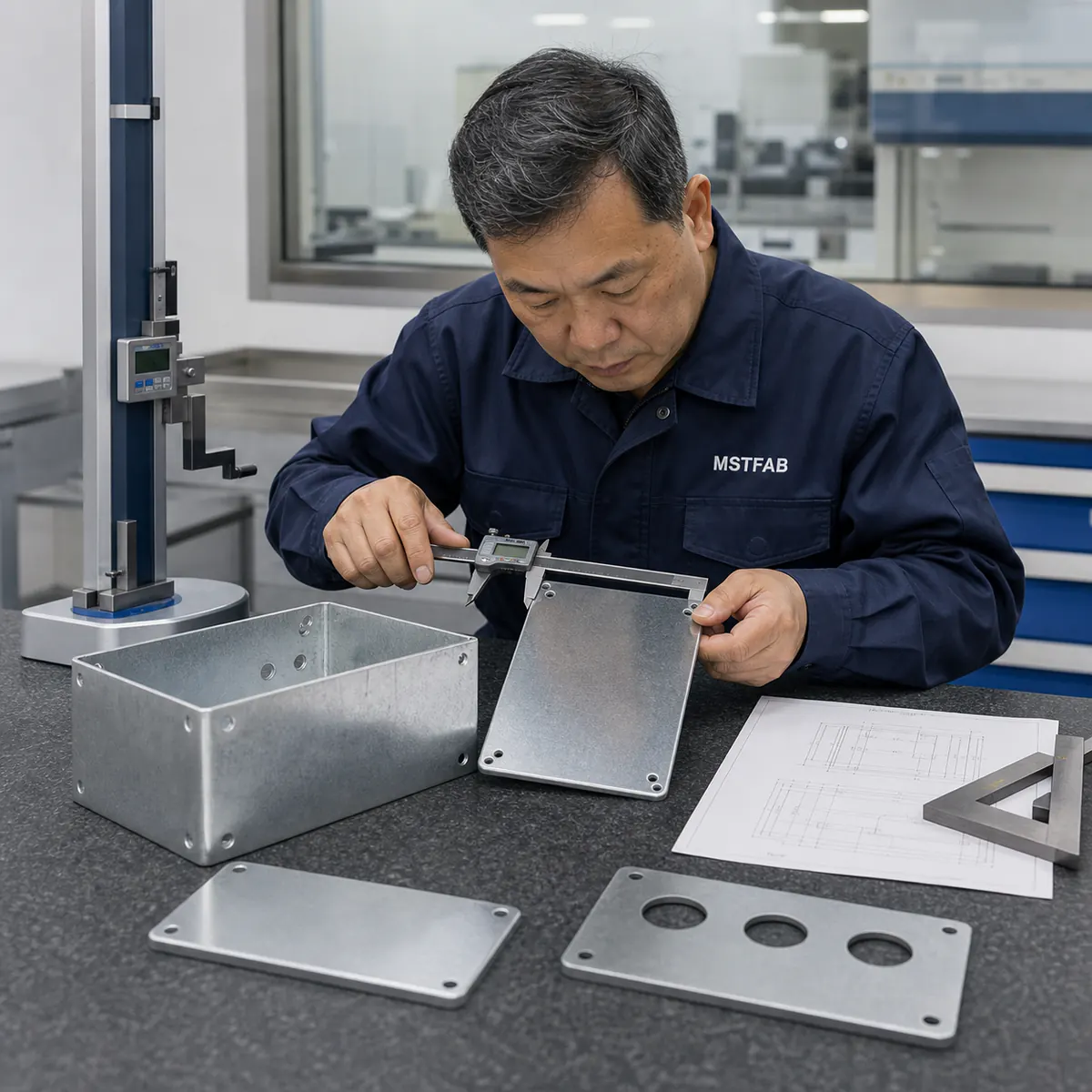
12. Do Not Put ±0.1 mm on the Whole Box
We understand why buyers do this. You want precision. So you write: General tolerance ±0.1 mm. Everywhere.
Then the quotation comes back. And suddenly precision feels expensive.
For sheet metal fabrication, tighter tolerances should go where they protect function. Possible tighter features include: mating hole patterns, connector cutouts, critical gland holes, mounting datums, stud positions, and interfaces with controlled components. Other formed or welded dimensions may need normal fabrication tolerances appropriate to the process.
Use precision where precision earns its salary. Not everywhere because it looks professional on the drawing.
13. Welding Is Not Automatically a Waterproofing Certificate
Another common shortcut is: Continuous weld = waterproof terminal box. Not automatically.
If your terminal box has a formal ingress requirement, the whole enclosure architecture matters: cover, gasket, flange, seams, gland entries, connectors, hardware, vents, and final assembly.
MSTFAB can manufacture the welded construction defined by your drawing. If the project needs an IP or NEMA requirement, say so separately and define the required validation route. Do not use ISO 9001 as proof of an ingress rating. Do not use welding as proof either. A weld is a manufacturing feature. It is not a certificate.
14. Check the Box After Welding, Not Only Before
Heat can move sheet metal. This is not a quality scandal. It is physics. Good fabrication controls it.
For welded terminal boxes, check important dimensions after the relevant welding operation. Typical examples include: cover opening, body squareness, mounting-hole relationships, internal bracket position, stud locations, and mounting plate fit.
If a flat blank was correct before welding but the finished box does not fit, your panel builder will not be comforted by the flat-pattern inspection report. Measure the condition you are actually shipping.
15. Hardware Needs a Part Number Too
PEM nuts, welded studs, screws, hinges and latches often look simple. Then somebody substitutes one. The thread is different. The head is taller. The plating looks different. The door no longer closes. Now the “small hardware change” has become everybody’s main project.
For repeat orders, control hardware by: part number, thread, size, material/finish and approved equivalent rules. If substitution is allowed, say so. If approval is required, say that too. The phrase: equivalent hardware should not mean: whatever is closest to the operator’s left hand.
16. Box #500 Is Where ISO 9001 Should Actually Help
This is the commercial value of a controlled manufacturing system. Almost any experienced sheet metal shop can spend extra time making one prototype look good. The real question is: Will box #500 still match the released drawing and approved sample?
ISO 9001 is useful here because the standard is built around controlled processes, customer requirements, performance evaluation and continual improvement. For a repeat terminal-box program, keep the production baseline clear: drawing revision, material, hardware, finish, critical dimensions, inspection method, packing, and any agreed process controls.
The prototype proves that something can be made. Repeat production proves that you actually have a supplier.
17. Stop Revision Confusion Before It Reaches the Laser
Here is a surprisingly common project:
- PDF: Rev C
- STEP: Rev D
- PO: Rev B
- Email: new gland holes
- WhatsApp: “This picture is final.”
Everybody knows what happens next. Nobody agrees which file caused it.
For production, release one clear manufacturing package. It should connect: part number → revision → STEP → PDF → material → hardware → finish → inspection requirements. If the drawing changes, update the package. Do not ask the laser operator to become a detective. They already have a job.
18. Changes After the First Article Need Rules
After the first sample is approved, things can change: galvanized material supplier, coating, hinge, screw, PEM nut, weld nut, finish supplier, packaging, or manufacturing method.
Not every internal factory change needs customer approval. But you should agree which changes do require notification before production. A sensible route is: propose → review → approve where required → update documents → produce.
The less useful version is: change → ship → explain that it is basically the same. “Basically the same” usually arrives just before a very long email chain.
19. Packaging Can Destroy a Good Terminal Box
Small boxes can still arrive damaged. Typical problems include: cover corners rubbing, powder-coated surfaces scratching, hinges taking impact, loose hardware moving inside the box, studs bending, or boxes rubbing against each other.
Define packaging according to the actual surface and geometry. Possible protection includes: individual bags, foam, cardboard separators, corner protection, protective film, hardware bags, and export cartons or pallets. Quality inspection ends at the factory. Customer satisfaction ends when the customer opens the package. Those are not always the same moment.
What ISO 9001 Really Gives the Buyer
As of August 20, 2026, ISO still lists ISO 9001:2015 as the current published edition. ISO says a new sixth edition is under publication and expected in September 2026; certified organizations will receive a transition period after the new edition is released.
For a terminal-box buyer, ISO 9001 should give confidence that the supplier operates a controlled QMS. But do not make the certificate carry more weight than it should.
ISO 9001 does not itself tell you: the terminal box dimensions, which galvanized steel to use, whether you need EN 10204 3.1, whether PMI is required, whether your box needs IP66, which gasket to use, or where your cable gland goes. Your engineering specification answers those questions. The QMS helps the factory follow it consistently. That is the useful relationship.
What MSTFAB Manufactures
MSTFAB’s current News/Blog and website position the Guangzhou factory as a drawing-based custom sheet metal fabrication source using an ISO 9001 quality-managed workflow for OEM enclosures and metal parts.
For a custom galvanized terminal box project, our mechanical scope can include: empty galvanized steel body; cover; door; mounting plate; DIN-rail support brackets; gland plate; cable openings; connector openings; mounting brackets; welded studs; weld nuts; PEM hardware; mechanical grounding interfaces; deburring; specified coating or finish; dimensional inspection; mechanical fit checks; and export packaging.
Typical fabrication route: Drawing review → laser cutting → CNC bending → welding where required → mechanical hardware → finishing → inspection → packing
Everything starts with your drawing.
What MSTFAB Does Not Supply
MSTFAB does not supply the completed electrical terminal box. Our standard sheet metal fabrication scope does not include: terminal blocks; electrical wiring; cable harnesses; breakers; live electrical devices; electrical design; energized testing; control-system design; or finished electrical-product certification.
We supply the metal shell. Your panel builder supplies the electrical assembly. This is worth stating clearly because “terminal box manufacturer” can mean very different things to different buyers.
If your drawing says: M5 weld stud here. Great. We know what to manufacture. If it says: Please make the complete electrical system safe. We will need your electrical engineer to join the conversation.
Terminal Box Buyer Scorecard
| Buyer Question | What You Actually Want to See |
|---|---|
| Is the supplier quality-managed? | Current applicable ISO 9001 certificate where required |
| Is the right revision being built? | Controlled STEP + PDF + part number |
| Is the material correct? | Approved material specification and agreed evidence |
| Will the cover fit? | Finished-box fit inspection |
| Will glands fit? | Correct cutouts and real clearance review |
| Will internals fit? | Mounting plate / DIN-rail mechanical review |
| Are grounding features correct? | Stud and masking verification |
| Are edges acceptable? | Defined deburring/edge condition |
| Will production repeat? | Controlled material, hardware and CTQs |
| What happens when something changes? | Agreed change-notification rules |
| Will it survive shipping? | Packaging matched to finish and geometry |
Notice what is not in the table: “Supplier says quality is very good.” Nobody has ever failed that question during a sales call.
What Should You Send for Quotation?
A good terminal-box RFQ should include: STEP/STP model; matching dimensioned PDF; part number and revision; galvanized steel grade/specification; thickness; finish; cover/door design; cable-gland or connector openings; mounting plate requirements; DIN-rail mechanical interfaces where applicable; hardware specification; grounding features; masking requirements; key tolerances; deburring/edge requirements; first-article inspection requirements; material-document requirements; prototype quantity; production quantity; annual forecast; packaging requirements; destination country.
A weak RFQ says: ISO 9001 galvanized terminal box, 1.5 mm, quote best price. It contains a standard, a material and a number. The factory still has a few questions.
Mechanical design follow-up: Use the galvanized terminal box shell DFM guide to freeze DIN-rail datums, cable-entry zones, cover fit and first-article checks before production.
FAQ
Does ISO 9001 certify the terminal box itself?
No. ISO 9001 specifies requirements for a quality management system. It supports consistent processes and meeting customer requirements, but it is not a product-level certification for an individual terminal-box shell.
Is ISO 9001:2015 still current in August 2026?
Yes. As of August 20, 2026, ISO 9001:2015 remains the current published edition. ISO’s sixth edition is under publication and is expected in September 2026.
Does ISO 9001 mean the box is waterproof?
No. Water or dust ingress performance depends on the actual enclosure design, cover, gasket, seams, penetrations, components and required validation. ISO 9001 does not provide an IP or NEMA product rating.
Does MSTFAB manufacture a complete wired terminal box?
No. MSTFAB manufactures drawing-based empty sheet metal enclosure shells. Your electrical assembler installs terminals, wiring, glands and other electrical equipment. The current MSTFAB article itself identifies the manufacturing scope as empty sheet metal enclosure shells.
Do I always need EN 10204 3.1 for galvanized sheet?
No universal rule applies to every terminal box. If your drawing, PO, customer standard or quality plan requires specific material documentation, state it in the RFQ. Do not order documentation by habit. Order the evidence your project needs.
What is the most common terminal-box mistake?
Usually a small interface nobody reviewed carefully: a gland hole too close to a bend; a mounting plate that cannot come out; a covered grounding point; a door that hits the installed components; or Revision D being manufactured from Revision C. None of those problems cares how nice the ISO certificate looks.
Request a Terminal Box Shell DFM Review
Send MSTFAB your: STEP + PDF + revision + galvanized steel specification + thickness + gland openings + mounting interfaces + hardware + quantity + inspection requirements.
We can review the metalwork around: material → cutting → bending → welding → cover fit → cable entry → mounting interfaces → hardware → inspection → repeat production → export packaging
You build what goes inside. MSTFAB builds the metal around it.
 WeChat Contact
 WhatsApp Me Directly