Galvanized enclosure shell supplier evidence should connect five things: the approved drawing revision, the specified sheet material, the fabrication route, measured critical dimensions, and the lot that actually ships.
ISO 9001 can support that control system, but a certificate is not a product approval and it does not prove that one enclosure is dimensionally correct. The useful question is not “Do you have a logo?” It is “Can you show how this order moves from revision B to a verified batch without losing the plot?”
MSTFAB scope: we fabricate empty sheet metal enclosure shells and mechanical parts to customer drawings. We do not supply wiring, breakers, PLCs, energized assemblies, or finished electrical products.

Why the old “electrical manufacturer” wording had to go
The previous title described an “electrical box electrical manufacturer.” Apart from making the word “electrical” do unpaid overtime, it implied a broader product scope than MSTFAB provides.
Our deliverable is the fabricated metal work: panels, covers, mounting features, welded seams, installed mechanical hardware, surface treatment, inspection, and export protection when specified. The customer or its appointed integrator remains responsible for electrical architecture, component selection, wiring, grounding design, energized testing, regulatory approval, and final-product certification.
That boundary matters to procurement. A beautiful shell does not become a certified electrical product simply because someone installs a DIN rail. Likewise, an ISO 9001 certificate does not transform a dimensional inspection report into an electrical safety report. Clear scope is less exciting than a badge, but considerably cheaper than a compliance argument after delivery.
What ISO 9001 evidence can actually tell you
ISO describes ISO 9001 as a standard that specifies requirements for a quality management system. It addresses controlled processes, documented information, performance evaluation, improvement, and customer requirements. Certification is one way an organization may demonstrate conformity, but ISO itself does not certify companies.
When certification is a purchase-order requirement, review the certificate rather than the sales brochure. Confirm the legal entity, manufacturing site, covered activities, issuing certification body, certificate validity, and the full standard edition shown. The official ISO 9001:2026 publication page is the current reference for the system-level purpose and edition status of the standard.
For electrical control-box projects shipped in stages or reordered later, use our ISO 9001 control box repeat-batch evidence guide to connect certificate scope with the released drawing, first article, CTQs, site interfaces and change approval.
What it may support
- Controlled drawings and work instructions
- Defined purchasing and production processes
- Calibration and inspection controls
- Nonconformance handling and corrective action
- Records that make repeat orders traceable
What it does not prove alone
- The material grade in your specific batch
- The accuracy of a critical hole pattern
- Ingress protection or electrical safety
- A weld, coating, or salt-spray result
- Fitness for your final application

Start with the drawing hierarchy
Most enclosure quality problems begin before the laser turns on. The 3D model says one thing, the 2D drawing says another, the quotation mentions a third finish, and an email from Tuesday adds “just one small change.” Small changes are excellent at becoming large invoices.
The RFQ should establish which document controls. A practical package normally includes a STEP model for geometry, a controlled 2D drawing for dimensions and tolerances, a material and finish specification, quantity, revision, and any inspection-document requirements. Critical-to-quality features should be named rather than left for the supplier to guess.
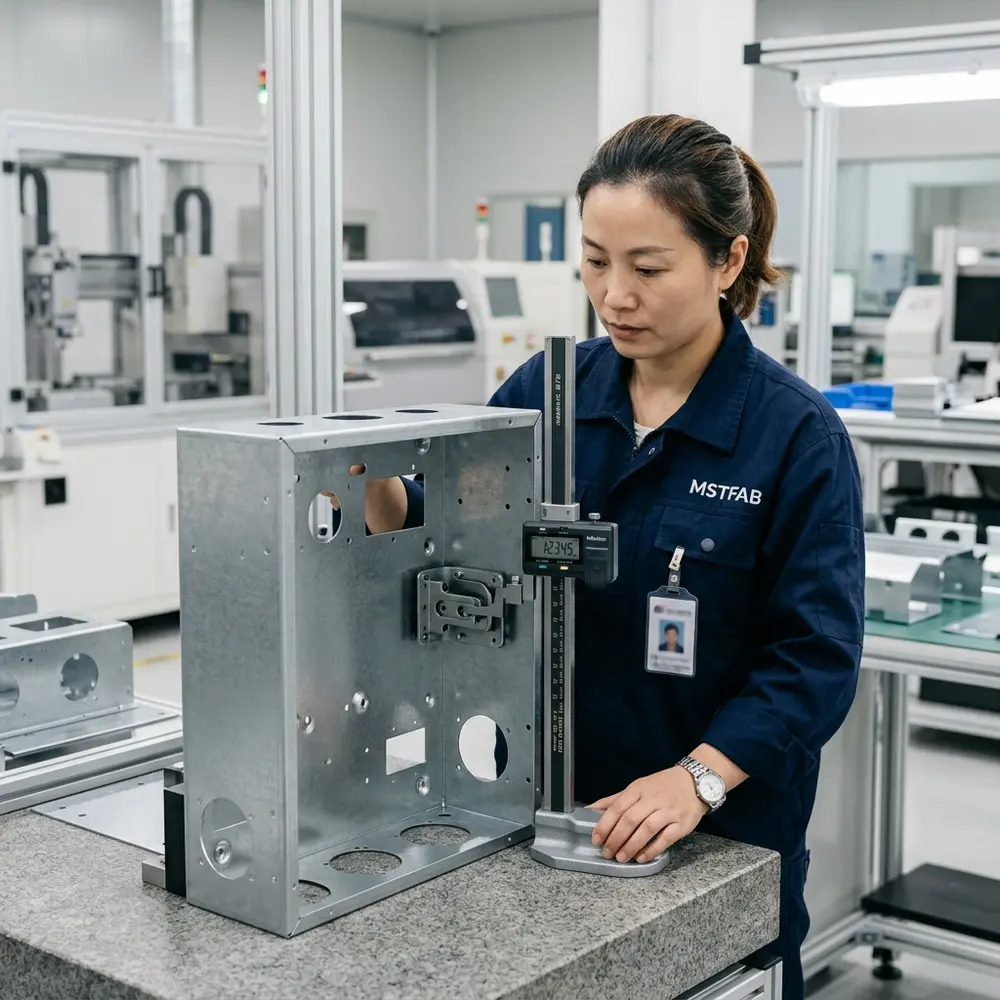
Typical CTQs for an empty galvanized enclosure shell include door opening, mounting-plate datums, stud locations, hole patterns, hinge alignment, flange flatness, cover fit, gasket land geometry, and clearances for customer-installed components. A supplier cannot measure “please make it precise.” Give the feature, datum, tolerance, and inspection method.
Specify the galvanized material without ambiguity
“Galvanized steel” is a family description, not a complete material specification. Pre-galvanized sheet, electro-galvanized sheet, and a fabricated carbon-steel part treated after fabrication are not interchangeable. Their coating coverage, edge condition, weld behavior, cosmetic appearance, and distortion risk differ.
State the base material standard and grade, sheet thickness, zinc-coating designation or required treatment, appearance expectations, and whether exposed cut edges or weld zones require supplementary protection. If a material certificate is required, put it on the RFQ and PO. If heat or coil traceability is required, define the record and retention period. Evidence should match project risk; demanding laboratory theater for every simple indoor bracket mostly creates paperwork with excellent posture.
MSTFAB reviews material substitutions with the buyer before production. A “close enough” grade can behave differently during bending or welding, and it may also break the customer’s downstream documentation chain.
Control the fabrication route, not just the final photograph
Laser cutting
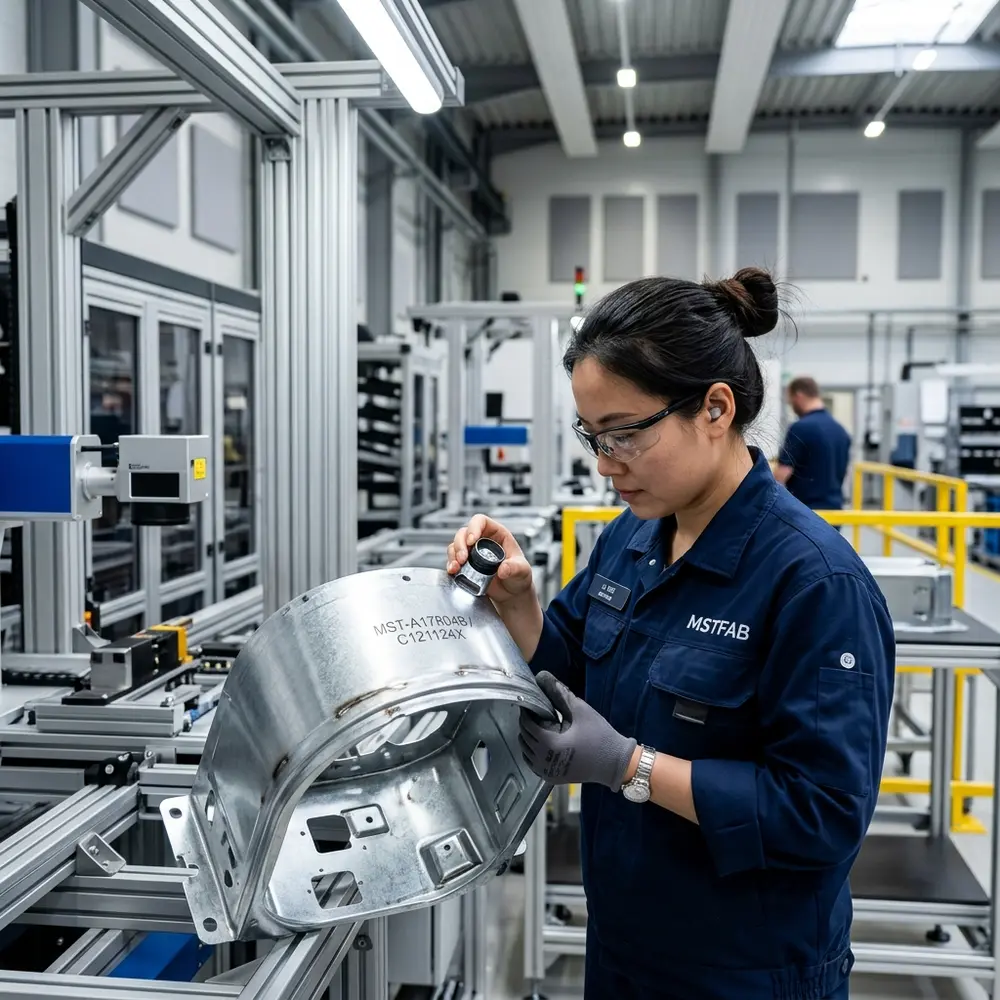
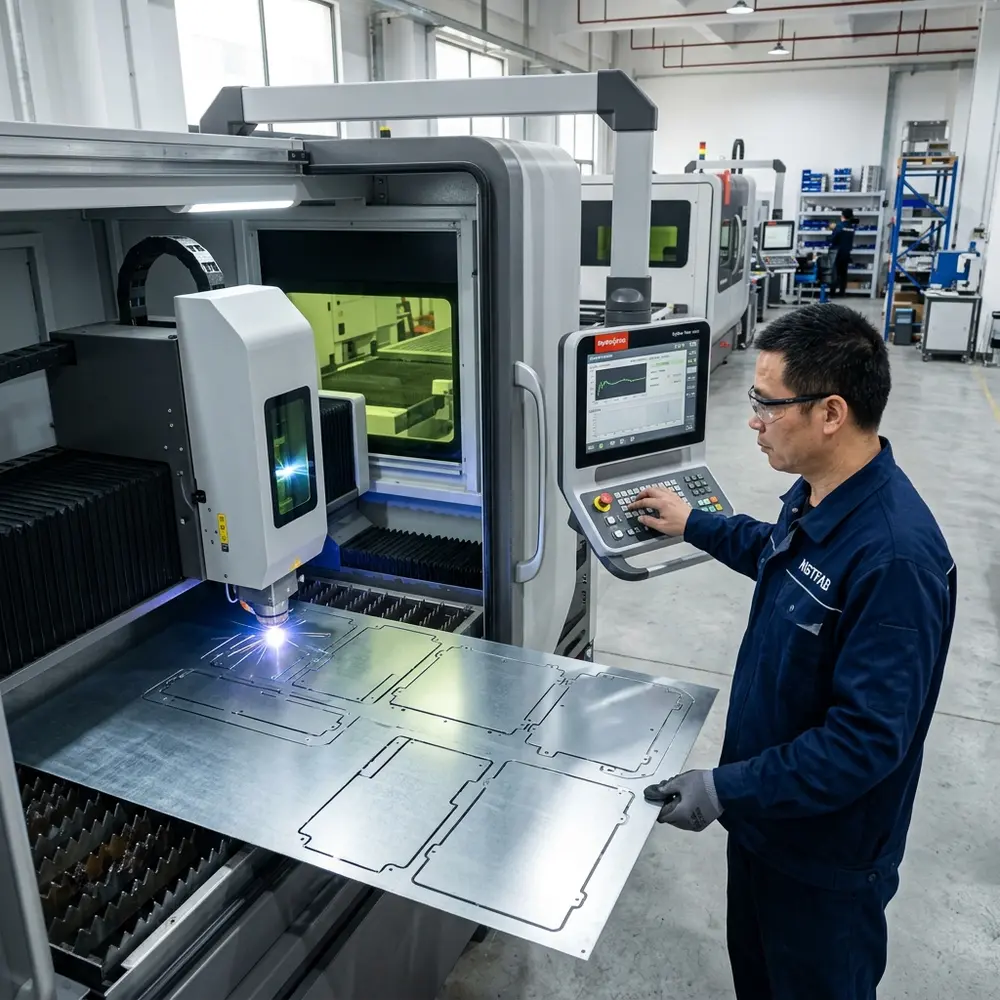
Cut files should be released from the approved revision and checked for units, duplicate lines, open contours, small holes, narrow slots, and tooling-sensitive features. Functional holes are best dimensioned from stable datums. A laser can repeat the wrong file with breathtaking consistency, which is why revision release belongs upstream.
CNC bending and formed relationships
Bend angle alone rarely tells the whole story. Flange length, inside radius, material temper, grain direction, tooling, and springback influence the final mounting relationship. On multi-bend shells, variation can accumulate across the part. Inspection should therefore follow functional datums and assembly relationships, not only isolated bend lines.

Welding, hardware, and zinc-affected areas
Welding can pull a square enclosure out of square. Fixtures, balanced weld sequences, controlled heat input, and intermediate checks help manage distortion. Weld and cut areas may also need defined corrosion-protection treatment because local zinc coverage can be affected.
PEM nuts, studs, hinges, and other mechanical hardware need their own acceptance criteria: correct type, location, orientation, seating, thread condition, and pull-out or torque requirements when specified. A stud installed perfectly in the wrong hole remains impressively useless.

Use first-article inspection to close the assumptions
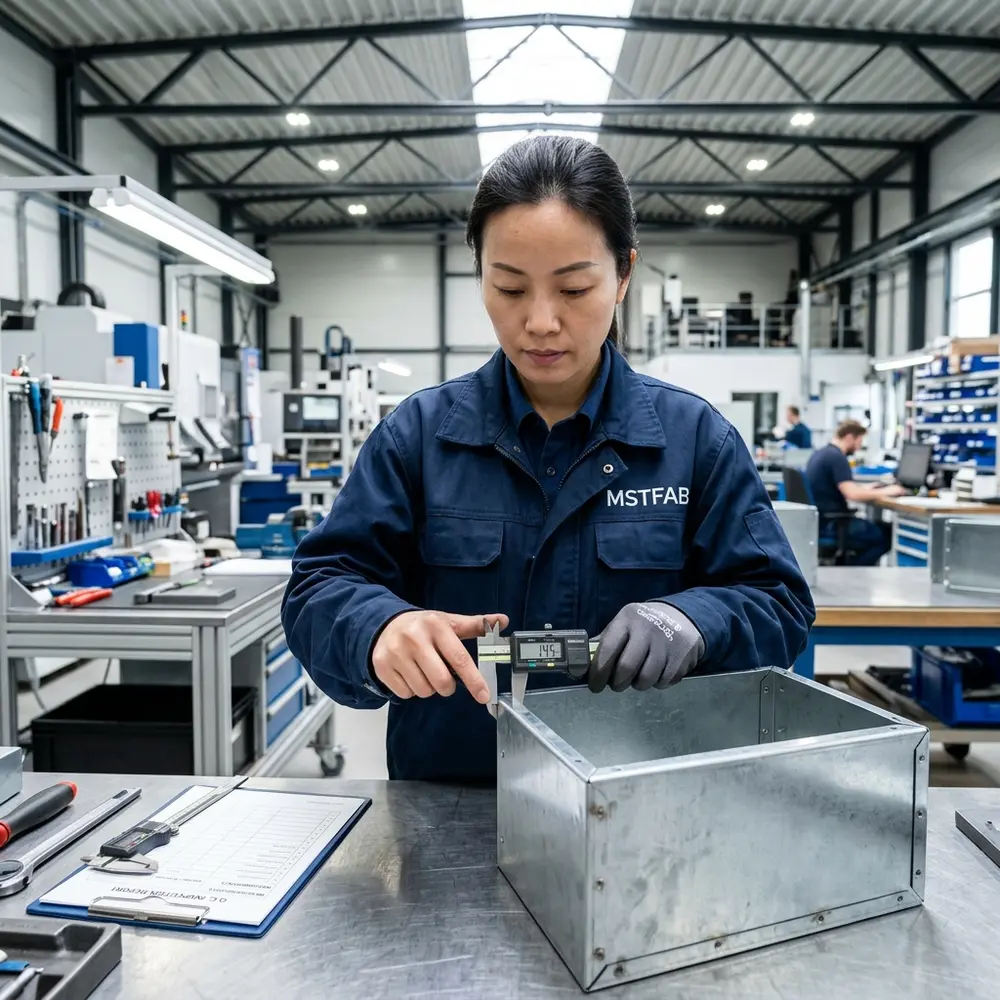
A first article is most useful when it verifies the buyer’s actual functional risks. The report should identify the part number, drawing revision, material, measurement equipment, results, and any approved deviations. Ballooned drawings make the evidence easier to audit because each reported value points to a controlled requirement.
For an enclosure family, the first article may also include a trial fit of the cover, mounting plate, hinges, latches, or customer-supplied mating sample. It does not need to become a 90-page novel. It needs to answer the questions that could stop assembly.
What should follow the approved first article
Approval is not the end of control; it is the baseline for repeat production. Retain approved setup information, fixtures or gauge methods, CTQs, finish references, and packaging requirements. For repeat orders, verify that the released revision and material specification still match the buyer’s PO.
Changes to material, tooling, subcontracted finishing, weld process, critical dimensions, or manufacturing location should follow the agreed notification and approval route. Read our practical guide to golden samples, CTQs, fixtures, and revision control for the production side of that handoff.

A risk-based evidence package
| Project situation | Practical evidence | Buyer decision protected |
|---|---|---|
| Prototype or engineering sample | Controlled drawing, material confirmation, key-dimension report, finish approval | Does it fit and can it be manufactured repeatedly? |
| Low-volume OEM batch | First-article approval, CTQ inspection plan, lot identity, hardware and cosmetic checks | Will the batch assemble without sorting or rework? |
| Repeat production | Revision release, retained setup, sampling plan, change notification, nonconformance history | Will order five behave like order one? |
| Regulated or customer-flow-down project | Current certificate if required, defined material records, documented special-process evidence, agreed retention | Can the supply chain demonstrate the specified controls? |
Nonconformance and corrective action without the theater
A credible supplier does not promise that defects are impossible. It shows how defects are contained, identified, investigated, corrected, and prevented from quietly rejoining the shipment. The response should distinguish immediate containment from root-cause correction and confirm how affected lots were traced.
For a dimensional issue, useful evidence might include revised setup instructions, a fixture change, operator retraining, and results from the next production run. “Inspector will be more careful” is not a process change; it is a sentence wearing a hard hat.
RFQ checklist for an empty galvanized enclosure shell
- STEP model plus controlled PDF drawing and revision
- Base material grade, thickness, and galvanized/coating designation
- Critical datums, dimensions, tolerances, and inspection method
- Weld type, size, location, cosmetic expectation, and distortion limits
- Mechanical hardware type, orientation, and verification requirement
- Prototype, batch, and annual quantity
- First-article, material, coating, or dimensional records required
- Change-notification and record-retention requirements
- Packaging, labeling, shipping destination, and acceptance standard
- Explicit statement that the requested deliverable is an empty mechanical shell

FAQ
Does ISO 9001 certify an enclosure shell as electrically safe?
No. ISO 9001 concerns the supplier’s quality management system. Electrical safety, ingress protection, environmental performance, and final-product compliance require their own design controls, tests, and certification route where applicable.
Does MSTFAB build complete electrical boxes?
No. MSTFAB manufactures custom empty sheet metal enclosure shells and mechanical parts to customer drawings. We do not select electrical components, wire assemblies, conduct energized testing, or certify the customer’s finished product.
Is a material certificate required for every enclosure?
Not automatically. The evidence package should follow the drawing, purchase order, regulatory flow-down, and project risk. Specify the required certificate, traceability level, and retention before quotation so cost and lead time are visible.
What is the most useful pre-order supplier check?
Choose one current job and ask how the drawing revision, material, production traveler, inspection result, nonconformance status, and shipping label connect. Connected records are the point. A folder full of unrelated PDFs is only a folder full of unrelated PDFs.
Can MSTFAB recommend changes during DFM review?
Yes. We can flag bend access, hole-to-bend distance, weld distortion, hardware access, finish masking, measurement, and packaging risks. Critical design requirements are not changed without customer approval.
Request a supplier-evidence review with your quote
Send MSTFAB the controlled drawing, material specification, quantity, CTQs, finish, and required records. We will review the mechanical fabrication scope before quotation and identify unclear evidence requirements while they are still inexpensive to fix.
 WeChat Contact
 WhatsApp Me Directly