⚡ Direct Answer: How to Mitigate Single-Source Risk in Custom Sheet Metal Fabrication?
Single-sourcing custom sheet metal parts creates severe operational vulnerability because custom chassis and brackets have zero off-the-shelf catalog substitutes. If your sole supplier suffers a factory fire, financial insolvency, labor strike, or equipment breakdown, your entire assembly line halts. Procurement leaders mitigate single-source risk through a 4-Pronged Strategic De-Risking Framework: 1) Execute a 70/30 or 80/20 Dual-Sourcing Allocation: Qualifying two independent fabricators simultaneously, directing the majority volume to a Tier-1 primary partner (such as MSTFAB) while feeding an audited secondary partner continuous low volume (20%-30%) to maintain active tooling and warm machine setups; 2) Mandate Parallel First Article Inspection (FAI) Approvals: Re-qualifying complete ballooned dimensional reports at both facilities before production ramp; 3) Avoid the “Captive Tooling Trap”: Guaranteeing unbundled tooling purchase orders with explicit Title Transfer on Payment clauses and physical asset tags; and 4) Pre-Stage Strategic Buffer Inventory: Maintaining a 4-to-6 week safety stock buffer at a neutral 3PL warehouse to bridge any emergency supplier switch.
Many purchasing teams default to single-sourcing custom sheet metal enclosures because “it’s simpler to manage one vendor” and captures higher volume tier discounts. However, when that sole supplier runs out of capacity or experiences financial distress, the true cost of single-sourcing becomes painfully clear: halted factory lines costing tens of thousands of dollars per day. Structured dual-sourcing eliminates this vulnerability.
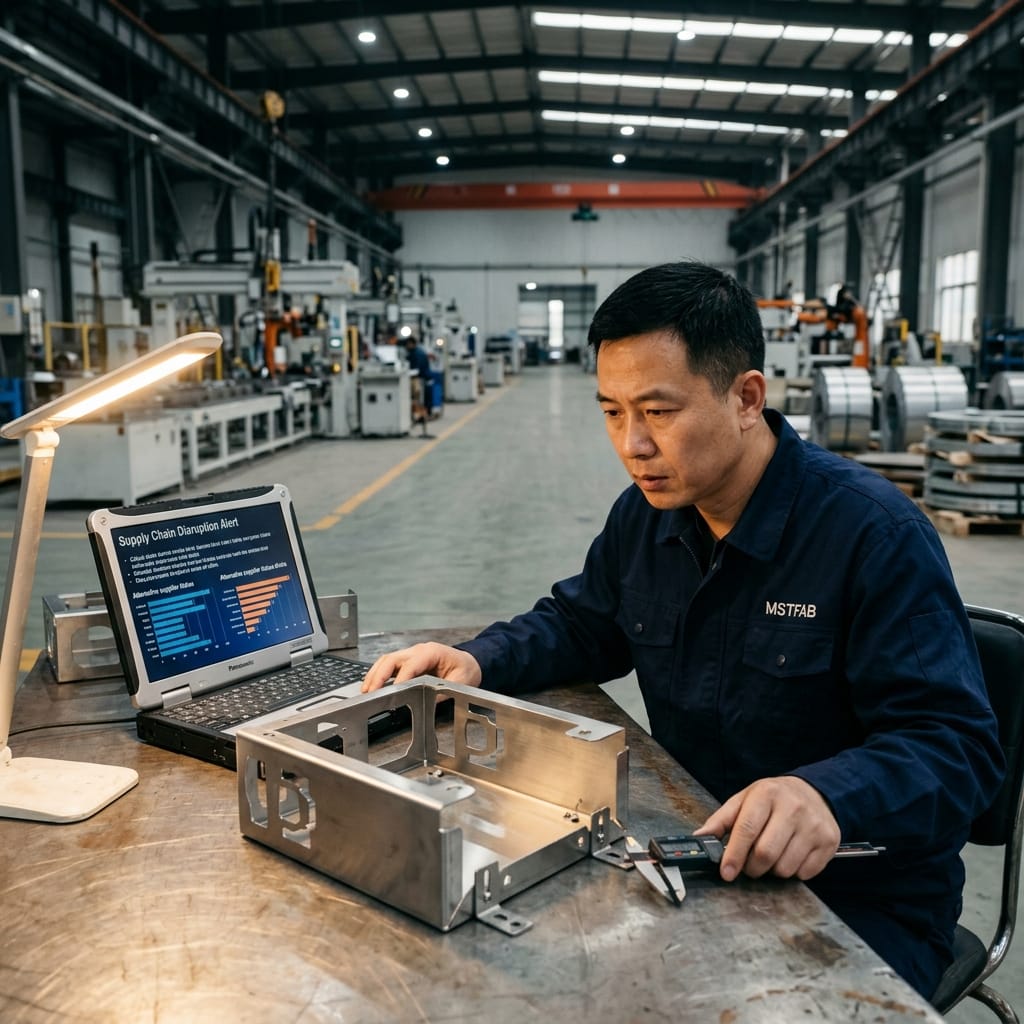
The 4 Hidden Dangers of Single-Sourcing Custom Sheet Metal
Unlike buying standard fasteners or off-the-shelf electronics, single-sourcing bespoke sheet metal parts exposes an OEM to four unique systemic hazards:
| Single-Source Hazard | Operational Mechanism | Financial & Production Impact | Mitigation Strategy |
|---|---|---|---|
| 1. The Captive Tooling Trap | Supplier builds custom stamping dies or welding fixtures with proprietary mounting plates compatible only with their own presses. | Buyer cannot move tooling to another shop without completely rebuilding dies ($20k-80k cost + 10-week delay). | Mandate universal bolster plate specifications and standardized CNC brake tooling geometries in the tooling PO. |
| 2. Unilateral Pricing Extortion | Once parts are locked into production, the supplier issues sudden 15%-25% price increases citing raw material or labor costs. | Buyer has zero competitive leverage and must absorb margin erosion or face shutdown. | Maintain an active secondary supplier (e.g. 80/20 split) with live quotes and validated FAI approvals. |
| 3. Peak Capacity Crowding-Out | Supplier wins a massive automotive or telecom contract, quietly pushing your lower-volume orders to the back of the queue. | Lead times double from 4 weeks to 9 weeks during your own peak sales quarter. | Execute binding Capacity Reservation Agreements with minimum machine-hour allocations. |
| 4. Supplier Insolvency or Force Majeure | Supplier suffers factory fire, environmental shutdown, or bank receivership. | Instant, total production paralysis lasting 3 to 6 months while qualifying a replacement shop. | Pre-stage 6-week finished goods buffer; keep duplicate tooling sets or modular sheet laser nests at MSTFAB. |

How to Structure an 80/20 Dual-Sourcing Model
The most cost-effective way to de-risk sheet metal procurement without sacrificing high-volume economies of scale is an 80/20 Production Allocation:
- Primary Partner (80% Volume): Assigned to a high-capacity, automated Tier-1 manufacturer like MSTFAB. This captures maximum bulk sheet nesting discounts, automated powder line efficiency, and dedicated capacity reservation.
- Secondary Partner (20% Volume): Fed regular, scheduled production batches. This keeps their press brake setups warm, CAM programming current, and quality inspection teams familiar with your drawing tolerances.
- Instant Elastic Ramp: If the primary supplier faces a bottleneck, the secondary partner can scale up to 60%-100% capacity within 48 hours because they are already producing certified, serialized parts.

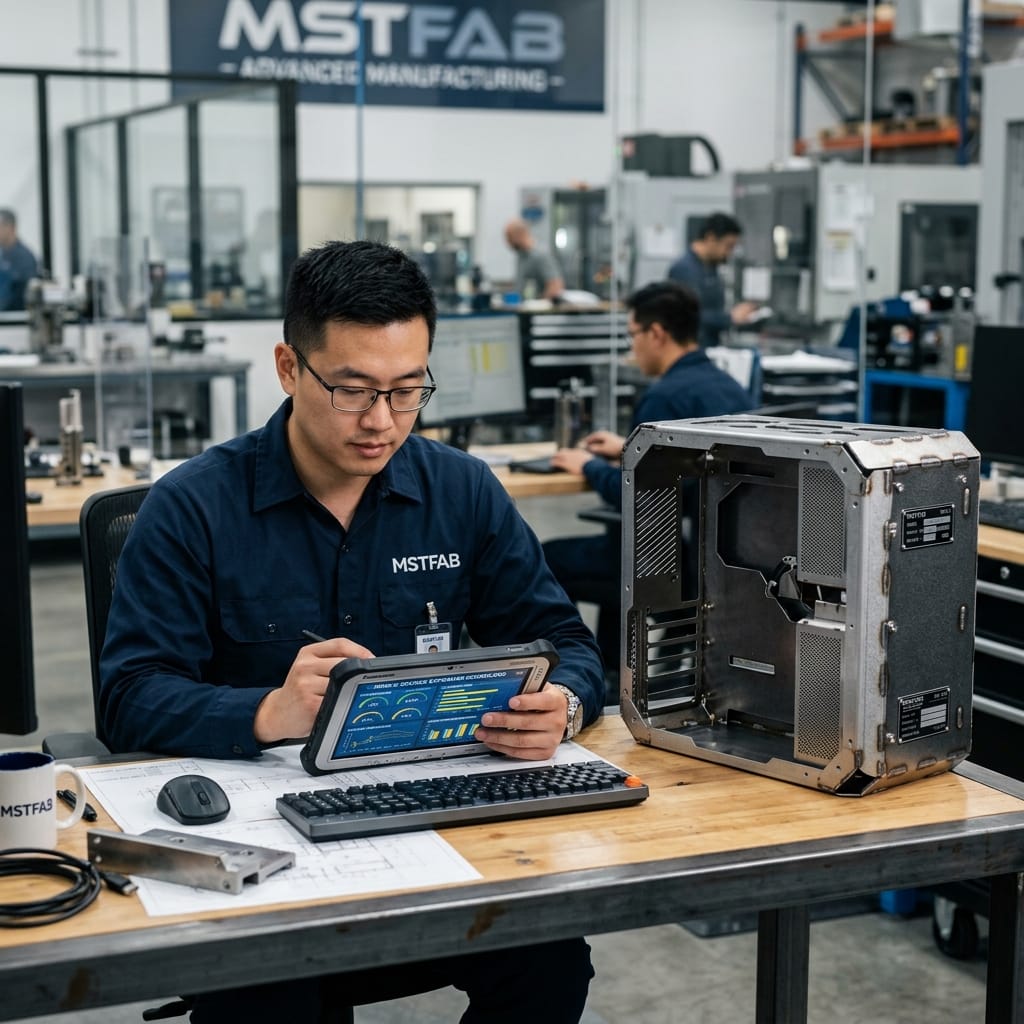
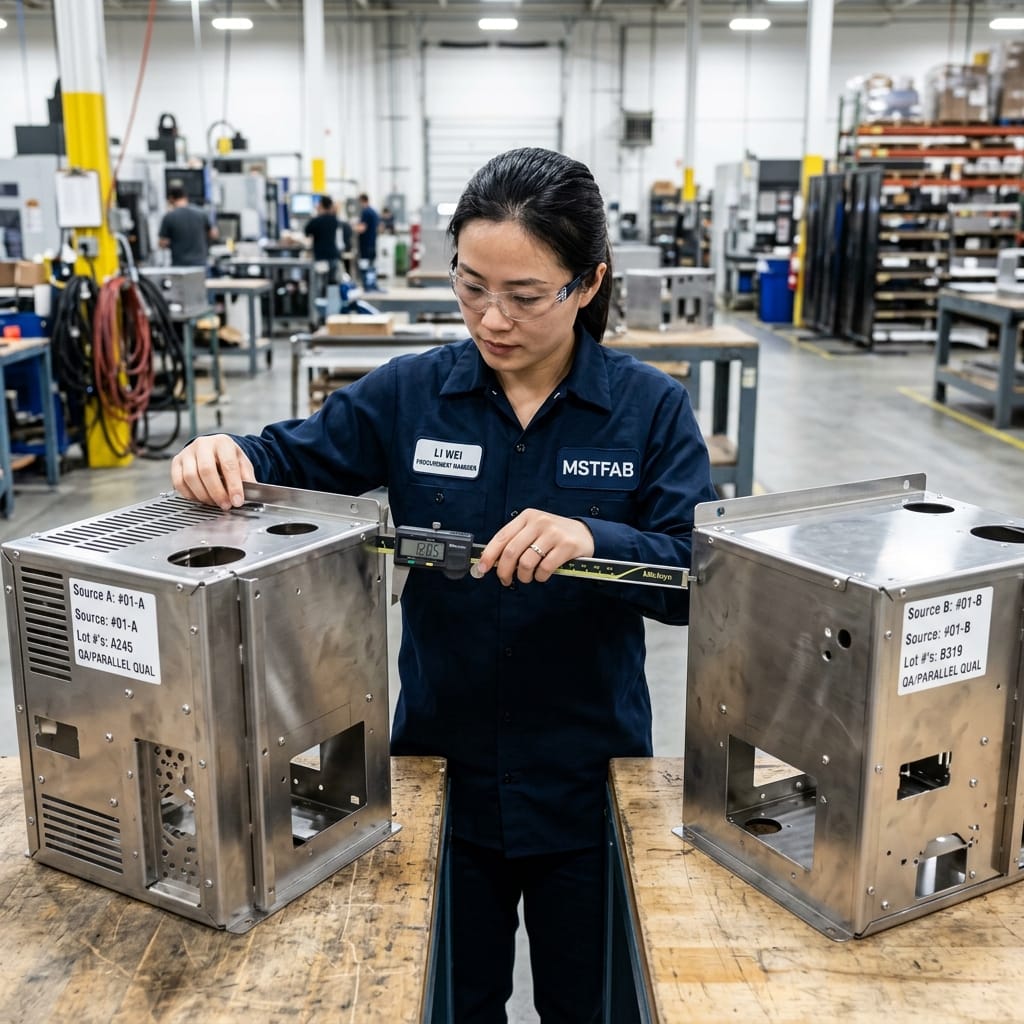
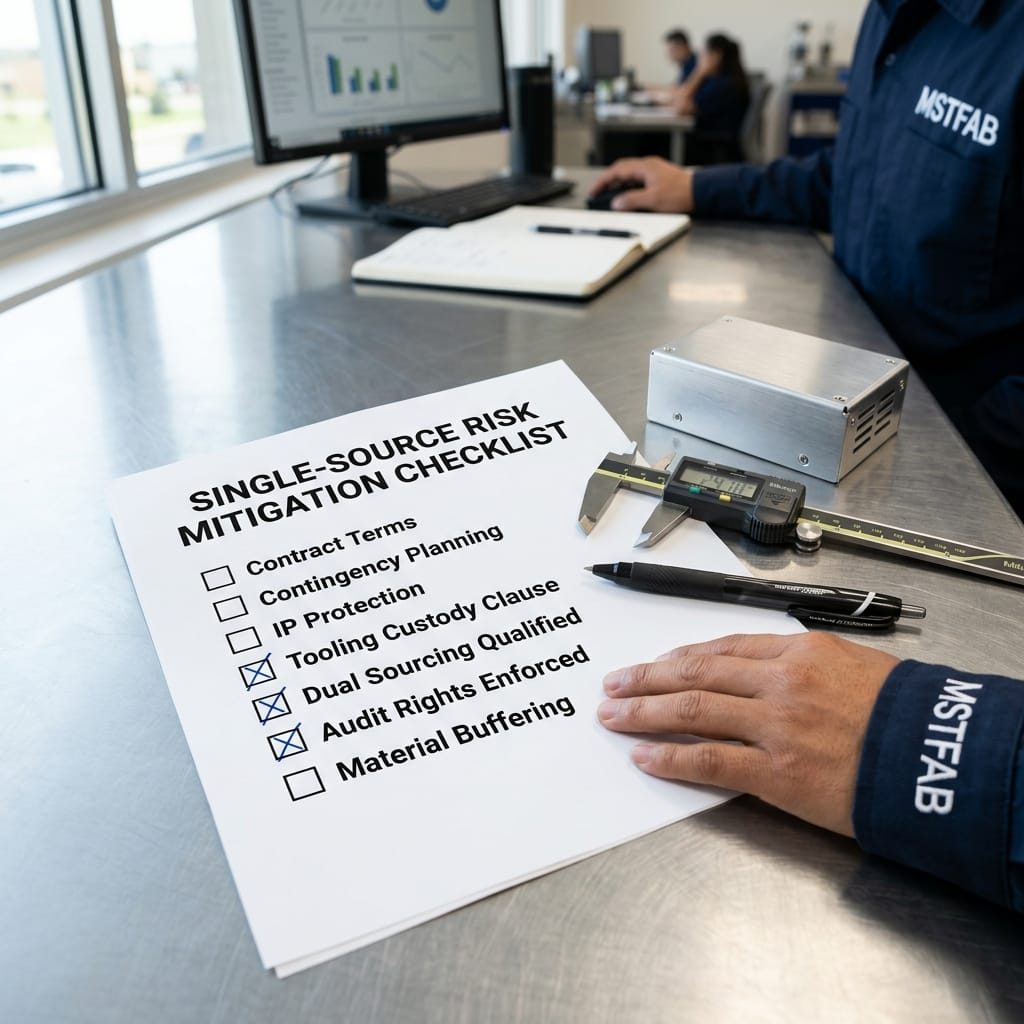
Secure Scalable Dual-Sourcing Sheet Metal Manufacturing Sourcing With MSTFAB
MSTFAB operates high-capacity automated fiber laser towers, robotic press brakes, and in-house powder coating lines backed by China-enforceable NNN IP security and reserved capacity agreements. Accelerate your production with zero downtime.
Frequently Asked Questions (FAQ)
Does dual-sourcing sheet metal parts increase total unit cost?
Splitting volume (e.g. 80/20) typically adds only 2% to 4% in marginal unit cost due to slightly smaller purchase batches at the secondary supplier. However, this nominal premium serves as an essential insurance policy that prevents factory line shutdowns costing hundreds of thousands of dollars.
Can MSTFAB act as an agile secondary manufacturing partner?
Yes! MSTFAB routinely serves as either primary manufacturing anchor (70%-80%) or agile secondary partner (20%-30%) for multinational OEMs. Our automated fiber lasers and modular CNC brake tooling allow us to run smaller warm batches cost-effectively while standing ready to scale to full volume on 48 hours notice.
How do you ensure parts from two different fabricators fit together identically?
By standardizing 2D drawings with unambiguous Geometric Dimensioning and Tolerancing (GD&T) datum reference frames, specifying ISO 2768-m general tolerances, and mandating that both suppliers perform 100% CMM inspection against identical functional check gauges.
 WeChat Contact
 WhatsApp Me Directly