⚡ Direct Answer: How to Build a Business Continuity Plan (BCP) for Sheet Metal Supply?
A resilient Business Continuity Plan (BCP) for custom sheet metal fabrication prevents catastrophic production halts by establishing operational failover protocols before disruptions strike. An audit-proof BCP incorporates 5 mandatory pillars: 1) Quantitative Recovery Metrics (RTO & RPO): Defining a maximum Recovery Time Objective (RTO) of ≤10 business days to restart finished part shipments after a primary plant shutdown, and a Recovery Point Objective (RPO) of zero lost CAD engineering revisions; 2) Tooling Mobility & Asset Tagging: Guaranteeing unbundled tooling title with riveted steel asset plates to prevent seizure during supplier insolvency or force majeure; 3) Pre-Qualified Secondary Manufacturing Line (Active 80/20 Dual Sourcing): Maintaining a secondary fabricator (such as MSTFAB) with pre-approved First Article Inspections (FAI) and active CAM programs; 4) Strategic Buffer Inventory: Staging a 4-to-6 week finished goods and unbent blank buffer at a neutral 3PL warehouse; and 5) Annual Tabletop Disaster Simulation Drills: Testing emergency tooling extraction and supply rerouting protocols annually.
Supply chains face unpredictable systemic shocks: regional power grid curbs, primary steel mill furnace outages, factory fires, geopolitical trade sanctions, or unexpected vendor insolvencies. For an equipment OEM, custom sheet metal enclosures are the structural skeleton of the entire product. Without a rigorous Business Continuity Plan, an external disruption creates months of assembly paralysis and devastating commercial losses.

The Sheet Metal Business Continuity Disruption Matrix
Model your supply chain continuity plan against these five real-world manufacturing disruption scenarios:
| Disruption Scenario | Primary Impact on Production | Target RTO | Pre-Engineered Continuity Countermeasure |
|---|---|---|---|
| 1. Primary Supplier Insolvency | Factory locks gates; assets frozen by bankruptcy courts | ≤ 5 business days | Execute Emergency Tooling Repatriation; shift volume 100% to pre-qualified secondary partner (MSTFAB). |
| 2. Primary Steel Mill Coil Outage | Rolling campaign delay; 8-to-12 week raw metal stockout | ≤ 48 hours | Activate pre-approved substitute alloy grades (e.g. 304L for 304; 5754 for 5052); draw from MSTFAB’s in-house master coils. |
| 3. Regional Power Grid Curbs | Local municipal electricity restrictions limit factory operation to 2 days/wk | ≤ 24 hours | MSTFAB operates automated night-shift production under off-peak power permits backed by heavy-duty diesel generator backup arrays. |
| 4. Ocean Shipping Port Congestion | Container vessels delayed 3 to 5 weeks at destination ports | ≤ 72 hours | Draw from 4-week regional 3PL consignment buffer; trigger emergency air freight for lightweight nested sub-assemblies. |
| 5. Catastrophic Fire / Machinery Loss | Total destruction of laser cutting and press brake lines | ≤ 10 business days | Redundant cloud-backed NC code files transmitted to duplicate machine cells; tool dies duplicated and stored off-site. |

How to Conduct an Annual Tabletop Disaster Simulation
A Business Continuity Plan that lives only on paper is an illusion. World-class OEMs conduct annual, cross-functional “Tabletop Drills” to test actual emergency execution:
- Simulate an Emergency Supplier Shutdown: Inject an unannounced drill scenario: “Primary Supplier X has suffered a major fire and cannot ship chassis for 60 days.”
- Trigger Tooling Custody Repossession: Audit the speed of gathering proof-of-ownership documentation, checking asset tag photos, and contacting heavy machinery riggers.
- Transmit Encrypted Backup NC Code to Secondary Partner: Transmit verified 3D STEP and 2D DXF packages to MSTFAB, verifying that CAM programming engineers can generate nested cut files within 24 hours.
- Verify 3PL Safety Stock Drawdown: Confirm that the regional consignment warehouse can release buffer inventory to assembly lines within 48 hours to bridge the transition.
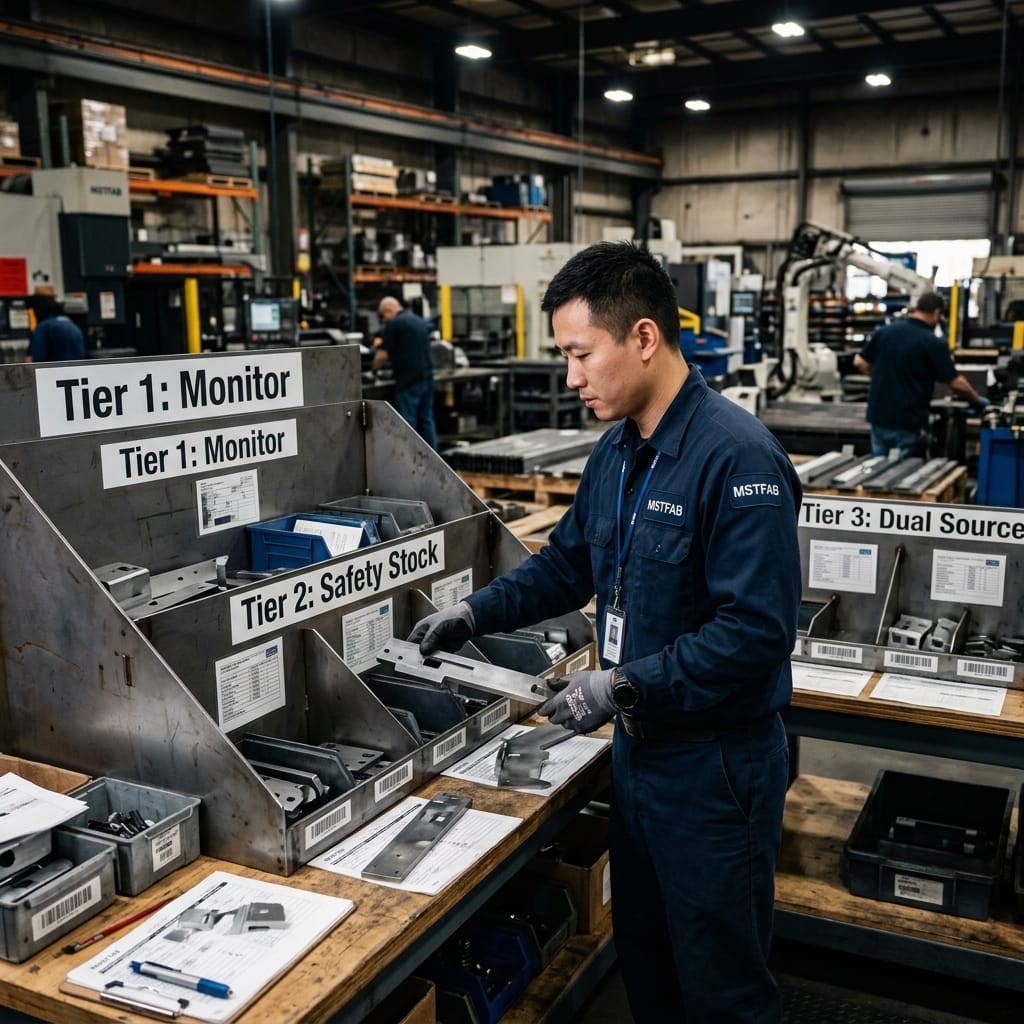


Secure Scalable Resilient Supply Chain Solutions Sourcing With MSTFAB
MSTFAB operates high-capacity automated fiber laser towers, robotic press brakes, and in-house powder coating lines backed by China-enforceable NNN IP security and reserved capacity agreements. Accelerate your production with zero downtime.
Frequently Asked Questions (FAQ)
What is the target Recovery Time Objective (RTO) for sheet metal parts?
For custom sheet metal enclosures, an RTO of ≤10 business days is the industry benchmark. This requires having a pre-qualified secondary fabricator like MSTFAB who already has validated FAI samples on file, pre-programmed CAM nesting files, and in-stock certified metal sheet stock ready for immediate cutting.
How does MSTFAB ensure business continuity for its own manufacturing operations?
MSTFAB maintains full operational redundancy across all core processes: multiple high-power fiber lasers with automated loading towers, redundant CNC press brakes with interchangeable tooling, dual automated powder coating booths, auxiliary industrial power generators, and direct credit lines with multiple primary steel and aluminum mills.
What documentation should be stored in an emergency supplier exit binder?
Every OEM should maintain an active Digital Emergency Binder containing: 1) Fully ballooned 2D PDF drawings and neutral 3D STEP models; 2) Proof of tooling ownership invoices and asset plate photographs; 3) Current First Article Inspection (FAI) dimensional reports; 4) Material specifications and approved substitute alloy lists; and 5) Machine-hour setup parameters.
 WeChat Contact
 WhatsApp Me Directly