⚡ Direct Answer: What Questions Uncover a Sheet Metal Fabricator’s True Capacity?
Before awarding a major custom sheet metal production contract, procurement teams must look past general sales claims by asking 10 Penetrating Pre-Award Technical Capacity Questions: 1) What is your current bottleneck process constraint (cutting, brake bending, welding, or finishing)? 2) What is your current machine utilization percentage on bottleneck equipment? 3) What is your Single-Minute Exchange of Die (SMED) changeover time between press brake jobs? 4) How many certified operators work your second and third shifts? 5) What is your Mean Time Between Failures (MTBF) and Mean Time to Repair (MTTR) on primary fiber lasers? 6) Is surface powder coating and plating performed in-house on an automated line or outsourced? 7) What are your primary steel mill coil purchasing lead times and stock volumes? 8) What percentage of total plant revenue does your largest single customer represent? 9) What is your scrap and internal defect rate (DPPM) on parts of similar geometry? 10) How will our peak production ramp curve be absorbed without displacing existing client orders?
In RFQ evaluations, suppliers invariably answer: “Yes, we have plenty of capacity to handle your order.” But when production begins and orders surge, vague promises evaporate into unreturned emails and delayed shipments. Asking technical, metric-driven questions forces suppliers to reveal real shop-floor constraints before contracts are signed.

The 10 Pre-Award Capacity Questions & Verification Benchmarks
Use this definitive question guide during supplier technical audits and RFQ interviews:
| Audit Question | Underlying Technical Risk | Red Flag Answer | World-Class Benchmark (MSTFAB) |
|---|---|---|---|
| 1. Where is your shop-floor bottleneck? | Every manufacturing plant has one governing constraint (Theory of Constraints). | “We have no bottlenecks anywhere; our capacity is fully balanced.” (Untruthful) | “Brake forming is our primary constraint; we manage it with 4 robotic bending cells and automated tool changers.” |
| 2. What is your current machine utilization? | Shops running >85% utilization cannot absorb volume surges without delay. | “We are running 95% to 100% 24/7 across all machines.” | “Current utilization is 68%, giving us 32% reserve capacity to absorb planned client ramps.” |
| 3. What is your tooling setup time (SMED)? | Long tool changeovers kill productivity and drive up batch minimums. | “Press brake setup takes 45 to 60 minutes per job.” | “Hydraulic quick-clamping tooling allows full punch/die changeover in <10 minutes.” |
| 4. How is your off-shift staffing structured? | Running second/third shifts requires experienced supervisors and QA staff. | “We hire temporary agency workers when big orders arrive.” | “Permanent two-shift operation with full-time staff; lasers run lights-out unattended 3rd shift.” |
| 5. What are your MTBF & MTTR metrics? | Machine reliability determines whether schedules hold or collapse. | “We fix machines when they break down.” (No preventive maintenance) | “MTBF > 1,200 operating hours; MTTR < 4 hours backed by on-site critical spare parts inventory.” |
| 6. Where is surface finishing executed? | Outsourced finishing adds 5 to 10 days of transit and quality loss. | “We outsource powder coating to a nearby shop.” | “100% in-house automated conveyorized powder coating with inline multi-stage pretreatment.” |
| 7. What is your in-stock raw coil volume? | Raw material stockouts create 6-to-8 week delays from steel mills. | “We purchase metal after you issue the PO.” | “Over 300 tons of prime certified coils (304/316 SS, AL 5052, Galv G90) permanently in warehouse.” |
| 8. What is your customer concentration? | Over-reliance on one client creates sudden priority crowding-out. | “Our main client takes 65% of our factory production.” | “Diversified across 5 major global industries; no single customer exceeds 18% of revenue.” |
| 9. What is your internal scrap rate? | High scrap rates mean orders must be over-cut, delaying deliveries. | “We don’t track scrap percentage.” or “>5% scrap.” | “Shop-floor scrap is <1.2%, backed by automated laser cut sensing and first-piece CMM sign-offs.” |
| 10. How will you absorb our ramp curve? | Tests whether the supplier has an actionable engineering plan or just hopes for the best. | “Don’t worry, we will work overtime on weekends.” | “We allocate Machine Cell #3, pre-stage raw coils under Month 2 forecast, and deploy robotic bending.” |



Secure Scalable Capacity-Verified Sheet Metal Sourcing Sourcing With MSTFAB
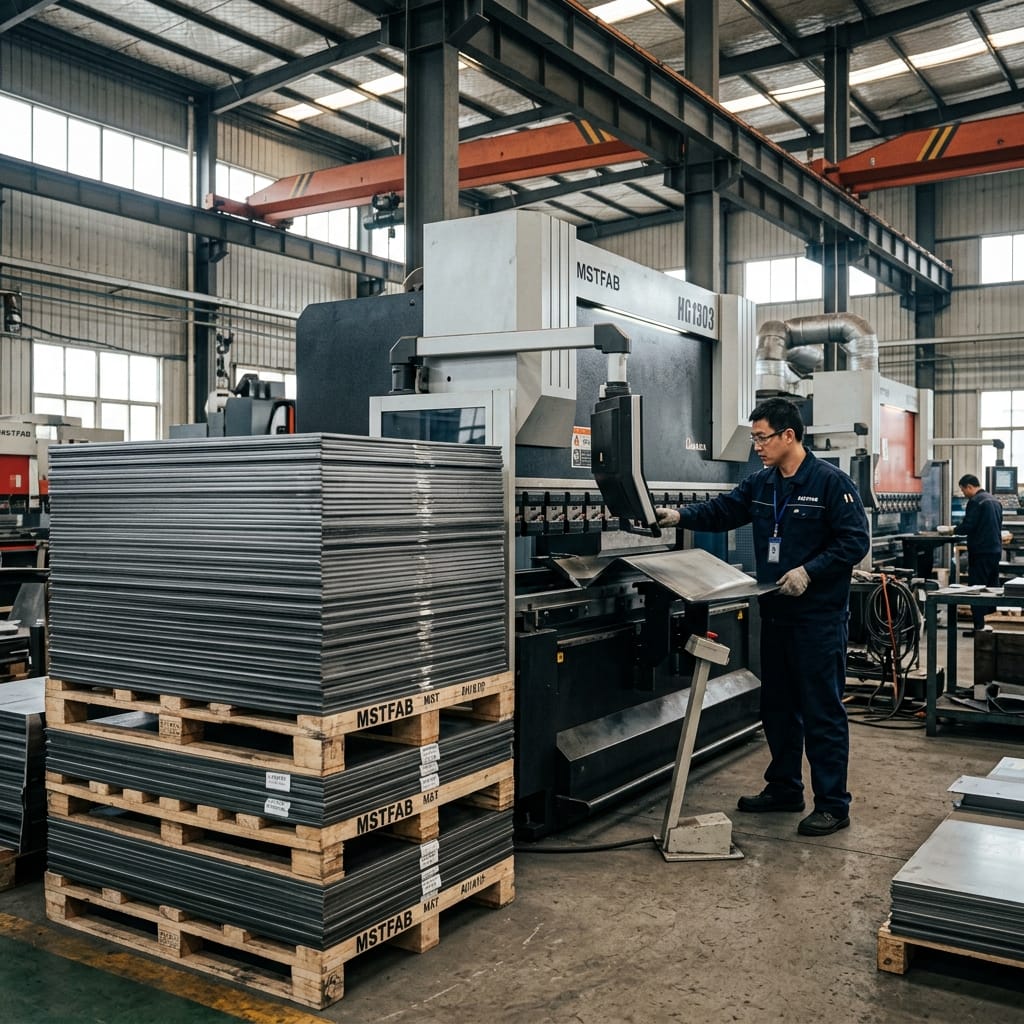
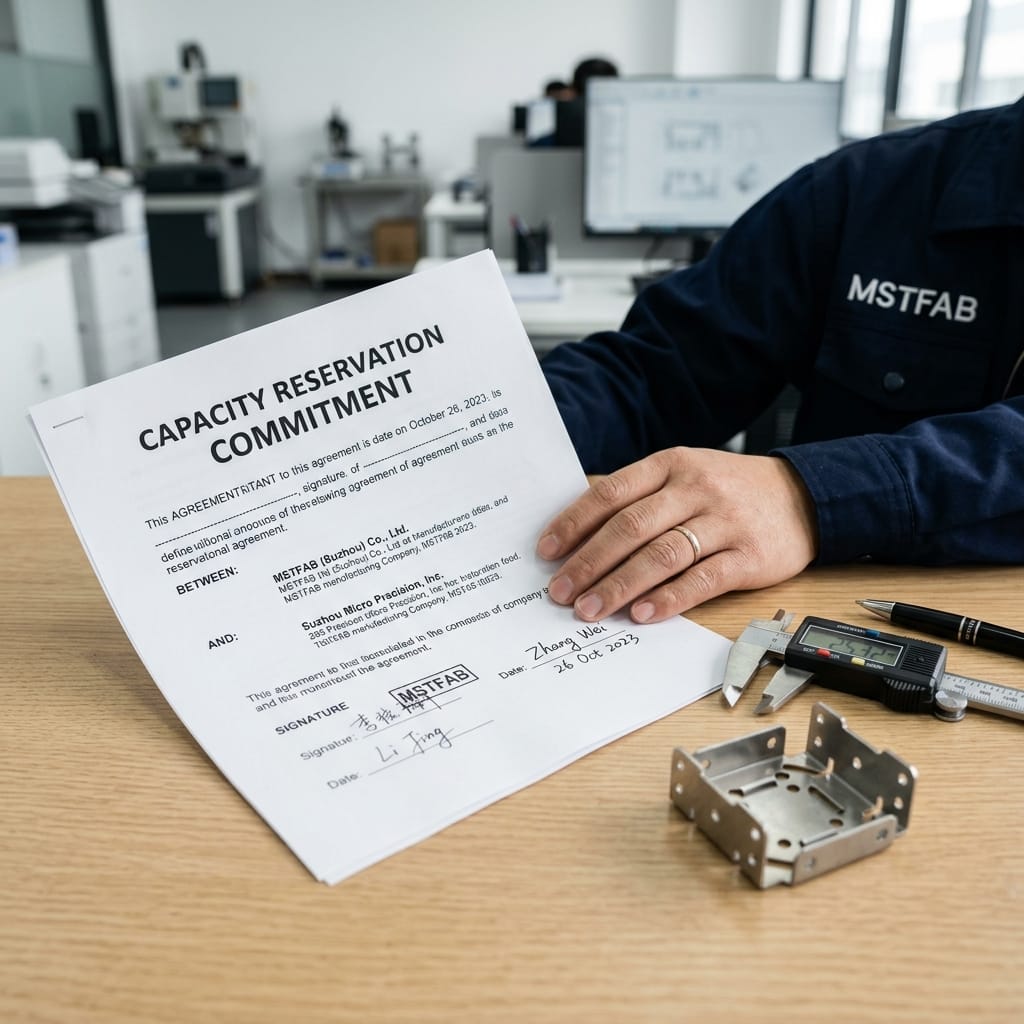
MSTFAB operates high-capacity automated fiber laser towers, robotic press brakes, and in-house powder coating lines backed by China-enforceable NNN IP security and reserved capacity agreements. Accelerate your production with zero downtime.
Frequently Asked Questions (FAQ)
Why is SMED changeover time so critical in sheet metal fabrication?
Single-Minute Exchange of Die (SMED) measures how fast a press brake operator can swap punches and V-dies between jobs. In a high-mix shop, a machine may change jobs 8 times per shift. If changeover takes 45 minutes, 6 hours of an 8-hour shift are lost to setup! At MSTFAB, automated hydraulic quick-clamping tooling cuts setup to under 10 minutes.
How does MSTFAB demonstrate machine maintenance discipline?
We operate under Total Productive Maintenance (TPM) protocols. Every fiber laser, automated material tower, and robotic press brake has digital QR maintenance logs recording daily optical cleaning, hydraulic fluid filtration, and nozzle calibrations, with MTBF > 1,200 operating hours.
Can buyers include capacity audit rights in the Master Supply Agreement?
Yes. Our standard customer agreements explicitly grant OEM buyers and third-party inspectors the right to conduct unannounced on-site floor walkthroughs and review live ERP machine utilization dashboards at any time.
 WeChat Contact
 WhatsApp Me Directly