⚡ Direct Answer: What Is a Controlled Sheet Metal Manufacturing Specification?
A Sheet Metal Manufacturing Specification Routing (also known as a Manufacturing Router, Traveler, or Process Traveler Card) is the authoritative, revision-controlled engineering document that dictates the exact sequence of factory operations required to fabricate a part. While a 2D CAD drawing specifies what the final part dimensions must be, the manufacturing routing specifies how it must be built. A production-grade routing locks five critical parameters: 1) Sequential operation work centers (e.g., Op 10 Laser Cutting → Op 20 Deburring → Op 30 CNC Press Brake → Op 40 Hardware Insertion → Op 50 Robotic TIG → Op 60 Powder Coat → Op 70 Final CMM Metrology); 2) Approved machine IDs and tooling catalog codes; 3) Locked CNC program filenames and laser recipes; 4) Mandatory in-process quality hold points; and 5) Explicit drawing revision synchronization that prevents obsolete drawing revisions from being manufactured.
A frequent cause of manufacturing defects in custom metal fabrication is relying solely on 2D PDFs or 3D STEP files on the shop floor. When operators are left to choose their own bend sequence, deburring method, or hardware insertion order, dimensional drift and aesthetic variations are guaranteed. A controlled manufacturing specification translates engineering drawings into foolproof, reproducible factory steps.

The Architecture of a Robust Sheet Metal Routing Specification
Every production routing issued by MSTFAB follows a standardized, ISO 9001 certified workflow that eliminates operator guesswork across all fabrication stages:
| Op # | Manufacturing Process | Machine & Tooling Callout | Key Parameter / Recipe Lock | Quality Acceptance Gate |
|---|---|---|---|---|
| Op 10 | Fiber Laser Blanking | Bystronic 10kW Fiber Laser (Mach #L04); 1.5mm nozzle | Program: #P-8842-REV-C.cnc; N2 assist gas at 16 bar; grain direction 0° locked | Optical 2D scanner verification of flat pattern envelope & hole pitch (±0.05mm) |
| Op 20 | Edge Deburring & Edge Rounding | Timesavers 42-Series Rotary Brush Deburring Station | Feed rate: 2.5 m/min; 180-grit ceramic disc; 0.2mm edge radius break | 100% burr-free tactile check; surface Ra ≤ 1.6 μm without scratch gouges |
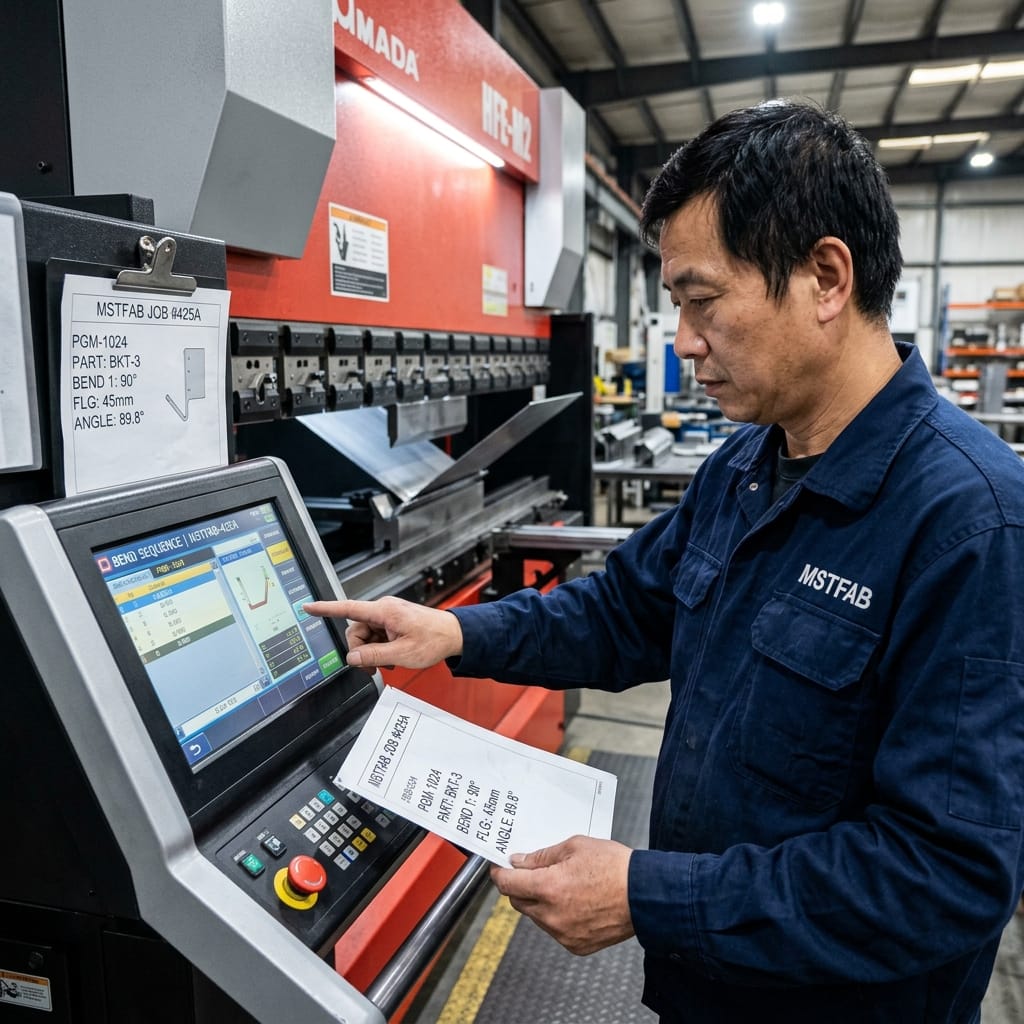
| Op 30 | CNC Press Brake Forming | Amada HG-1003 CNC Press Brake (Mach #PB02); R0.8 punch / V12 die | Program: #B-8842-SEQ4.bnd; 4-bend sequence locked; backgauge axis X1/X2 locked | First piece CMM dimensional inspection + digital protractor check on all 4 bends (±0.3°) |
| Op 40 | PEM Hardware Insertion | Haeger 824-OneTouch Automated Fastener Insertion Press | Pressure: 32 kN; Anvil #A-M4-02; PEM part #CLS-M4-2 stainless standoff | Torque-out & push-out destructive test on 1st piece; 100% thread gauge go/no-go check |
| Op 50 | Robotic TIG Corner Welding | Fanuc 6-Axis Welding Cell; Miller Dynasty 400 TIG source | Fixture #WJ-8842; 100% Argon shield at 14 L/min; pulse mode 120A; ER308L filler | Visual inspection per AWS D1.2 / ISO 5817 Level B; dye penetrant test on critical seams |
| Op 60 | Pretreatment & Powder Coat | Automated 5-stage iron phosphate wash tunnel + Gema electrostatic line | AkzoNobel RAL 9005 Fine Texture; cure oven 10 min at 200° C metal temperature | Dry film thickness (60–80 μm); cross-hatch adhesion ASTM D3359 5B; gloss meter |
| Op 70 | Final Inspection & Packaging | Zeiss CMM coordinate measuring station & custom assembly go/no-go fixture | Anti-static EPE foam wrap + custom double-wall export carton with desiccant packs | 100% Certificate of Conformance (CoC) sign-off + barcode serial tracking label applied |

Why Drawings Fail Without a Manufacturing Routing
A common engineering misconception is assuming that modern CNC machinery can autonomously interpret a 3D CAD model without human process design. In reality, multiple valid manufacturing sequences can produce the exact same final 3D geometry—but only one sequence achieves maximum repeatability and minimum cost:
- Forming Flange Interference: If a technician bends Flange A before Flange B, the workpiece may collide with the press brake ram or punch holder, forcing the operator to tilt the part manually and lose backgauge repeatability. The routing locks the exact physical bend sequence.
- Hardware Insertion Timing: Installing PEM self-clinching studs after bending often requires deep-throat custom anvils or may even be physically impossible due to flange clearance constraints. A proper routing mandates hardware insertion at the flat sheet stage (Op 20/30) before forming.
- Weld Shrinkage Compensation: Welding corners distorts adjacent flanges by up to 0.8mm. The routing defines whether laser cutting apertures near weld zones should be cut undersized and post-machined, or if specific weld pre-cambering fixtures must be applied.


Achieve Flawless Manufacturing Specification & Routing Consistency With MSTFAB
MSTFAB enforces ISO 9001 certified quality gates, CMM automated metrology, locked CNC bend sequences, and tamper-proof golden sample governance. Guarantee batch-to-batch repeatability from pilot run to mass production.
Frequently Asked Questions (FAQ)
How do you maintain revision control when a customer submits an Engineering Change Notice (ECN)?
When an ECN is received, our ERP system immediately places a digital stop-order on the current routing traveler. The CAM engineering team updates the CNC code, validates tooling clearances, increments the routing version (e.g., Rev 03 locked to Drawing Rev D), and purges obsolete physical and digital travelers from the shop floor.
Can customers review and approve the manufacturing routing before production begins?
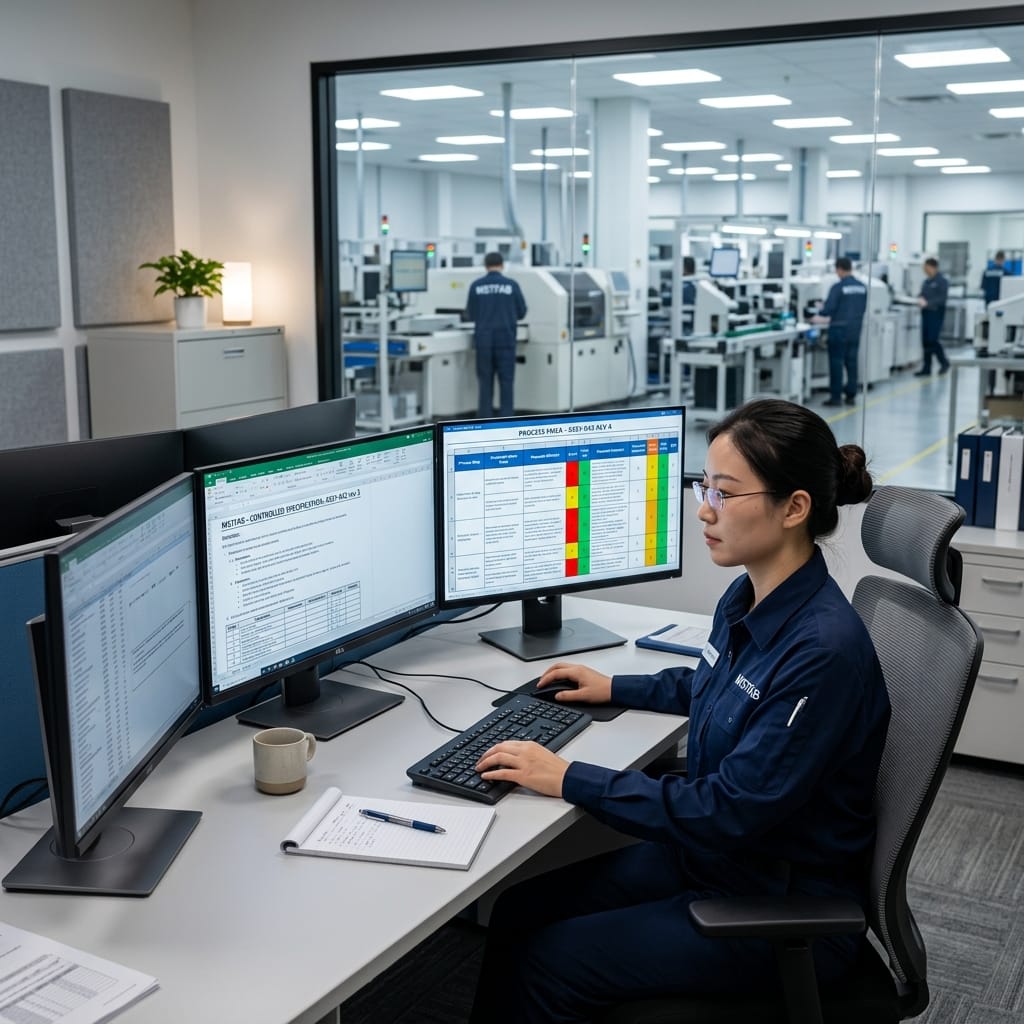
Yes. For aerospace, medical, and defense contracts, MSTFAB submits the complete Process Routing and Process FMEA (PFMEA) as part of the formal Production Part Approval Process (PPAP Level 3) package for customer engineering sign-off prior to pilot run release.
What happens if an operator deviates from the locked routing sequence?
Our shop floor MES (Manufacturing Execution System) requires operators to scan their employee badge, the traveler barcode, and the machine tool ID before the CNC machine will accept the NC program. Skipping an operation or scanning an unapproved machine triggers an immediate line supervisor lockout.
 WeChat Contact
 WhatsApp Me Directly