⚡ Direct Answer: How to Reserve Dedicated Sheet Metal Fabrication Capacity?
Reserving dedicated sheet metal manufacturing capacity requires executing a Capacity Reservation Agreement (CRA) that contractually blocks out specific machine hours on bottleneck equipment (automated fiber laser cutting tables, CNC press brakes, and robotic welding cells) ahead of actual production releases. Structuring an effective agreement deploys 4 commercial mechanisms: 1) Named Machine-Hour Allocations: Reserving dedicated spindle/beam hours (e.g. 120 laser cutting hours and 80 press brake hours per month); 2) Balanced Financial Payment Model: Utilizing a Minimum-Commit 70/30 Retainer where the buyer guarantees 70% of baseline capacity spend while retaining 30% elasticity without idle penalties; 3) 8-Week Rolling Capacity Lock-In: Freezing exact production dates 4 weeks out while providing flexible ±15% volume adjustments between Weeks 5–8; and 4) Capacity Release Notice Protocols: Allowing the fabricator to release unused reserved machine slots to open-market orders if the buyer provides written notice at least 14 days in advance.
During seasonal market demand surges, unreserved purchase orders are subject to open-market queue delays. If a larger customer enters the shop with a massive rush order, your unreserved parts will be quietly delayed by weeks. Locking in dedicated capacity guarantees that your parts take immediate priority on the production schedule.
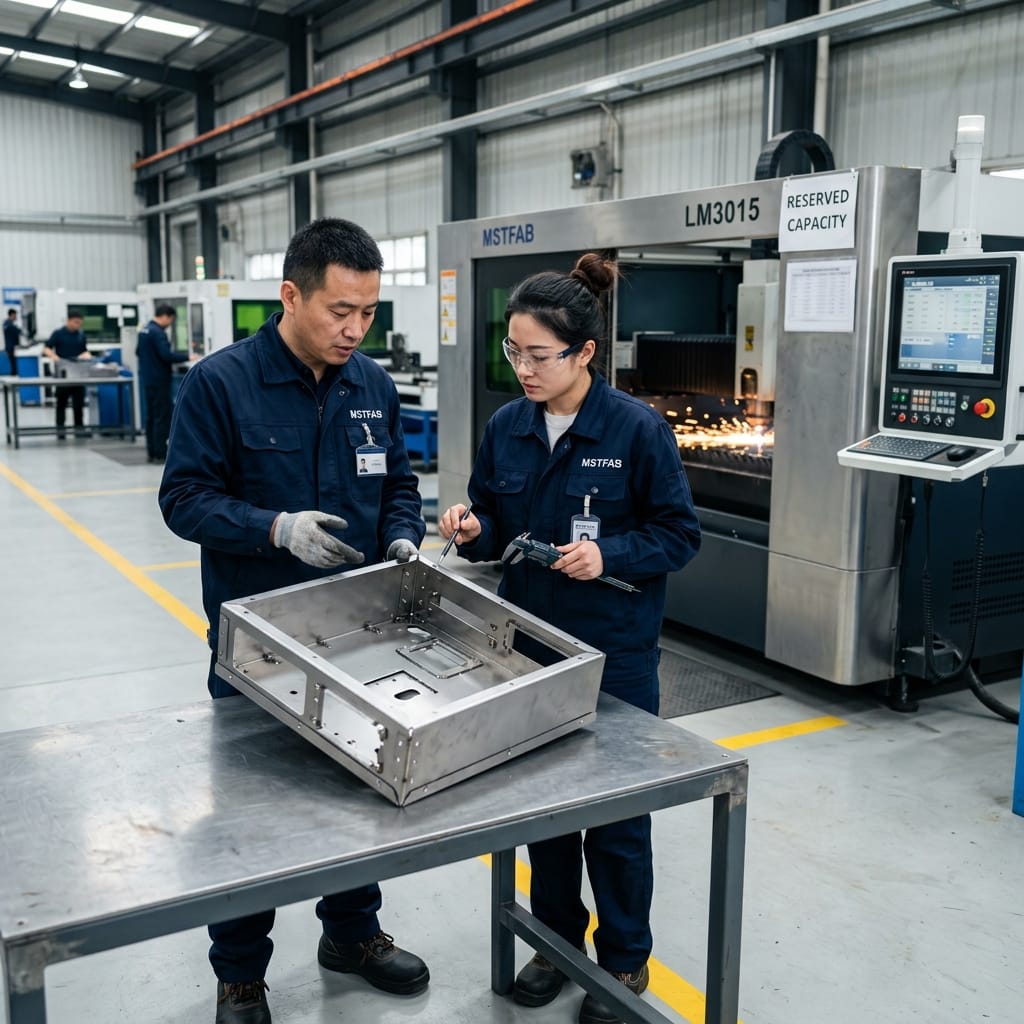
Commercial Capacity Reservation Models Compared
Compare the four primary commercial structures used to secure sheet metal manufacturing capacity:
| Reservation Model | Commercial Structure | Buyer Financial Liability | Lead Time Guarantee | Best Application |
|---|---|---|---|---|
| 1. Take-or-Pay Fixed Retainer | Fixed monthly fee for dedicated line access regardless of usage | 100% of reserved machine fee payable | Instant (24 – 48 hours) | Mission-critical defense, medical equipment, or high-consequence zero-downtime programs. |
| 2. Minimum-Commit 70/30 (MSTFAB) | Guarantee 70% baseline volume; remaining 30% flexible elasticity band | Balanced & Equitable (70% floor) | 5 – 8 business days | Standard commercial OEM equipment, EV charging infrastructure, telecom chassis. |
| 3. Dedicated Manufacturing Cell | Co-investment in dedicated press brake or robotic welding fixture station | Amortized tooling / fixture capex | Immediate dedicated queue | Multi-year high-volume programs (>10,000 units/year). |
| 4. Unreserved Spot Purchasing | Ad-hoc individual purchase orders placed when demand occurs | Zero ongoing liability | Unpredictable (4 – 9 weeks) | Non-critical prototypes, one-off maintenance brackets. |

Key Contractual Provisions in a Capacity Reservation Agreement
When drafting a Capacity Reservation Agreement with MSTFAB or another Tier-1 manufacturer, ensure these 4 clauses are explicitly documented:
- Named Equipment Scope: Explicitly designate which machine centers are reserved (e.g. “Bystronic 15kW Fiber Laser #2 and Amada HG-1003 7-Axis CNC Press Brake #4”) rather than vague promises of “factory capacity”.
- Guaranteed Expedited Cycle Time: The agreement must specify: “Fabricator guarantees that production of released parts shall commence within 48 hours of call-off PO transmission, with finished parts packaged within 7 business days.”
- Unused Capacity Release Mechanism: If the OEM gives written notice at least 14 days prior to the start of a production block that reserved hours will not be needed, the fabricator may release the machine hours to other jobs without charging the buyer an idle standby fee.
- Maintenance Down-Time Indemnity: If reserved machinery suffers unscheduled mechanical breakdown, the fabricator must re-route jobs to equivalent backup CNC machines within 12 hours at the fabricator’s sole expense.


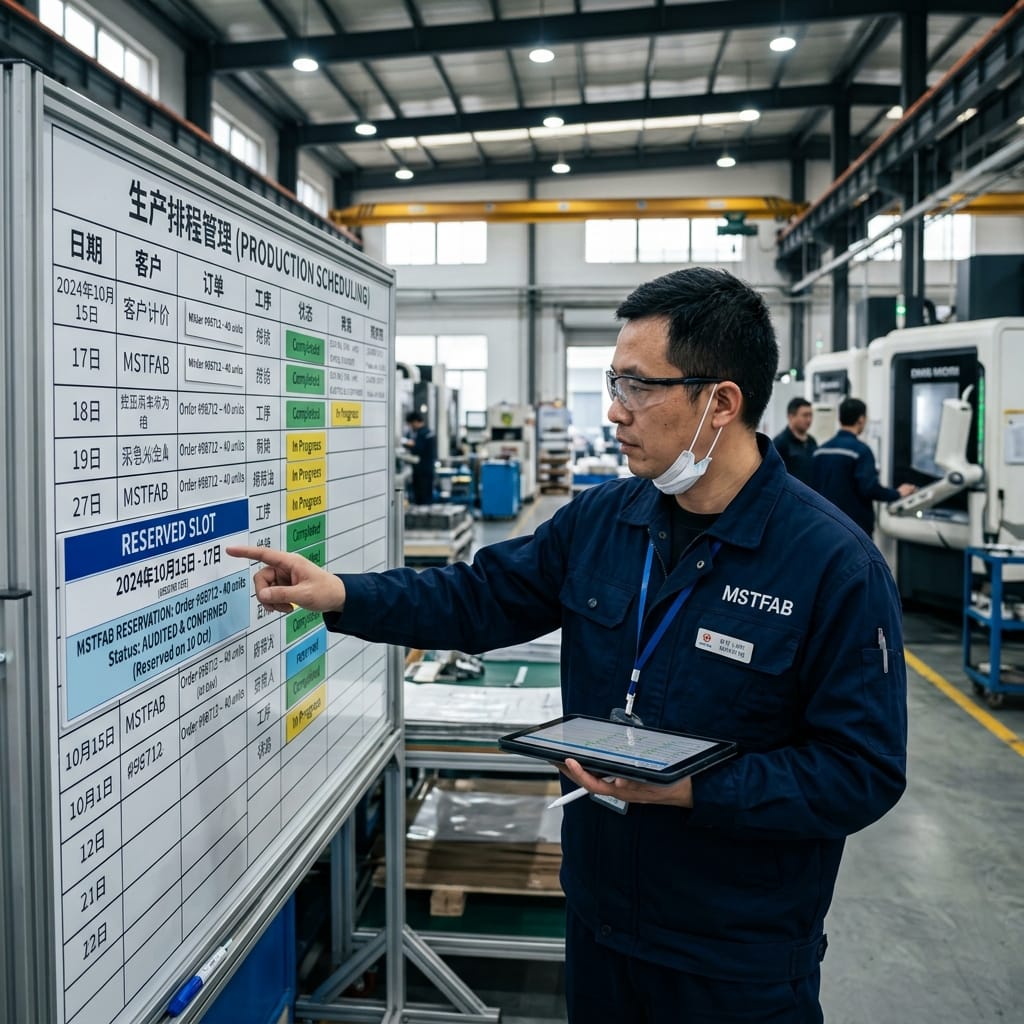

Secure Scalable Reserved Manufacturing Capacity Sourcing With MSTFAB
MSTFAB operates high-capacity automated fiber laser towers, robotic press brakes, and in-house powder coating lines backed by China-enforceable NNN IP security and reserved capacity agreements. Accelerate your production with zero downtime.
Frequently Asked Questions (FAQ)
How does capacity reservation differ from a Blanket Purchase Order?
A Blanket Purchase Order (BPO) locks pricing for a committed total quantity of finished parts over a timeframe. A Capacity Reservation Agreement (CRA) locks machine hours and scheduling priority. High-performing OEM procurement teams often combine both: executing a Blanket PO for volume pricing while pairing it with a CRA to guarantee immediate production turnaround.
What happens if the fabricator takes on open-market work in my reserved slot?
Your contract should include a Daily Delay Penalty (e.g. 1.0% to 2.0% per day of delayed PO value) if the fabricator fails to commence manufacturing within the agreed 48-hour call-off window. This guarantees that your work is never deprioritized for another customer.
Does MSTFAB offer flexible capacity reservation for growing hardware OEMs?
Yes! MSTFAB works with growing equipment manufacturers to establish elastic capacity reservation agreements. We dedicate automated laser and press brake machine blocks tailored to your seasonal build schedules, supported by pre-staged master coil buffers.
 WeChat Contact
 WhatsApp Me Directly