⚡ Direct Answer: How Do Raw Material Shortages Impact Sheet Metal Lead Times?
In custom sheet metal fabrication, raw metal sourcing accounts for 60% to 75% of total production lead time when non-standard alloys or unusual sheet gauges are specified. Primary steel and aluminum mills (such as Baosteel, POSCO, and Chalco) do not roll every material thickness continuously; they operate on 6-to-12 week batch melting campaigns. If a fabricator runs out of an uncommon raw material (e.g. 2.5mm 316L stainless steel or 5052-H34 aluminum), order lead times instantly explode from 3 weeks to 10–14 weeks while awaiting the next mill rolling schedule. Sourcing managers insulate projects from raw material delays using 4 proven controls: 1) Standardizing on Primary Mill In-Stock Gauges (e.g. 1.2mm, 1.5mm, 2.0mm, 3.0mm); 2) Specifying Approved Pre-Qualified Substitute Alloys directly on the 2D blueprint; 3) Mandating Separate “Material ETA” Milestones in purchase orders; and 4) Partnering with Fabricators Carrying Multi-Ton In-House Master Coils (like MSTFAB).
A frequent source of frustration for procurement engineers is placing a sheet metal order with a supplier who quotes a 3-week delivery, only to receive an email two weeks later stating: “Production is delayed 6 weeks because the steel service center has no 11-gauge 316L stainless in stock.” Understanding mill production dynamics transforms material lead time from a reactive crisis into a predictable engineering variable.

Primary Mill Rolling Campaigns & Alloy Availability Matrix
Compare the typical mill campaign frequencies, stockout lead times, and pre-approved substitutes for common sheet metal alloys:
| Material & Alloy Grade | Mill Campaign Frequency | In-Stock Lead Time | Mill Stockout Lead Time | Pre-Approved Fast Substitute |
|---|---|---|---|---|
| 304 Stainless Steel (1.2 / 1.5 / 2.0mm) | Continuous (Weekly melts) | 5 – 10 business days | 3 – 4 weeks | 304L (Low-carbon equivalent, identical forming) |
| 316L Marine Stainless (Non-std gauges) | Every 6 – 8 weeks | 10 – 15 business days | 8 – 12 weeks | Upsize to nearest standard standard millimeter gauge (e.g. 2.5mm → 3.0mm) |
| Aluminum 5052-H32 (Sheet & Plate) | Every 2 – 3 weeks | 5 – 10 business days | 4 – 6 weeks | AL 5754-H22 (Identical weldability & bend ductility) |
| Galvanized Steel ASTM A653 G90 | Continuous (Weekly continuous lines) | 5 – 8 business days | 3 – 5 weeks | EN 10346 DX51D+Z275 (Direct international equivalent) |
| Cold Rolled Steel SPCC / 1008 | Continuous | 3 – 7 business days | 2 – 4 weeks | DC01 / St12 (European standard commercial deep-draw) |

5 Tactics to Protect Production from Material Stockouts
Deploy these five procurement and DFM strategies to insulate your supply chain from steel mill volatility:
- Design Around Metric Standard Mill Gauges: Avoid designing sheet metal thickness to obscure imperial gauge conversions (e.g. 0.090 in = 2.286 mm). Steel service centers do not stock 2.286mm plate. Design to 2.0mm or 2.5mm standard mill stock.
- Include Pre-Approved Material Substitutions in the Blueprint Title Block: Add an engineering note: “Material: 304 Stainless Steel 1.5mm. Approved substitutes: 304L Stainless Steel 1.5mm or 316L Stainless Steel 1.5mm.” This gives the fabricator immediate authority to cut from in-stock metal without a 2-week CAD change review.
- Mandate a Separate “Material On-Dock Date” in the PO: Require the supplier to confirm raw coil receipt within 7 business days of PO placement. If the metal is not on-dock by Day 7, you immediately know lead time is slipping.
- Authorize Whole-Sheet Upsizing: If 2.3mm thickness is unavailable, authorize your supplier to substitute 2.5mm stock at no added cost. The fractional weight difference is trivial compared to a 6-week shutdown.
- Pre-Stage Dedicated Coil Buffers with MSTFAB: Partner with MSTFAB under a Material Reservation Agreement where we hold dedicated 5-ton master coils allocated exclusively for your annual production drawdowns.

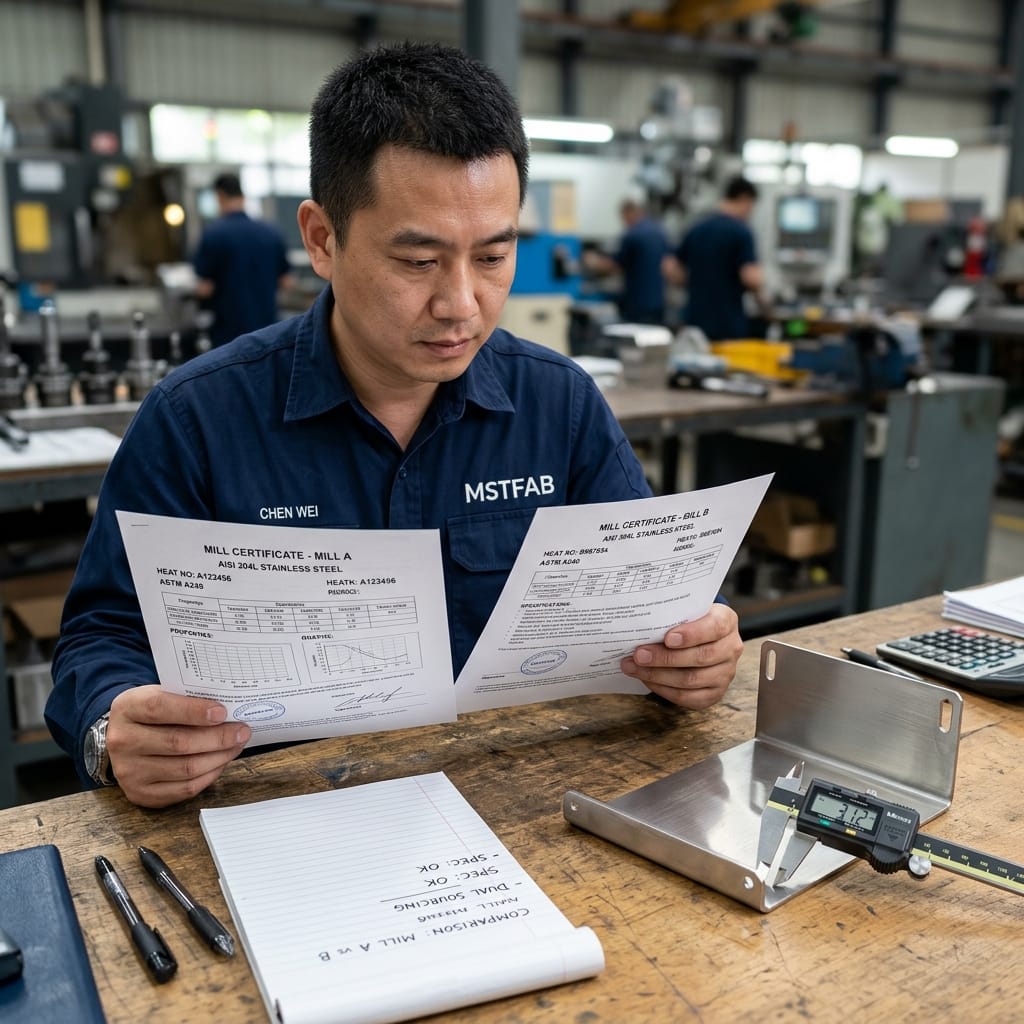


Secure Scalable Guaranteed Material Availability Sourcing With MSTFAB
MSTFAB operates high-capacity automated fiber laser towers, robotic press brakes, and in-house powder coating lines backed by China-enforceable NNN IP security and reserved capacity agreements. Accelerate your production with zero downtime.
Frequently Asked Questions (FAQ)
What raw materials does MSTFAB keep in permanent inventory?
MSTFAB maintains permanent master coil stock in standard gauges (0.8mm to 6.0mm) across prime certified grades: 304 / 304L / 316L Stainless Steel, 5052-H32 / 6061-T6 Aluminum, Hot-Dip Galvanized ASTM A653 G90 / DX51D+Z275, and Cold Rolled SPCC steel, ensuring 24-to-48 hour cutting commencement on production orders.
How does sheet metal thickness variance affect press brake bending?
If you substitute an alternative sheet gauge or if raw coil thickness varies by ±0.10mm from nominal, the press brake’s penetration depth changes, altering the resulting bend angle by up to 1.5°. At MSTFAB, our CNC press brakes feature dynamic optical laser angle compensation that measures bend angles in real time to correct for thickness variations automatically.
Can buyers lock raw material pricing during long production contracts?
Yes. Under our Blanket PO and Framework Agreement contracts, MSTFAB offers raw material hedging programs that lock metal pricing for 6 to 12 months by pre-purchasing physical mill coils upon contract signing.
 WeChat Contact
 WhatsApp Me Directly