Quick Answer: Positive Material Identification (PMI) for stainless steel sheet metal parts is the on-the-spot test that proves what alloy you actually received — reading the metal’s chemistry with a handheld analyzer rather than trusting a certificate. For sheet metal buyers, the move that pays the bills is simple: use PMI (usually XRF) at receiving to verify 304 vs 316 stainless steel by checking for molybdenum. 316 contains 2-3% molybdenum; 304 contains essentially none. If the gun reads ~0% Mo, it is not 316, no matter what the grade box or the mill cert says. A 30-second scan catches the single most common stainless fraud — billing 304 as 316 — before a single bracket gets welded.
What PMI Actually Is (and Why a Certificate Is Not Enough)
Positive Material Identification is exactly what it sounds like: positively identifying the material you hold in your hand. Not “the cert says 316,” not “the tag says 316” — the actual chemistry of the actual part, measured on the actual metal.

Here is the uncomfortable gap buyers keep falling into. A Mill Test Certificate is a promise from the mill; a Certificate of Conformance is a promise from the trader. Promises get edited. Heat numbers get reused. Grades get swapped between the coil and your dock. PMI testing sheet metal parts cuts through all of that because it asks the metal, not the paper.
Think of it this way: the cert is the suspect’s statement. PMI is the fingerprint. You want both, but if they disagree, the fingerprint wins.
The Three PMI Methods You Will Meet
Not all PMI is the same tool. Three technologies dominate, and knowing which is which saves you from a confident-but-wrong result.
- XRF (X-ray Fluorescence). A handheld gun fires X-rays at the metal; the fluorescent response reveals the elemental mix. Non-destructive, fast (seconds), great for chromium, nickel, and — crucially — molybdenum. This is the workhorse for sheet metal receiving. The catch: XRF is weak on light elements, so it reads carbon poorly.
- OES / Arc-Spark (Optical Emission Spectroscopy). A small spark vaporizes a tiny spot and reads the emitted light spectrum. Excellent at carbon and all major elements, so it can confirm “L” low-carbon grades — but it leaves a tiny burn mark and needs a flat, ground surface.
- LIBS (Laser-Induced Breakdown Spectroscopy). A laser pulse reads the plasma; good on carbon and works on some coated or awkward surfaces, but less common on buyer docks.
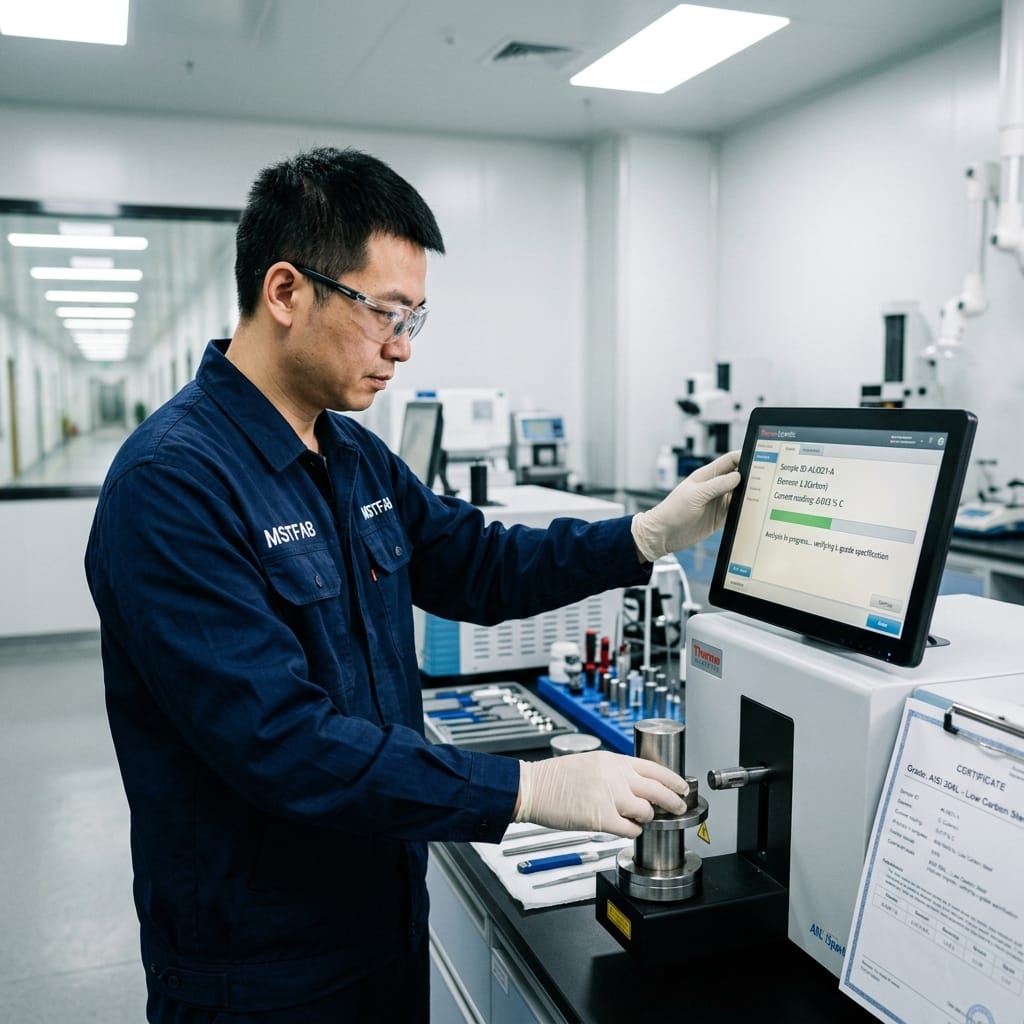
For most stainless sheet metal, XRF is your friend: fast, clean, and it nails the molybdenum tell that separates 304 from 316. Bring in OES only when you must confirm carbon (L-grades) or when a result is disputed.
How to Run PMI on Thin Stainless Sheet
Thin sheet is trickier than a thick block — the X-ray can “see through” a 0.5 mm part and read the table underneath. Do it right:
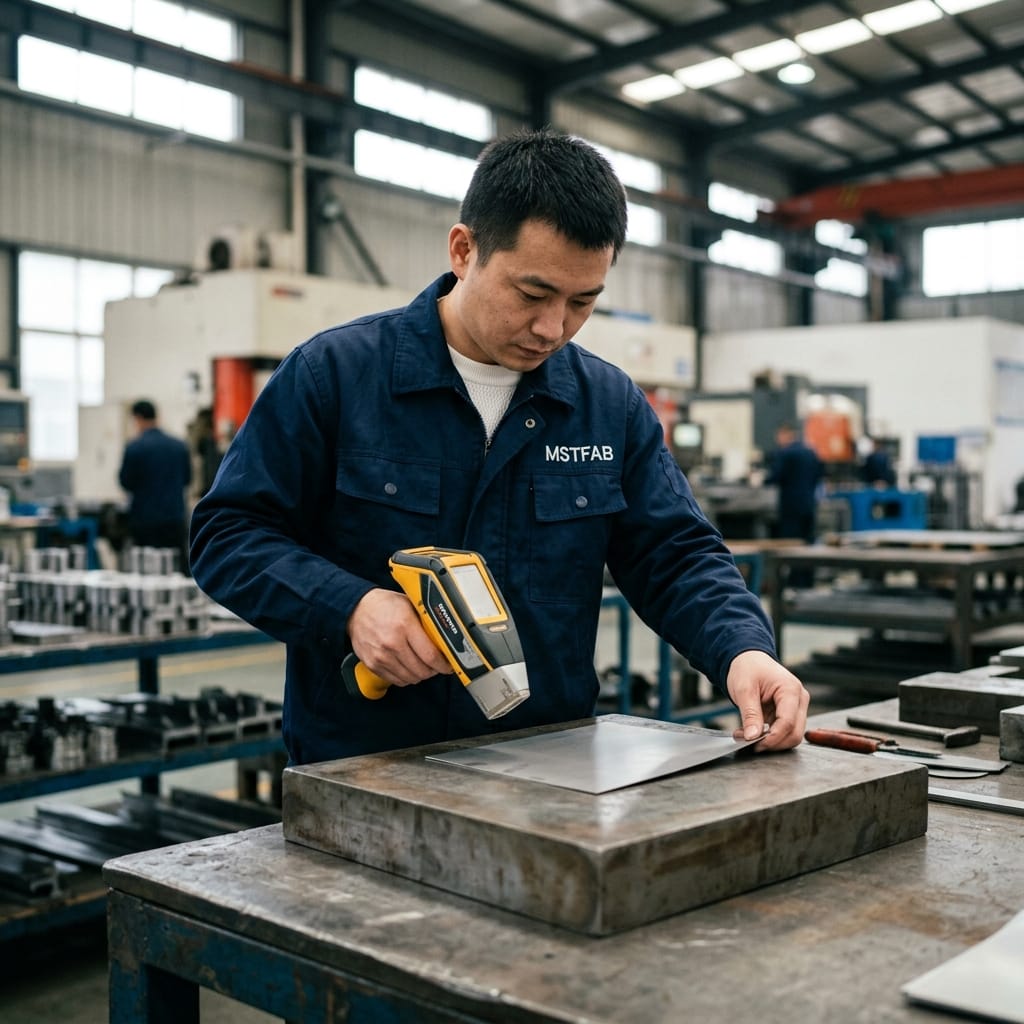
- Prep the surface. Remove oil, paint, powder coat, and any coating at the test spot. A coated surface lies to the gun — it reports the coating, not the steel.
- Couple flat to the part. Press the gun’s window flush against a flat area. On a curved or ribbed bracket, hold the part firmly or use a small flat coupon cut from the same lot.
- Mind the thickness floor. Below roughly 1 mm, place the sheet on a thick steel or acrylic block so the X-ray doesn’t read through it.
- Shoot multiple spots. Alloys can be locally inconsistent. Take 2-3 readings across the lot; if they disagree, that is data, not noise.
- Tag the reading to the heat. Record the result against the heat number and packing list.
A 30-second scan per coil at receiving is the highest-return habit in this entire guide.
The 304 vs 316 Proof: Molybdenum Is the Tell
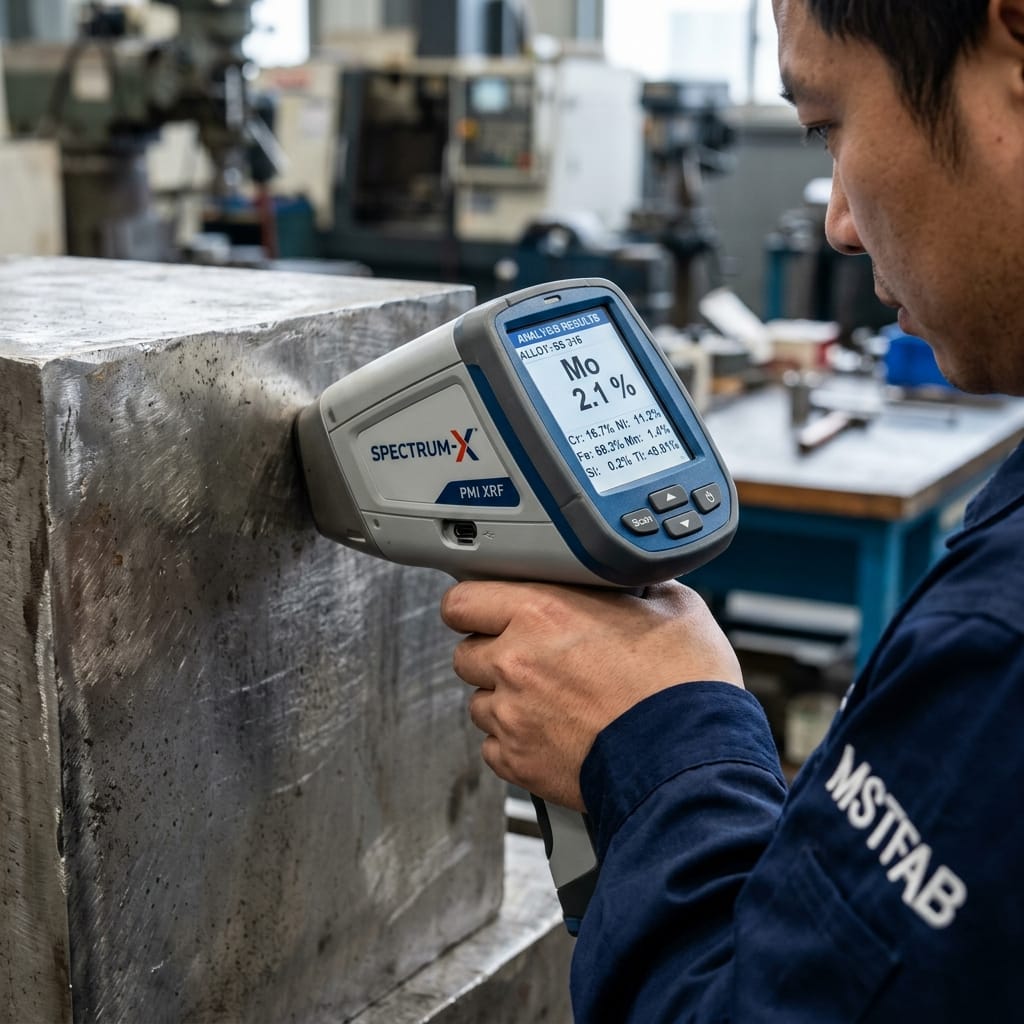
This is the whole ballgame for stainless buyers. Open the elemental readout and look at one number:
| Element | 304 (typical) | 316 (typical) |
|---|---|---|
| Chromium (Cr) | 18-20% | 16-18% |
| Nickel (Ni) | 8-10.5% | 10-14% |
| Molybdenum (Mo) | ~0% | 2-3% |
| Carbon (C) | ≤0.08 (L: ≤0.03) | ≤0.08 (L: ≤0.03) |
To verify 304 vs 316 stainless steel, the molybdenum reading decides it. 316 must show 2-3% Mo. 304 shows essentially zero. If the gun reads 0.0-0.1% Mo, you are holding 304 — regardless of the cert’s grade box. Chromium and nickel alone will not separate them. Molybdenum is the discriminator, full stop.
The ugly version of this scam: a shop buys 304 at a 304 price, bills you at a 316 price, and prays you never scan. PMI is the prayer-breaker.
Limitations and Gotchas
PMI is powerful but not magic. The ways it lies to you:
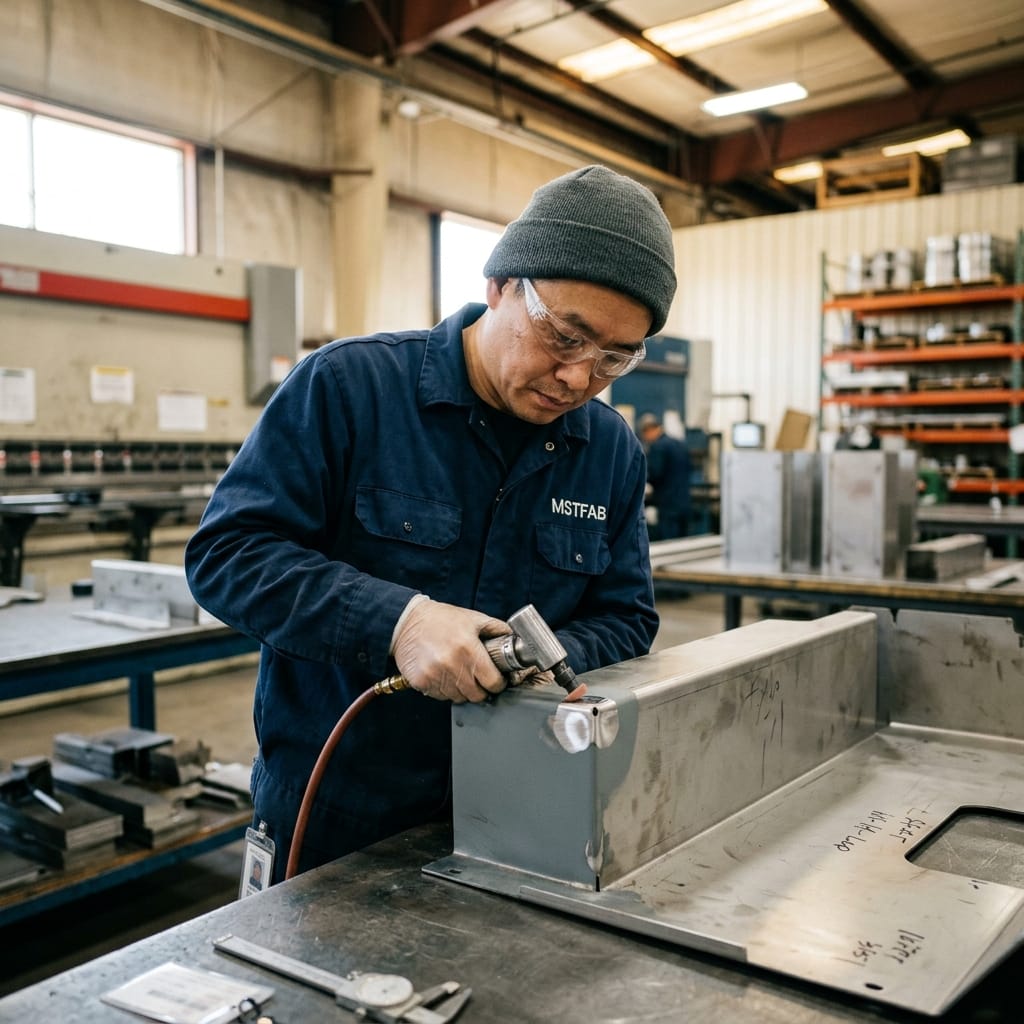
- Coatings: Paint, zinc, or oil at the test spot reports the coating, not the steel. Always strip a clean window.
- Surface decarburization / heat tint: Welded or heat-treated zones can read off; test the base metal away from weld zones.
- Calibration drift: A gun that hasn’t been calibrated against reference standards quietly drifts.
- Alloy families XRF can’t split: Two grades that differ mainly in carbon (304 vs 304L) need OES or lab testing.
Where PMI Lives in Your Process
PMI is not a one-time event. Slot it into four gates:

- Receiving gate: Scan the coil or a part from each lot before it enters stock. This is where swaps are caught cheapest.
- Pre-production verification: Before a critical run, confirm the material staged at the press brake matches the drawing.
- In-process check: On long jobs, periodic re-scan catches a silent coil swap mid-order.
- Dispute / recall: When a cert and a failure disagree, PMI the suspect part to bound the problem.
MSTFAB Trust & Quality Verification Table
| PMI Protocol | Standard Industry Practice | MSTFAB Standard | Buyer Benefit |
|---|---|---|---|
| Receiving Inspection | Files the MTC and assumes the metal matches | Mandatory XRF scan on 100% of incoming stainless coils | Zero risk of 304 masquerading as 316 entering production |
| L-Grade Verification | Relies entirely on XRF (which cannot read carbon reliably) | OES Arc-Spark / Lab testing triggered for all L-grades | Guaranteed weldability and corrosion resistance for 316L/304L |
| Calibration Discipline | Gun calibrated sporadically; operators self-taught | Daily standard-block calibration; certified operators | Data you can trust in a dispute, not just “noise” |
| Thin Sheet Handling | Scans in the air or directly on workbenches | Strict use of backing blocks for materials under 1mm | Accurate chemistry readings on even the thinnest shims |
Calibration and Competence

A PMI result is only as good as the gun and the hand holding it:
- Calibrate against reference standards on the maker’s schedule.
- Train the operator. Surface prep, coupling, and reading interpretation are skills.
- Document the result. Part/heat ID, reading (raw elements), gun ID, operator, timestamp.
One-Page PMI Checklist
- Surface prepped (coating/oil removed at test spot)?
- Gun calibrated and coupled flush to flat area?
- Thickness floor respected (block under thin sheet)?
- 2-3 spots read per lot?
- Mo ≥ 2% for 316? (~0% means 304).
- Ni/Cr in claimed range? Carbon/L-grade confirmed by OES if required?
- Reading tied to heat number + packing list?
- Result documented (gun ID, operator, timestamp, photo)?
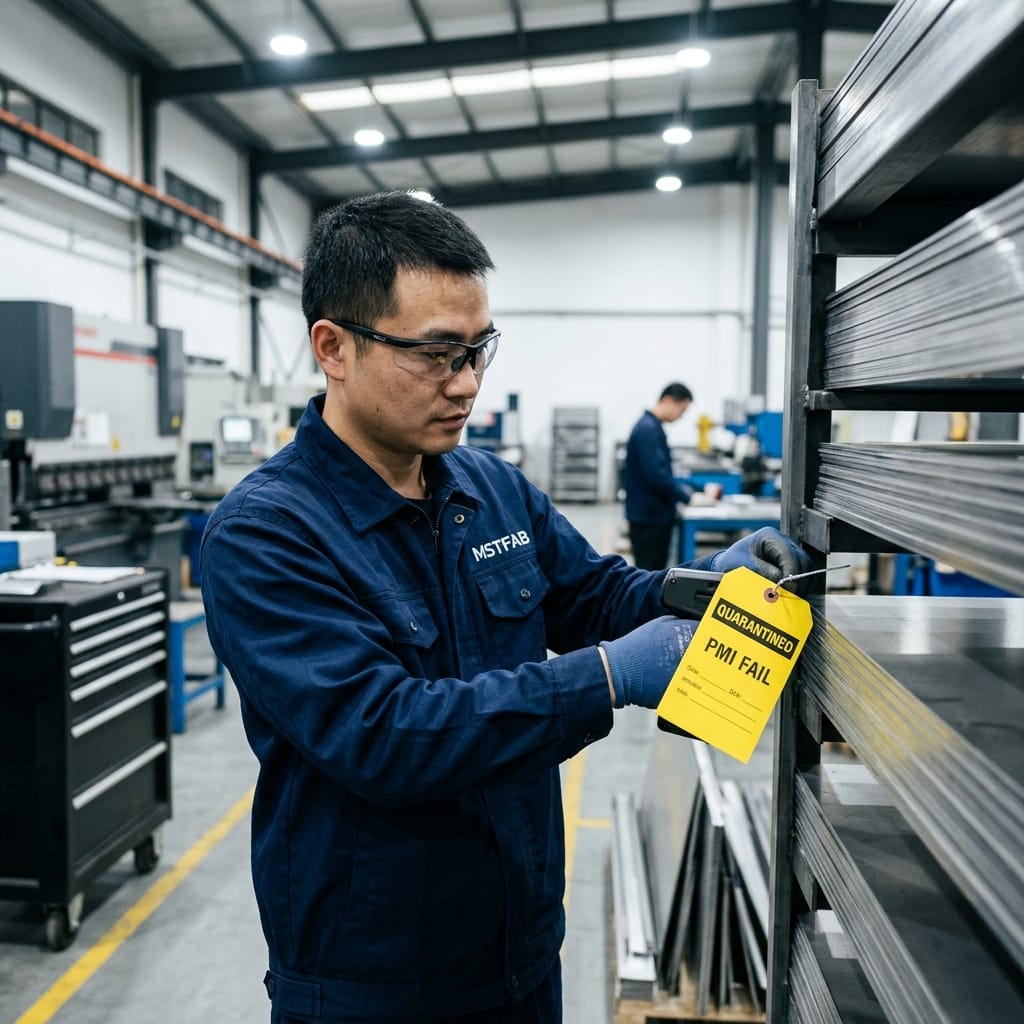
- Failing lot quarantined, not welded?
FAQ
What is positive material identification and why do I need it for stainless sheet?
Positive Material Identification (PMI) is the on-site test that reads a part’s actual elemental chemistry with a handheld XRF gun, instead of relying on a certificate. You need it because stainless fraud (billing 304 as 316) is invisible on paper.
How do I verify 304 vs 316 stainless steel with PMI?
Look at the molybdenum reading. 316 contains 2-3% molybdenum; 304 contains essentially none. If the XRF reads ~0-0.1% Mo, it is 304 regardless of what the cert claims. Molybdenum is the discriminator.
Can XRF PMI tell 304L from 304, or 316L from 316?
Not reliably. XRF is weak on light elements like carbon. The only difference is the carbon ceiling, which XRF barely sees. To confirm an L-grade, use an arc-spark OES test or an independent lab.
What are the biggest mistakes when doing PMI on thin sheet metal?
Scanning through a coating, using one spot only, ignoring the thickness floor so the gun reads the table underneath, assuming XRF proves an L-grade, running an uncalibrated gun, and failing to tie the reading to a heat number.
Is PMI enough, or do I still need a mill test certificate?
Use both. PMI is the fast field gate that catches a grade swap at receiving; a mill test certificate is the documented proof of chemistry, mechanical properties, and traceability. They work together.
 WeChat Contact
 WhatsApp Me Directly