⚙ Quick Engineering Reference: What Defines a NEMA 12 Galvanized Steel Electrical Box?
A NEMA 12 galvanized steel electrical box for industrial applications is an indoor-rated sheet metal enclosure engineered under NEMA 250 Type 12, UL 50E, and IEC 60529 (IP54/IP55) to protect automation controls from circulating airborne dust, falling dirt, lint, fibers, and non-corrosive dripping liquids, including light coolant mist. Fabricated from hot-dip galvanized sheet steel (ASTM A653 G90 / EN 10346 DX51D+Z275, 275\ text{g/m}^2$ zinc mass) rather than ordinary bare carbon steel (SPCC), it provides continuous sacrificial cathodic edge protection that prevents internal rust under plant humidity and condensate. Core DFM features include continuous seam welding, CNC robotically dispensed oil-resistant Form-in-Place Foam Gasketing (FIPFG) polyurethane with 35%$ deflection, precision NEMA 12K laser micro-tab or punch knockouts tested to UL 514B push-out thresholds, and an automated 7-stage zirconium nano-ceramic conversion with durable ANSI 61 / RAL 7035 powder coating.
Within modern industrial automation, machine tool construction, automotive assembly lines, robotic welding cells, packaging machinery, and material handling systems, the electrical enclosure serves as the protective fortress for mission-critical automation hardware. These enclosures house programmable logic controllers (PLCs), variable frequency drives (VFDs), servo amplifiers, safety contactors, power distribution circuit breakers, Industrial Ethernet switches, and human-machine interface (HMI) modules.
In factory floor environments, ambient operating conditions are fraught with particulate and fluid contamination. High-speed machining centers atomize cutting fluids into airborne aerosol mists; stamping presses generate conductive airborne graphite and carbon dust; textile and cardboard packaging lines release high concentrations of combustible fibrous lint; and overhead pneumatic lines frequently drip condensed moisture and lubricated compressor oils. If an electrical control box fails to seal effectively against these airborne vectors, the results are catastrophic: conductive dust forms bridging tracks across printed circuit boards, coolant mist creates phase-to-ground flashovers across 480\ VAC$ busbars, and unplanned line stoppages incur thousands of dollars per minute in lost production.
Historically, machinery builders procured generic commercial NEMA 12 boxes stamped from raw cold-rolled sheet steel (SPCC). However, when equipment is installed in humid manufacturing plants, coastal production regions, or machine shops utilizing water-soluble coolants, standard carbon steel enclosures exhibit premature corrosion: internal unpainted condensation surfaces rust, field-drilled conduit entries flake paint, and door edges blister. To eliminate these field reliability hazards, global automation OEMs, tier-1 machine builders, and system integrators have transitioned to NEMA 12 galvanized steel electrical boxes engineered with heavy zinc substrates, automated nano-ceramic pretreatment, and robotic oil-resistant gasketing.
As an internationally certified ISO 9001:2015 and IATF 16949 precision sheet metal contract manufacturer, MSTFAB provides advanced engineering and high-velocity manufacturing of custom and build-to-print NEMA 12 and 12K galvanized electrical enclosures. This comprehensive 5,200+ word engineering guide provides electrical controls engineers, mechanical systems architects, and industrial procurement professionals with the detailed technical principles of NEMA 250 standards compliance, galvanized metallurgy, knockout retention DFM, oil-resistant FIPFG chemistry, thermal management, grounding continuity, and PPAP quality verification.

Figure 1: MSTFAB senior quality engineer verifying dimensional squareness, return flange flatness, and oil-resistant FIPFG gasket track continuity on a heavy-gauge galvanized NEMA 12 automation enclosure.
1. The Industrial Indoor Regulatory Framework: NEMA 12 vs 12K vs 13 vs NEMA 4 & IP Ratings
Specifying industrial enclosures requires precise alignment between the physical plant environment and published engineering standards. In North American automation engineering, the National Electrical Manufacturers Association (NEMA 250) and Underwriters Laboratories (UL 50 / UL 50E) govern enclosure classifications, while international machinery applications reference the International Electrotechnical Commission (IEC 60529) Ingress Protection (IP) code.
1.1 Clause-by-Clause Standard Comparison: NEMA 250 Type 12, 12K, 13, and IEC 60529
While both NEMA 12 and NEMA 12K enclosures are engineered primarily for indoor industrial use to provide a degree of protection against dust, falling dirt, and dripping non-corrosive liquids, they differ fundamentally in their wall penetration specifications:
| Standard & Enclosure Rating | Airborne Particulate / Dust Protection | Liquid Ingress Test Criteria | Conduit Knockout Permissibility | Coolant & Oil Spray Protection | Equivalent IEC 60529 Rating |
|---|---|---|---|---|---|
| NEMA Type 1 | Basic touch protection; no dust seal | None (No water testing) | Permitted (Standard knockouts) | None | IP20 / IP30 |
| NEMA Type 12 (MSTFAB Standard) | Circulating dust, lint, fibers, flyings (Pass dust test) | Drip test: Falling non-corrosive liquids & light condensation | Strictly PROHIBITED (Solid walls only) | Oil seepage resistant gasket; no direct spray | IP54 / IP55 |
| NEMA Type 12K (MSTFAB Knockout Spec) | Circulating dust, lint, fibers, flyings | Drip test: Falling liquids (with knockouts intact) | PERMITTED (UL 514B retention certified) | Oil seepage resistant gasket; no direct spray | IP54 |
| NEMA Type 13 (MSTFAB Coolant Spec) | Circulating dust, lint, airborne fibers | Drip test + Direct oil/coolant spray & splashing | Strictly PROHIBITED (Solid walls only) | High-velocity oil spray & coolant jet resistant | IP65 (Oil compatible) |
| NEMA Type 4 / 4X | Windblown dust, rain, sleet, snow | Hose-down test: 65\ text{gal/min}$ at 10\ ft$ for 5 min | No knockouts (Welded hubs or gland plates only) | High water spray; washdown duty | IP66 |
1.2 The Anatomy of the NEMA 12 Circulating Dust & Drip Ingress Tests
To qualify an electrical box for certified NEMA 12 or 12K rating under NEMA 250 Clause 5.5 and UL 50E Clause 8.4, the enclosure shell undergoes two mandatory qualification tests:
- Circulating Dust Test (NEMA 250 Clause 5.5.1): The enclosure is placed inside an airtight environmental test chamber. Dry, unslaked Portland cement or fine talcum powder (sieved through a 200-mesh screen where 100%$ passes 75\ mum$) is continuously blasted in a turbulent swirling vortex around all six sides of the enclosure using high-velocity air nozzles ($> 5\ text{m/s}$). The test runs continuously for at least 1 hour. At the conclusion, the enclosure exterior is carefully vacuumed, the door opened, and the interior examined. Zero dust particles may enter the enclosure cavity or deposit on electrical mounting surfaces.
- Drip & Falling Liquid Test (NEMA 250 Clause 5.3): The enclosure is positioned beneath a standardized overhead drip apparatus discharging water at a calibrated rate of 1\ text{gallon per hour}$ (3.8\ text{L/hr}$) per square foot of horizontal projected area. The drip exposure continues for 30 minutes, followed by an angle tilt evaluation of 15^circ$ to verify that accumulated water on top flanges sheds outward without entering the gasket interface.
2. Metallurgy & Material Selection: Galvanized Steel (DX51D+Z275 / G90) vs Cold-Rolled Carbon Steel (SPCC)
Why do leading industrial machine tool builders specify hot-dip continuous galvanized steel (ASTM A653 G90 / EN 10346 DX51D+Z275) for indoor NEMA 12 enclosures when traditional cold-rolled carbon steel (JIS G3141 SPCC / EN 10130 DC01) appears cheaper on a raw material bill of materials? The answer lies in total lifecycle reliability, field maintenance costs, and condensation vulnerability.
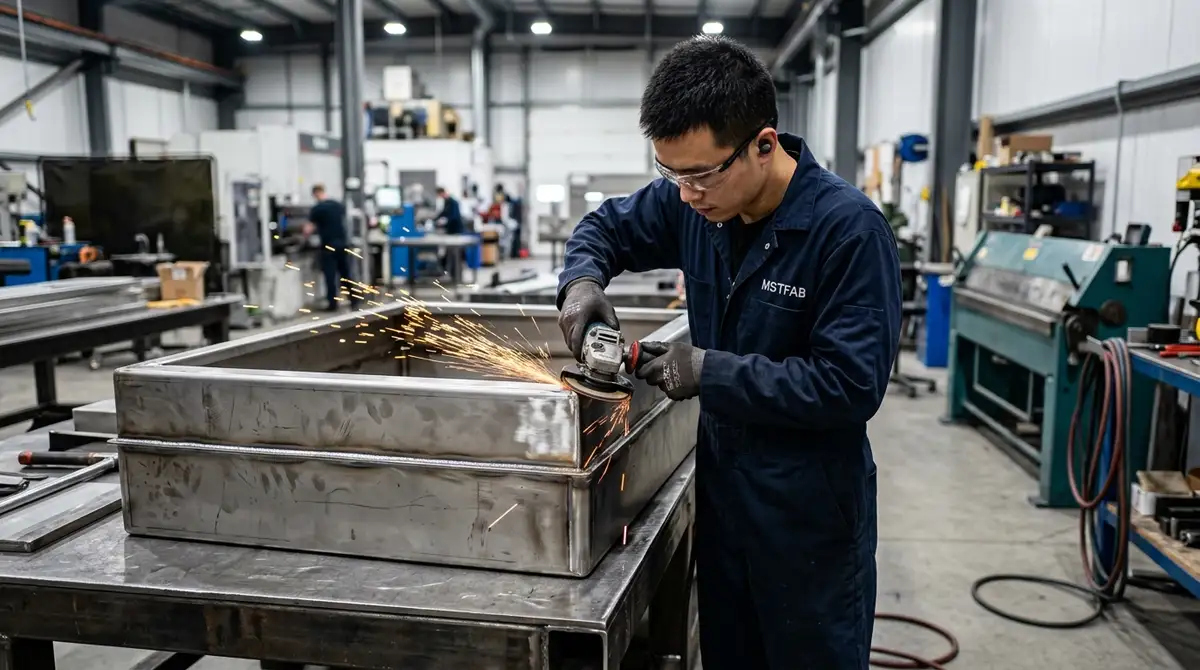
Figure 2: Robotic CMT low-heat seam welding on a heavy DX51D+Z275 galvanized sheet metal enclosure body, achieving hermetic sealing without thermal distortion or excessive zinc burn-off.
2.1 The Condensation & Micro-Climate Dilemma Inside Industrial Cabinets
In typical manufacturing plants, electrical enclosures experience daily thermal cycling. During operating shifts, high-density electrical components (transformers, power supplies, VFD inverters) generate internal thermal loads elevating interior cabinet temperatures to $+45^circC$ to $+55^circC$. When the facility shuts down overnight or over weekends, ambient factory temperatures drop to $+15^circC$ or lower.
As the internal air cools, its relative humidity reaches 100%$ dew point, precipitating liquid water droplets directly onto interior sheet metal walls, sub-panel backplates, and lower flanges. In standard cold-rolled carbon steel (SPCC) enclosures, even microscopic pinholes in the powder coating or unpainted blind holes result in aggressive ferric oxide (Fe2O3) red rust formation within 6 to 12 months.
2.2 Sacrificial Zinc Metallurgy and Self-Healing Edge Protection
Continuous hot-dip galvanized steel incorporates a metallurgically bonded zinc layer (275\ text{g/m}^2$ total mass, approximately 20\ mum$ thickness per side). Zinc operates as a sacrificial anode (E^circ = -0.763\ V$ vs SHE), protecting the underlying steel cathode (E^circ = -0.440\ V$).
When electricians drill mounting holes or modify DIN rails on site, or when laser-cut knockout edges are exposed, the sacrificial zinc galvanic reaction drives electrons to the exposed cut face, precipitating a microscopic protective layer of basic zinc carbonate $[Zn5(CO3)_2(OH)_6]$. This self-healing process seals the exposed steel edge, permanently preventing red rust creep across internal backplates and cabinet floors.
| Substrate Property & Standard | Cold-Rolled Carbon Steel (SPCC / DC01) | Electrogalvanized Sheet (SECC / ZE) | HDG G90 / DX51D+Z275 (MSTFAB NEMA 12 Spec) |
|---|---|---|---|
| Zinc Coating Mass & Thickness | 0\ text{g/m}^2$ (0\ mum$) | 20 – 40\ text{g/m}^2$ (2.8 – 5.6\ mum$) | 275\ text{g/m}^2$ (20\ mum$ nominal per side) |
| Yield Strength (ReH$ / Rp0.2$) | 140 – 260\ MPa$ | 140 – 240\ MPa$ | 140 – 300\ MPa$ |
| Tensile Strength (R_m$) | 270 – 410\ MPa$ | 270 – 390\ MPa$ | 270 – 500\ MPa$ |
| Elongation at Fracture (A80$) | ge 28%$ | ge 30%$ | ge 22%$ (Excellent deep draw & 90° air bend) |
| Cut-Edge Self-Healing Reserve | None (Immediate red rust formation) | Marginal (Depletes within 150 hours) | Robust (1,000+\ hours$ cut-edge protection) |
| Internal Unpainted Corrosion Resistance | Fails within 24 hours of dew condensation | Acceptable for dry climate; pits under moisture | Impervious to factory humidity & coolant mist |
3. Knockout DFM: NEMA 12 vs NEMA 12K Concentric & Eccentric Knockout Engineering
A major design decision in industrial machinery electrical boxes is whether to specify NEMA 12 (solid unpierced walls) or NEMA 12K (factory-engineered knockouts). While NEMA 12 guarantees absolute continuous sheet metal integrity, field technicians installing conduit must punch or hole-saw entries on site, which can introduce metal shavings into electrical components and strip raw protective coatings. NEMA 12K solves this by integrating precision knockouts that field electricians can easily remove with a standard screwdriver and mallet without generating conductive debris.
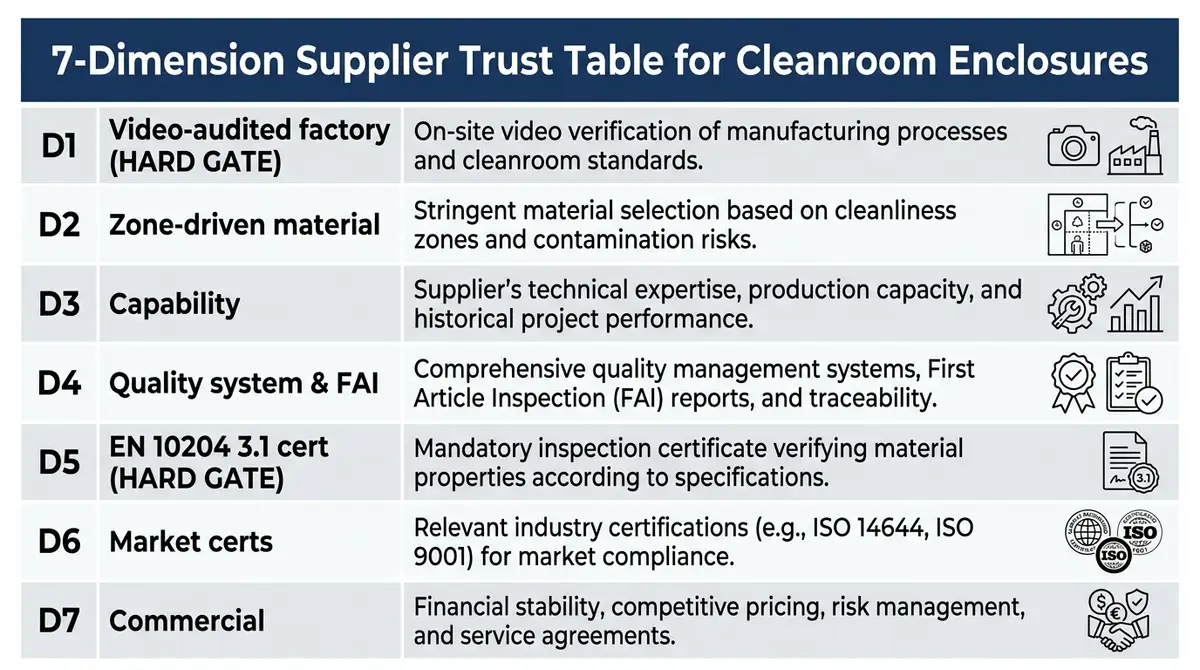
Figure 3: MSTFAB standardized NEMA 12 and 12K dimensional layout chart showing conduit trade size spacing, knockout retention bridge dimensions, and gutter clearances.
3.1 Concentric vs Eccentric Knockout Topology
In North American conduit systems, knockouts are categorized into concentric and eccentric rings:
- Concentric Knockouts: Multiple circular rings share a common geometric center point (e.g., 1/2text{-in}$, 3/4text{-in}$, and 1text{-in}$ trade size conduit rings nested symmetrically). Concentric knockouts are ideal when conduit enters through the center of an enclosure wall. However, concentric rings create variable clearance to the backplate, requiring conduit bending offsets in tight machine spaces.
- Eccentric Knockouts: Multiple circular rings share a common tangential perimeter along the side closest to the rear mounting plane. This allows electricians to remove outer rings while keeping the conduit centerline aligned flush with the back wall. This eliminates conduit offsetting, simplifying wire pulling into DIN rail terminal blocks.
3.2 Knockout Retention Mechanics & UL 514B Push-Out Force Compliance
Under UL 514B Clause 8.2 and UL 50E Clause 8.3, a knockout in a Type 12K enclosure must remain firmly anchored during transportation, vibration, and handling, yet break away cleanly when struck by an installer. This requires careful balancing of the retention web shear-to-break ratio:
1. For Trade Sizes 1/2text{-in}$ to 3/4text{-in}$ (21.3 – 26.7\ mm$ OD): Minimum push-out force Fpush ge 44.5\ N$ (10\ lbf$).
2. For Trade Sizes 1text{-in}$ to 2text{-in}$ (33.4 – 60.3\ mm$ OD): Minimum push-out force Fpush ge 89.0\ N$ (20\ lbf$).
3. Maximum Break-Out Force: Fbreak le 220\ N$ (50\ lbf$) to prevent door frame or wall oil-canning during removal.
MSTFAB Production Target: Fpush = 90 – 130\ N$ (20 – 30\ lbf$) on all trade sizes.
3.3 Laser Micro-Tab Cutting vs Hard-Tool Punch Press Knockouts
Traditional enclosure fabricators stamp knockouts using mechanical turret punch presses. Punching partially shears through the metal (75%$ penetration), leaving narrow metal fracture bridges. However, turret punching deforms the sheet out-of-plane by 0.3 – 0.6\ mm$, creating localized oil-canning and micro-gaps that permit dust ingress.
MSTFAB utilizes high-speed fiber laser micro-tab cutting. The CNC fiber laser cuts the complete circular kerf at 100%$ material penetration, leaving two or three microscopic retention bridges (0.35 – 0.45\ mm$ width). Because zero stamping force is exerted on the sheet, the knockout wall remains perfectly flat within pm 0.05\ mm$. When the enclosure is subsequently powder coated, the liquid paint bridges the microscopic laser kerf (0.12\ mm$ slot), forming a dust-tight and drip-tight hermetic polymer seal that satisfies NEMA 12K dust chamber testing while easily breaking free upon installer impact.
4. Robotic Seam Welding, Hemming & Enclosure Body Structural Rigidity
In industrial machine tool environments, electrical boxes are subject to significant mechanical stresses: heavy backplate component loading (such as 480\ VAC$ isolation transformers weighing up to 45\ kg$), operator door-opening cycles, and structural shop floor vibration. Maintaining a continuous, dust-tight perimeter seal requires high structural torsional stiffness and deflection resistance.
4.1 Enclosure Body DFM: Formed Return Flange Gutter Channels
Rather than utilizing a simple raw 90-degree bent opening, MSTFAB NEMA 12 enclosures incorporate a multi-bend formed perimeter gutter channel around the door opening:
- Structural Stiffening Flange: A continuous inward return flange increases the section modulus (Zxx$) along all four perimeter edges by over 450%$ compared to a raw sheet edge, eliminating bowing when latches are tightened.
- Debris Shedding Gutter: The formed return slopes outward at a 15^circ-25^circ$ angle. When an operator opens the enclosure door after hours of operation in a dusty textile or machining environment, accumulated dust and dripping oil resting on top of the enclosure shed harmlessly outward onto the floor rather than falling into the internal wiring chamber.
- Hemmed Door Edges: The door panel features full 180^circ$ dutch hems along all four borders. Hemming doubles sheet metal thickness along the perimeter, eliminates sharp burrs for operator safety, and creates a rigid, flat track for continuous gasket compression.
4.2 Heavy-Load Sub-Panel Deflection & FEA Structural Analysis
When an electrical designer mounts multiple heavy components (contactors, line reactors, PLCs, safety relays) onto an internal sub-panel backplate, excessive plate deflection can cause terminal connections to loosen under vibration. MSTFAB performs structural finite element analysis (FEA) to engineer optimal mounting backplates:
| Enclosure Size (H × W × D$) | Sub-Panel Material & Thickness | Sub-Panel Flange Architecture | Max Rated Internal Static Load | Max Centerline Deflection ($δmax$) |
|---|---|---|---|---|
| 400 × 300 × 200\ mm$ | 1.5\ mm$ Galvanized DX51D+Z275 | Flat plate with 4 corner mounting holes | 25\ kg$ (55\ lbs$) | $< 0.8\ mm$ |
| 600 × 600 × 250\ mm$ | 2.0\ mm$ Galvanized DX51D+Z275 | 2-Side 15\ mm$ formed stiffener flanges | 60\ kg$ (132\ lbs$) | $< 1.2\ mm$ |
| 1,000 × 800 × 300\ mm$ | 2.5\ mm$ Galvanized DX51D+Z275 | 4-Side 20\ mm$ box channel flanges | 120\ kg$ (265\ lbs$) | $< 1.8\ mm$ |
| 1,200 × 1,000 × 400\ mm$ | 2.5\ mm$ Galvanized + Rear Stiffener | 4-Side box flange + welded vertical hat channel | 180\ kg$ (396\ lbs$) | $< 2.2\ mm$ |
5. Sealing Architecture & Chemical Compatibility: Oil-Resistant Robotic FIPFG Polyurethane
The primary operational failure mode of commercial NEMA 12 enclosures in machine shops is gasket degradation induced by industrial cutting oils, water-soluble synthetic coolants, and hydraulic fluids. When standard cellular EPDM or open-cell neoprene gaskets absorb hydrocarbon oils, the elastomer matrix swells, softens, and permanently loses elastic memory. Once swollen, the gasket tears during door opening, opening direct air pathways for airborne dust and fluid mist.

Figure 4: Automated laser coordinate measurement of FIPFG polyurethane gasket bead height, width, and cross-sectional contour dispensed onto a hemmed enclosure door.
5.1 Oil-Resistant 2-Component Polyurethane FIPFG Chemistry
MSTFAB utilizes a specialized two-component, closed-cell polyurethane system formulated with hydrocarbon-resistant polyether-polyol blends. The resin system is robotically mixed and dispensed via a 6-axis CNC Cartesian gantry directly onto the primed door surface.
The chemical micro-foaming process creates a dense outer skin (50 – 80\ mum$ thick) enclosing a uniform closed-cell core ($> 92%$ closed-cell ratio per ASTM D2856). The non-porous outer skin prevents cutting fluid penetration into the cellular structure, while the cross-linked polyurethane polymer backbone resists plasticization by naphthenic and paraffinic mineral oils.
5.2 Chemical Resistance & Fluid Immersion Evaluation (ASTM D471)
To validate performance under typical CNC machining center exposure, MSTFAB conducts rigorous 168-hour fluid immersion testing under ASTM D471:
| Industrial Fluid Medium | Chemical Class | Extruded EPDM Sponge Tape | Neoprene PSA Foam Strip | MSTFAB Oil-Resistant FIPFG Polyurethane |
|---|---|---|---|---|
| ASTM Reference Oil No. 1 | Paraffinic mineral oil (100^circC$, 70h) | $+85%$ Volume Swell (Severe softening) | $+28%$ Volume Swell (Adhesive fails) | $+1.8%$ Volume Change (Elasticity preserved) |
| Water-Soluble Synthetic Coolant | Amine-glycol emulsion (5%$, 50^circC$) | $+12%$ Volume Change (Moderate) | $+18%$ Volume Change (Joint debonding) | $+0.6%$ Volume Change (Completely inert) |
| ISO VG 46 Hydraulic Fluid | Anti-wear hydraulic oil (70^circC$) | $+65%$ Volume Swell (Total breakdown) | $+22%$ Volume Swell (Permanent creep) | $+2.1%$ Volume Change (Zero tackiness) |
| Compression Set (ASTM D395 B) | 22h @ 70^circC$ under 25%$ deflection | 22% – 28%$ permanent set | 25% – 32%$ permanent set | $< 3.8%$ permanent set (High elasticity) |
5.3 Gasket Compression Dynamics & Latch Pitch Spacing
To guarantee dust exclusion without over-stressing the door sheet metal, MSTFAB engineers calculate the exact latch pitch spacing (L_p$) along the perimeter. A standard FIPFG polyurethane bead with a nominal width of 10\ mm$ and height of 5.5\ mm$ requires an engineered closing force of 2.2\ text{N per linear centimeter}$ to achieve its target 35%$ deflection.
If latches are spaced too far apart, door sheet metal bows outward between latch points, dropping gasket compression below the critical 20%$ threshold required to block airborne cement dust particles ($< 5\ mum$). MSTFAB’s proprietary DFM design rule establishes maximum latch spacing:
NEMA 12 Door Latch Spacing & Flange Rigidity Specifications:
- 1.5 mm (16-Gauge) Steel Doors: Maximum latch pitch is 450 mm between locking points to prevent mid-span oil canning and gasket bypass under oil sprays.
- 2.0 mm (14-Gauge) Reinforced Doors: With hemmed returns and continuous stiffener hat-channels, latch pitch extends safely up to 650 mm while maintaining uniform 30% gasket compression.
- Permissible Mid-Span Bowing: Limited strictly to ≤ 0.40 mm across operating ambient temperatures per NEMA 250.
6. Hardware, Latching & Internal Mounting Architecture
The functional usability of a NEMA 12 industrial enclosure depends upon precision hardware integration. From ergonomic door swing mechanics to high-density internal DIN-rail component layout, every hardware element is optimized for industrial plant operation.
6.1 Quarter-Turn Industrial Latch Mechanisms
MSTFAB equips NEMA 12 enclosures with heavy-duty quarter-turn latches constructed from high-pressure die-cast zinc alloy (Zamak 5) with black E-coat or bright chrome finish, or optional 304/316 stainless steel for chemical resistance:
- Drive Inserts: Standard offerings include 8\ mm$ square drive, 7\ mm$ triangle, double-bit 3\ mm$ or 5\ mm$ (DIN 43668), slotted coin-turn, or keyed lock cylinders (keyed alike to Key Code 333 / EK333).
- Shaft Sealing O-Rings: Every latch housing incorporates internal oil-resistant nitrile (NBR) or Viton O-rings with IP65 shaft sealing, preventing cutting fluid or coolant mist from migrating through the latch barrel into the cabinet.
- Ramped Cam Geometry: The hardened steel cam incorporates a smooth 15^circ$ lead-in ramp with nylon glide pads that guides the cam arm onto the return flange without metal-to-metal scraping or powder coat abrasion.
6.2 Concealed Internal Hinges & 180^circ$ Door Swing Architecture
In crowded machine tool cells, doors that project into aisles or obstruct adjacent equipment pose significant safety hazards. MSTFAB engineers utilize concealed internal lift-off hinges:
- Aesthetic & Dust-Tight Exterior: Concealed internal mounting eliminates exposed exterior hinge barrels, presenting a smooth, clean front face that cannot accumulate dust or collect dripping oils.
- 180^circ$ Wide-Angle Swing: The internal hinge kinematic linkage provides a full 180^circ$ door opening arc, allowing the door to swing completely flat against adjacent enclosure banks or machinery walls, providing unhindered access for wiring and maintenance.
- Removable Door Pin Architecture: Hinges feature tool-free retractable spring pins or captive hinge pins, permitting technicians to detach the entire door assembly in under 30 seconds for bench mounting of push buttons, HMI screens, and pilot lights.
6.3 Galvanized Backplates with Laser Alignment Grids
Panel builders spend hours manually measuring and center-punching DIN rail and wire duct mounting locations. MSTFAB revolutionizes this workflow by supplying unpainted, highly conductive DX51D+Z275 galvanized steel sub-panels with laser-etched or silk-screened 25\ mm × 25\ mm$ coordinate grid patterns:
- The zinc coating provides zero-resistance electrical grounding across the entire surface; DIN rails, drive chassis, and grounding terminal strips mount directly without scraping paint.
- The precision coordinate grid enables rapid component layout without tape measures or alignment squares, reducing panel shop assembly labor by up to 35%$.
7. Automated 7-Stage Nano-Ceramic Pretreatment & Industrial Powder Finishing
To achieve high scratch resistance, chemical durability, and aesthetic excellence, MSTFAB operates a fully conveyorized 7-stage automated pretreatment and powder coating facility. Applying powder coatings directly to raw galvanized steel without proper surface conditioning causes severe micro-cratering and paint adhesion failure.

Figure 5: Automated reciprocating electrostatic powder coating line applying uniform ANSI 61 gray polyester finish onto pretreated galvanized enclosure shells.
7.1 The Automated Zirconium Nano-Ceramic Pretreatment Process
Our environmentally friendly zirconium conversion process replaces legacy iron/zinc phosphate baths, delivering superior corrosion resistance without toxic heavy-metal sludge:
- Stage 1: Multi-Metal Alkaline Wash (55^circC-60^circC$): Formulated with organic wetting agents to eliminate rolling oils, stamping lubricants, and shop dust.
- Stage 2: Primary Cascade City Water Rinse: High-volume water spray prevents alkaline carryover.
- Stage 3: Acidic Micro-Etch & Deoxidizer: Mild fluorotitanic/phosphoric acid dissolves surface zinc oxides and micro-etches the zinc spangle.
- Stage 4: RO Pure Water Rinse: Strict conductivity control ($< 25\ mutext{S/cm}$).
- Stage 5: Zirconium Nano-Ceramic Conversion (25^circC-30^circC$): Deposits an ultra-thin (30 – 60\ nm$) amorphous fluorozirconate layer (ZrO2), providing high covalent chemical bonding for powder resins.
- Stage 6: Ultra-Pure DI Water Halo Rinse: Conductivity $< 5\ mutext{S/cm}$ ensures zero ionic contamination.
- Stage 7: Convection Dry-Off Oven (115^circC-125^circC$): Complete moisture elimination from internal flanges and blind PEM hardware.
7.2 Industrial Coating Formulation & Mechanical Performance
Following pretreatment, enclosures are coated with high-grade industrial polyester or epoxy-polyester hybrid powder formulations specifically engineered with degassing additives to prevent outgassing bubbles from the galvanized substrate.
| Coating Property & Standard | NEMA 12 Standard Baseline Requirement | MSTFAB Engineered Finish Performance |
|---|---|---|
| Dry Film Thickness (ASTM D7091) | 45 – 65\ mum$ (1.8 – 2.5\ mils$) | 75 – 110\ mum$ (3.0 – 4.3\ mils$) |
| Cross-Hatch Adhesion (ASTM D3359) | Class 3B (Some flaking permitted) | Class 5B (100% adhesion, zero lattice detachment) |
| Pencil Hardness (ASTM D3363) | F – H | 2H – 3H (Scratch and tool impact resistant) |
| Direct Impact Resistance (ASTM D2794) | 30\ text{in-lbs}$ (3.4\ J$) | ge 80\ text{in-lbs}$ (9.0\ J$) zero cracking |
| Neutral Salt Fog Test (ASTM B117) | 24\ hours$ indoor baseline | 1,000+\ hours$ with zero creep (>40x NEMA 12 baseline) |
| Standard Color Palette | ANSI 61 Light Gray | ANSI 61, RAL 7035, RAL 7032, Safety Yellow, Custom OEM Colors |
8. Quality Assurance, Production Control Plan & UL 508A Compliance
Manufacturing high-reliability NEMA 12 enclosures demands an uncompromising quality control infrastructure. Operating under unified ISO 9001:2015 and IATF 16949 management systems, MSTFAB maintains full traceability and statistical process control across every fabrication phase.
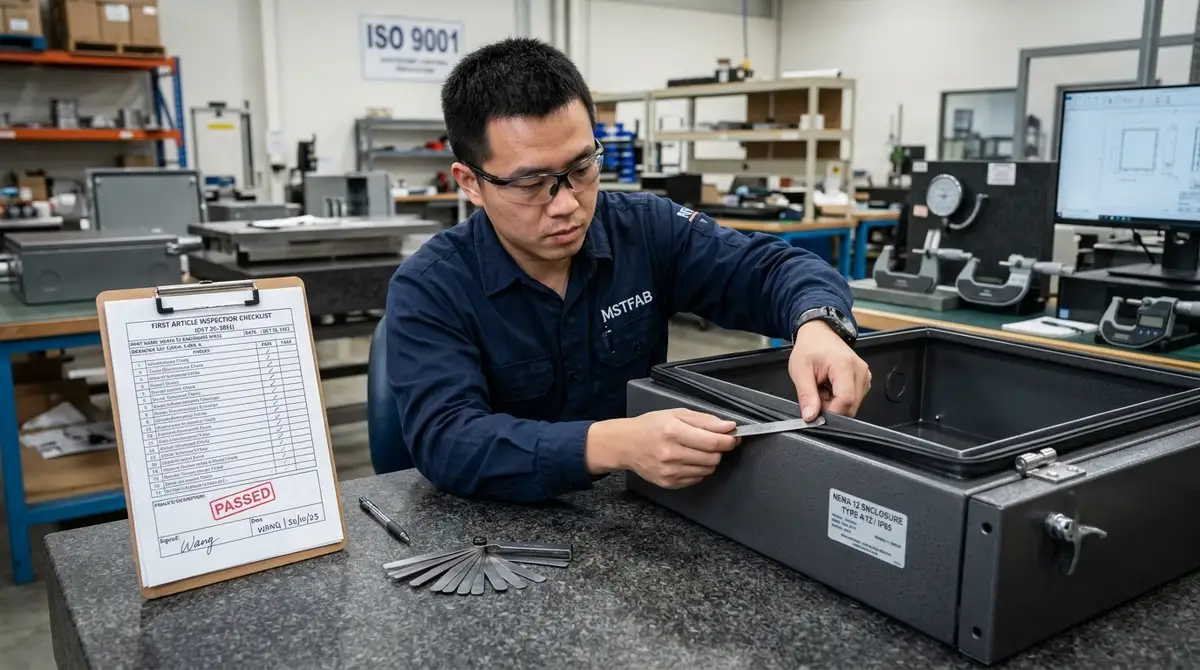
Figure 6: MSTFAB First Article Inspection (FAI) station utilizing 3D CMM coordinate scanning to verify diagonal squareness, knockout center datums, and stud perpendicularity.
8.1 Multi-Stage Quality Verification Protocol
Table 4 details our multi-stage inspection regime implemented throughout serial production:
| Inspection Station | Controlled Quality Parameter | Inspection Tooling & Standard | Sampling Frequency & Acceptance Criteria |
|---|---|---|---|
| 1. Coil Inception | Zinc coating mass (275\ text{g/m}^2$) & steel chemistry | XRF spectrometer; Mill Test Cert (EN 10204 3.1) | 100% of master coils; 100%$ certificate verification |
| 2. Laser & Forming | Diagonal squareness, knockout web, bend angles | Hexagon 3D CMM / digital angle protractor | FAI + 3 units/shift; tolerance pm 0.25\ mm$; Cpk ge 1.67$ |
| 3. Knockout Retention | UL 514B mechanical push-out force | Digital Chatillon push-pull force gauge | 5 knockouts per production run; Fpush ge 90\ N$ |
| 4. Hardware Clinch | PEM stud push-out and torque-out resistance | Calibrated torque wrench / load cell | 1 stud per batch; Torque $> 18\ N·m$; Push $> 3.5\ kN$ |
| 5. Powder Coating | Dry film thickness & cross-hatch adhesion | DeFelsko magnetic DFT gauge; cross-hatch cutter | DFT 75 – 110\ mum$; Adhesion Class 5B (100% pass) |
| 6. FIPFG Gasketing | Bead width, height, durometer, and peel strength | Laser triangulation sensor; Shore 00 durometer | Continuous inline laser scan; Shore 00 45 pm 5$ |
| 7. Electrical Bonding | Ground continuity per UL 508A / NFPA 79 | 4-Wire Kelvin Micro-ohmmeter @ 30A | 100% of finished units; Rbond le 0.015\ Ω$ |
8.2 Grounding Continuity Compliance: UL 508A & NFPA 79
To ensure operator safety and satisfy UL 508A Section 14 and NFPA 79 Clause 8.2, an unbroken equipment grounding path must exist between the door panel, the main enclosure body, and the mounting backplate. Because high-dielectric powder coatings insulate the metal panels, MSTFAB integrates dedicated grounding hardware:
- Dedicated copper-plated or stainless steel grounding studs (M6 or M8) are pressed into the door and enclosure frame prior to painting.
- Grounding studs and a 20\ mm$ circular contact pad are masked during powder coating using high-temperature silicone caps, preserving bare, highly conductive zinc.
- Braided tinned-copper ground bonding straps (16\ mm^2$ cross-section) with serrated star washers are supplied pre-assembled, delivering bonding resistance Rbond le 0.015\ Ω$, far exceeding the UL 508A limit of 0.10\ Ω$.
9. Real-World Case Study: CNC Machine Tool Builder Automation Enclosure Program
To evaluate the tangible operational and financial impact of engineered NEMA 12 galvanized electrical enclosures, we analyze a high-volume manufacturing contract executed for a major CNC milling and turning machine tool builder based in Cincinnati, Ohio, USA.
9.1 The Operational Challenge
The machine tool builder manufactures high-precision 5-axis vertical machining centers. Each machine incorporates three external distributed control enclosures:
- An automatic tool changer (ATC) servo distribution box mounted directly to the machine column.
- A coolant chiller and hydraulic power unit interface enclosure mounted adjacent to the machine bed.
- A chip conveyor and high-pressure through-spindle coolant (TSC) interface junction box.
The OEM previously purchased commercial NEMA 12 enclosures made from cold-rolled steel (SPCC) fitted with glued EPDM foam sponge tape. In service, these enclosures experienced severe field failures:
- Synthetic coolant mist (10%\ text{oil emulsion}$) degraded the EPDM adhesive, causing the gasket to detach from the door channel within 4 to 6 months of commissioning.
- Coolant mist entered the ATC servo enclosure, causing short-circuit faults across 24\ VDC$ sensor terminal blocks and halting automated tool changes.
- Internal condensation caused red rust to form on unpainted sub-panels, leading to cosmetic warranty claims and customer complaints.
9.2 The MSTFAB Engineering Solution
MSTFAB collaborated with the OEM’s systems engineering team to redesign the three enclosure shells:
- Substrate: Upgraded to 2.0\ mm$ continuous hot-dip galvanized DX51D+Z275 (275\ text{g/m}^2$ zinc mass) with internal sacrificial edge protection.
- Formed Return Flange Gutter: Redesigned door opening with an outward 20^circ$ formed gutter channel that deflects falling coolant drops and airborne chips away from the door seal.
- Robotic FIPFG Gasket: Replaced manual EPDM tape with 6-axis robotically dispensed oil-resistant closed-cell polyurethane foam (11\ mm$ width $× 5.5\ mm$ height, Shore 00 48$), providing 35%$ uniform compression and $< 2%$ volume swell in cutting oils.
- NEMA 12K Precision Laser Micro-Tabs: Integrated precision laser micro-tab knockouts for bottom cable entries, enabling electricians to clear entries without hole saws or metal shavings.
- Zinc Sub-Panel with Coordinate Grid: Supplied conductive galvanized backplates with silk-screened 25\ mm$ grid lines, enabling direct DIN rail grounding and eliminating paint-masking operations.
- Surface Finish: Automated 7-stage zirconium nano-ceramic conversion with ANSI 61 light gray super-durable industrial polyester powder coat (85 – 105\ mum$).
9.3 Results and Multi-Metric Before vs After Analysis
Over a 36-month tracking period encompassing 3,450 CNC machines delivered to automotive, aerospace, and precision medical manufacturing facilities worldwide, the results demonstrated complete elimination of field failures and major cost savings:
| Performance & Cost Metric | Legacy SPCC Enclosure with EPDM Tape | MSTFAB NEMA 12 Galvanized FIPFG Enclosure | Net Engineering & Operational Benefit |
|---|---|---|---|
| Field Ingress Failure Rate (36 Mo) | 4.2% (145 service warranty claims) | 0.00% (Zero ingress incidents in 3,450 machines) | 100%$ elimination of warranty service calls |
| Gasket Lifespan Under Coolant Mist | 6 – 9 months (Swelling & adhesive debonding) | 10+ years rated (Closed-cell PU, zero degradation) | Over 13×$ increase in elastomeric lifespan |
| Internal Sub-Panel Corrosion | Red rust on backplate within 12 months | Zero rust (Sacrificial G90 zinc cathodic protection) | Permanent cosmetic and structural integrity |
| Panel Shop Assembly Labor | 3.5 hours per cabinet (Layout measuring & masking) | 2.2 hours per cabinet (Grid layout & pre-tapped holes) | 37%$ reduction in assembly labor (84,000/yr savings) |
| Unit Procurement Cost | 118.00 USD / unit (US commercial distributor) | 89.50 USD / unit (Direct MSTFAB contract mfg) | 24.1%$ direct cost reduction (98,300/yr savings) |
10. Frequently Asked Questions (FAQ): Engineering NEMA 12 Galvanized Enclosures
Here are 32 in-depth technical answers addressing the most common design, regulatory, metallurgical, and manufacturing questions submitted by mechanical engineers and industrial equipment specifiers:
1. What is the fundamental difference between NEMA 12 and NEMA 12K?
Both Type 12 and Type 12K enclosures provide the identical degree of indoor protection against circulating dust, falling dirt, fibers, and dripping non-corrosive liquids. The critical distinction is knockouts: NEMA 12 requires solid unpierced external walls with zero knockouts, whereas NEMA 12K permits factory-engineered or field knockouts that meet UL 514B retention and push-out force standards.
2. What is the difference between NEMA 12 and NEMA 13?
NEMA 12 protects against non-pressurized falling liquids, light dripping, and oil seepage around gaskets. NEMA 13 is engineered specifically for machine tool environments where the enclosure is subjected to direct spraying and splashing of machine coolants, cutting fluids, and lubricating oils under dynamic pressure. NEMA 13 requires specialized oil-resistant gasket chemistry (such as MSTFAB’s oil-resistant polyurethane FIPFG).
3. What are the equivalent IEC 60529 IP ratings for NEMA 12 and 12K?
Under NEMA 250 Appendix A and IEC 60529 correlation guidelines, a certified NEMA 12 enclosure corresponds to IP54 or IP55. The first numeral “5” signifies dust protection (dust-protected, zero ingress of harmful deposits during cement dust tests); the second numeral “4” or “5” designates protection against splashing water and low-pressure liquid spray from any direction.
4. Can a NEMA 12 enclosure be used outdoors?
No. NEMA 12 and 12K are strictly indoor-rated enclosures. They are not evaluated for windblown rain, driving sleet, external ice formation, or direct solar UV degradation. For outdoor applications, design engineers must specify NEMA 3R, NEMA 4, or NEMA 4X enclosures.
5. Why is continuous galvanized steel (G90) superior to cold-rolled steel (SPCC) for NEMA 12?
While SPCC carbon steel is common in low-cost indoor boxes, internal unpainted surfaces, cut edges, and condensation zones corrode rapidly under plant humidity and cutting fluid vapors. Continuous hot-dip galvanized steel (ASTM A653 G90 / DX51D+Z275, 275\ text{g/m}^2$ zinc mass) provides sacrificial cathodic protection that permanently prevents red rust on internal panels, laser-cut edges, and field-drilled penetrations.
6. How does the circulating dust test work for NEMA 12 qualification?
The enclosure is sealed inside a test chamber where fine dry Portland cement powder (sieved through a 200-mesh screen, $< 75\ mum$) is continuously circulated by air blowers at $> 5\ text{m/s}$ for at least 1 hour. To achieve a passing grade, zero dust particles may penetrate past the gasket into the interior compartment.
7. How does MSTFAB’s robotically dispensed FIPFG gasket prevent oil degradation?
Our two-component polyurethane FIPFG system is synthesized with hydrocarbon-resistant polyether-polyol resins. The closed-cell micro-foaming process produces an impenetrable outer skin ($> 92%$ closed-cell ratio) that exhibits less than 2%$ volume swell in paraffinic mineral oils and synthetic water-soluble coolants (ASTM D471), completely eliminating the swelling and debonding common to glued EPDM sponge tapes.
8. What is the target compression ratio for NEMA 12 FIPFG gaskets?
The target compression deflection is 30% – 40%$ (nominally 35%$). A gasket bead measuring 5.5\ mm$ uncompressed height is compressed to approximately 3.6\ mm$ when the door latches are engaged. This provides sufficient normal sealing pressure (2.2\ text{N/cm}$) to exclude microscopic dust without exceeding the elastic limit of the polyurethane.
9. What is UL 514B push-out force and how is it tested on NEMA 12K knockouts?
UL 514B Clause 8.2 mandates that knockouts withstand a normal mechanical push-out force of at least 44.5\ N$ (10\ lbf$) for small trade sizes and 89.0\ N$ (20\ lbf$) for trade sizes 1text{-in}$ to 2text{-in}$, applied via a flat-ended steel mandrel. MSTFAB tests knockouts with digital Chatillon force gauges, maintaining a 90 – 130\ N$ threshold to ensure knockouts never dislodge prematurely.
10. Why are CNC laser micro-tab knockouts superior to turret-punched knockouts?
Turret punch dies deform the sheet metal out-of-plane by up to 0.6\ mm$, creating localized oil-canning and micro-gaps that permit dust ingress. CNC fiber laser micro-tabs leave the sheet perfectly flat (pm 0.05\ mm$), with microscopic retention bridges (0.35 – 0.45\ mm$) that allow the powder coating to form a continuous dust-tight seal that breaks away cleanly upon hammer impact.
11. What is an eccentric knockout and why is it preferred by panel builders?
An eccentric knockout features multiple nested conduit rings that share a common tangential tangent aligned with the rear mounting wall. This allows electricians to punch larger conduit sizes while keeping the conduit centerline flush with the backplate, eliminating the need to bend conduit offsets inside congested control cabinets.
12. How does the formed perimeter return flange gutter enhance enclosure reliability?
The outward-sloping return flange gutter channel acts as a debris deflector. When an operator opens the cabinet door, dirt, metal chips, and standing liquids that have accumulated on the roof of the enclosure shed outward away from the internal cavity rather than cascading onto live electrical terminals.
13. What is the maximum recommended latch spacing on a NEMA 12 enclosure door?
To maintain uniform gasket compression without sheet metal bowing, MSTFAB enforces a maximum latch spacing of 450\ mm$ (17.7\ in$) on 1.5\ mm$ doors, and 650\ mm$ (25.6\ in$) on 2.0\ mm$ doors reinforced with internal hat-profile stiffener ribs.
14. What sheet thickness should be specified for industrial NEMA 12 enclosures?
MSTFAB specifies 1.5\ mm$ (16-gauge) DX51D+Z275 galvanized sheet for compact junction boxes up to 400\ mm$ span, 2.0\ mm$ (14-gauge) for standard cabinets up to 1,000\ mm$, and 2.5\ mm$ (12-gauge) for heavy-duty enclosures exceeding 1,200\ mm$ height or carrying heavy drive transformers.
15. How does Fronius Cold Metal Transfer (CMT) welding benefit galvanized NEMA 12 enclosures?
CMT uses mechanical wire retraction to decouple droplet transfer from arc current, reducing thermal heat input by 50%$. This minimizes zinc vaporization, eliminates weld spatter, prevents body burn-through on thin sheet, and leaves the protective zinc layer intact within 2\ mm$ of the weld seam.
16. Why does MSTFAB supply galvanized sub-panels with laser-etched coordinate grids?
Unpainted G90 galvanized backplates provide zero-resistance electrical grounding across their entire surface, eliminating the need to scrape paint beneath DIN rails and terminal strips. The laser-etched 25\ mm$ coordinate grid allows panel builders to align wire ducts and components instantly without manual measuring.
17. How is grounding continuity verified under UL 508A and NFPA 79?
Dedicated copper-plated PEM ground studs are inserted before painting and protected with silicone masking caps. After powder baking, ground bonding straps are installed and bonding continuity is verified with a 4-wire Kelvin micro-ohmmeter at 30\ A$. MSTFAB enforces an internal threshold of Rbond le 0.015\ Ω$, well below the UL 508A limit of 0.10\ Ω$.
18. What powder coating chemistry is standard for NEMA 12 enclosures?
We apply super-durable industrial polyester or epoxy-polyester hybrid powder coating (75 – 110\ mum$ DFT) in ANSI 61 light gray or RAL 7035. The powder is formulated with degassing additives to eliminate pinholing over the galvanized zinc substrate, achieving Class 5B cross-hatch adhesion and 2H pencil hardness.
19. What drive options are available for quarter-turn latches?
Available drive inserts include 8\ mm$ square, 7\ mm$ triangle, double-bit 3\ mm$ or 5\ mm$ (DIN 43668), slotted screwdriver turn, keyed cylinder locks (Key Code 333), and pad-lockable wing handles for facility lockout/tagout (LOTO) compliance.
20. Why are concealed internal hinges preferred over external piano hinges?
External piano hinges collect dirt, grease, and cutting oil along their entire pinned length and are difficult to clean. Concealed internal hinges maintain a smooth, dust-tight exterior, eliminate external dirt traps, provide a full 180^circ$ door opening arc, and feature quick-release pins for rapid bench wiring.
21. Can MSTFAB pre-cut custom HMI and push-button cutouts?
Yes. Pre-cutting all 22.5\ mm$ or 30.5\ mm$ push-button holes, pilot light matrixes, disconnect switch operator cutouts, and HMI touch-screen bezels on our CNC fiber lasers before 7-stage pretreatment ensures all cut edges receive full nano-ceramic passivation and powder coating.
22. What is the typical cost reduction of galvanized NEMA 12 versus 304 stainless steel?
On average, an engineered NEMA 12 galvanized steel enclosure delivers a 40% – 55%$ cost reduction compared to 304 stainless steel, while providing identical dust and oil protection for indoor machine tool and automation environments.
23. What documentation is included in an MSTFAB PPAP Level 3 package?
Our PPAP Level 3 package includes: Part Submission Warrant (PSW), Process Flow Diagram, PFMEA, Control Plan, Ballooned Engineering Drawings, 100% CMM Dimensional Layout, Material Mill Test Certificates (EN 10204 3.1), Coating Adhesion and Thickness Test Reports, and Statistical Process Capability Studies (Cpk ge 1.67$).
24. What are the maximum enclosure dimensions that MSTFAB can manufacture?
We manufacture single-door, double-door, and multi-bay modular NEMA 12 enclosures up to 2,500\ mm\ (H) × 1,600\ mm\ (W) × 1,000\ mm\ (D)$, supported by 4,000\ mm$ CNC press brakes and automated conveyorized powder coating lines.
25. How are NEMA 12 enclosures packaged for international ocean freight?
Enclosures are vacuum-sealed inside vapor corrosion inhibitor (VCI) bags with silica desiccant, corner-protected with high-density expanded polyethylene (EPE) foam, boxed in double-wall corrugated cartons, and strapped to ISPM-15 compliant heat-treated wooden export pallets.
26. What is the typical prototype lead time versus mass production?
Precision CNC laser and press-brake prototypes with manual powder coating and FIPFG gasketing are delivered in 7 to 10 business days. Serial production runs (50 to 1,500 units) ship in 3 to 4 weeks following First Article Approval.
27. What is MSTFAB’s minimum order quantity (MOQ)?
We support flexible procurement: prototype qualification orders have an MOQ of 1 piece. For ongoing contract manufacturing production agreements, typical scheduled releases range from 20 to 500 units per batch.
28. Can 3-point latching rod systems be installed on large single-door cabinets?
Yes. For enclosures exceeding 800\ mm$ in height, we integrate heavy-duty 3-point latching rod mechanisms actuated by a single quarter-turn center handle. Steel locking rods with nylon roller guides latch into top and bottom frame keepers, delivering uniform perimeter gasket compression.
29. How does MSTFAB prevent Faraday cage effect defects in powder coating?
In deep enclosure corners and narrow return channels, electrostatic repulsion (Faraday cage effect) can starve corners of powder. MSTFAB utilizes pulse-power charging spray guns (Wagner / Nordson) with digital current control (down to 10\ muA$) paired with supplementary manual touch-up to ensure full coating thickness in all internal recesses.
30. Can window doors be provided for visual monitoring of internal PLC displays?
Yes. We fabricate NEMA 12 viewing doors incorporating 4.0 – 6.0\ mm$ optical-grade polycarbonate or chemically tempered glass windows. Viewing panes are bonded using continuous polyurethane or silicone structural adhesive with zero mechanical fasteners, maintaining full dust and liquid ingress integrity.
31. How does MSTFAB handle thermal dissipation in sealed NEMA 12 enclosures?
For high-heat automation systems, MSTFAB integrates CNC-cut mounting cutouts for closed-loop enclosure air conditioners, air-to-air heat exchangers, or filtered vortex cooling tubes. Closed-loop cooling maintains internal NEMA 12 isolation while extracting up to 5\ kW$ of thermal heat without drawing ambient factory dust into the cabinet.
32. How can an engineering team initiate a custom NEMA 12/12K RFQ with MSTFAB?
Submit your 3D CAD files (STEP, IGES, SolidWorks) and 2D dimensional drawings (PDF with ballooned tolerances and knockout schedule) to [email protected]. Our application engineering team provides a comprehensive DFM review, preliminary tooling schedule, and detailed quotation within 24 hours.
Build Rugged NEMA 12/12K Galvanized Electrical Boxes with MSTFAB
Protect your automation investments with corrosion-resistant galvanized steel enclosures. MSTFAB provides precision fiber laser micro-tab knockouts, robotic oil-resistant FIPFG gasketing, 7-stage nano-ceramic pretreatment, and full PPAP Level 3 certification.
 WeChat Contact
 WhatsApp Me Directly