From robust industrial machinery base frames, heavy hydraulic reservoirs, and electrical power distribution cabinets to high-volume telecommunication racks, mounting brackets, and chassis enclosures, mild steel sheet metal fabrication services represent the workhorse backbone of global mechanical and structural manufacturing. Offering an unbeatable combination of high tensile strength, exceptional ductility, superior weldability, and raw material cost-efficiency, carbon steel alloys deliver maximum structural rigidity per dollar invested. As an ISO 9001:2015 certified contract manufacturer, MSTFAB provides end-to-end mild steel manufacturing—from high-speed fiber laser cutting with high-pressure nitrogen to CNC press brake forming, robotic MIG/TIG welding, automated hardware clinching, and Class A electrostatic powder coating.
Table of Contents
- 1. Metallurgy of Carbon Steel: Cold-Rolled (SPCC) vs. Hot-Rolled Pickled & Oiled (HRPO)
- 2. Thermal Cutting Technologies: Fiber Laser (Oxygen vs. Nitrogen) and High-Definition Plasma
- 3. CNC Press Brake Forming: Plastic Deformation, K-Factors, and Bend Allowances
- 4. Welding & Joining: Robotic GMAW/MIG, GTAW/TIG, Resistance Spot Welding, and Distortion Control
- 5. Fastening Technologies: Extruded Tapped Collars, Clinch Hardware (PEM), and Weld Studs
- 6. Surface Pretreatment & Corrosion Protection: Iron Phosphate, E-Coat, Zinc Plating, and Powder Coating
- 7. Critical DFM Rules for Mild Steel Sheet Metal Assemblies
- 8. Quality Metrology: CMM Probing, Weld Macro-Etching, and Adhesion Testing
- 9. Comprehensive Engineering Data Matrices and Manufacturing Benchmarks
- 10. Real-World OEM Case Studies: Structural Validations
- 11. Frequently Asked Technical Questions (36 Detailed Engineering Q&As)
1. Metallurgy of Carbon Steel: Cold-Rolled (SPCC) vs. Hot-Rolled Pickled & Oiled (HRPO)
Carbon steels are iron-carbon alloys where carbon content ranges from 0.05% to 2.1% by weight. In precision sheet metal fabrication, mild steel (also called low-carbon steel) contains between 0.05% and 0.25% carbon. This low carbon level ensures exceptional ductility, high fracture toughness, and superior weldability without the risk of brittle martensitic transformation during rapid cooling. Selecting the correct steel specification is the first step in optimizing component cost, dimensional precision, and aesthetic finish:
1. Cold-Rolled Commercial Steel (SPCC / ASTM A1008 CS Type B / DC01 per EN 10130)
Cold-rolled sheet steel is produced by taking hot-rolled pickled coil and rolling it below its recrystallization temperature at room temperature, followed by annealing and skin-pass rolling. This process yields:
- Tight Gauge Tolerances: Thickness variations held strictly within +/- 0.03 mm to +/- 0.05 mm across the entire coil width.
- Superior Class A Surface: A smooth, matte, scale-free surface finish (Ra approx 0.6 um to 1.2 um), making it the premier substrate for high-gloss powder coating, silk-screening, and precision electronic enclosures.
- Formability & Yield Behavior: Yield strength typically ranges from 140 to 240 MPa with elongation at break exceeding 28% to 38%, allowing sharp inside bend radii (R = 0.5 * T) without cracking.
- Thickness Availability: Typically manufactured in thicknesses ranging from 0.5 mm to 3.2 mm (24 gauge to 10 gauge).
2. Hot-Rolled Pickled & Oiled Steel (SPHC / ASTM A1011 HRPO / DD11 per EN 10111)
Hot-rolled steel is rolled above its recrystallization temperature (approx 1100 deg C). As the steel cools in air, oxygen reacts with hot iron to create a tough, brittle iron oxide scale (mill scale: FeO, Fe3O4, Fe2O3) up to 20 microns thick. In HRPO processing, the mill scale is chemically dissolved in an automated hydrochloric acid pickling bath, rinsed, and coated with a light mineral oil film to prevent flash rusting:
- Cost Efficiency: Approximately 15% to 25% lower raw material cost than cold-rolled steel, especially in heavier gauges.
- Structural Applications: HRPO is the standard specification for structural chassis, heavy mounting brackets, equipment bases, and agricultural implements from 2.0 mm up to 12.0 mm thick.
- Surface Quality: While free of mill scale, HRPO exhibits a slightly rougher surface texture (Ra approx 2.0 um to 3.5 um) and wider thickness tolerances (+/- 0.10 mm to +/- 0.20 mm) compared to cold-rolled sheet.
3. High-Strength Low-Alloy (HSLA) Steels (Q345B / ASTM A572 Grade 50 / S355JR)
When structural assemblies require higher load-bearing capacity without increasing plate thickness and overall equipment weight, MSTFAB fabricates micro-alloyed HSLA steels containing trace additions of niobium, vanadium, and titanium. Offering a minimum yield strength of 345 to 355 MPa (approx 50% stronger than standard mild steel), HSLA steels allow engineers to down-gauge sheet metal by 20% to 30% while maintaining identical structural deflection limits.

Figure 1: MSTFAB precision manufacturing: comprehensive assembly of custom mild steel sheet metal brackets, structural base frames, and equipment enclosures ready for export.
2. Thermal Cutting Technologies: Fiber Laser (Oxygen vs. Nitrogen) and High-Definition Plasma
Precision blanking is the critical upstream process governing downstream forming accuracy and edge weldability. MSTFAB operates high-power CNC fiber laser cutting systems (6 kW to 20 kW) and high-definition underwater plasma systems to process mild steel plate up to 25 mm thick.
Fiber Laser Cutting: Oxygen Assist Gas vs. High-Pressure Nitrogen
The choice of assist gas during laser cutting fundamentally alters the chemical and metallurgical properties of the cut edge:
1. Oxygen Assist Gas Cutting (Exothermic Combustion)
When oxygen (O2) is introduced at low pressure (0.5 to 2.5 bar), it reacts exothermically with molten iron: Fe + 0.5 O2 -> FeO (Delta H = -267 kJ/mol). This exothermic chemical reaction generates up to 60% of the total thermal cutting energy, allowing lower-power lasers to slice through heavy carbon steel plate (up to 25 mm) with relatively low gas consumption.
- The Critical Laser Oxide Layer Problem: The oxygen reaction leaves a thin, brittle black iron oxide (magnetite, Fe3O4) recast layer (10 to 25 microns thick) adhering to the cut edge. If an OEM attempts to powder coat or paint directly over an oxygen-cut edge, the brittle oxide layer will fracture and delaminate under environmental humidity or mechanical impact, taking the powder coating with it!
- Oxide Removal: Oxygen-cut edges must undergo secondary edge-rounding and mechanical deoxidation (vibratory deburring or rotary wire descaling) prior to finishing.
2. High-Pressure Nitrogen Assist Gas Cutting (High-Purity Inert Vaporization)
To deliver ready-to-finish components without secondary descaling, MSTFAB deploys high-power fiber lasers utilizing high-pressure nitrogen gas (18 to 25 bar). Nitrogen is chemically inert and does not react with molten steel; it functions purely as a mechanical kinetic jet that instantly expels molten metal from the kerf.
- 100% Oxide-Free Cut Edges: The resulting cut edge displays a brilliant, bare-metal silver finish completely free of iron oxide. Powder coating applied directly onto nitrogen-cut edges achieves 100% molecular bonding and passes 1,000+ hour ASTM B117 salt spray testing with zero edge peeling.
- Superior Weldability: Nitrogen-cut edges can be directly robotic MIG or TIG welded without creating internal porosity or weld puddle slag contamination.

Figure 2: Fiber laser cutting: processing heavy mild steel plate with automated high-pressure nitrogen assist to deliver 100% oxide-free, ready-to-weld edges.
3. CNC Press Brake Forming: Plastic Deformation, K-Factors, and Bend Allowances
Mild steel is widely celebrated in manufacturing for its forgiving, predictable plastic deformation characteristics. When stressed past its yield point, carbon steel undergoes uniform plastic flow with minimal localized necking. However, achieving precise flange lengths and angular repeatability (+/- 0.25 deg) requires calibrated K-factor modeling and active deflection compensation.
Empirical K-Factors and Bend Deduction for Mild Steel
The K-factor represents the depth of the neutral axis relative to material thickness (K = t_neutral / T). For standard CNC air bending of mild steel across typical V-die ratios (V = 6 * T to 8 * T), the neutral axis settles at K = 0.42 to 0.44:
Bend Allowance (BA) = pi * (theta / 180) * (R + K * T)
Bend Deduction (BD) = 2 * (R + T) * tan(theta / 2) – BA
For a standard 90-degree bend (theta = 90 deg) on 2.0 mm SPCC cold-rolled steel using an inside bend radius R = 2.0 mm and K = 0.42:
- BA = 3.14159 * (90 / 180) * (2.0 + 0.42 * 2.0) = 1.5708 * 2.84 = 4.46 mm
- BD = 2 * (2.0 + 2.0) * tan(45 deg) – 4.46 mm = 8.00 – 4.46 = 3.54 mm
Minimum Bend Radii and Grain Orientation
While mild steel is ductile, bending with an excessively sharp punch radius (R < 0.5 * T) concentrates tensile strains in the outer fibers, causing surface micro-fissuring and visible orange-peel roughness. MSTFAB recommends maintaining minimum inside bend radii:
- SPCC Cold Rolled: R_min = 0.5 * T to 1.0 * T
- SPHC / HRPO Mild Steel: R_min = 1.0 * T to 1.5 * T
- ASTM A36 / Q235B Plate: R_min = 1.2 * T to 2.0 * T
- Grain Direction Alignment: When sheet metal coils are cold-rolled, ferrite-pearlite grains elongate parallel to the rolling direction. Bending perpendicular (transverse) to the rolling grain allows the tightest radii without cracking. Bending parallel (longitudinal) to the grain increases cracking risk and amplifies springback variations by up to 35%. MSTFAB CAD/CAM nesting software automatically aligns critical bends transverse to grain lines.

Figure 3: CNC forming: bending heavy carbon steel brackets with multi-axis CNC backgauges and real-time hydraulic crowning to maintain tight angular tolerances.
4. Welding & Joining: Robotic GMAW/MIG, GTAW/TIG, Resistance Spot Welding, and Distortion Control
Mild steel is the most readily weldable engineering metal, exhibiting zero preheat requirements for thicknesses up to 20 mm under standard ambient conditions. MSTFAB operates manual and 6-axis robotic welding cells configured for precision and aesthetic joint finishing:
1. Robotic GMAW / MIG Welding
Gas Metal Arc Welding is the primary production method for structural frames, chassis enclosures, and heavy brackets. We utilize premium solid copper-coated welding wire (AWS A5.18 ER70S-6) containing elevated levels of silicon and manganese deoxidizers, paired with a shielding gas blend of 82% Argon / 18% CO2. This mixture produces a stable spray-transfer arc with minimal spatter, deep weld penetration, and tensile strengths exceeding 500 MPa.
2. GTAW / TIG Welding for Cosmetic Enclosures
For visible seams on electronic enclosures, medical console shells, and sanitary machinery covers, TIG welding with 100% pure argon shielding gas produces flawless, ripple-free weld beads. Autogenous corner welds can be dressed down flat with pneumatic graining discs, creating seamless, invisible corner transitions that disappear completely beneath powder coating.
3. Automated Resistance Spot Welding (RSW)
Spot welding joins overlapping sheet metal flanges in milliseconds without filler metal or consumable gas. Mild steel’s moderate electrical resistivity and thermal conductivity make it the ideal spot-welding candidate. MSTFAB maintains certified nugget diameters exceeding the standard AWS D8.9 requirement (d_n >= 5 * sqrt(T)), ensuring shear strengths that exceed the parent metal yield point.
Controlling Thermal Distortion in Welded Steel Assemblies
Because steel has a thermal expansion coefficient of alpha = 12 * 10^-6 / deg C, localized welding heat creates steep thermal gradients. As the molten weld puddle freezes and cools, longitudinal shrinkage forces (F_shrink = sigma_yield * A_weld) cause angular distortion, bowing, and racking of welded frames. MSTFAB mitigates thermal distortion through four proven manufacturing controls:
- Rigid Hydraulic & Pneumatic Fixturing: Precision-machined welding jigs clamp the workpiece firmly along neutral axes, restraining angular movement during thermal cycles.
- Symmetrical and Back-Step Welding Sequences: Welders alternate weld passes across opposing sides of the structural neutral axis, allowing opposing shrinkage forces to cancel each other out.
- Pre-Cambering: Pre-forming or shimming components slightly out of square in the opposing direction prior to welding, so that thermal contraction pulls the assembly into exact 90-degree squareness upon cooling.
- Pulsed Robotic Welding: High-frequency pulsed arc control lowers total heat input by 25% to 35% compared to conventional continuous spray transfer, drastically reducing heat-affected zone (HAZ) distortion.

Figure 4: Robotic welding cell: executing automated multi-pass MIG welds on a carbon steel frame chassis with dedicated clamping fixtures to eliminate thermal distortion.
5. Fastening Technologies: Extruded Tapped Collars, Clinch Hardware (PEM), and Weld Studs
Modern precision sheet metal enclosures require rapid, reusable threaded connections. MSTFAB offers three primary fastening methods optimized for mild steel substrates:
1. CNC Formed Extruded Tapped Holes (Extrusion Tapping)
In thin sheet metal (1.0 mm to 2.5 mm), a standard tapped hole provides only 1 to 2 thread pitches, which strip easily under nominal fastener torque. Rather than adding expensive weld nuts, MSTFAB uses a specialized punching or rotary friction-form tool to draw the sheet downward into a cylindrical collar, followed by cold-form thread tapping:
- Thread Engagement Multiplier: Increases effective material thickness by 2.5x to 3.0x. For example, a 1.2 mm SPCC sheet yields a 3.2 mm deep collar, providing 4 to 5 full pitches of M4 or M5 thread.
- Cost Savings: Completely eliminates loose hardware purchasing, feeding, and secondary welding operations, reducing unit assembly costs by up to 35%.
2. Self-Clinching Hardware (PEM Fasteners)
Self-clinching nuts, studs, and standoffs are permanently pressed into laser-cut holes using automated Haeger insertion presses. When the installation punch descends, sheet metal cold-flows into the fastener’s undercut annular groove and serrated knurl, locking the hardware against push-out and rotational spin-out. Because mild steel is ductile and typically exhibits a hardness of HRB 50 to 65, standard hardened carbon steel PEM fasteners (Rockwell hardness > HRB 80) seat with exceptional mechanical retention.
3. Capacitor Discharge (CD) Weld Studs
For applications where exterior fastener heads or clinch impressions are unacceptable on cosmetic front panels, CD stud welding attaches threaded steel studs to the rear surface in milliseconds. The high-energy discharge melts the stud base and sheet surface without burning through or discoloring the opposite Class A cosmetic face.
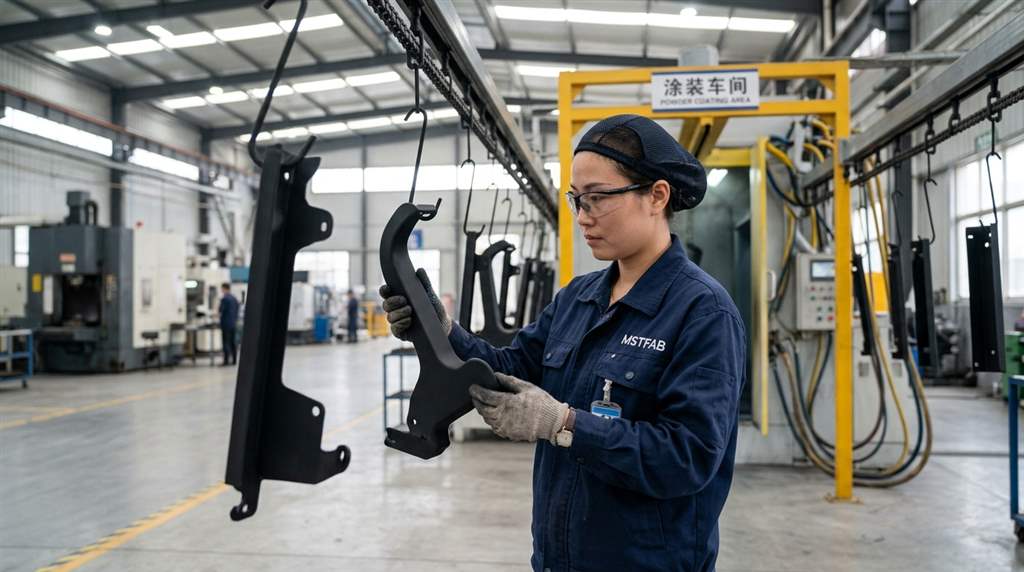
Figure 5: Advanced finishing: automated electrostatic powder coating line applying durable, UV-resistant polyester finish over pretreated mild steel assemblies.
6. Surface Pretreatment & Corrosion Protection: Iron Phosphate, E-Coat, Zinc Plating, and Powder Coating
Unlike stainless steel or aluminum, bare mild steel lacks a natural passive oxide film. When exposed to ambient moisture and oxygen, iron oxidizes rapidly into destructive red rust (Fe2O3 . nH2O). To guarantee decades of maintenance-free service, MSTFAB provides advanced surface finishing systems backed by automated multi-stage chemical pretreatment:
1. Automated Multi-Stage Chemical Conversion Pretreatment
Superior paint and powder adhesion begins with chemical conversion. Our automated finishing lines process mild steel parts through a 5-stage automated spray wash tunnel:
- Stage 1 (Hot Alkaline Degreasing): High-pressure wash at 60 deg C removes all rolling oils, cutting fluids, and shop dirt.
- Stage 2 (Fresh Water Rinse): Neutralizes and washes away chemical degreasers.
- Stage 3 (Iron / Zinc Phosphate Conversion): Acidic phosphate bath chemically reacts with the steel surface, converting metallic iron into a dense, micro-crystalline iron phosphate or zinc phosphate conversion coating (coating weight: 0.4 to 0.8 g/m2). This microscopic crystal matrix provides mechanical interlocking for organic coatings and prevents rust creep beneath the paint.
- Stage 4 (Deionized Water Final Rinse): Removes all residual mineral salts to ensure zero osmotic blistering.
- Stage 5 (Nanoceramic Zirconium Seal & Dry-Off Oven): Nanoscale zirconium silane passivates crystal pores, followed by 120 deg C convection dry-off.
2. Electrostatic Powder Coating
Electrostatic powder coating provides superior impact resistance, abrasion resistance, and chemical protection compared to liquid paint. Electrostatically charged dry powder particles (epoxy, polyester, or hybrid) are sprayed onto grounded steel parts, then cured in a convection oven at 180 deg C to 200 deg C for 20 minutes to form a continuous, cross-linked protective film (70 to 110 microns thick). MSTFAB offers full RAL color matching, fine textures, anti-graffiti, and antimicrobial formulations.
3. Cathodic Electrodeposition (E-Coat / KTL)
For complex welded assemblies with internal cavities, enclosed box channels, and deep recesses where electrostatic spray cannot penetrate due to Faraday cage effects, E-coating immerses the entire assembly in an electrified paint bath. Epoxy paint particles deposit uniformly across every interior and exterior surface, achieving 100% total coverage at a precise 15 to 25 micron film thickness. E-coat is often used as a corrosion-resistant primer beneath an exterior powder coat.
4. Zinc Electroplating (ASTM B633)
For internal brackets, slide rails, and precision fasteners requiring dimensional control without paint buildup, electrolytic zinc plating deposits 5 to 15 microns of pure zinc, followed by trivalent chromate conversion (clear/blue, yellow, or black). Zinc plating provides sacrificial cathodic protection and maintains electrical grounding continuity.
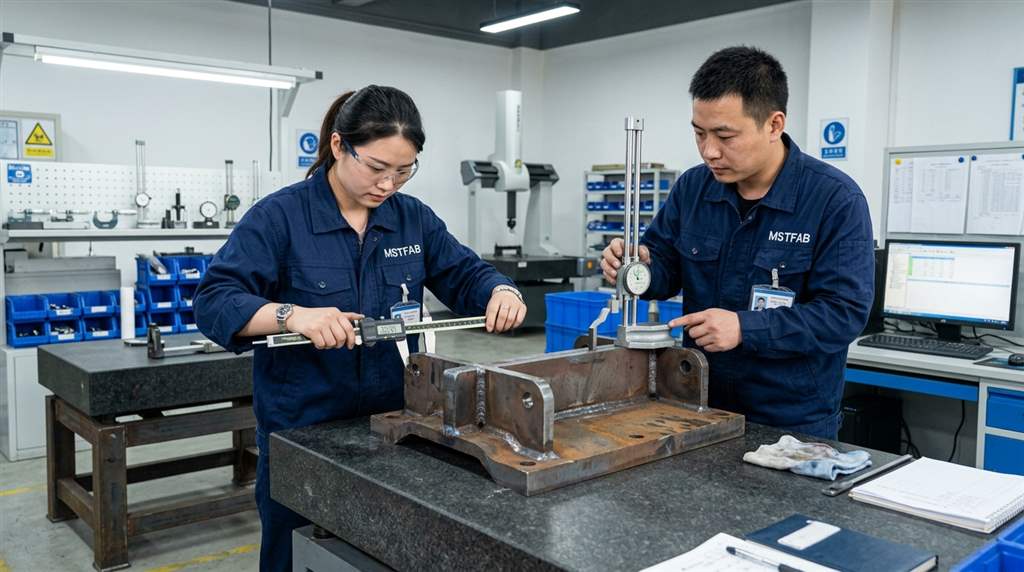
Figure 6: Metrology validation: inspecting true position, hole centerlines, and overall form tolerances on a welded mild steel chassis using a bridge CMM.
7. Critical DFM Rules for Mild Steel Sheet Metal Assemblies
Adhering to proven Design for Manufacturability (DFM) rules during CAD modeling eliminates manufacturing bottlenecks, reduces tooling complexity, and lowers piece-part costs:
Rule 1: Minimum Flange Height (L_min)
To ensure the sheet metal blank bridges across both die shoulders of the press brake V-die opening without slipping, specify minimum flange length:
L_min >= 4 * T + R
Rule 2: Minimum Distance from Hole to Bend Tangent (D_min)
Any hole or cutout located too close to the plastic deformation zone of a bend will stretch into an oval. Maintain minimum edge-to-bend distance:
D_min >= 2.5 * T + R
If holes must be placed closer to the bend line, incorporate a tear-drop relief notch or laser-cut the hole post-bending using our 5-axis 3D laser system.
Rule 3: Corner Bend Reliefs for Box Enclosures
When two flanges bend toward each other to form a 90-degree corner, rectangular or circular relief notches must be placed at the intersection to prevent uncontrolled sheet tearing and material bulging:
Relief Width (W) >= T + 0.5 mm, Relief Depth (D) >= R + T
8. Quality Metrology: CMM Probing, Weld Macro-Etching, and Adhesion Testing
MSTFAB enforces comprehensive quality control procedures certified under ISO 9001:2015:
- Bridge Coordinate Measuring Machine (CMM): Zeiss automated bridge CMMs probe hole-to-hole centerlines, true position, and geometric perpendicularity across complex multi-bend welded chassis to +/- 0.025 mm.
- Weld Metallurgical Macro-Etching: Cross-sectional samples of production welds are cut, polished, and etched with 5% Nital acid solution. Microscopic inspection verifies complete weld root penetration, fusion integrity, and zero internal cracking.
- Paint Adhesion Testing (ASTM D3359): Cross-hatch tape adhesion testing ensures powder coating achieves a 5B rating (zero paint detachment).
- Impact & Salt Spray Testing: Rapid deformation impact testing per ASTM D2794 and continuous neutral salt spray fog testing per ASTM B117 (500 to 1,500 hours).
9. Comprehensive Engineering Data Matrices and Manufacturing Benchmarks
The following engineering data matrices summarize mechanical properties, cutting parameters, and forming specifications for mild steel fabrication:
Table 1: Mild Steel Material Grades Comparison Matrix
| Steel Grade & Standard | Yield Strength (MPa) | Tensile Strength (MPa) | Elongation (%) | Min. Bend Radius | Primary Application |
|---|---|---|---|---|---|
| SPCC (JIS G3141) | 190 – 240 | 270 – 370 | >= 34% | 0.5 * T | Cold-rolled electronic chassis, audio panels, server cases |
| ASTM A1008 CS Type B | 170 – 240 | 310 – 410 | >= 32% | 0.5 * T | North American standard cold-rolled sheet for appliances & IT |
| SPHC / HRPO (JIS G3131) | 210 – 260 | 340 – 440 | >= 30% | 1.0 * T | Pickled & oiled structural brackets, machinery guards, bases |
| ASTM A36 / Q235B | >= 235 | 400 – 520 | >= 23% | 1.5 * T | Heavy structural skids, welded machine bases, equipment frames |
| Q345B / S355JR (HSLA) | >= 345 | 470 – 630 | >= 21% | 2.0 * T | High-strength mobile machinery, crane booms, trailer chassis |
Table 2: Laser Cutting Speed & Assist Gas Comparison for Mild Steel
| Sheet Thickness | Oxygen Assist Speed (m/min) | Nitrogen Assist Speed (m/min) | Cut Edge Quality | Powder Coating Readiness |
|---|---|---|---|---|
| 1.0 mm (0.040″) | 14 – 18 m/min | 35 – 45 m/min | Nitrogen: 100% oxide-free, brilliant silver | Direct powder coat without deburring |
| 2.0 mm (0.078″) | 8.5 – 12 m/min | 20 – 28 m/min | Nitrogen: Clean square edge, zero dross | Direct powder coat without deburring |
| 3.0 mm (0.120″) | 5.5 – 7.5 m/min | 12 – 16 m/min | Nitrogen: Smooth Ra < 1.5 um | Direct powder coat without deburring |
| 6.0 mm (0.236″) | 2.8 – 3.8 m/min | 4.5 – 6.5 m/min | Oxygen: Black oxide layer present | Requires edge descaling or wire brush |
| 12.0 mm (0.472″) | 1.4 – 2.0 m/min | 1.8 – 2.5 m/min | Oxygen: Minimal striations, stable kerf | Requires mechanical edge descaling |
10. Real-World OEM Case Studies: Structural Validations
Case Study 1: Heavy Industrial Automated Packaging Machine Base Chassis
- Application: High-rigidity vibration-damped machine base for high-speed multi-axis sorting machinery.
- Material: 4.0 mm & 6.0 mm SPHC / HRPO mild steel with internal welded rib stiffeners and precision CMM-probed mounting pads.
- Customer Problem: Previous fabricator experienced severe 4.5 mm racking and diagonal twisting across the 2.4-meter frame caused by unmanaged MIG welding heat, requiring extensive manual shimming during final machine assembly.
- MSTFAB Solution: Redesigned frame using tab-and-slot self-aligning interlocks cut via fiber laser. Engineered a heavy pneumatic clamping fixture and deployed balanced robotic MIG welding with back-step sequences. Applied stress-relief post-weld inspection.
- Results: Overall diagonal squareness held within +/- 0.50 mm across the entire frame. Eliminated 6 hours of assembly shimming per machine, reducing client manufacturing overhead by 28%.
Case Study 2: Telecom 19-Inch Outdoor Power Conversion Cabinet
- Application: Weatherproof telecom power cabinet with multi-compartment shelving, heat exchanger louvers, and 120 captive PEM studs.
- Material: 1.5 mm SPCC cold-rolled steel with zinc phosphate pretreatment and 90-micron architectural polyester powder coating.
- Customer Problem: Paint flaked off laser-cut louver edges within 8 months of outdoor deployment, leading to customer warranty rejections and red rust streaks.
- MSTFAB Solution: Switched blank cutting from oxygen to 22-bar high-pressure nitrogen assist, completely eliminating the brittle edge oxide layer. Implemented an automated 5-stage iron phosphating and deionized seal wash.
- Results: Salt spray resistance exceeded 1,200 hours without edge blistering or creep. Over 8,000 units delivered globally with zero field coating failures.
Case Study 3: Off-Highway Construction Vehicle Cab Operator Control Console
- Application: Ergonomic multi-flange cab control console housing joysticks, display screens, and wiring harnesses.
- Material: 2.0 mm SPCC cold-rolled steel with extruded tapped holes and matte black fine-texture powder coating.
- Customer Problem: Loose clinch nuts frequently spun out when technicians torqued mounting bolts during harsh vibration field testing.
- MSTFAB Solution: Replaced loose clinch nuts with CNC extruded tapped collars (M5 x 0.8), providing 4.5 mm of thread engagement directly in the parent steel sheet.
- Results: Increased stripping torque resistance by 45%, eliminated 18 hardware components per console, and cut assembly labor time by 22%.
11. Frequently Asked Technical Questions (36 Detailed Engineering Q&As)
Q1: What is the main metallurgical difference between mild steel and carbon steel?
Mild steel is a specific subset of carbon steel with low carbon content (0.05% to 0.25% C). Higher-carbon steels contain up to 1.0% C, offering higher hardness but significantly reduced ductility and weldability.
Q2: What is the difference between SPCC cold-rolled steel and SPHC hot-rolled steel?
SPCC is rolled at room temperature, yielding a smooth Class A surface, tight gauge tolerance (+/- 0.04 mm), and high formability. SPHC is hot-rolled, pickled to remove mill scale, and oiled (HRPO); it is lower in cost and ideal for heavier structural brackets from 2.0 mm to 12.0 mm.
Q3: Why is high-pressure nitrogen laser cutting superior to oxygen for parts intended for powder coating?
Oxygen cutting creates an exothermic reaction that leaves a brittle black iron oxide layer on the cut edge. Powder coating will peel off this oxide layer. Nitrogen cutting is an inert melt-ejection process that leaves a 100% oxide-free edge, ensuring permanent paint adhesion.
Q4: What is the typical K-factor used for air bending mild steel?
For standard air bending of mild steel with a V-die ratio of V = 6 * T to 8 * T, the empirical K-factor is typically K = 0.42. For bottom bending, K increases to approximately 0.45.
Q5: How does MSTFAB control weld distortion on large sheet metal chassis?
We deploy rigid hydraulic/pneumatic clamping fixtures, symmetrical weld sequencing, back-step welding, pre-cambering, and low-heat pulsed robotic MIG welding to counteract and balance thermal shrinkage forces.
Q6: What is thread extrusion tapping and how does it save manufacturing costs?
Extrusion tapping uses a punch or rotary friction tool to draw sheet metal downward into a tubular collar before tapping. It increases thread engagement by 2.5x to 3x, allowing strong M4-M8 threads in thin sheet without buying or welding separate clinch nuts.
Q7: What is the minimum recommended inside bend radius for SPCC cold-rolled steel?
SPCC has excellent ductility (elongation > 34%). The minimum inside bend radius is R_min = 0.5 * T, although specifying R = 1.0 * T provides optimal tooling life and eliminates orange-peel surface stretching.
Q8: What shielding gas is used for MIG welding mild steel?
We use an 82% Argon / 18% CO2 shielding gas mixture with AWS ER70S-6 wire. This provides a smooth spray-transfer arc, deep weld penetration, and minimal spatter compared to 100% CO2.
Q9: What is the function of iron phosphate or zinc phosphate pretreatment?
Phosphate baths chemically convert surface iron atoms into a micro-crystalline phosphate layer. This layer provides a physical anchor for powder coating and prevents under-film corrosion creep if the paint is scratched.
Q10: What is Cathodic Electrodeposition (E-Coat) and when is it specified for steel parts?
E-coating immerses the part in an electrified paint bath, depositing 15-25 microns of epoxy paint across every interior and exterior surface, including enclosed hollow sections. It is specified for automotive chassis and severe-environment machinery.
Q11: Why must holes be located away from the press brake bend line?
Material in the bend zone undergoes severe plastic stretching. Holes placed closer than D < 2.5 * T + R will deform into an egg shape, preventing bolt insertion and hardware seating.
Q12: Can self-clinching PEM nuts be installed after powder coating?
PEM nuts should always be installed prior to powder coating to ensure metal-to-metal clinch retention and proper seating. Threaded holes can be masked with silicone pull-plugs during painting to preserve clean threads.
Q13: How does material grain direction affect mild steel bending?
Bending perpendicular to rolling grain provides maximum ductility and tightest radii. Bending parallel to the grain increases cracking risk and amplifies springback variations by up to 35%.
Q14: What dimensional tolerances can be achieved on CNC-formed mild steel parts?
MSTFAB holds linear dimensions within +/- 0.12 mm and angular tolerances within +/- 0.25 degrees on precision press brakes equipped with laser angle measurement and dynamic crowning.
Q15: What is the maximum plate thickness MSTFAB can laser cut in carbon steel?
Our high-power 20 kW fiber lasers cut carbon steel plate up to 25.0 mm (1.0 inch) thick with clean, square edges and tight kerf tolerances.
Q16: How do you verify weld quality on mild steel assemblies?
We perform destructive macro-etching with 5% Nital acid to verify penetration, non-destructive dye penetrant inspection (ASTM E165), and automated CMM dimensional checks for frame squareness.
Q17: What is the advantage of HSLA steels like Q345B over standard mild steel?
HSLA steels provide 50% higher yield strength (345 MPa vs 235 MPa), allowing engineers to reduce sheet gauge by 20% to 30% without sacrificing load capacity, resulting in lighter machinery.
Q18: What is tab-and-slot design and how does it benefit welded chassis fabrication?
Tab-and-slot design incorporates laser-cut interlocking tabs and slots that snap components together like a puzzle, ensuring exact self-fixturing and dimensional repeatability before welding.
Q19: How do you prevent zinc plating embrittlement on high-strength fasteners or brackets?
High-strength steels (> 1000 MPa) can suffer hydrogen embrittlement during acid pickling and electroplating. We perform hydrogen de-embrittlement baking at 200 deg C for 4 to 8 hours immediately after plating.
Q20: What is the typical lead time for custom mild steel prototypes and volume runs?
Laser-cut, CNC-formed, and welded prototypes typically ship within 5 to 7 working days. Production volumes (500 to 10,000 units) ship within 3 to 4 weeks.
Q21: Can capacitor discharge (CD) weld studs be welded without marking cosmetic front faces?
Yes. CD stud welding discharges in milliseconds, melting only the stud base and sheet surface without burning through or discoloring the opposing Class A cosmetic face.
Q22: How does springback in mild steel compare to stainless steel or aluminum?
Mild steel has relatively low yield strength and high elastic modulus (E = 205 GPa), resulting in minimal springback (approx 1.0 to 1.5 degrees), making it far more predictable than stainless steel (3.0 to 5.0 degrees).
Q23: What surface finishes are available for mild steel parts at MSTFAB?
We provide electrostatic powder coating, wet spray enamel, cathodic electro-coating (E-coat), electrolytic zinc plating (ASTM B633 clear/yellow/black), and batch hot-dip galvanizing (ASTM A123).
Q24: What is the difference between air bending and bottom bending on a press brake?
Air bending contacts the sheet at three points without touching the bottom of the V-die, requiring lowest tonnage. Bottom bending presses the sheet into full contact with die walls, achieving tighter angular consistency (+/- 0.20 deg) at higher tonnage.
Q25: What is the purpose of corner bend reliefs?
Corner reliefs remove material where two flanges intersect, preventing uncontrolled tearing, bulging, and interference that would hinder corner welding or fitting.
Q26: What quality management certifications does MSTFAB hold for mild steel fabrication?
MSTFAB is certified under ISO 9001:2015, operating with full raw material mill test report (MTR) heat lot traceability, calibrated measurement tools, and PPAP / FAI reporting capability.
Q27: How does MSTFAB ensure thread quality in tapped holes?
We use thread plug go/no-go gauges to verify 100% compliance with ISO metric (6H) and Unified (2B) thread standards on all tapped holes and extruded collars.
Q28: Can MSTFAB perform spot welding on pre-painted or coated steel?
No. Resistance spot welding requires bare metal-to-metal contact to conduct electrical current. Pre-painted or coated sheets must be joined via mechanical clinching, riveting, or fasteners.
Q29: How do you package custom mild steel parts for overseas shipping?
Parts receive vapor corrosion inhibitor (VCI) protective wrapping, desiccant packs, high-density polyethylene foam cell dividers, and are secured inside ISPM-15 certified timber export crates.
Q30: What salt spray hours are standard for powder-coated mild steel?
With multi-stage iron phosphate pretreatment, powder-coated mild steel achieves 500 to 1,000 hours of neutral salt spray testing (ASTM B117). Adding an epoxy e-coat primer extends performance to > 2,000 hours.
Q31: How does mild steel compare to stainless steel in machining and tool wear?
Mild steel is far easier to cut, punch, and form than austenitic stainless steel, requiring 40% less press tonnage and extending punch and die tooling life by 3x to 5x.
Q32: Can MSTFAB assemble secondary hardware, wiring, and seals into steel chassis?
Yes. We offer complete electromechanical contract manufacturing: installing wiring harnesses, DIN rails, circuit breakers, hinges, locks, and continuous-bead foam gaskets.
Q33: What is the minimum flange length required for press brake forming?
The standard minimum flange length is L_min >= 4 * T + R to ensure safe and stable positioning across the V-die opening.
Q34: How do you verify coating thickness on painted mild steel?
We use calibrated digital magnetic induction coating thickness gauges compliant with ASTM B499, measuring paint film thickness across flat and formed features to ensure 70-110 microns.
Q35: What 3D CAD formats are required when requesting a fabrication quote?
We accept STEP (AP214/AP242), IGES, and SolidWorks CAD files, accompanied by 2D PDF engineering drawings detailing critical dimensions, tolerances, and surface finish specifications.
Q36: How can an OEM submit an RFQ for mild steel fabrication to MSTFAB?
Upload your 3D models and drawing packages through our secure RFQ portal. Our DFM engineering team will review your specifications, optimize blank nesting and forming parameters, and return a comprehensive quotation within 24 to 48 hours.
Partner with MSTFAB for Precision Mild Steel Sheet Metal Fabrication
Eliminate weld distortion, paint delamination, and assembly fit bottlenecks. Partner with MSTFAB for ISO 9001 certified mild steel and carbon steel sheet metal fabrication—backed by nitrogen laser cutting, precision CNC forming, robotic MIG/TIG welding, and high-performance powder coating. Contact our engineering team today for a comprehensive DFM review and quotation.
 WeChat Contact
 WhatsApp Me Directly