⚡ Direct Answer: What IATF 16949 Standards Apply to Semiconductor Tool Enclosure Housings?
External equipment housing shells on semiconductor fabrication machinery protect internal chemical valves, laser optics, and wafer robot bays from cleanroom particulate intrusion while shielding operators from RF radiation. Fabricating custom galvanized steel housings under IATF 16949:2016 automotive quality flowdowns requires 4 essential manufacturing controls: 1) Door Flange Co-Planarity (≤±0.5mm): Multi-point laser scanning verifies door flatness across 2-meter tall panels to guarantee continuous compression on conductive EMC/particulate gaskets; 2) Process Capability Studies (Cpk ≥ 1.67): Demonstrating statistical dimensional consistency across HMI cutout centerlines, interlock switch brackets, and service panel latches; 3) Level 3 PPAP Documentation: Submitting full Process Flow Diagrams (PFD), Process FMEA, Control Plans, and Part Submission Warrants (PSW); and 4) Full Material Lot Traceability: Archiving EN 10204 3.1 Mill Test Reports confirming ASTM A653 G90 / DX51D zinc coating weights and non-outgassing powder topcoats.
Semiconductor fab cleanroom space costs thousands of dollars per square foot. Enclosure skins must fit tool frames with tight, flush tolerances and maintain laminar cleanroom airflow without creating air turbulence pockets. MSTFAB manufactures empty precision galvanized steel tool housing shells built under automotive-grade quality management systems.
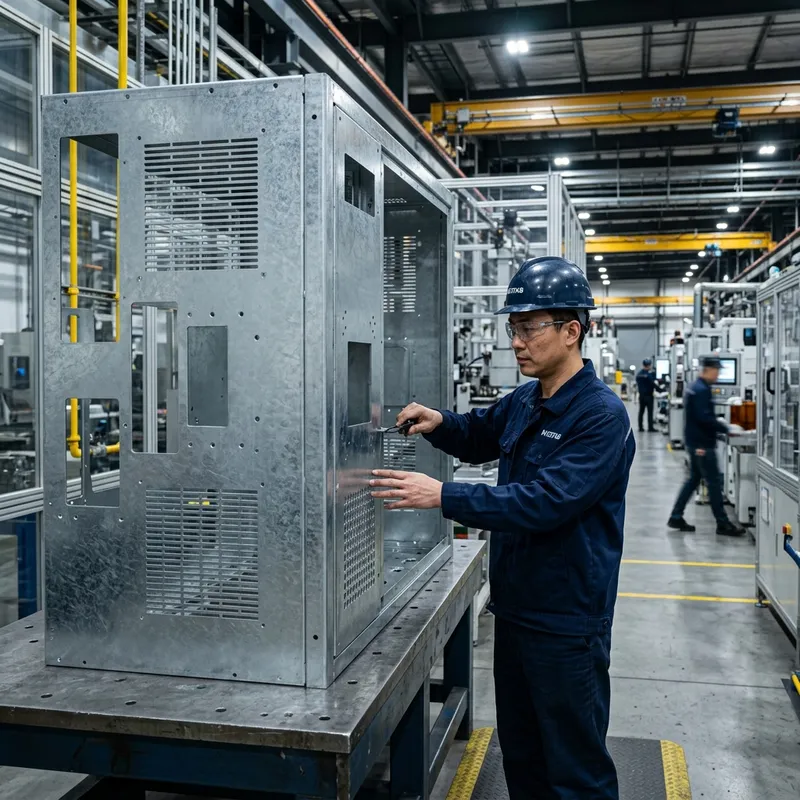
Semiconductor equipment housing shell: Flush-fitting access doors, safety interlock bracket provisions, and precision CNC cooling louvers.
Quality Comparison: Commercial Sheet Metal vs Semiconductor IATF 16949 Housing
| Quality Metric | Standard Sheet Metal Shop | MSTFAB IATF 16949 Semiconductor Housing | Fab Equipment OEM Benefit |
|---|---|---|---|
| Door Fitment & Gaps | ±2.0mm gap variation; visible bowing | Uniform 2.0mm ±0.5mm perimeter gaps; Cpk ≥ 1.67 | Ensures aesthetic perfection and laminar cleanroom airflow. |
| Interlock Switch Alignment | Manual hand fitting; frequent binding | CNC laser cut datum holes (±0.1mm) with PEM hardware | Guarantees flawless safety interlock engagement per SEMI S2. |
| Outgassing & Cleanliness | Standard industrial paint; VOC outgassing | Solvent-free, low-outgassing polyester powder topcoat | Prevents chemical contamination on wafer production lines. |
| Engineering Change Control | Informal drawing revisions on shop floor | Strict Level 3 ECN protocol with customer sign-off | Ensures exact backward compatibility for spare parts. |
Precision Fabrication Details for Cleanroom Housings
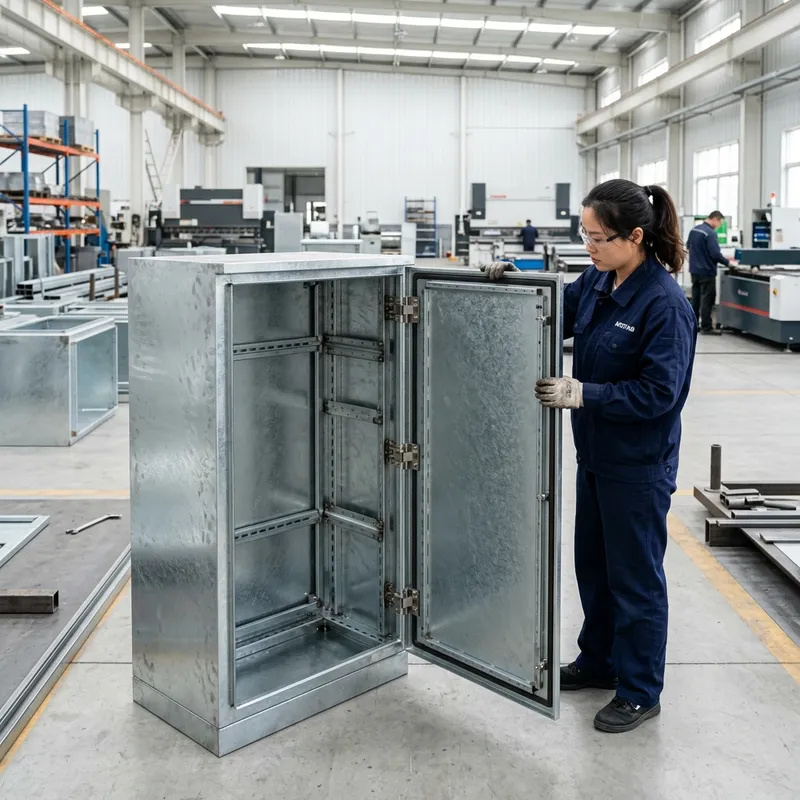
Concealed Hinges & Quick-Release Latches
Internal 180° lift-off concealed hinges and flush-mounted 1/4-turn latches eliminate external snag hazards, allowing technicians rapid tool maintenance access.
Acoustic & Thermal Insulation Mounting
Internal sheet metal panels feature welded insulation retention pins and formed baffles to house cleanroom-rated sound absorption foam, dampening vacuum pump noise.
Custom Semiconductor Equipment Housing Shells
Engineer clean, aesthetic, and compliant housing shells for your semiconductor machinery. Send your 3D CAD models to MSTFAB for rapid DFM evaluation and quote.
Frequently Asked Questions (FAQ)
How is EMC shielding implemented across removable housing panels?
We apply conductive copper or nickel-plated gaskets along panel return flanges and mask bare zinc grounding contact pads, providing a continuous Faraday cage across all seams.
Can viewing windows be integrated into cleanroom doors?
Yes. We fabricate laser-cut window frames equipped with anti-static polycarbonate or ESD-coated acrylic viewing panels sealed with certified silicone gaskets.
What sheet metal thicknesses are used for semiconductor tool housings?
Doors and cosmetic access panels typically utilize 1.5mm to 2.0mm (16 Ga to 14 Ga) galvanized steel with welded stiffener ribs, while structural corner posts utilize 2.5mm (12 Ga) steel.
 WeChat Contact
 WhatsApp Me Directly