How should OEM procurement teams accurately measure sheet metal supplier On-Time Delivery (OTD)?
OEM procurement teams measure sheet metal supplier delivery accurately using the On-Time In-Full (OTIF) standard: OTIF (%) = (Total PO Line Items Delivered On-Time AND 100% Conforming to Quantity and Quality ÷ Total PO Lines Due) × 100. Delivery dates must be judged against the buyer’s Purchase Order Promise Date (not shipping dock dispatch date), with strict rules governing allowable grace windows (typically +0 / -2 days), partial shipment scoring, and non-conforming lot disqualification.
In custom sheet metal fabrication, “On-Time Delivery” is often the most contentious metric between buyers and suppliers. A fabricator claims 98% OTD because they printed a shipping bill of lading on Friday at 5:00 PM, while the buyer’s receiving dock did not physically receive the goods until Tuesday afternoon – after an entire automated assembly line sat idle for 36 hours. To eliminate disputes, procurement teams must implement an objective, contractually defined On-Time In-Full (OTIF) measurement framework.

The 4 Cornerstones of Precision Sheet Metal OTIF Tracking
1. Delivery Date Benchmark: Promised Date vs. Ship Date
OTD must be calculated against the Purchase Order Promised Due Date at the buyer’s physical dock location (DAP / DDP terms). Counting vendor ship dates or factory dispatch dates allows suppliers to claim compliance while ocean or freight delays starve assembly lines.
2. The “In-Full” Requirement (Zero Unplanned Partials)
Delivering 400 pieces against a 500-piece purchase order is not an “on-time” order – it is a partial failure that disrupts production planning. Under rigorous OTIF rules, an incomplete shipment counts as a 0% hit unless an authorized partial split was mutually agreed in writing at least 5 business days in advance.

3. The Quality Disqualification Rule
If a delivery arrives on the exact promised date, but receiving inspection rejects the lot due to cracked bend radii, undersized hole diameters, or coating adhesion failure, the delivery is classified as LATE. Delivering defective parts on time is functionally identical to not delivering parts at all.
4. The Grace Window (+0 / -2 Days)
Best-in-class supply chains establish a strict grace window: shipments arriving up to 2 business days early are accepted without penalty, but shipments arriving even 1 day late are counted as non-compliant (0% score). Shipments arriving more than 5 days early may be rejected at the dock to prevent warehouse inventory bloat.

OTIF Calculation Rules & Scoring Scenarios Matrix
The table below provides standard evaluation rules for common delivery situations in custom precision sheet metal sourcing:
| Delivery Scenario | PO Quantity Due | Delivery Date vs. Due Date | Quality Inspection Result | Official OTIF Status | Score Impact |
|---|---|---|---|---|---|
| 1. Perfect Delivery | 500 pcs delivered | Delivered on promised date | 100% Passed AQL Level II | ON-TIME IN-FULL | 100% Score |
| 2. Unplanned Partial Delivery | 350 pcs delivered (150 short) | Delivered on promised date | All 350 pcs passed inspection | FAILED (Incomplete Qty) | 0% Score |
| 3. Quality Failure at Dock | 500 pcs delivered | Delivered on promised date | REJECTED – 15% hole shift | FAILED (Non-Conforming) | 0% Score + NCR |
| 4. Minor Grace Window | 500 pcs delivered | Delivered 1 day early | 100% Passed AQL Level II | ON-TIME (Within Window) | 100% Score |
| 5. 1-Day Delay | 500 pcs delivered | Delivered 1 day late | 100% Passed AQL Level II | LATE SHIPMENT | 0% Score |
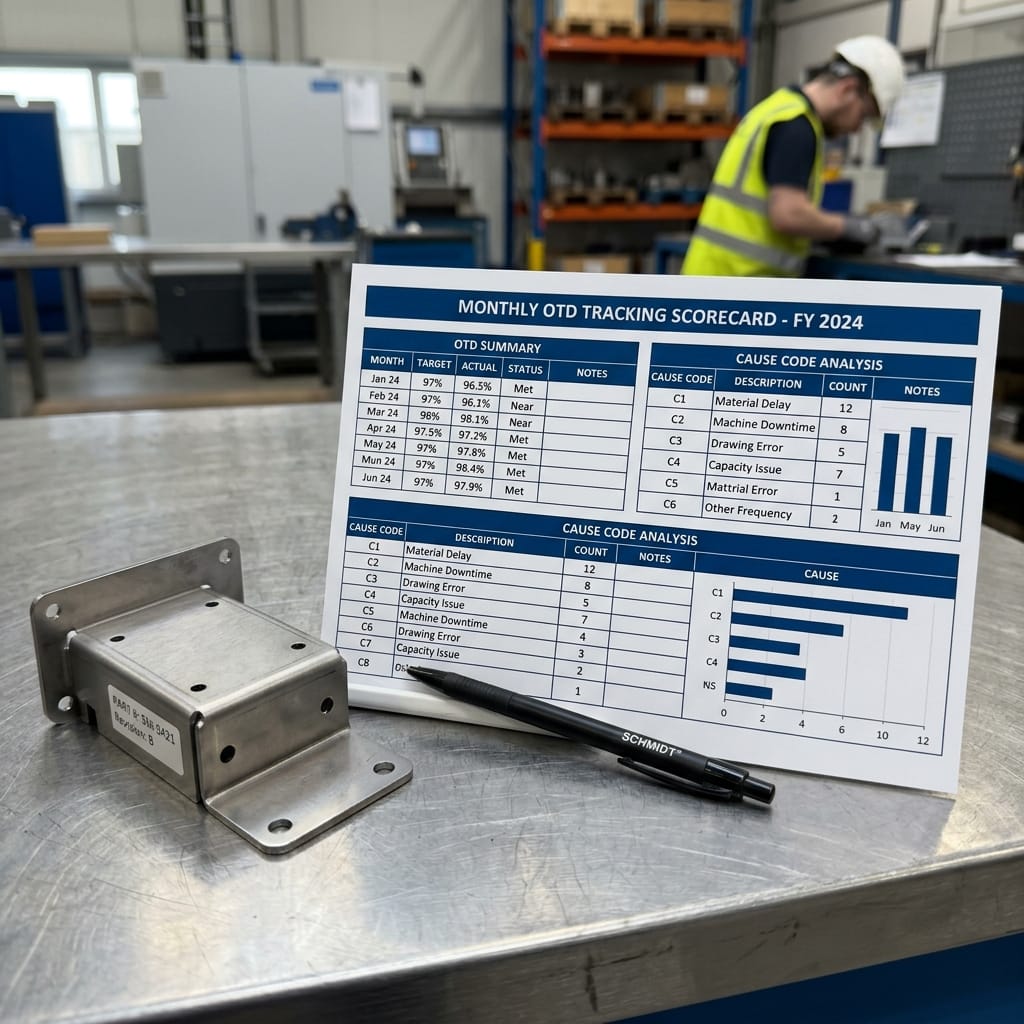

Demand 99%+ On-Time In-Full Sheet Metal Performance
MSTFAB operates with an industry-leading 99.2% OTIF delivery record across high-precision global technology programs. With fully automated ERP scheduling, dedicated buffer coil stock, and in-house finishing lines, we ensure your production lines never wait for parts. Contact our logistics and production planning team today.
 WeChat Contact
 WhatsApp Me Directly