⚡ Direct Answer: What Is Heat Number Traceability in Sheet Metal Fabrication?
Heat number traceability in sheet metal fabrication is the rigorous chain-of-custody system that links every cut, bent, and welded part back to the specific metallurgical melting batch (the “heat”) produced at the steel or aluminum mill. A complete heat traceability workflow requires five mandatory checkpoints: 1) Intake Tag Verification: Matching mill coil/pallet metal tags to EN 10204 3.1 Mill Test Reports (MTR) upon receiving; 2) ERP Batch Segregation: Registering sheet bundles under unique internal lot IDs to prevent cross-contamination during raw inventory storage; 3) Single-Heat Laser Nesting: Restricting CNC nesting layouts so that components requiring full pedigree are cut strictly from verified single-heat sheet stacks; 4) Direct Part Marking (DPM): Laser-etching or stamping the heat number and part revision onto non-critical cosmetic surfaces; and 5) Digital Traveler Records: Retaining physical traveler cards and digital ERP routing logs across forming, clinching, welding, powder coating, and final crating.
When manufacturing structural enclosures for rail, aerospace, power generation, and medical equipment, an untraced material defect can cause catastrophic assembly failures or field recalls. Without heat number traceability, a failure forces the quarantine and recall of an entire year of production. With strict heat-level tracking, containment is pinpointed to the exact batch produced from that specific mill run.

Heat Traceability Control Plan Across Sheet Metal Fabrication Stages
Maintaining unbroken traceability requires rigid procedural gates from raw metal receiving through export logistics:
| Process Stage | Tracking Mechanism | Verification Method | Failure Prevention Control |
|---|---|---|---|
| 1. Receiving & Warehousing | Steel coil / bundle barcode tag + internal ERP QR code | MTC chemical analysis cross-check + XRF PMI spot test | Quarantine zone lock until QA releases inspection sign-off |
| 2. CNC Laser / Punch Nesting | CAM software nesting program tied to sheet ERP ID | Operator barcode scan before loading sheet stack to shuttle | Prohibition of mixed-heat sheet mixing on the pallet shuttle |
| 3. Blank Marking (DPM) | Direct part marking: fiber laser etching or CNC dot-peen | Automated machine vision scanner or optical magnifier check | Engraving parameters tuned to avoid surface pitting on corrosion zones |
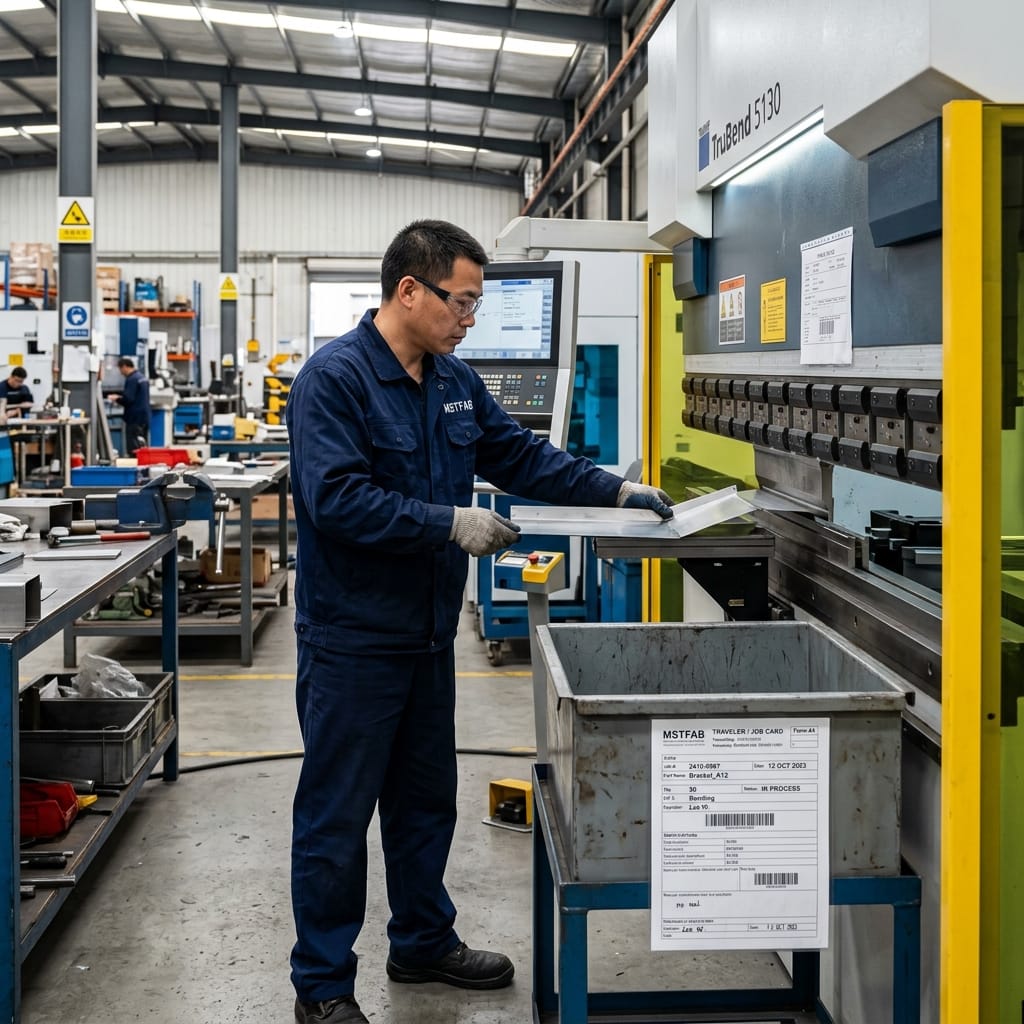
| 4. Press Brake Forming | Physical job traveler traveler bin card with route sheet | Operator sign-off on first-piece bend angle and part stamp | Dedicated WIP totes; zero co-mingling of adjacent project lots |
| 5. Welding & Hardware Clinch | WPS weld log + PEM fastener lot tracking number | Visual inspection + fastener pushout torque test record | Weld filler wire / stud heat certs paired to traveler dossier |
| 6. Packaging & Export Crating | Master crate shipping label with heat number summary | Final QA audit comparing crate manifest to ERP traveler | Waterproof document pouch enclosed with certified MTC copies |

Managing Remnants and Off-Cuts: The Traceability Trap
One of the most frequent points of failure in sheet metal shops is the handling of remnant sheets (“drops”). After a laser cuts 60% of a 4×8 ft plate, the skeleton or unused portion is returned to stock. Uncontrolled shops toss remnants into a general scrap pile, losing all pedigree. When a low-volume order is subsequently cut from that remnant, the heat number is lost.
At MSTFAB, remnant control is managed through automated ERP drop tracking:
- Automated Drop Generation: When the CAM nesting program completes, the nesting software registers a new ERP inventory item with dimensions and parent heat ID.
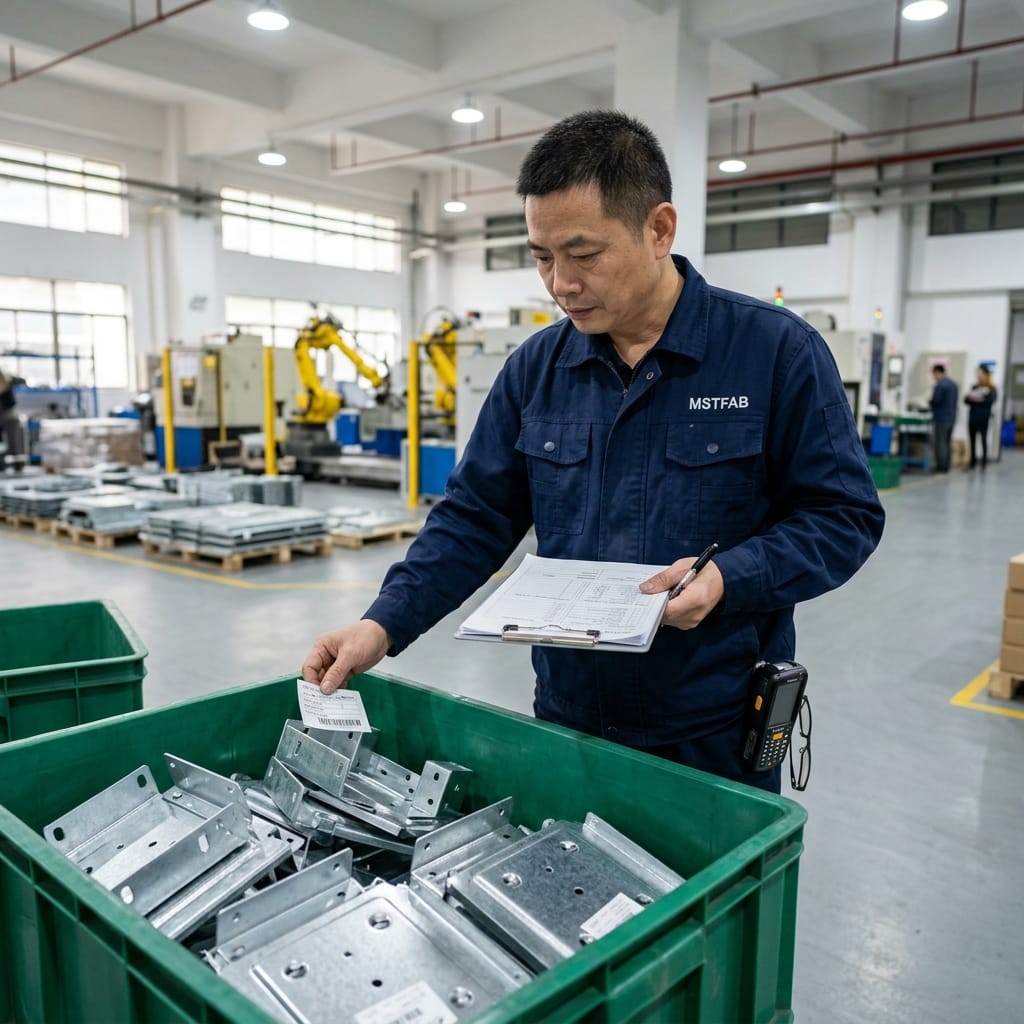
- Physical Barcode Color-Tagging: The laser operator immediately affixes a permanent barcode label to the remnant corner before it leaves the shuttle table.
- Quarantine Staging for Unidentified Remnants: Any sheet without a verifiable barcode is permanently routed to non-critical commercial brackets or disposed of via metal recycling.




Streamline Your Traceable Sheet Metal Components Procurement & Production
MSTFAB provides end-to-end custom precision sheet metal fabrication, full material traceability (EN 10204 3.1 MTRs, XRF PMI), and flexible supply chain agreements (Blanket POs, VMI, Frameworks). Request a DFM review and instant quote within 24 hours.
Frequently Asked Questions (FAQ)
What is the difference between a Heat Number and a Lot Number?
A Heat Number identifies the chemical batch of liquid metal poured during a single furnace melting cycle at the primary mill (typically 50 to 300 tons of steel). A Lot Number (or Batch Number) is an internal fabrication identifier assigned by the sheet metal fabricator to represent a specific manufacturing run of parts cut and formed under identical machine setups.
Can powder coating obscure laser-etched heat numbers?
Yes. Standard electrostatic powder coating deposits a 60 to 120 micron dry film thickness (DFT), which can easily fill shallow fiber laser markings. For parts receiving heavy powder coating, MSTFAB either uses deep CNC dot-peen marking (depth >0.25mm), marks on internal unexposed flanges, or applies high-durability thermal transfer metalized barcode labels after powder curing.
What documentation does MSTFAB deliver with heat-traced shipments?
Each shipment includes a complete Quality Dossier: 1) Certificate of Conformance (CoC); 2) Authenticated EN 10204 3.1 Mill Test Certificates; 3) First Article Inspection (FAI) dimensional report; 4) Material heat-to-serial reconciliation matrix; and 5) Handheld XRF alloy chemistry verification logs.
 WeChat Contact
 WhatsApp Me Directly