⚡ Direct Answer: What Is a Framework Agreement in Sheet Metal Fabrication?
A Framework Agreement (or Master Supply Agreement / MSA) in custom sheet metal fabrication is a long-term master contract establishing commercial, legal, and engineering terms for repeat part numbers over an extended duration (typically 12 to 36 months) without committing the buyer to immediate fixed delivery volumes. It decouples legal and commercial negotiations from day-to-day operations through 4 key components: 1) Transparent Conversion Cost Pricing: Fixing machine hour rates, labor, and tooling amortization while linking raw material metal costs to public commodity market indices (e.g. London Metal Exchange or Shanghai Metal Market); 2) Rapid Call-Off Release Mechanism: Allowing buyers to issue 1-page release POs or automated EDI triggers with compressed lead times (e.g. 5-10 business days instead of 5 weeks); 3) Dedicated Tooling & Fixture Ownership: Stipulating clear OEM title rights and maintenance responsibilities for stamping dies, welding jigs, and check fixtures; and 4) Engineering Change Order (ECO) Protocols: Pre-defining scrap liability cutoffs, drawing revision sign-offs, and first-article requalification gates.
Issuing isolated transactional purchase orders for repeat sheet metal components creates massive administrative friction. Buyers must renegotiate pricing on every run, re-explain drawing revisions, and face fluctuating production lead times as shop capacities shift. A structured Framework Agreement transforms repeat sourcing into a predictable, frictionless flow.

Framework Agreement vs. Discrete Transactional Purchase Orders
Compare how operating under a negotiated Master Framework Agreement dramatically outperforms ad-hoc spot purchasing:
| Operational Metric | Discrete Transactional POs | Master Framework Agreement (MSTFAB) |
|---|---|---|
| Reorder Lead Time | 4 – 7 weeks (full cycle setup & material order) | 5 – 12 business days (pre-staged raw coils & tooling) |
| Pricing Stability | Volatile, negotiated anew every PO | Fixed fabrication margin + index-linked metal pass-through |
| Tooling & Fixture Setup | Setup fees billed on every small run ($150-500/setup) | Amortized or waived; dedicated fixtures permanently maintained |
| Engineering Change Control (ECO) | Ad-hoc, high risk of obsolete part shipments | Rigid 5-step ECO sign-off with clear cut-off serialization |
| Administrative Overhead | 15-20 hours procurement time per PO batch | < 30 minutes to generate call-off release against open contract |

Structuring the Price Adjustment Clause (Index-Linked Formula)
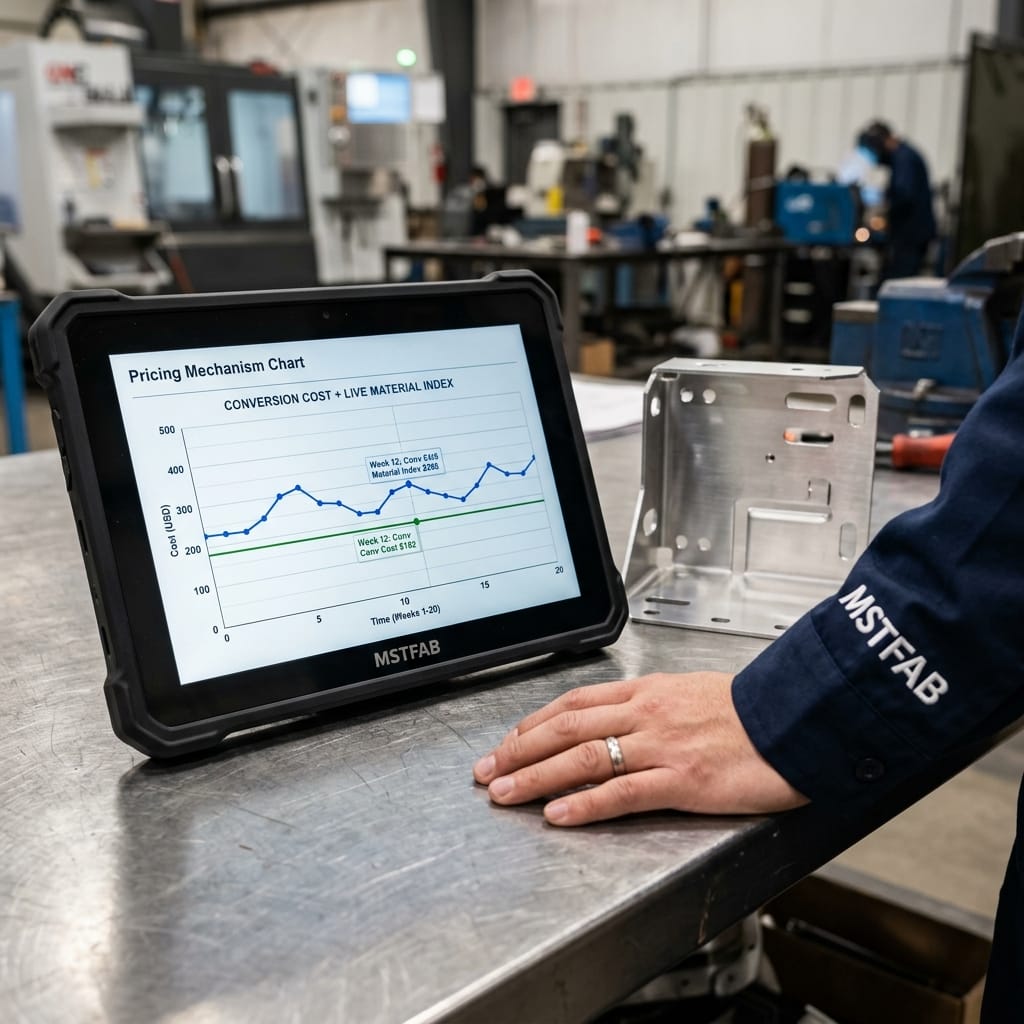
The most contentious aspect of multi-year sheet metal contracts is raw material price volatility. If the price of nickel or aluminum spikes 30%, a fixed-price supplier will either absorb losses, cut quality, or walk away. A best-practice Framework Agreement solves this with an objective Mathematical Price Indexation Clause:
- Fabricator Base Fee: Covers CNC laser cutting time, press brake forming, welding labor, hardware clinching, powder coating, packaging, and profit margin. Remains fixed for 12 months.
- Scrap Factor: Pre-agreed percentage (typically 15% to 25% depending on part geometry nesting efficiency) accounting for sheet skeleton off-fall.
- Metal Index: Objective published index (e.g. SMM 304 Stainless Cold Rolled Coil or LME Aluminum) reviewed on a quarterly or semi-annual basis.



Verified Engineering Standards & Regulatory References:
- ISO 9001:2015 Clause 8.4 Control of Externally Provided Processes – Framework procurement quality standards.
- London Metal Exchange (LME) Non-Ferrous Metals – Global benchmark pricing for raw aluminum and copper indexing.
Streamline Your Long-Term Sheet Metal Partnerships Procurement & Production
MSTFAB provides end-to-end custom precision sheet metal fabrication, full material traceability (EN 10204 3.1 MTRs, XRF PMI), and flexible supply chain agreements (Blanket POs, VMI, Frameworks). Request a DFM review and instant quote within 24 hours.
Frequently Asked Questions (FAQ)
Does a Framework Agreement legally bind the buyer to purchase a fixed minimum volume?
No. Unlike a take-or-pay contract, a standard Framework Agreement establishes price tiers, quality standards, and terms of delivery without binding the buyer to buy a fixed volume. Buyers only incur financial liability when they issue specific Release Purchase Orders for scheduled quantities.
How are custom stamping dies and dedicated welding fixtures handled?
The agreement explicitly stipulates that the buyer owns 100% of custom tooling assets once paid. MSTFAB tags all customer tooling with permanent steel asset plates, stores them in fireproof racks, provides free preventive maintenance, and guarantees replacement if tool wear occurs within the agreed design life cycle.
What happens if the OEM issues an Engineering Change Order (ECO) during the contract?
The Framework Agreement contains a predefined ECO protocol: MSTFAB calculates remaining finished goods (FG) inventory, work-in-progress (WIP), and raw material stocks. The buyer can choose to consume remaining WIP or compensate for scrap raw material before activating the new CAD revision with updated First Article Inspection (FAI) sign-off.
 WeChat Contact
 WhatsApp Me Directly