Fast-turnaround laser cutting for prototype parts starts with a released specification, not a machine-speed promise. Confirm the drawing revision, material, critical features, post-cut operations and inspection scope before accepting a dispatch date. Treat transport to your test location as a separate milestone. MSTFAB project timing requires drawing and capacity review; this guide does not promise a universal one-day turnaround.
What determines prototype laser cutting lead time?
A flat mounting plate with approved geometry has a different schedule from a chassis that also needs bending, inserts, coating and an assembly trial. Cutting time is only one part of either order. Material procurement, clarification, production queues and inspection can determine when the sample is ready.
Request these dates separately: specification release, material confirmation, fabrication completion, inspection release and dispatch. Record the required arrival date and destination too. A promise to ship is not a promise that parts will be available at your engineering bench that day.
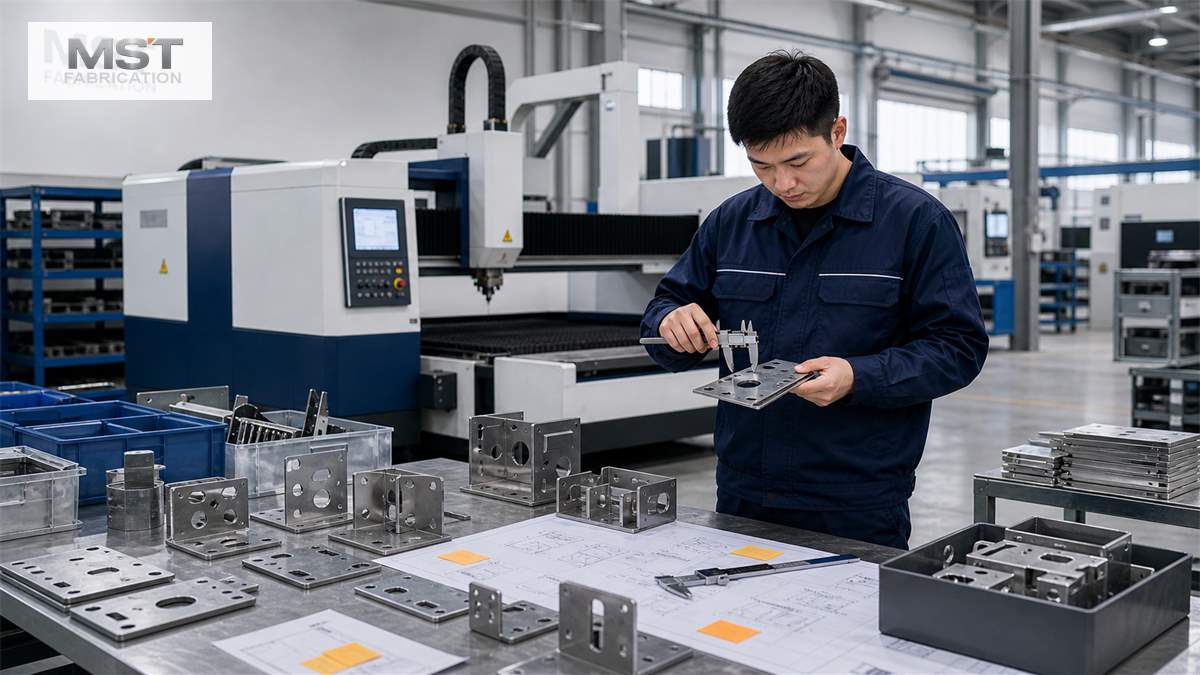
Rush prototype order: hold or release checklist
Use this checklist before reserving an urgent production slot. An unresolved item needs written clarification, not an assumed default.
| Release item | Hold the order when | Evidence needed to proceed |
|---|---|---|
| CAD and revision | The DXF outline and dimensioned drawing disagree, or units are unclear. | One approved file set, revision identifier, units and agreed document precedence. |
| Material and thickness | The specified grade is unavailable or a substitute has not been approved. | Confirmed grade, thickness and condition; written acceptance of any substitution. |
| Critical fit features | A hole, slot or interface needs a tolerance that has not been reviewed. | Marked critical dimensions, measurement conditions and any agreed secondary machining. |
| Finish and downstream work | The quote covers flat blanks but the test requires formed or coated parts. | An explicit route covering deburring, forming, hardware and finish where required. |
| Shipment release | Inspection, identification or packing acceptance is still undefined. | Agreed records, part counts, revision labels and protected packaging before dispatch. |
Which files should accompany an urgent prototype RFQ?
- Flat geometry: send a DXF when available, with units and a matching dimensioned drawing. Identify cut contours separately from reference geometry.
- Formed geometry: include the STEP model and drawing for bent parts. Agree who owns the production flat pattern and bend allowance; do not assume an unreviewed customer flat pattern will produce the required formed dimensions.
- Order definition: list each part number, revision and quantity. Separate engineering samples from additional pilot quantities.
- Acceptance scope: mark fit-critical features, edge condition, cosmetic faces, finish, hardware and required inspection records.
- Schedule: state the test date, delivery destination and whether a partial shipment would be useful.
For geometry issues rather than scheduling, use the laser cutting DFM review checklist. General process information belongs on our sheet metal laser cutting services page.
How to shorten the schedule without invalidating the test
First define what the prototype must prove. A flat profile sample can test mounting-hole alignment, but cannot establish the fit of a bent chassis. A bare-metal sample does not confirm clearance after coating. A substituted alloy may be acceptable for a visual mock-up while being unsuitable for validating strength, forming behavior or corrosion performance.
Ask for two clearly scoped options if needed: an early geometry sample and a later production-intent sample. Document every difference from the final design and the tests each version may support. Do not silently remove deburring, inspection or protective packaging to gain time.
After release, route changes through a single revision owner. If a hole location changes after cutting begins, request a written assessment of affected parts, rework feasibility, cost and schedule. A new CAD filename alone is not a production-change approval.
What should be checked before dispatch?
Agree the checks at quotation: material identification, thickness, selected hole or slot dimensions, profile dimensions, edge condition and quantity. For formed samples, add the relevant bend angles and assembly interfaces. Record whether dimensions apply before or after finishing and how the part is supported during measurement.
Inspection photographs help identify parts and visible conditions, but do not replace dimensional results. Label packages by part number and revision, protect contact surfaces and separate parts that could scratch one another. Ask which documents accompany the shipment and when tracking information becomes available.
Frequently asked questions
Can laser-cut prototype parts be delivered in 24 hours?
Do not assume so. Confirm material availability, released files, production capacity, secondary operations, inspection and transport before accepting an arrival date. A supplier’s cutting or dispatch time is not the same as delivery to your location.
Is a DXF file enough for a rush prototype order?
A DXF can define a flat profile, but does not by itself communicate every material, tolerance, finish or inspection requirement. Include a dimensioned drawing and revision information; provide a STEP model when formed geometry or assembly interfaces need review.
Can an unfinished prototype be approved for production?
Only within the agreed approval scope. An unfinished sample may support selected geometry checks, but does not validate coated fit, final appearance or corrosion performance. Record outstanding checks before releasing the production specification.
Request a drawing-based prototype schedule
Send MSTFAB your prototype RFQ with the approved files, material, quantities, inspection scope and required arrival date. Ask for a proposed fabrication and dispatch schedule with assumptions and exclusions identified before ordering.
Process background: TRUMPF’s cutting-process comparison explains how process choice affects precision, speed and post-processing. Equipment performance is not a confirmed MSTFAB order lead time.
 WeChat Contact
 WhatsApp Me Directly