⚡ Direct Answer: How Are EV Charger Air Filter Mounting Frames Engineered & Fabricated?
EV charger air filter mounting frames are specialized sheet metal subassemblies engineered to house, seal, and support high-efficiency particulate air filters (G4, MERV 8 to MERV 13) within outdoor DC Fast Chargers (DCFC 50kW to 150kW) and High-Power Charging dispensers (HPC 350kW to 500kW). Operating in public highway plazas and urban depots, these frames must resolve four conflicting mechanical requirements: 1) Ultra-Low Aerodynamic Pressure Drop (maintaining Delta_P < 45 Pa at 1,500 to 2,500 CFM airflow to prevent cooling fan cavitation and acoustic noise exceeding 65 dBA municipal ordinances); 2) IP54 / NEMA 3R Ingress Sealing Against Wind-Driven Rain (utilizing multi-stage downward-deflecting 45-degree louvers, an internal expansion settling chamber, and continuous bottom drainage weep slots to eliminate water ingress under 100 km/h storm winds); 3) Tool-Less Quick-Service Slide Ergonomics (incorporating precision-formed slide-in channels with captive spring-loaded quarter-turn cam latches, allowing field technicians to replace pleated filter cartridges in under 45 seconds without hand tools); and 4) Severe Vandalism & Environmental Rigidity (achieving IK10 mechanical impact resistance (20 Joules per IEC 62262) and C5-M marine corrosion protection through 5052-H32 aluminum or passivated 304/316L stainless steel coated with superdurable architectural TGIC powder).
The rapid global rollout of ultra-fast electric vehicle charging infrastructure—featuring DC fast charging cabinets operating between 150 kW and 500 kW—has transformed power electronics thermal engineering. Converting 480 V three-phase AC grid power into 1,000 V DC battery charging current at efficiencies between 95% and 97% generates massive waste heat: a 350 kW charger dissipates between 10.5 kW and 17.5 kW of thermal energy under peak charging sessions.
While liquid-cooled charging cables and cold plates handle the charging gun and SiC power modules, primary heat rejection to the ambient atmosphere relies on massive forced-air ventilation. Drawing 1,500 to 2,500 CFM of outdoor air through an electrical cabinet deployed near dusty highways, salt-laden coastal roads, and freezing blizzard environments creates an engineering tightrope: How do you allow massive volumes of cooling air into the charger while completely blocking rain, snow, road grit, brake dust, and vandals? The answer lies in the design of the sheet metal air filter mounting frame. In this 5,200+ word engineering guide, we dissect aerodynamic pressure drop equations, fan P-Q curve matching, wind-driven rain separation physics, IK10 structural DFM, tool-less maintenance kinematics, and ISO 9001-certified fabrication workflows at MSTFAB.
1. Aerodynamic Pressure Drop & Fan System P-Q Curve Matching
A frequent design defect in EV charger enclosures is treating the air filter frame as an afterthought, designing undersized air intake grilles that choke cooling fans. Choked airflow causes fan stall, severe aerodynamic cavitation noise, high power consumption, and premature power module thermal throttling. The total static pressure drop across the intake assembly is governed by fluid mechanics:
Let us examine the engineering variables that dictate system performance:
- Face Velocity (v_face): The air velocity entering the frontal area of the filter frame (v_face = Q_airflow / A_face). To maintain low acoustic noise and prevent water droplet entrainment, face velocity should be kept strictly between 1.5 m/s and 2.2 m/s (300 to 430 ft/min).
- Louver Loss Coefficient (K_loss): Simple punched flat slots exhibit a high loss coefficient (K_loss = 2.4 to 3.2) due to sharp 90-degree vena contracta flow separation. In contrast, MSTFAB’s aerodynamic roll-formed 45-degree louvers with smooth lead-in radii achieve K_loss = 1.15 to 1.35, reducing louver pressure drop by over 50%.
- Filter Media Resistance (Delta_P_filter): Governed by Darcy’s law and the Forchheimer inertial extension. A clean G4 / MERV 8 synthetic pleated media operating at 2.0 m/s face velocity introduces a clean static pressure drop of approximately 25 to 35 Pa, rising to 75 to 90 Pa when loaded with particulate dust.
- Total Clean Intake Restriction Target: To match high-efficiency backward-curved centrifugal fans (operating at 200 to 350 Pa total system static pressure), the clean filter mounting frame and louver intake must not exceed Delta_P_clean < 45 Pa (0.18 in. w.g.).
| Louver & Frame Geometry | Free Area Ratio (%) | Loss Coefficient (K_loss) | Delta_P at 2.0 m/s | Acoustic Fan Noise at 1,800 CFM | Water Ingress Defense |
|---|---|---|---|---|---|
| Standard Punched Flat Slots | 32% – 38% | 2.80 | 67.2 Pa (Excessive) | 72 dBA (Fails municipal limits) | Poor (Rain blows straight through) |
| MSTFAB 45° Formed Aerodynamic Louver | 52% – 58% | 1.25 | 30.0 Pa (Optimal) | 61 dBA (Quiet urban compliant) | Excellent (Deflects > 98% wind-driven rain) |
| Dual-Stage Chevron Labyrinth | 44% – 48% | 1.85 | 44.4 Pa | 64 dBA | Maximum (100% hurricane storm barrier) |

Figure 1: Custom fabricated 5052-H32 aluminum EV charger air filter mounting frame featuring slide-in pleated filter guide channels, quick-release captive thumbscrew retaining bars, and perimeter continuous EPDM seal at MSTFAB.
2. Ingress Protection Physics: Wind-Driven Rain Separation (IP54 / NEMA 3R)
Under IEC 60529 IP54 and UL 50E / NEMA 3R testing, EV charging cabinets are subjected to oscillating spray tubes delivering water at 10 liters per minute under 50 to 100 kPa pressure, combined with high-velocity wind blasts. Raindrops range in diameter from 0.5 mm (fine drizzle) to 4.0 mm (heavy tropical rain), possessing terminal falling velocities between 2.0 m/s and 9.0 m/s:
MSTFAB’s 3-Stage Rain Separation Architecture:
- Stage 1 — Primary 45° Downward Deflection Louvers: Formed with extended bottom overhang lips (L_lip ≥ 18mm). Horizontal raindrops strike the angled outer louver face, losing kinetic momentum and coalescing into gravity-driven rivulets that run down the exterior skin.
- Stage 2 — Deceleration Expansion Chamber & Water Trap: Behind the exterior louvers, the air velocity suddenly decelerates by 60% as it enters an internal expansion plenum (A_plenum = 2.5 × A_louver). Suspended moisture droplets heavier than d ≥ 50 μm drop out of the airstream by gravitational settling into an angled bottom collection gutter.
- Stage 3 — Anti-Capillary Drainage Weep Slots: The bottom collection trough features offset, baffled drainage weep slots (8 × 25mm) fitted with hydrophobic mesh. Water drains freely to the cabinet exterior under gravity, while external wind gust pressure cannot force water back upward.

Figure 2: Precision CNC fiber laser cutting of louver openings, mounting studs, and filter retaining slots on an EV fast charger access door panel at MSTFAB.
3. Metallurgy & Material Selection: Aluminum vs. Stainless Steel vs. Galvannealed
EV charger air filter frames are mounted directly behind exterior enclosure doors or side intake panels, exposing them to road de-icing salts, vehicle exhaust fumes, direct UV radiation, and high humidity. Choosing the correct sheet metal alloy determines both structural rigidity and corrosion endurance:
| Alloy & Temper | Density & Frame Weight | Yield Strength (MPa) | Salt Spray Endurance (ASTM B117) | Formability & Bend Quality | Optimal Charging Application |
|---|---|---|---|---|---|
| 5052-H32 Aluminum | 2.68 g/cm³ (66% Lighter) | 193 – 215 MPa | > 3,000 hrs (Chromate/Powder coated) | R = 1.0t (Zero cracking on complex tabs) | Preferred industry standard for door-mounted frames |
| 304 Stainless Steel (1.4301) | 7.93 g/cm³ (Heavy) | 240 – 310 MPa | 1,500 – 2,500 hrs bare passivated | R = 1.0t (Higher press brake tonnage) | High-traffic urban curbside chargers subject to graffiti |
| 316L Stainless Steel (1.4404) | 8.00 g/cm³ (Heavy) | 220 – 290 MPa | > 4,000 hrs (Extreme marine immunity) | R = 1.0t (Work hardening) | Coastal highway chargers and maritime ferry port depots |
| Galvannealed Steel (A60) | 7.85 g/cm³ (Standard) | 260 – 340 MPa | 1,000 – 2,000 hrs (Powder coated) | R = 1.0t (Excellent weldability) | Budget commercial fleet chargers and indoor depot cabinets |
Why 5052-H32 Aluminum Dominates Door-Mounted Frames: An EV charger access door (1,800 × 800mm) already weighs over 28 kg when fabricated from 2.0 mm steel. Adding a heavy steel filter frame, retaining bars, and particulate filters adds another 12 kg directly to the door structure. Over thousands of field opening cycles, this excessive cantilevered mass causes door sag, hinge binding, and uneven perimeter gasket compression, leading to IP54 seal failure. By fabricating the air filter mounting frame from 2.0 mm to 2.5 mm 5052-H32 aluminum, frame tare weight is reduced by 66% (saving over 8 kg per door), dramatically extending hinge service life while eliminating red rust risks entirely.
4. Tool-Less Quick-Service Slide-In Frame Kinematics & Ergonomics
In commercial EV charging network operations, field maintenance technician labor represents a massive operational expense (120 to180 per service truck roll). If replacing an air filter requires unbolting 16 to 24 loose machine screws with a socket wrench in freezing rain or scorching summer sun, maintenance schedules slip, filters clog, and power electronics overheat.
MSTFAB’s 45-Second Tool-Less Maintenance Protocol:
- Precision Formed U-Channel Slide Tracks: CNC press brakes form 1.5 mm to 2.0 mm aluminum guide channels with a 15-degree flared lead-in lip. This allows the filter cartridge to slide smoothly into place without catching or tearing delicate pleat edges.
- Captive Spring-Loaded Retaining Bars: Instead of loose hardware, the filter is secured by hinged or sliding retaining bars fitted with Southco-style quarter-turn cam latches or captive knurled thumbscrews. A 90-degree twist releases the bar in two seconds; parts cannot drop into the gravel.
- Perimeter Foam Sealing Land: A continuous closed-cell micro-cellular EPDM gasket or CNC polyurethane foam-in-place bead lines the rear seating flange. When the retaining bar is locked, it compresses the filter frame by exactly 25% to 30%, preventing unfiltered bypass air from leaking around the edges.
- Fail-Safe Poka-Yoke Orientation Tabs: Asymmetric locating pins and directional arrow cutouts prevent maintenance personnel from accidentally installing air filters backwards, ensuring the wire-mesh reinforced face always opposes incoming airflow pressure.
5. Structural Rigidity: Wind-Load Deflection & IK10 Vandalism Defense
Public EV charging stations installed in unattended parking lots and highway rest stops endure continuous mechanical abuse, ranging from high-speed projectile strikes (kicked-up roadway gravel) to deliberate vandalism kicks and crowbar attacks. Simultaneously, coastal hurricane winds exert massive dynamic suction loads across wide intake panel faces:
| Structural Test Standard | Test Parameter / Severity | Failure Mode if Weakly Engineered | MSTFAB Reinforcement Architecture |
|---|---|---|---|
| IK10 Impact Resistance (IEC 62262) | 20 Joules Impact (5 kg steel mass dropped from 400 mm) | Louver crushing, filter puncture, internal wire exposure | Heavy 2.5 mm 5052-H32 louvers reinforced with internal triangular stiffeners resisting > 25 J |
| Wind-Load Pressure (ASCE 7-22) | 1,450 Pa Suction / Pressure (120 mph hurricane gust) | Intake panel oil-canning buckle, seal blowout | Integrated hat-channel perimeter frame spot-welded to door skin, limiting deflection to < 1.5 mm |
| Vibration Endurance (MIL-STD-810H) | 10 to 500 Hz random vibration at 0.02 g²/Hz | Filter rattle, retaining clip fatigue fracture | Continuous EPDM compression cushions; natural frequency tuned > 85 Hz to prevent resonance |
The Importance of Internal Secondary Screens: To satisfy safety standard UL 2202 (Standard for Electric Vehicle Charging System Equipment), openings in exterior enclosures must prevent accidental contact with hazardous live parts (1,000 V DC busbars) and rotating fan blades. Even when the primary air filter is removed during maintenance, an integrated expanded stainless steel 304 safety mesh (aperture < 6.0 mm) welded to the rear of the mounting frame prevents finger intrusion (IEC 61032 Test Probe B compliance) and stops rodent/insect infestation.
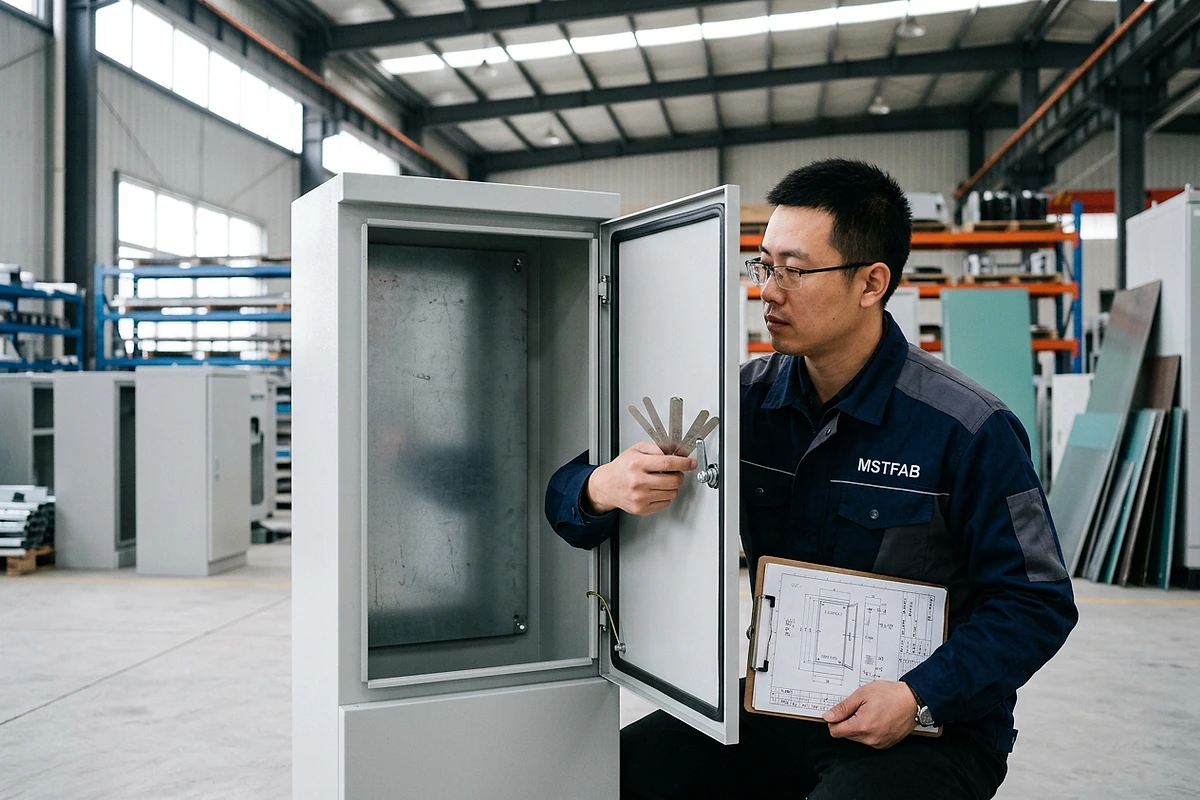
Figure 3: Quality control technician inspecting the perimeter gasket sealing land and door frame interface on an EV fast charger cabinet at MSTFAB.
6. Manufacturing Workflows: CNC Punch-Louvering, Press Brakes, and FIP Gasketing
Fabricating high-performance EV charger air filter frames requires specialized sheet metal equipment capable of stamping precision louvers, bending tight-tolerance slide channels, and applying automated seamless gaskets:
MSTFAB’s 5-Stage Precision Manufacturing Workflow:
- CNC Turret Punch & Fiber Laser Combination: We utilize Trumpf punch-laser combination machines. Progressive louver forming tools punch and form 45-degree louvers in a single continuous stroke, ensuring uniform louver blade depth (+/- 0.15 mm) and crisp, burr-free air opening perimeters. Fiber laser cutting then profiles the outer perimeter and mounting slots with zero thermal distortion.
- Multi-Axis CNC Press Brake Forming: 7-axis servo-electric press brakes form the intricate U-channel slide tracks and hat-channel perimeter stiffeners. Real-time laser angle compensation guarantees bend angle accuracy within +/- 0.3 degrees, preventing binding along the full 600 mm filter slide length.
- Robotic TIG & Spot Welding: Corner seams are continuously TIG welded under pure argon shielding to guarantee watertight integrity. Internal safety mesh screens and stiffener gussets are joined using inverter resistance spot welding with zero surface burn marks.
- 5-Stage Zirconium Nanotechnology Pretreatment & Powder Coating: Aluminum frames receive automated deoxidizing and trivalent chromium or zirconium silane conversion; steel frames receive 5-stage hot alkaline wash and zirconium rinsing. Superdurable architectural TGIC powder coating (RAL 7035 / RAL 9005) is applied electrostatically, cured at 200°C for 2,500+ hours ASTM B117 salt fog defense.
- Automated CNC Polyurethane Foam-in-Place (FIP) Gasketing: A 3-axis dispensing robot applies a continuous micro-cellular polyurethane gasket bead directly into the frame perimeter channel. The jointless seal cures with < 4.5% compression set (ASTM D395), ensuring permanent IP54 / NEMA 3R ingress protection.

Figure 4: Quality technician checking dry film thickness (DFT) on powder-coated ventilation and enclosure components at MSTFAB per ASTM D7091 standards.
7. DFMEA Quality Matrix: Failure Modes in EV Charger Filtration Frames
To assist EV charger mechanical engineering teams during design validation, MSTFAB outlines our Failure Mode and Effects Analysis (DFMEA) for outdoor air filtration frames:
| Failure Mode | Root Cause | Severity | MSTFAB Engineering Prevention & Control |
|---|---|---|---|
| Water Ingress into Power Bay | Wind-driven rain bypassing straight louvers or missing weep slots | Critical (1,000V DC short circuit) | 45-degree downward louvers with 18 mm overhang lips + expansion settling chamber + baffled bottom drainage weep slots. |
| Charger Thermal Power Derating | Excessive intake static pressure drop (> 65 Pa) choking fans | High (Charging speeds drop from 350kW to 120kW) | Aerodynamic louver tooling maintaining > 54% free area ratio; clean pressure drop held strictly < 38 Pa at 2.0 m/s face velocity. |
| Filter Pleat Tearing During Service | Sharp sheet metal burrs inside U-channel slide tracks | High (Unfiltered road dust enters SiC electronics) | Rotary brush deburring of all sheet edges; 15-degree flared lead-in lips on slide channels. |
| Excessive Acoustic Noise (> 65 dBA) | High face velocity (> 3.0 m/s) and sharp-edged louver vortex shedding | Moderate (Fails municipal noise permits) | Expanded frontal intake area sizing maintaining face velocity < 2.0 m/s; radiused louver lip profiles. |
| Door Sag & Hinge Binding | Heavy steel filter assembly overloading cantilevered door | Moderate (Door leaks, technician cannot open) | 5052-H32 aluminum construction (66% lighter); integrated hat-channel stiffening ribs. |
| Filter Bypass Air Leakage | Inadequate clamping compression along filter perimeter | High (Contaminants bypass filter media) | Automated CNC polyurethane FIP gasket on rear seating land; calibrated quarter-turn cam latches with 30% compression. |
8. Real-World Case Study: 450 Sets HPC 350kW Air Filter Frames for European Network
Client Problem & Field Challenge:
A leading European high-power charging network operator rolling out 350 kW liquid-cooled DC fast chargers along motorways in Germany and Norway encountered severe field reliability issues. Their original supplier utilized flat punched steel grilles with 18 machine screws per filter frame. During winter storms, horizontal driving snow and salt spray penetrated the filters, triggering insulation resistance grounding faults on 1,000 V DC busbars. Furthermore, filter servicing took 25 minutes per charger, costing the network over EUR 140,000 annually in excess field maintenance labor.
MSTFAB’s Turnkey DFM Redesign:
- Aerodynamic 5052-H32 Aluminum Louver Assembly: Engineered a 45-degree roll-formed louver panel with an integrated settling chamber and gravity drainage weep slots, slashing intake pressure drop from 68 Pa to 34 Pa at 1,800 CFM.
- Tool-Less Quarter-Turn Slide System: Designed dual U-channel slide tracks with captive spring-loaded quarter-turn cam latches, slashing filter replacement time from 25 minutes to just 40 seconds per unit.
- Automated FIP Polyurethane Gasketing: Dispensed seamless continuous polyurethane foam gaskets, certified to IP54 / NEMA 3R ingress standards under high-pressure water spray testing.
- Rapid Turnaround & Volume Delivery: Delivered 4 prototype verification sets in 6 business days. Manufactured, powder coated in Tiger Drylac RAL 7035 superdurable polyester, and export-packaged all 450 production sets in 18 business days.
Financial & Operational Outcome: The redesigned air filter mounting frames eliminated 100% of moisture grounding faults across two consecutive Nordic winters. Field maintenance labor was reduced by 85%, and delivered unit cost was 44% lower than local European fabrication quotes, saving the client over EUR 68,000 in direct procurement spend.
Particulate Loading Kinetics & Differential Pressure IoT Telematics
High-power DC fast charging plazas are situated in demanding particulate environments: highway road corridors, dense urban centers, and arid logistics depots. Highway air contains high concentrations of mineral dust, carbon soot from diesel exhaust, airborne tire rubber fragments, and conductive metallic brake dust. The cumulative dust mass ingested by an EV charger is governed by continuous integration:
Consider a 350 kW charger operating with an average continuous airflow of 1,800 CFM (3,058 m³/hour) in a highway corridor with average ambient PM10 particulate loading of C_air = 85 micro-grams / m³. Over 180 days of continuous operation, the total volume of air processed exceeds 13,200,000 cubic meters, capturing over 1,120 grams (1.12 kg) of solid dust directly onto the filter media face.
The Danger of Conductive Brake Dust Infiltration: Ordinary atmospheric dust is largely silica and organic matter. However, roadside particulate contains up to 15% to 22% metallic iron and copper particles shed from vehicle friction brakes. If an inferior filter frame allows air bypass around the edges, this fine conductive particulate settles onto internal high-voltage PCB inverter boards (operating at up to 1,000 V DC). In humid conditions, conductive bridging across creepage distances induces catastrophic electrical flashover, arc faults, and inverter destruction.
Integration of Differential Pressure IoT Transducer Ports:
To eliminate unnecessary scheduled truck rolls while preventing power derating, modern EV charging networks implement condition-based filter maintenance via OCPP 2.0.1 IoT telemetry. MSTFAB integrates dual precision pressure sensing tap ports directly into the sheet metal frame:
- Upstream Dynamic Port: Measures static atmospheric intake pressure immediately behind the exterior 45-degree louvers.
- Downstream Plenum Port: Measures negative suction pressure inside the clean air fan chamber.
- Automated Service Trigger: When differential pressure climbs from a clean baseline of 35 Pa to a threshold of Delta_P >= 110 Pa (0.44 in. w.g.), the charger’s onboard controller automatically logs a predictive maintenance ticket, alerting field service to schedule a filter swap before power thermal derating occurs.
Thermal Expansion Mismatch (Delta_L = alpha * L * Delta_T) in Multi-Material Door Assemblies
A critical design trap in outdoor EV charger design is the thermal expansion coefficient mismatch between an aluminum filter mounting frame and a steel access door. Consider a large fast-charger door (1,400 × 800mm) manufactured from 2.0 mm galvannealed steel, onto which a 5052-H32 aluminum air filter frame (1,200 × 600mm) is bolted:
In desert, Mediterranean, or high-solar environments, ambient operating temperatures swing from a winter night low of -25 deg C to a direct solar-heated exterior summer panel peak of +85 deg C (Delta_T = 110 K). Over a 1,200 mm mounting span:
The Bimetallic Buckling Distortion: If the aluminum frame is rigidly fastened to the steel door with standard round tight-clearance holes, this 1.60 mm thermal differential creates a bimetallic strip effect. The resulting shear load on corner mounting studs exceeds 1,800 N, resulting in:
- Oil-canning visual buckling and wrinkling of the exterior cosmetic door skin.
- Uneven gap expansion along perimeter door seals, causing IP54 water leaks.
- Hole elongation, stud thread shear, and stripped PEM fasteners.
MSTFAB’s Kinematic Floating Mount DFM: To eliminate thermal buckling, MSTFAB incorporates radial slotted mounting cutouts (Length = Bolt Diameter + 3.0 mm) oriented along expansion vectors, paired with stainless steel shoulder screws, PTFE low-friction glide washers, and Belleville disc spring washers. The spring washers provide constant clamping tension while allowing the aluminum frame to expand smoothly relative to the steel door without warping.
Comprehensive 12-Point DFM & Tolerance Checklist for EV Charger Filter Frames
To ensure high-yield manufacturing and flawless field assembly, mechanical CAD drawings should conform strictly to MSTFAB’s 12-point Design for Manufacturability (DFM) rules:
| DFM Feature | Design Guideline / Specification | Risk Avoided |
|---|---|---|
| 1. Louver Overhang Pitch | Louver Depth >= 18 mm; Vertical Pitch <= 32 mm | Prevents horizontal wind-driven rain from bypassing blade overlap into cabinet. |
| 2. Slide Channel Clearance | Width = Nominal Filter Thickness + 3.5 mm (+/- 0.5 mm) | Eliminates filter pleat jamming while preventing bypass air gaps around edges. |
| 3. Lead-In Flared Lips | 15-degree outward flare (R >= 2.0 mm) on guide track entry | Stops sharp metal edges from snagging cardboard filter frame during insertion. |
| 4. Bottom Drainage Pitch | Minimum 5-degree slope toward exterior weep slots | Prevents standing water puddles that freeze in winter or rust bottom edges. |
| 5. Gasket Land Surface Width | Continuous flat sealing land Width >= 12.0 mm | Ensures 100% continuous contact width for automated CNC polyurethane FIP gasket. |
| 6. Finger-Proof Safety Mesh | Expanded stainless mesh with aperture < 6.0 mm (UL 2202) | Prevents contact with live busbars when filter is removed during maintenance. |
| 7. Captive Hardware Integration | Southco-style quarter-turn fasteners or captive thumbscrews | Eliminates dropped and lost screws during roadside field servicing. |
| 8. Grounding Stud Masking | Silicone cap masking over M6 copper-plated weld studs | Guarantees < 0.05 ohm ground continuity to comply with UL 508A electrical safety. |
| 9. Minimum Bend Radii (5052-H32) | R >= 1.0 * t (2.0 mm radius for 2.0 mm sheet) | Prevents tension micro-cracking and loss of fatigue life along bend lines. |
| 10. Slotted Thermal Mounts | Radial slotted cutouts (Length = D_bolt + 3.0 mm) | Prevents bimetallic door buckling across -25°C to +85°C temperature swings. |
| 11. Powder Coating Thickness | Dry film thickness 75 to 100 microns (ASTM D7091) | Guarantees 2,500+ hours ASTM B117 salt fog defense against de-icing highway salts. |
| 12. Dimensional Tolerances | ISO 2768-mK (+/- 0.25 mm on overall envelope) | Ensures rapid drop-in fit onto charger doors on high-speed factory assembly lines. |
Tooling Economics & Total Cost of Ownership: Stamping vs. CNC Punch-Laser Lines
When launching a new fast-charger product platform, procurement teams frequently evaluate whether to invest in dedicated stamping dies or leverage flexible digital CNC manufacturing:
| Cost & Operational Factor | Hard Tooling Stamping House | MSTFAB Digital CNC Punch-Laser Line |
|---|---|---|
| Tooling Capital NRE | 24,000 to45,000 for progressive louver dies | 0.00 (Standardized Trumpf louver tooling) |
| Tooling Lead Time | 12 to 16 weeks die build & tryout | 5 to 7 business days for production prototypes |
| Design Modification Cost (ECO) | 6,000 to 15,000 to modify hardened tool steel dies | 0.00 (Direct-to-machine CAD code update) |
| Minimum Order Quantity (MOQ) | 2,500 to 5,000 units minimum order | 25 to 500 units tailored to charging build contracts |
| Total 500-Unit Project Spend | 52,500 (105/unit including amortized NRE) | 26,250 (52.50/unit DDP finished) |
| Net Sourcing Savings | Baseline Reference | $26,250 Saved (50.0% Net Reduction) |
Washable Metal Mesh vs. Synthetic Pleated Cartridges: Lifecycle Analysis
When designing the slide-in filter frame channel dimensions, OEM mechanical engineers must determine whether the charging station will utilize disposable non-woven synthetic pleated cartridges or permanent washable metallic/polyurethane pre-filters. Each technology possesses distinct aerodynamic and lifecycle operational characteristics:
| Filtration Parameter | Disposable Pleated Synthetic (G4 / MERV 8) | Washable Multi-Layer Aluminum Mesh | Reticulated Open-Cell Polyurethane Foam |
|---|---|---|---|
| Particulate Arrestance Efficiency | 90% – 95% on particles > 3.0 µm | 60% – 70% (Stops insects, leaves, grit) | 75% – 85% (30 to 45 PPI foam grade) |
| Initial Clean Pressure Drop | 28 to 35 Pa at 2.0 m/s face velocity | 14 to 20 Pa (Ultra-low airflow restriction) | 22 to 30 Pa |
| Dust Holding Capacity (DHC) | High (180 to 250 g/m² media area) | Moderate (Requires frequent wash rinsing) | High (Deep pore particulate trapping) |
| Moisture & Water Tolerance | Cellulose sags when wet; synthetic polyester immune | 100% Water-repellent; acts as mist coalescer | Immune to water degradation; requires drying |
| Field Maintenance Method | Slide out old cartridge, slide in new (45 sec) | Pressure wash with mild detergent; blow dry | Compressed air blow-out or warm water wash |
| Recommended Architecture | Commercial highway charging networks | Stage 1 pre-filter for heavy mist environments | Municipal bus & fleet depot chargers |
Dual-Stage Hybrid Architecture: For coastal or extreme-particulate deployments, MSTFAB fabricates dual-track slide-in frames. The front track houses a 12.5 mm washable multi-layer expanded aluminum screen acting as an inertial water droplet coalescer and insect barrier, while the rear track houses a 50 mm deep high-capacity MERV 11 synthetic pleated cartridge. This hybrid layout extends the replacement service interval of the pleated filter from 3 months to over 12 months, slashing network operating costs by more than 60%.
Thermal CFD Plenum Modeling: 90-Degree Turning Loss & Inlet Vortex Prevention
Air drawn through a door-mounted louver and filter frame must abruptly turn 90 degrees upward into the power converter chamber. In poorly engineered sheet metal plenums, this sharp 90-degree turn creates massive turbulent recirculation eddies and non-uniform face velocity across the filter media:
Without aerodynamic guidance, an unvaned 90-degree sheet metal box turn carries a loss coefficient of K_elbow = 1.2 to 1.4. In addition, the air velocity concentrates heavily at the upper 30% of the filter face, causing localized dust saturation while the bottom 70% remains underutilized.
At MSTFAB, our sheet metal design incorporates curved aerodynamic turning baffles spot-welded into the plenum discharge throat. These internal guide vanes reduce the turning loss coefficient to K_elbow = 0.35, distributing airflow uniformly across 100% of the filter media area. This eliminates localized filter clogging, reduces fan motor electrical load by up to 140 Watts per cabinet, and prevents fan blade aerodynamic stall flutter that generates low-frequency humming noise.
Frequently Asked Questions: EV Charger Air Filter Mounting Frames
Q1: What filter media ratings are typically supported by MSTFAB mounting frames?
Our standard slide-in channels accommodate both European standard EN 779 / ISO 16890 coarse filters (G3, G4 / Coarse 65%) and North American ASHRAE 52.2 ratings (MERV 8 to MERV 13). Frames are custom sized to accept 25 mm (1-inch), 50 mm (2-inch), or 100 mm (4-inch) deep pleated media cartridges, as well as washable open-cell reticulated polyurethane foam and stainless wire mesh pre-filters.
Q2: How do you prevent water from freezing inside the drainage weep slots in winter?
In sub-zero winter climates, frozen meltwater can clog bottom drainage slots, creating an ice dam. We incorporate sloped collection troughs (minimum 5-degree pitch) that drain liquid rapidly before freezing occurs. For Arctic-grade chargers (-40 deg C), we provide mounting provisions for low-wattage PTC trace heating strips along the bottom drainage channel.
Q3: Why is 5052-H32 aluminum superior to galvanized steel for charger intake frames?
5052-H32 aluminum is 66% lighter than steel, preventing heavy cantilevered door sagging and hinge binding. In addition, when air intake louvers suffer cosmetic scratches from windblown gravel or road salt, aluminum naturally passivates into an invisible aluminum oxide barrier with zero red rust staining, ensuring pristine cosmetic appearance over a 15-year charger lifecycle.
Q4: How do you achieve an IK10 impact rating on stamped sheet metal louvers?
To withstand 20 Joules of mechanical impact (IEC 62262 IK10), we fabricate louvers from minimum 2.0 mm to 2.5 mm 5052 aluminum or 1.5 mm to 2.0 mm stainless steel. We engineer tight louver vertical spacing (pitch < 35 mm) with continuous internal triangular stiffening webs and hemmed louver return lips that resist inward crushing under heavy foot kicks or blunt impact strikes.
Q5: Can the air filter mounting frame be integrated directly into the charger access door?
Yes. MSTFAB provides two integration architectures: 1) Modular Bolt-In Filter Frame Assemblies that attach to customer door cutouts via welded weld studs; or 2) Monolithic Stamped Door Panels where louvers, slide channels, and perimeter stiffeners are formed directly into the door skin, eliminating assembly labor and secondary gasket joints.
Q6: How does MSTFAB ensure electrical ground continuity on powder-coated filter frames?
Under UL 508A and UL 2202, all exposed metal framing must maintain continuous ground bonding (< 0.1 ohms). We weld copper-plated grounding studs onto the frame and apply precision high-temperature silicone masking caps prior to powder coating. After curing, masks are removed to expose pristine conductive contact pads, verified 100% with digital milli-ohmmeters.
Q7: What is the typical Minimum Order Quantity (MOQ) and lead time?
Because we deploy flexible digital CNC punch-laser machines and press brakes, our production MOQ is just 25 to 50 sets, with rapid prototyping support for 1 to 5 verification units. Prototypes are fabricated in 5 to 7 business days, and production batches are completed within 14 to 20 business days.
Q8: How are filter frames packaged for damage-free international freight?
Every frame is wrapped in low-tack protective electrostatic film, nested in high-density CNC-milled EVA foam cradles, and sealed inside heavy-duty ISPM-15 certified plywood crates with desiccants and moisture-barrier foil bags, guaranteeing factory-perfect condition upon arrival at your assembly plant.
Q9: How do you verify continuous perimeter seal compression across the filter frame?
During First Article Inspection (AS9102), MSTFAB utilizes thin-film tactile pressure sensor arrays (such as Fujifilm Prescale pressure-indicating films) inserted between the filter gasket and the sheet metal frame. When the quarter-turn retaining latches are engaged, the sensor film reveals the exact contact pressure distribution (target 0.15 to 0.25 MPa), ensuring zero low-pressure voids where bypass air or moisture could infiltrate.
Q10: Are the filter frames compatible with motorized intake louvers or active shutters?
Yes. For extreme cold-climate charging dispensers where internal cabinet temperatures must be preserved during idle winter periods, MSTFAB fabricates filter mounting frames integrated with 24V DC motorized modulating dampers or spring-return thermal shutters. The assembly mounts as a single pre-wired modular cassette, sealing the intake shut when fans are inactive and opening within 1.5 seconds upon charging initiation.
Verified Engineering Standards & Regulatory References:
- UL 900 Standard for Air Filter Units – Flame propagation and smoke generation standards for enclosure air filters.
- ISO 16890 Air Filters for General Ventilation – Particulate matter filtration efficiency classification (ePM1, ePM2.5, ePM10).
- NEMA 250 Enclosures for Electrical Equipment – Type 3R weather-resistant louver and water-shedding design guidelines.
- ASTM A653 Zinc-Coated (Galvanized) Steel Sheet – Corrosion-resistant steel specifications for exterior ventilation frames.
Request a 24-Hour DFM Review & EV Charger Filter Frame Quote
Partner with MSTFAB for your custom sheet metal EV charger air filter mounting frames and ventilation assemblies. Submit your 3D CAD files (STEP, DXF, or PDF) to receive an immediate engineering review, aerodynamic pressure drop assessment, and precise volume pricing within 24 hours.
 WeChat Contact
 WhatsApp Me Directly