⚡ Direct Answer: Is IATF 16949 Required for Industrial Machinery Enclosures?
No. By official IATF eligibility rules, IATF 16949 certification is strictly reserved for suppliers of automotive production parts that are physically installed onto serial production road vehicles. Industrial machinery enclosures, factory automation PLC cabinets, test bench housings, and manufacturing line guards are classified as capital manufacturing equipment (tooling/facilities). Therefore, the legally governing and internationally accepted quality standard for machinery enclosure fabricators is ISO 9001:2015, supplemented by automotive-grade quality disciplines like PPAP Level 2/3, First Article Inspection (FAI), and Cpk capability studies when requested by automotive equipment buyers.
Scope Demarcation: Vehicle Parts vs. Factory Machinery Enclosures
| Quality & Standard Aspect | Serial Automotive Parts (IATF 16949 Mandate) | Machinery & Automation Enclosures (ISO 9001) |
|---|---|---|
| 1. End Application | Serial production vehicles (chassis, brackets, EV battery trays) | Plant equipment, robotics control cells, conveyor guards, assembly test benches. |
| 2. Certifying Scope Eligibility | Eligible for formal IATF 16949 registrar audit | Ineligible for direct IATF audit (Standard explicitly excludes capital plant tooling). |
| 3. Primary Quality Management | IATF 16949:2016 third-party certificate | ISO 9001:2015 third-party certificate with full material traceability. |
| 4. Automotive Core Tools Usage | Mandatory across all part numbers (APQP, MSA, SPC, FMEA, PPAP) | Applied selectively based on OEM contract requirements (PPAP Level 3, FAI reports). |
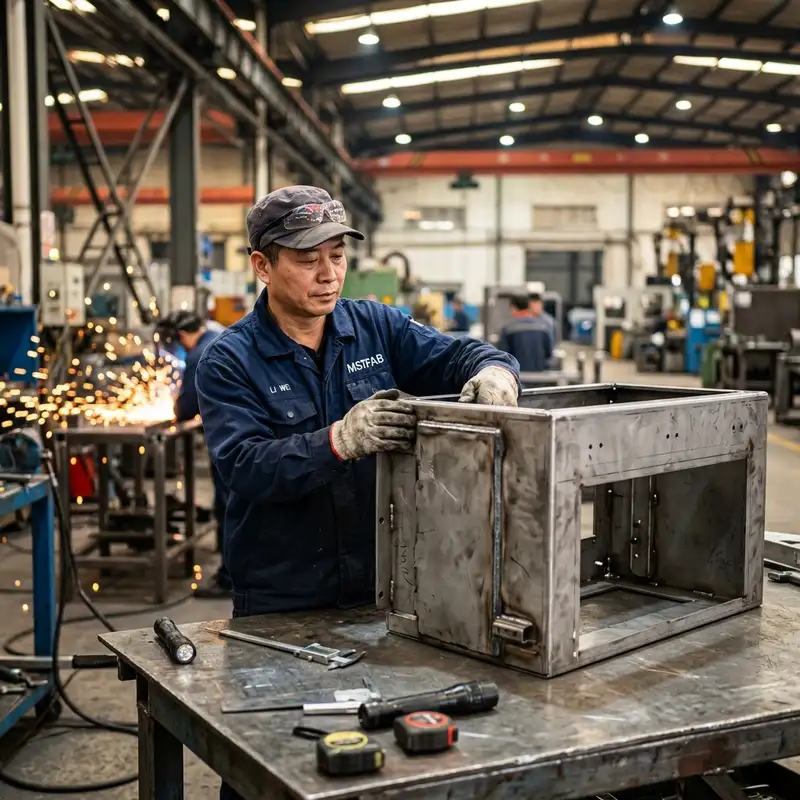
What Automotive Line Builders Actually Need from an Enclosure Supplier
When automotive plant engineers procure electrical and machinery control enclosures, they do not need an IATF certificate; they need automotive-level execution discipline:
- Full Dimensional FAI Reports: 100% ballooned print verification with CMM scan data showing that mounting bolt patterns, conduit entry gland plates, and interlock door switches meet ±0.20mm tolerances.
- Welding Structural Integrity: Certified welders complying with AWS D1.1 / EN ISO 15614 structural welding procedures to ensure heavy machine vibration will never cause weld seam rupture.
- Industrial Paint Durability: Powder coatings verified to withstand exposure to industrial hydraulic fluids, cutting coolants, and machine oils (MEK rub test > 100 double rubs).
- Safety Compliance & Grounding: Continuity testing (< 0.1 Ω) between all removable doors, gland plates, and internal sub-panels per NFPA 79 / IEC 60204-1 machine safety codes.

Source Automotive-Grade Machinery Enclosures with Confidence
MSTFAB provides turnkey sheet metal fabrication for industrial automation, robotics cells, and assembly line enclosures with complete ISO 9001 and PPAP documentation.
Frequently Asked Questions on IATF & Machinery Enclosures
Can MSTFAB provide a PPAP package without having an IATF certificate?
Yes. PPAP (Production Part Approval Process) is an engineering submission methodology used across aerospace, medical, and industrial sectors. MSTFAB regularly supplies complete Level 2 and Level 3 PPAP packages under our ISO 9001:2015 quality management system.
What standard governs electrical safety for machine tool enclosures?
In North America, industrial machinery electrical enclosures must comply with NFPA 79 and UL 508A. In Europe and international markets, the governing standard is IEC 60204-1 (Safety of machinery – Electrical equipment of machines).
 WeChat Contact
 WhatsApp Me Directly