What critical DFM and RFQ standards govern custom laser cut sheet metal procurement?
Successful procurement of custom laser cut parts requires submitting complete CAD packages (1:1 scale clean DXF/DWG flat patterns paired with 3D STEP models and fully toleranced 2D PDFs), maintaining minimum hole-to-thickness aspect ratios (d ≥ 1.0t for carbon steel, d ≥ 1.2t for aluminum/stainless) to prevent piercing blowout, specifying assist gas based on post-processing (high-pressure nitrogen for oxide-free weld/paint prep; oxygen for economical heavy plate), designing shared cut lines and micro-tab stabilization for nesting efficiency, and verifying cut edge perpendicularity and tolerances compliant with ISO 9013 Class 1 (±0.05 mm to ±0.10 mm).
1. The Purchasing Perspective: Streamlining the Sheet Metal RFQ Workflow
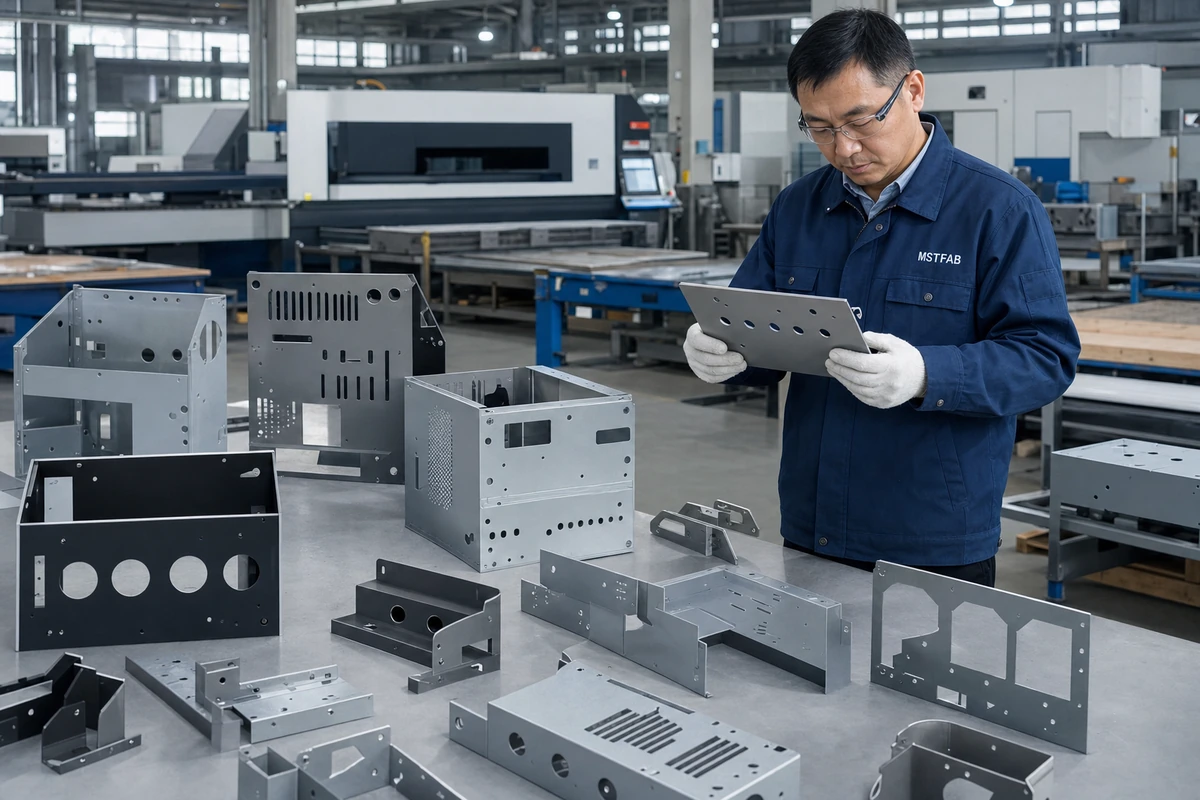
In modern industrial procurement, laser cutting represents the foundational manufacturing gateway for almost every sheet metal enclosure, bracket, chassis, and machine frame. Flaws or ambiguities introduced during the Request for Quotation (RFQ) and flat pattern generation phase propagate through downstream CNC press brake bending, hardware insertion, welding, and surface coating—triggering unexpected lead time delays and costly revision cycles.
Procurement professionals and mechanical designers who master Design for Manufacturability (DFM) specific to high-power fiber laser cutting can drastically reduce part costs, eliminate quote turnaround delays, and guarantee first-article dimensional compliance from prototype quantities through high-volume production runs.
2. Essential File Formats for Accurate Quoting
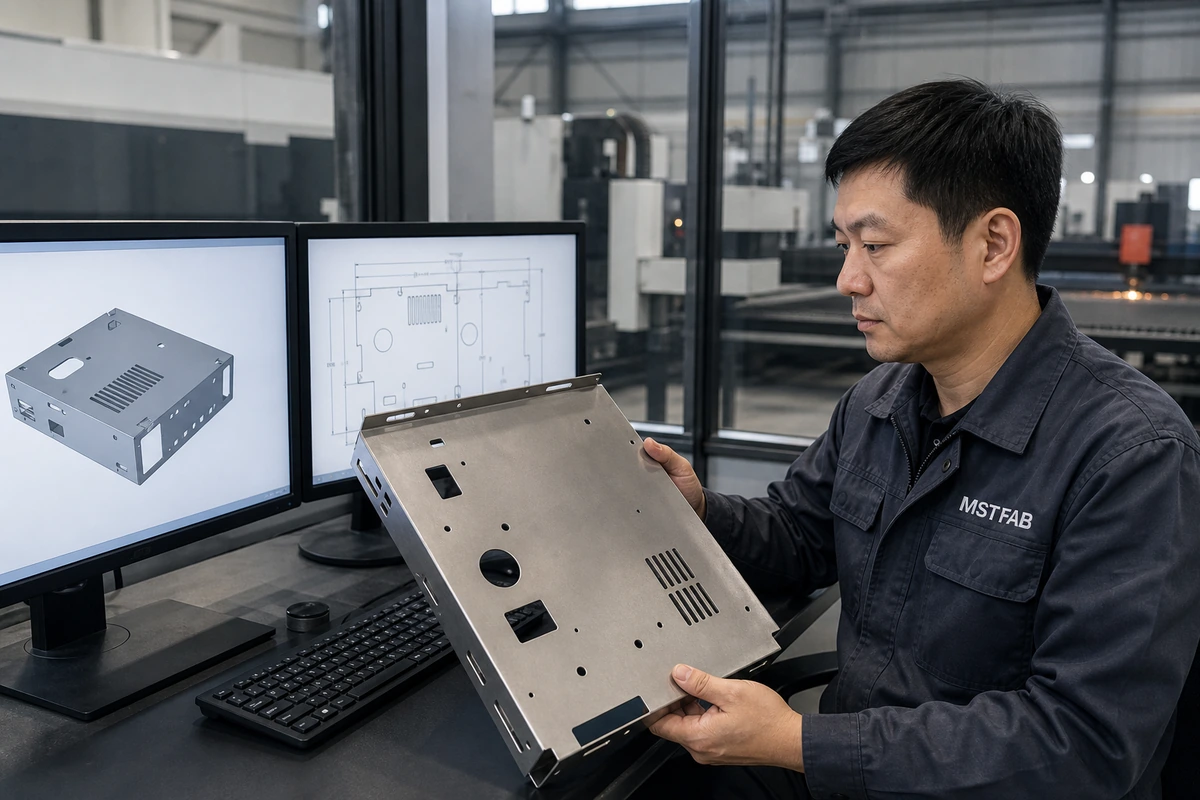
To obtain an instant, accurate quotation without back-and-forth engineering clarification, buyers must provide a complete Three-File Manufacturing Package:
- 1:1 Flat Pattern DXF/DWG: The DXF must contain only continuous, closed cut-loop perimeters on a single layer. It must be free of title blocks, border lines, dimension text, bend callout lines, or open contours. All internal geometries must represent true 1:1 scale (in millimeters).
- 3D CAD Model (STEP / IGES): Allows manufacturing engineers to inspect the finished folded part, verify flange returns, simulate press brake tooling collisions, and validate K-factor bend allowances.
- 2D Engineering Drawing (PDF): Defines critical-to-quality (CTQ) dimensions, GD&T datum references, material alloy and temper (e.g., 5052-H32 vs. 6061-T6), finish specifications (e.g., RAL powder coat, clear anodize), and hardware installation callouts.
3. Geometric DFM Rules for Laser Cutting
Fiber laser beams focus immense power (typically 6 kW to 15 kW) into an optical spot size under 0.1 mm. However, thermal dynamics impose clear physical limitations on cut geometry:

- Minimum Hole Diameter: The minimum diameter of any laser-cut hole should equal or exceed sheet thickness: d ≥ 1.0t for carbon steel, and d ≥ 1.2t for aluminum and stainless steel. Piercing holes smaller than sheet thickness causes molten slag to reflect upward into the laser cutting nozzle, causing nozzle tip erosion, beam defocus, and tapered, out-of-round holes. For sub-thickness holes, laser-center-punching followed by secondary CNC drilling is recommended.
- Minimum Slot & Web Spacing: The minimum distance between two adjacent cutouts, or between a cutout and the sheet edge (the web ligament), must be at least equal to sheet thickness: w ≥ 1.0t. Narrower webs absorb excessive heat, resulting in localized melting, edge distortion, and thermal burn-through.
- Lead-In / Lead-Out Geometry: Every closed cut loop starts with a laser piercing point and lead-in line. Never place lead-ins on critical functional mating edges or cosmetic radii. MSTFAB cam software positions lead-ins in waste slugs or flat non-critical edges to eliminate pierce divots.

4. Assist Gas Selection: Nitrogen vs. Oxygen vs. High-Pressure Air
The choice of assist gas injected co-axially through the laser nozzle dictates cut speed, edge chemistry, and total part cost:
- High-Pressure Nitrogen (N2 / 16–22 bar): An inert mechanical purge. Nitrogen prevents molten metal oxidation, producing a 100% bright, bare metallic cut edge. This oxide-free edge is mandatory for stainless steel, aluminum, and any carbon steel parts requiring subsequent powder coating, electroplating, or precision TIG welding. Coatings adhere directly without secondary chemical or mechanical de-scaling.
- Oxygen (O2 / 0.5–2.5 bar): An exothermic reactive gas. Oxygen reacts with carbon steel, releasing substantial chemical heat that allows high-tonnage cutting of heavy carbon steel plate (up to 25 mm). However, it leaves a black, brittle iron-oxide layer. If powder coated without prior edge blasting or vibratory deburring, the paint will flake off along the cut seam.
- High-Pressure Compressed Air (Filtered & Dried / 14–18 bar): Composed of ~78% nitrogen and ~21% oxygen. For gauge-thickness mild steel (0.8 mm to 2.5 mm), shop air cutting offers the lowest operating cost per meter while delivering clean edges suitable for general industrial applications.
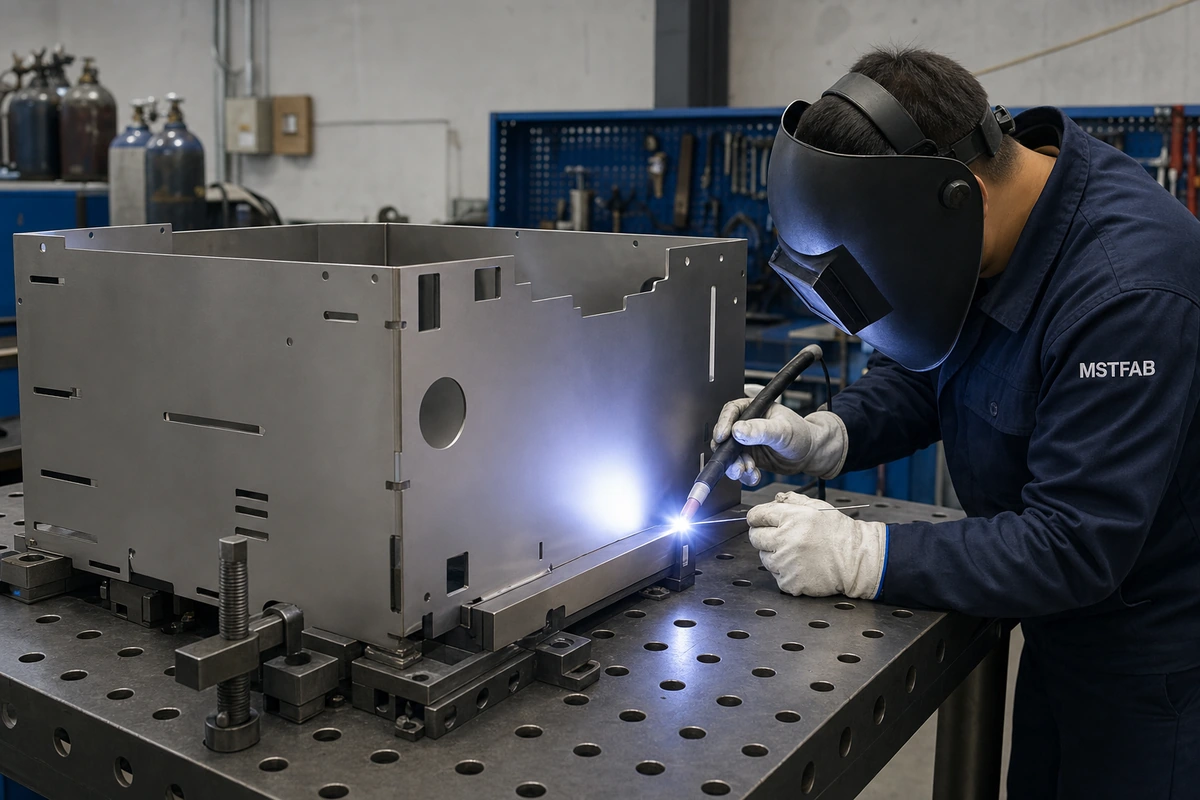
5. Integrated Post-Processing: Bending, Hardware & Welding
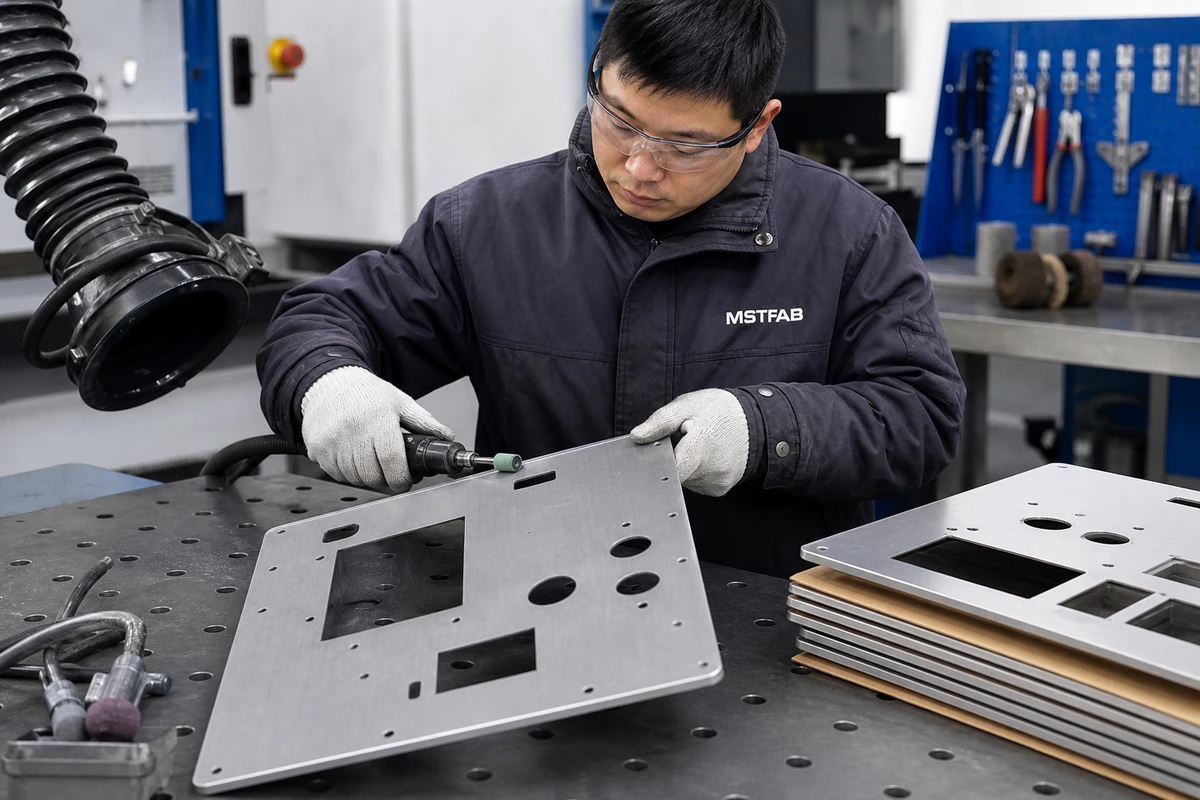
Laser-cut blanks rarely remain flat. They transition directly into downstream secondary fabrication cells:

- CNC Press Brake Bending: Laser cut holes must maintain a minimum distance from bend tangent lines: d ≥ 2.5t + r. Positioning holes closer to bend zones results in egg-shaped elongation during plastic forming.
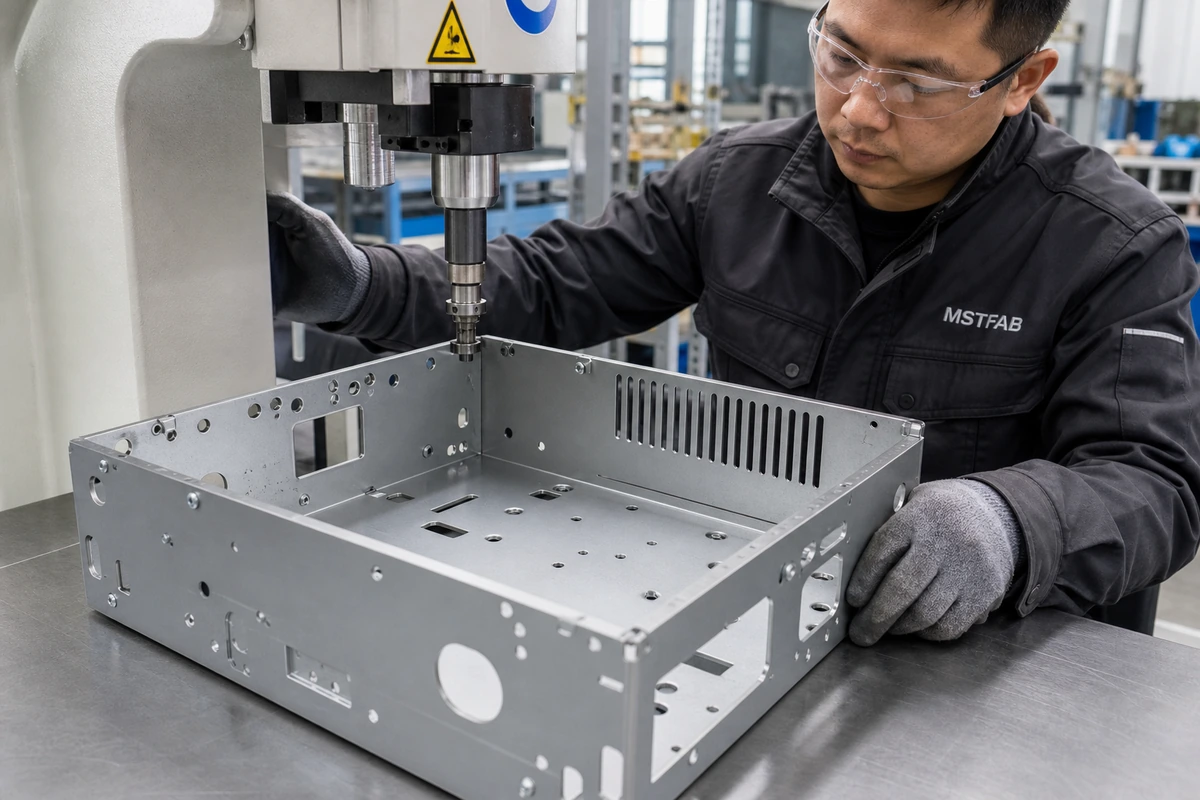
- Self-Clinching Fasteners (PEM Hardware): Clinch studs, standoffs, and nuts are installed on hydraulic insertion presses. Precision laser-cut pilot holes (±0.05 mm) ensure optimal metal displacement around the clinch collar, preventing push-out and torque-out failures.
6. Materials, Surface Finishes & Tolerance Matrix
MSTFAB processes a comprehensive spectrum of engineering sheet metals with standard commercial and precision tolerances:

| Material Category | Common Grades & Tempers | Thickness Range | Recommended Assist Gas | Standard Laser Tolerance |
|---|---|---|---|---|
| Cold Rolled Steel | ASTM A1008 CS Type B | 0.8 mm – 3.0 mm (22–11 ga) | High-Pressure Nitrogen (N2) | ±0.05 mm to ±0.10 mm |
| Hot Rolled Carbon Steel | ASTM A1011 HRPO / A36 Plate | 3.0 mm – 25.0 mm | Oxygen (O2) / Nitrogen | ±0.12 mm to ±0.25 mm |
| Stainless Steel | AISI 304/304L, 316/316L (2B, #4 Brush) | 0.8 mm – 15.0 mm | High-Purity N2 (99.999%) | ±0.05 mm to ±0.10 mm |
| Aluminum Alloy | 5052-H32 (Forming), 6061-T6 (Structural) | 1.0 mm – 12.0 mm | High-Pressure Nitrogen (N2) | ±0.08 mm to ±0.15 mm |
| Galvanized Steel | ASTM A653 G90 / Hot-Dip Galvanized | 1.0 mm – 4.0 mm | High-Pressure Nitrogen (N2) | ±0.08 mm to ±0.12 mm |
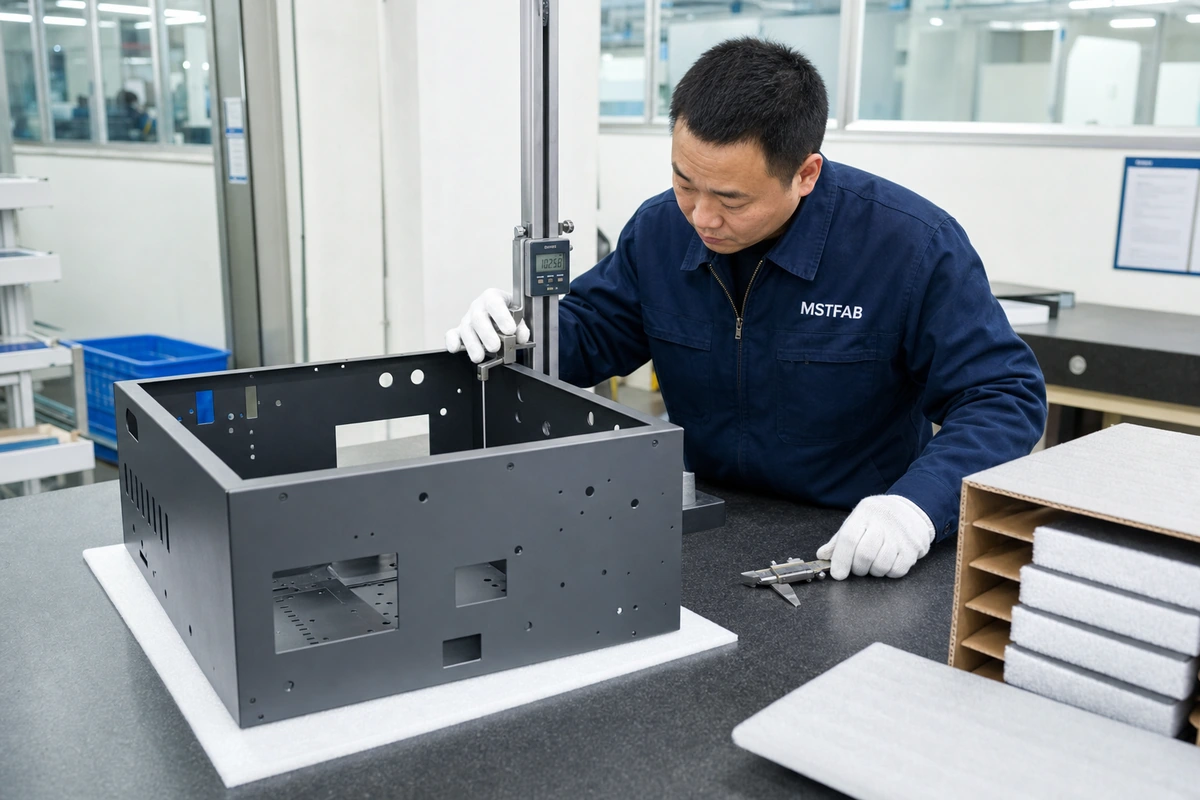
Ready to Source Precision Laser Cut Sheet Metal Parts?
Upload your 1:1 DXF flat patterns and 3D STEP files. MSTFAB provides high-speed fiber laser cutting (up to 15 kW), edge deburring, CNC press brake forming, hardware insertion, and complete turnkey finishing.
 WeChat Contact
 WhatsApp Me Directly