How do expert fabricators eliminate bend cracking and surface die scratches during custom aluminum sheet metal fabrication?
Eliminating defects in aluminum fabrication requires selecting formable alloys (5052-H32 for deep bends, reserving 6061-T6 for structural components with generous bend radii ≥ 3.0t to 4.0t), aligning critical bends perpendicular to sheet rolling direction, high-pressure nitrogen fiber laser cutting (18–22 bar) to prevent dross, protective polyurethane die film and mirror-polished tooling (Ra ≤ 0.2 μm) on CNC press brakes to prevent die gouges, dedicated AC TIG/MIG welding with ER5356/ER4043 wire following mechanical oxide removal, and MIL-DTL-5541 chemical conversion coating or Type II/III anodizing.
1. The Aluminum Dilemma: Lightweight Performance vs. Sensitive Formability
Aluminum is the premier engineering material across aerospace, medical electronics, telecommunications enclosures, and high-performance automotive sub-assemblies. Offering one-third the density of steel (2.70 g/cm3 vs 7.85 g/cm3), excellent strength-to-weight ratios, natural atmospheric corrosion resistance via an instantaneous aluminum oxide (Al2O3) surface layer, and outstanding thermal and electrical conductivity, aluminum is essential for modern lightweight equipment.
However, aluminum poses distinct manufacturing challenges that trip up inexperienced sheet metal shops: high optical reflectivity and thermal conductivity during laser cutting, low ductility and notch-sensitivity leading to outer-fiber cracking during press brake bending, extreme susceptibility to surface scratching and tool galling, and a tenacious oxide layer that complicates precision welding.
2. Alloy Selection: 5052-H32 vs. 6061-T6 vs. 3003-H14
Selecting the wrong aluminum alloy or temper is the number-one root cause of cracked flanges and failed prototypes. Engineers must understand the metallurgical distinctions:
- 5052-H32 (The Sheet Metal Workhorse): An aluminum-magnesium alloy (2.2%–2.8% Mg). It is non-heat-treatable, strain-hardened, and stabilized. 5052-H32 provides excellent formability, medium-to-high fatigue strength, superior marine atmosphere corrosion resistance, and excellent weldability. It can be bent to tight internal radii (1.0t to 1.5t) without outer-fiber cracking. It is the premier choice for custom electronic enclosures, chassis, brackets, and outdoor junction boxes.
- 6061-T6 (High-Strength Structural): An aluminum-magnesium-silicon alloy, precipitation heat-treated and artificially aged to maximum tensile strength (yield strength ≥ 276 MPa, tensile strength ≥ 310 MPa). While ideal for CNC machined components, 6061-T6 is brittle in sharp bending. Forcing a tight bend radius (≤ 2.0t) will cause severe micro-fracturing or complete corner snapping. If 6061 must be formed, specify IR ≥ 3.0t to 4.0t, or form in the annealed 6061-O temper and artificially age-harden to T6 post-forming.
- 3003-H14 (Cost-Effective & Highly Ductile): Alloyed with manganese (1.0%–1.5% Mn). Moderate strength, excellent deep-drawing capability, and exceptional corrosion resistance. Frequently used for fluid tanks, stamped covers, heat shielding, and HVAC ducting.
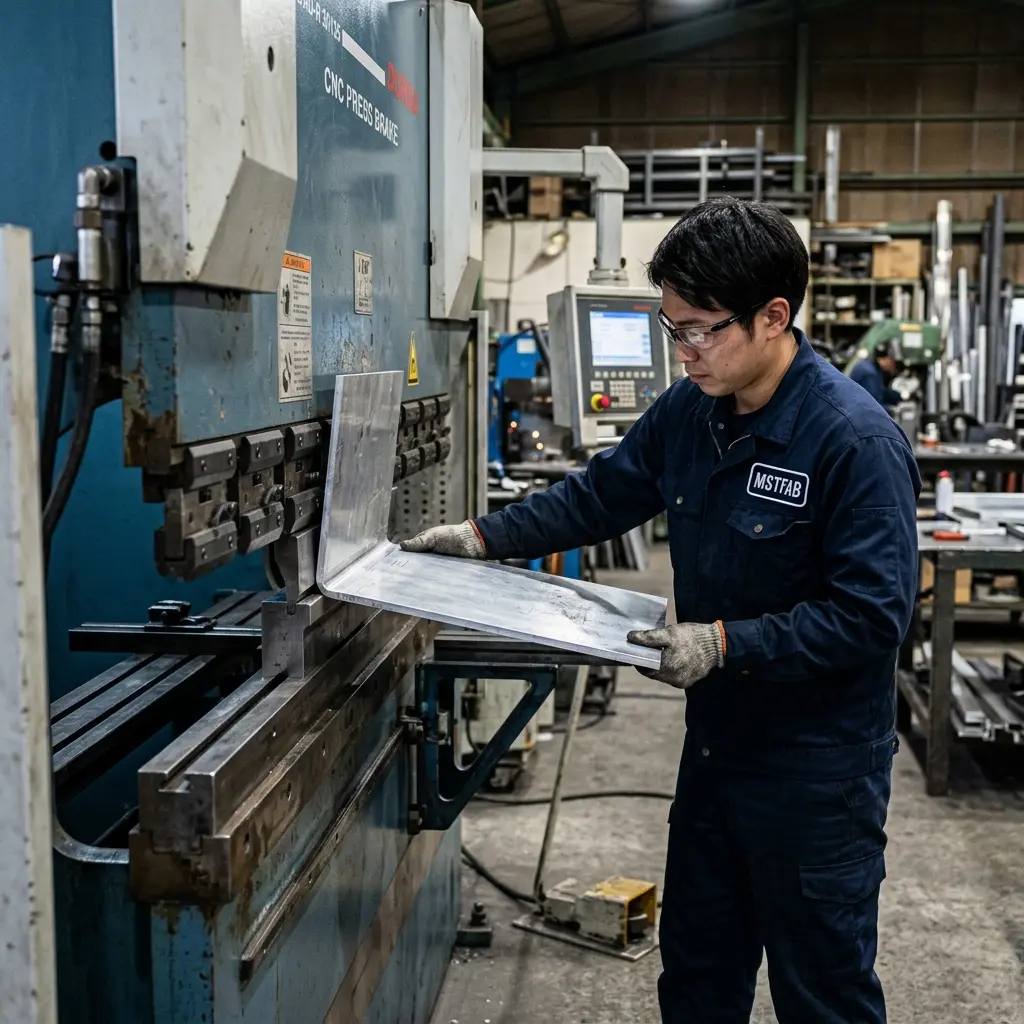
3. Preventing Bend Cracking: Grain Direction & Tooling Geometry
During cold sheet rolling at the aluminum mill, grain structures elongate in the direction of rolling. Bending aluminum parallel to this rolling direction concentrates tensile strain along longitudinal grain boundaries, initiating micro-tears that propagate across the bend corner.
To eliminate outer-fiber bend cracking, MSTFAB applies three core DFM standards:
- Transverse Nesting: CAD nesting software is configured to orient critical 90° structural bends perpendicular (or at least 45°) to the sheet rolling direction.
- Radius Sizing: Never specify a razor-sharp inside bend radius. Even on ductile 5052-H32, the punch radius should be equal to or greater than sheet thickness (r ≥ 1.0t). For 3.0 mm sheet, use a 3.0 mm punch tip rather than a standard 0.8 mm steel punch.
- Proper V-Die Width: Use a wider die opening (typically 8× to 10× material thickness) to reduce localized contact pressures and allow the aluminum to flow smoothly into the die trough without excessive tensile necking.
4. Eliminating Die Scratches & Surface Galling
Aluminum is significantly softer than tool steel (Brinell hardness ~60–95 HB vs tool steel > 500 HB). When bare aluminum sheet slides across steel V-die shoulders under hundreds of kilonewtons of force, microscopic aluminum particles adhere to the die shoulders—a phenomenon known as die galling. Once galled, the die acts like coarse sandpaper, gouging every subsequent part.
MSTFAB maintains strict tooling protocols to protect aluminum surfaces:
- Protective Urethane Die Tape: Heavy-duty, anti-marking polyurethane die tape (0.5 mm thick) is laid across the entire die length, isolating the aluminum sheet completely from metal-to-metal tooling contact.
- Protective Surface Film: Aluminum sheets are ordered from the mill with heavy blue or clear protective PE film. Secondary laser-cut blanks retain this film throughout CNC press brake forming and PEM hardware insertion, removed only prior to final chemical pretreatment.
- Mirror-Polished Tooling: Preshaped press brake punches and dies are polished to a mirror finish (Ra ≤ 0.2 μm) and kept clean of foreign metal debris.
5. Nitrogen Fiber Laser Cutting of Reflective Aluminum
Aluminum’s high optical reflectivity (reflecting > 90% of infrared radiation at room temperature) historically posed a severe risk of back-reflection damage to laser resonators. Modern fiber lasers operating at 1.07 μm wavelength, combined with back-reflection optical isolators, cut aluminum safely and with incredible speed.
However, aluminum’s thermal conductivity is nearly four times higher than carbon steel, dissipating heat rapidly away from the cut zone. To achieve clean, square cut edges without heavy underside dross or micro-burrs, MSTFAB cuts aluminum exclusively using high-purity nitrogen assist gas (18 to 22 bar). The high-velocity nitrogen blast evacuates molten aluminum instantly before it can solidify into dross on the lower kerf edge, eliminating labor-intensive secondary deburring.
6. AC TIG & MIG Welding: Oxide Stripping & Filler Alloy Matching
Welding aluminum requires overcoming a fundamental metallurgical paradox: the base aluminum metal melts at approximately 660° C, but the microscopic aluminum oxide (Al2O3) film on its surface melts at over 2060° C. Attempting to weld through this oxide film causes severe lack of fusion, tungsten contamination, and porous, structurally defective joints.
MSTFAB certified aluminum welders resolve this through rigorous process controls:
- Mechanical Oxide Removal: Joint seams are degreased with non-chlorinated solvent and wire-brushed using a dedicated stainless steel wire brush immediately prior to welding (within a 4-hour window) to strip surface oxides.
- AC TIG with Square-Wave Inverters: Welded with Alternating Current (AC). The electrode-positive (EP) half-cycle blasts away the tough refractory oxide film through cathodic cleaning, while the electrode-negative (EN) half-cycle directs intense heat into the base metal to achieve deep, clean penetration.
- Filler Alloy Selection:
- ER4043 (Al-Si): Contains 5% silicon. Lower melting temperature, superior puddle fluidity, reduced solidification shrinkage, and high resistance to hot cracking. Ideal for cosmetic welds and non-anodized assemblies.
- ER5356 (Al-Mg): Contains 5% magnesium. Provides higher shear and tensile strength, superior ductility, and importantly, matches the base metal color perfectly after sulfuric acid anodizing (whereas 4043 welds turn dark charcoal grey under anodizing baths).
7. Chemical Conversion & Anodizing Specification Matrix
Post-fabrication finishing protects aluminum from aggressive environmental degradation while enhancing electrical grounding or aesthetic appeal:
| Surface Treatment | Industry Specification | Key Characteristics | Ideal Application |
|---|---|---|---|
| Chemical Conversion (Chromate-Free) | MIL-DTL-5541 Type II Class 3 (RoHS/REACH) | Electrically conductive; low surface contact resistance (< 5000 μΩ); excellent paint primer base | EMI/RFI shielded enclosures, grounding chassis, server racks |
| Type II Sulfuric Anodizing (Clear / Color) | MIL-A-8625 Type II Class 1 (Clear) / Class 2 (Dyed) | Film thickness 8–25 μm; dielectric insulation; brilliant satin or dyed cosmetic appearance | Medical front panels, optical housings, audio faceplates |
| Type III Hardcoat Anodizing | MIL-A-8625 Type III Class 1 / Class 2 | Film thickness 40–60 μm; extreme micro-hardness (60–70 HRC equivalent); superior wear resistance | Industrial slide rails, pneumatic pistons, defense components |
| Architectural Powder Coating | AAMA 2604 / ASTM B117 (≥ 3000 hrs salt spray) | Electrostatic polyester/polyurethane 60–90 μm; UV resistant, impact resistant, textured finishes | Outdoor telecom cabinets, EV charging stations, solar enclosures |
Need Precision Scratch-Free Aluminum Sheet Metal Fabrication?
Partner with MSTFAB for crack-free 5052/6061 CNC bending, high-speed nitrogen fiber laser cutting, certified AC TIG welding, and MIL-spec chem-film and anodizing services.
 WeChat Contact
 WhatsApp Me Directly