Quick Answer: There is no single fixed ranking of China’s top metal casing companies for the electronics industry, because an aluminum instrument housing, a powder-coated steel controller enclosure, a stainless outdoor electronics cabinet, and an extruded PCB case are entirely different manufacturing projects. Before selecting a Chinese electronic casing manufacturer, you must evaluate their specific process capabilities, EMI shielding and grounding support, thermal-management integration, and environmental sealing. The best supplier is not the one with the lowest price; it is the manufacturer that understands how the metal casing interacts with your electronics, identifies interface risks before production, and supports its claims with controlled drawings, First Article Inspection (FAI), and a representative trial order.
What Does “Metal Casing” Mean in Electronics?

The term “metal casing” in electronics covers everything from rack-mount server chassis and robotics controller boxes to precision optical sensor housings. The casing must provide mechanical protection while simultaneously handling heat dissipation, electrical bonding, electromagnetic (EMI) shielding, and dust or water protection.
Material selection should begin with the complete product requirement. A general statement like “aluminum is better” is dangerous. You must match the metal to the specific manufacturing route.
Four Common Manufacturing Routes

- 1. Fabricated Sheet Metal Casings: Uses laser cutting and press-brake bending to form cold-rolled steel, galvanized steel, or aluminum sheet. Ideal for low-to-medium volumes and rectangular designs that may undergo revisions.
- 2. Extruded Aluminum Casings: Ideal for instruments and embedded computers sharing a constant cross-section (like integrated heat-sink fins and PCB rails) across various lengths.

- 3. CNC-Machined Metal Housings: Used for low-volume or premium electronic products requiring precision cavities, sealing grooves, or thick heat-spreader surfaces.
- 4. Die-Cast Metal Housings: Reserved for stable, high-volume demand where complex curved surfaces and internal bosses can justify the initial tooling cost.
The 7-Dimension Supplier Scorecard
Don’t rank your electronics housing suppliers by gut feel. Use this 7-dimension scorecard to evaluate their engineering depth:
Evaluate EMI Shielding, Bonding, and Grounding

A metal wall alone does not guarantee that an electronic product will pass electromagnetic compatibility (EMC) testing. Shielding behavior is heavily affected by seams, door gaps, ventilation openings, and conductive gaskets.
Coatings Can Interrupt Electrical Contact: Powder coating and anodizing can electrically isolate surfaces. The drawing must identify masked grounding areas, conductive conversion coatings, and bare contact zones. A steel casing is not automatically EMC-compliant if the panels cannot electrically bond to each other.
Review Thermal-Management Integration
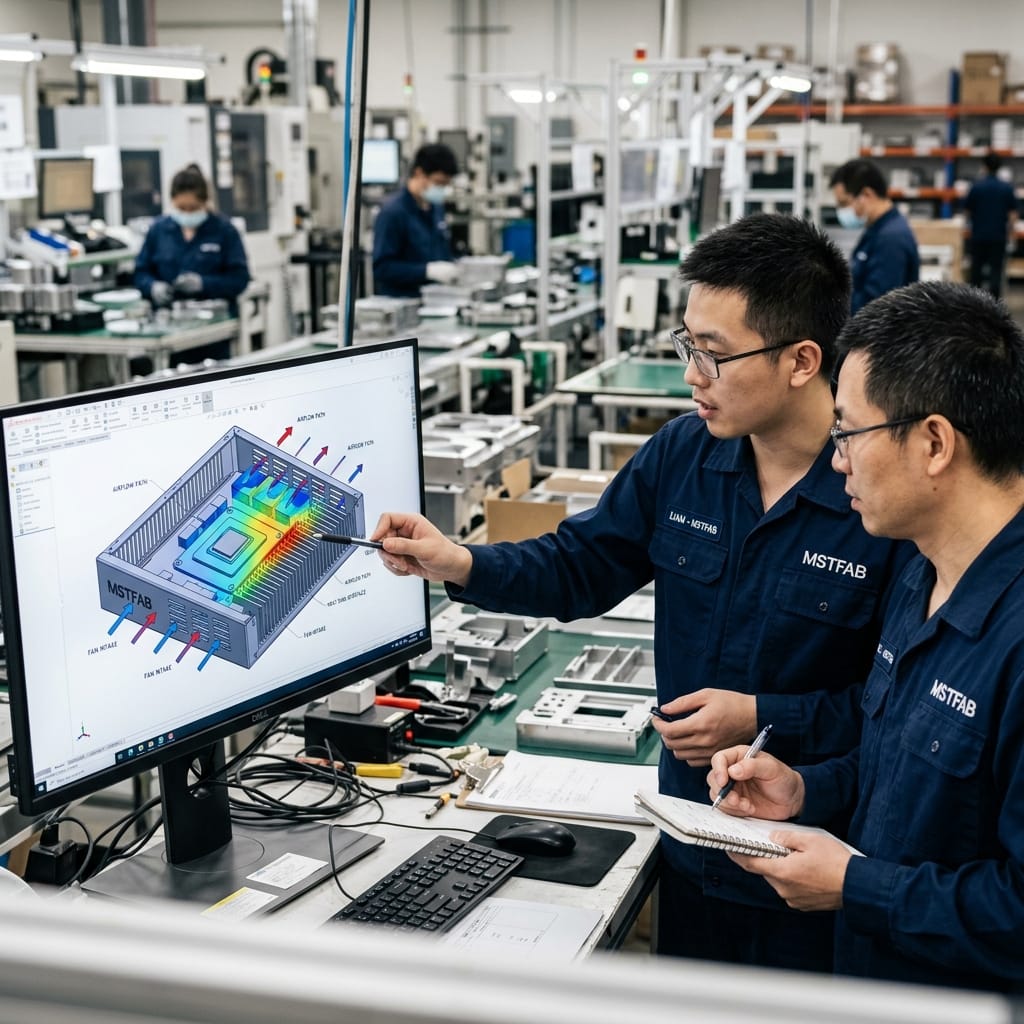
Metal casings contribute heavily to thermal management, but simply choosing aluminum over steel does not automatically solve heat problems. The supplier must fabricate accurate heat-sink interfaces, ventilation paths, and flat conductive mounting surfaces to ensure your electronics stay within operating temperatures.
Verify Sealing and Inspection (IP / NEMA)

IP and NEMA classifications should not be used as interchangeable marketing labels. A sealed casing may reduce water entry but increase internal temperature. Door and cover seals must be carefully matched to the compression method. Always demand a First Article Inspection (FAI) on a trial order to physically verify gasket compression and dimensional tolerances before authorizing a full production run.
Key Takeaways
- Match the casing design to the correct factory profile: Fabricated sheet metal, extruded aluminum, CNC machined, or die-cast.
- Cold-rolled steel provides excellent rigidity; aluminum offers lightweight thermal integration; stainless steel is necessary for harsh outdoor environments.
- Always verify that grounding points and EMI shielding interfaces are properly masked during the powder coating or anodizing process.
- Prove the supplier’s capability with a paid trial order and a rigorous First Article Inspection (FAI) focusing on mating tolerances and environmental sealing.
FAQ
What is the best metal for an electronics casing?
There is no universal best metal. Cold-rolled steel suits rigid chassis and cabinets. Aluminum suits lightweight, machined, or extruded products. Stainless steel suits corrosion-sensitive outdoor environments. The selection must follow your specific mechanical, thermal, and EMI requirements.
Is aluminum or steel better for EMI shielding?
Neither material is automatically better. Shielding performance depends on frequency, conductivity, magnetic properties, seams, openings, conductive gaskets, and electrical bonding between panels. The assembled product must be EMC tested.
Does powder coating affect grounding?
Yes, significantly. Powder coating is an electrical insulator. Grounding and bonding surfaces must be explicitly masked during the painting process to establish reliable electrical contact for safety and EMI shielding.
Is IP65 the same as NEMA 4X?
No. They belong to different enclosure classification systems. NEMA 4X includes specific requirements for corrosion resistance that IP65 does not automatically cover. Always use the rating required by your product design and destination market.
Can a casing manufacturer guarantee EMC compliance?
No. A manufacturer can fabricate the casing according to an EMC-focused design (masking grounds, fitting conductive gaskets), but complete EMC compliance depends entirely on the assembled electronics, cables, and internal operating configuration.
 WeChat Contact
 WhatsApp Me Directly