⚡ Direct Answer: Certificate of Conformance (CoC) vs. Mill Test Certificate (MTC / MTR)
The fundamental difference between a Certificate of Conformance (CoC) and a Mill Test Certificate (MTC / MTR EN 10204 Type 3.1) lies in empirical testing versus compliance assertion. A CoC is a fabricator-issued document declaring that finished parts meet the purchase order and drawing specifications without providing raw material chemical or mechanical test data. In contrast, an MTC (Mill Test Report) is an authenticated metallurgical test document directly from the primary steel or aluminum mill certifying exact heat-lot chemical composition (%C, %Cr, %Ni, %Mo), mechanical yield strength, tensile strength, and elongation verified under ISO 10474 / EN 10204 standards. Regulated applications (semiconductor, medical, marine, defense, and pressurized enclosures) legally mandate Type 3.1 MTRs linked to heat numbers, whereas commercial brackets and consumer enclosures typically require only a standard CoC.
In industrial sheet metal procurement, specifying the wrong level of material documentation can either lead to costly supply chain delays or fatal compliance rejections at European and North American customs. Sourcing custom chassis, brackets, and cabinets requires procurement managers and QA engineers to align part criticality with the appropriate European Standard EN 10204 inspection document level.
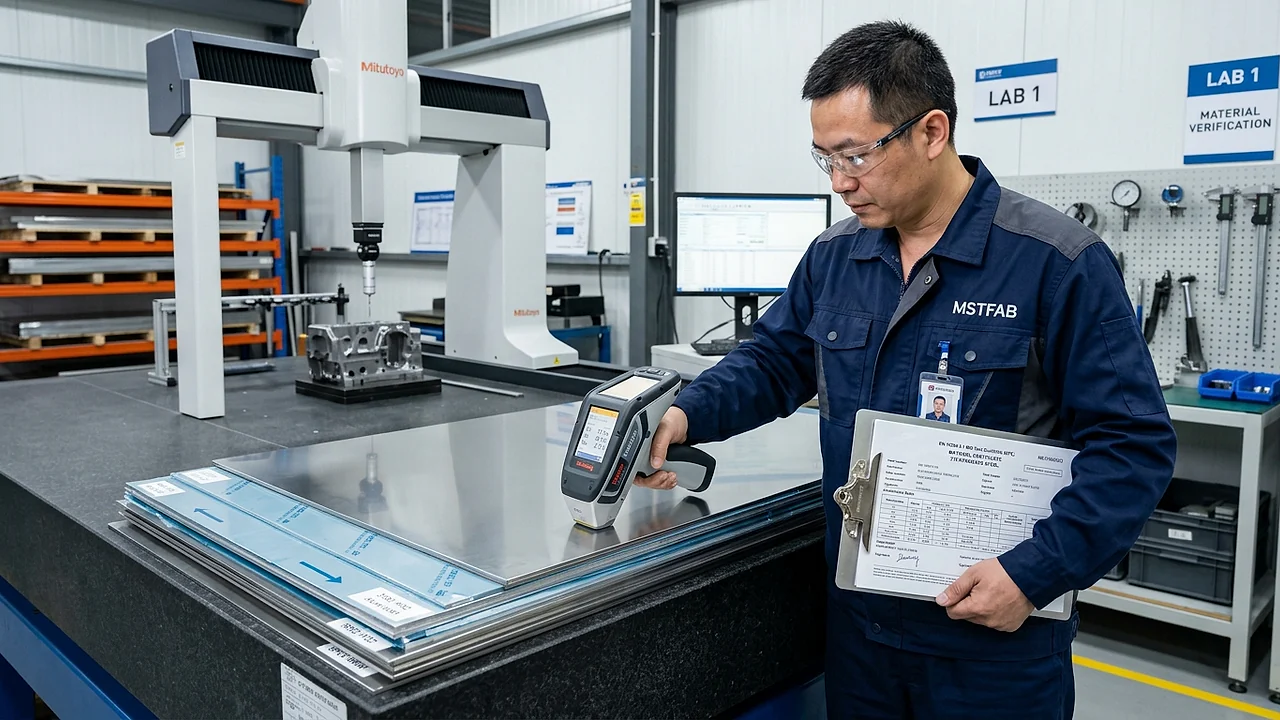
EN 10204 Inspection Document Levels Explained
The European standard EN 10204 defines four distinct tiers of inspection documents for metallic products. Knowing which tier your project requires prevents unnecessary testing fees while ensuring audit-proof traceability:
| EN 10204 Type | Document Title | Testing Basis | Validated By | Typical Sheet Metal Applications |
|---|---|---|---|---|
| Type 2.1 | Declaration of Compliance | None (general order compliance) | Manufacturer representative | Commercial covers, cable trays, consumer brackets |
| Type 2.2 | Test Report (Generic) | Non-specific mill inspection data | Manufacturer QA | Industrial cabinets, general telecom racks, ducting |
| Type 3.1 | Inspection Certificate (MTC/MTR) | Specific batch heat chemical & mechanical tests | Independent mill QA inspector | Medical equipment, food-grade 316L, marine, EV charging |
| Type 3.2 | Independent Inspection Certificate | Witnessed testing of specific lot | 3rd party (TUV, DNV, Lloyd’s Register) | Offshore oil & gas, nuclear, aerospace structural frames |

Key Information Contained in an EN 10204 3.1 Mill Test Certificate
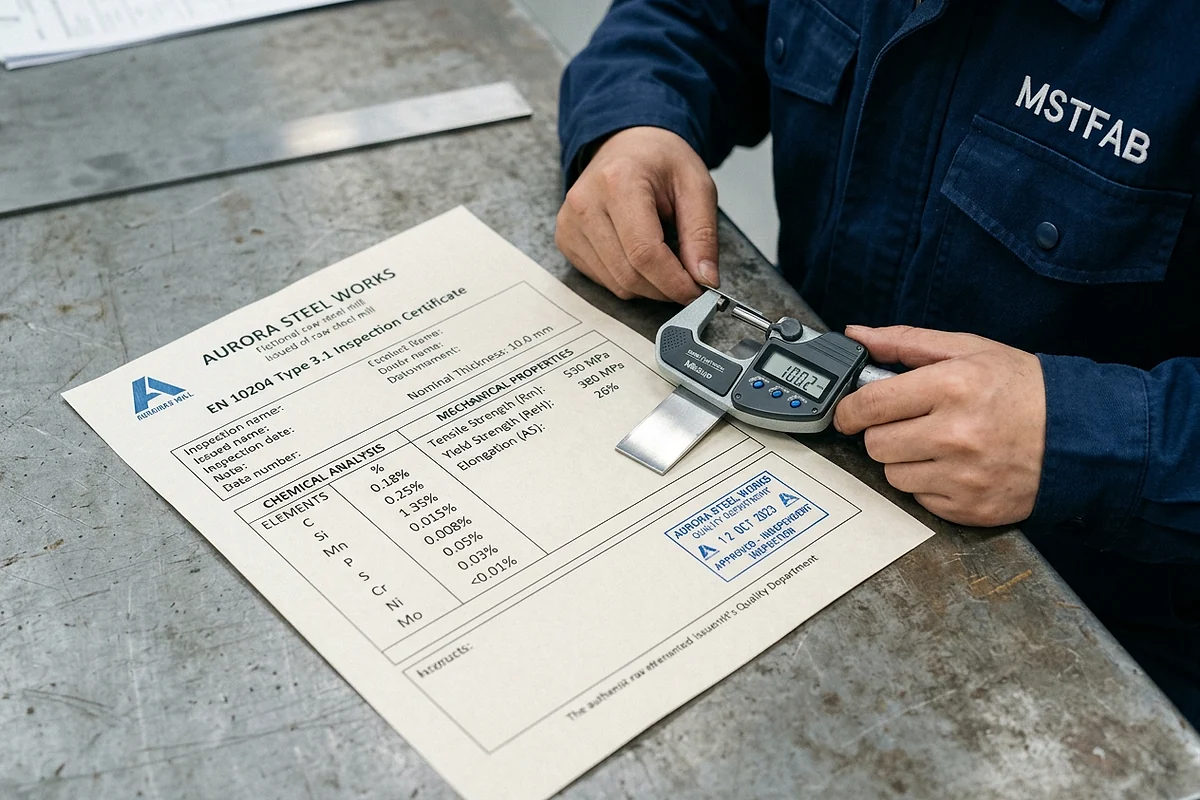
When receiving custom sheet metal parts accompanied by a Type 3.1 certificate, a procurement engineer must cross-reference four essential metallurgical data points against the engineering drawing:
- Heat Number & Coil/Plate ID: The physical casting identifier tying the raw stock back to the basic oxygen furnace or electric arc furnace heat lot.
- Ladle Chemical Analysis: Quantitative weight percentages of Carbon (C), Manganese (Mn), Phosphorus (P), Sulfur (S), Silicon (Si), Chromium (Cr), Nickel (Ni), and Molybdenum (Mo) verified against ASTM / DIN EN material thresholds.
- Mechanical Properties: Yield Strength (Rp0.2 / ReH), Ultimate Tensile Strength (Rm), and Percent Elongation at fracture (A50mm).
- Passivation & Surface Treatment: Galvanizing coating mass (e.g., Z275 / G90 coating weight in g/m²), pickling status, or trivalent chromium chromate conversion.
How Fabricators Maintain Traceability on the Shop Floor
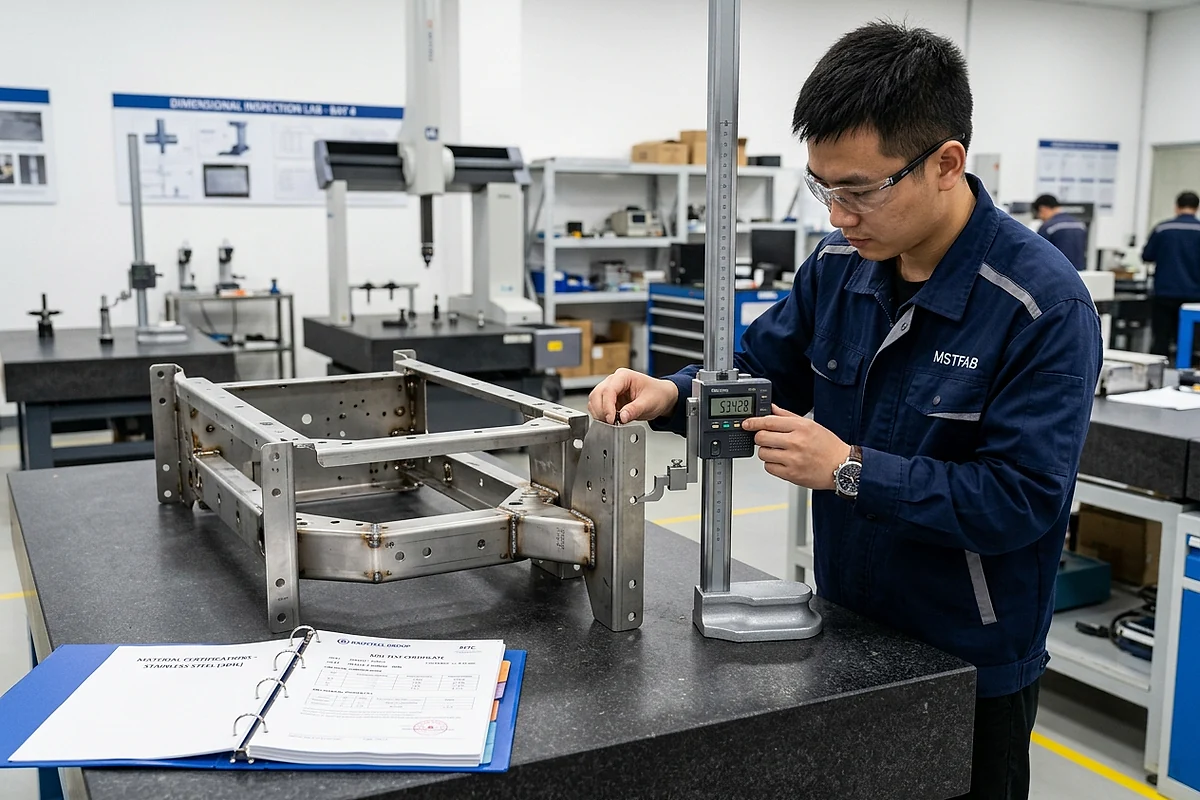
Having a legitimate MTC is meaningless if the sheet metal fabricator loses trace of which coil was fed into which laser cutting machine. At MSTFAB, physical traceability is maintained through 3 strict process controls:
- Coil Ingestion & ERP Logging: Each incoming bundle or sheet master is assigned an internal Heat Lot Barcode tied to the mill’s MTC before warehouse put-away.
- CNC Nesting Heat Segregation: Laser and punching software nests parts exclusively from sheets sharing the same heat lot. Mixed-lot nesting is strictly prohibited for Type 3.1 orders.
- Laser Marking & Traveler Job Cards: Finished chassis or critical brackets receive micro-laser etched 2D data-matrix codes or heat lot alphanumeric stamps directly on non-cosmetic flange faces.

Streamline Your Certified Sheet Metal Procurement & Production
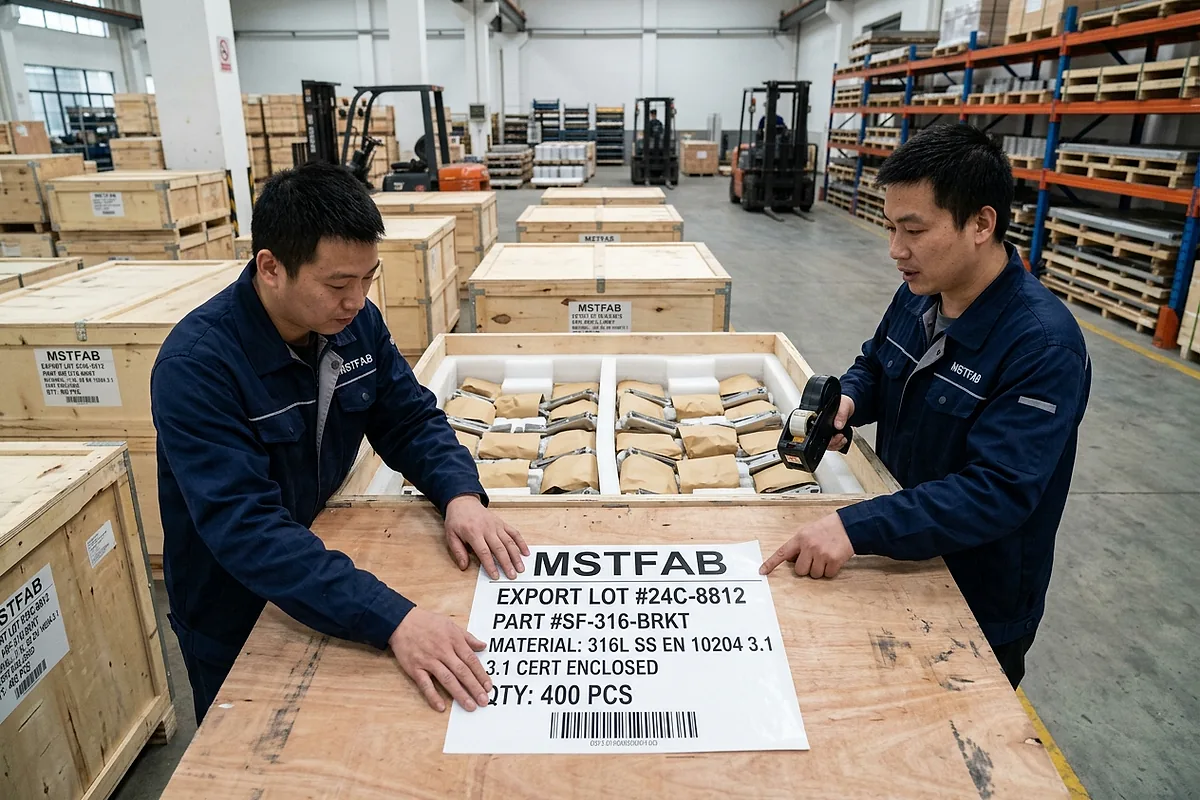
MSTFAB provides end-to-end custom precision sheet metal fabrication, full material traceability (EN 10204 3.1 MTRs, XRF PMI), and flexible supply chain agreements (Blanket POs, VMI, Frameworks). Request a DFM review and instant quote within 24 hours.
Frequently Asked Questions (FAQ)
Can a fabricator issue an EN 10204 3.1 MTC if they are not the primary steel mill?
No. Only the primary manufacturing steel or aluminum mill can generate the original Type 3.1 certificate. However, ISO 9001 certified precision fabricators provide an authenticated copy of the original mill MTC endorsed with their company inspection stamp, along with a fabrication Certificate of Conformance (CoC) tying the cut parts to that exact mill certificate.
How does XRF Positive Material Identification (PMI) complement an MTC?
XRF PMI testing acts as an empirical physical gatekeeper. While paper certificates can theoretically be forged or mismatched, a handheld XRF analyzer non-destructively shoots the incoming metal sheet and instantly reads elemental percentages (%Cr, %Ni, %Mo), ensuring that 316L stainless steel has not been accidentally swapped with lower-cost 304 or 201 alloys.
What is the typical cost difference between requesting a standard CoC vs. Type 3.1 MTC?
A standard CoC is included free of charge with every production order at MSTFAB. Sourcing raw materials with specific EN 10204 3.1 MTCs from primary mills generally carries no premium or a nominal administrative fee ($50-150 per heat lot dossier), whereas Type 3.2 third-party witness inspection (e.g. DNV / Lloyd’s Register) can add 1,500 to4,000 depending on inspector day rates and destructive tensile test sample quantities.
 WeChat Contact
 WhatsApp Me Directly